

What is a Backlink? Definition & Explanation
A backlink is an incoming link from another website to your website. Incoming links are important because they help improve a website’s search engine ranking. Backlinks are part of the so-called SEO Off-Page Optimization.
Search engines consider the quality and quantity of a website’s backlinks when determining its ranking. The more links a website has from high-quality websites, the higher it will rank in the search engine results pages (SERPs). Furthermore, the anchor text of a backlink can also influence the ranking.
Anchor text (Anchor Text) is the visible, clickable text on a web page that contains a hyperlink. Backlinks with keyword-rich anchor text can improve a website’s ranking for that keyword.
For example, if a website linking to your website contains the anchor text „cheap shoes,“ this can contribute to your website’s ranking for the keyword „cheap shoes.“
However, too many backlinks with the same anchor text can appear as spam to search engines and harm your ranking.
Creating high-quality content and building relationships with other websites through guest blogging, social media, and comments are all effective ways to obtain backlinks and improve your website’s ranking.

Florian Ibe
CEO & Marketing Consultant
Request a non-binding consultation now:
Become more visible on Google & Social Media?
In a free strategy consultation for data-driven online marketing, we uncover your untapped potential, review any existing ad accounts if necessary, examine your SEO ranking and visibility, and determine which strategy is appropriate for your budget and which active measures will lead to more inquiries or sales.

✅ More visibility & perception through targeted placement
✅ More visitors > prospects > customers > revenue
✅ Reach target groups scalably with SEA
✅ Act and grow sustainably with SEO
🫵 Maximum success with our hybrid strategy
💪 More than 15 years of experience across industries in over 1,000+ projects demonstrable!






Open contact form
Your contact person: Florian Ibe
Why backlinks are so important for search engine optimization
When you create a website, one of your main goals should be to attract visitors from search engines. This is done through a process called search engine optimization (also SEO).
One of the most important aspects of SEO is backlinks.
A backlink is simply a link from another website to yours. Search engines use these links to assess the popularity and relevance of your website. The more backlinks you have, the higher your website will rank in search results. That’s why it’s so important to focus on building backlinks when creating your website.
There are a number of ways to create backlinks, such as guest articles on other websites like article directories and social media marketing.
By using these strategies, you can ensure that your website appears at the top of search results and attracts as many visitors as possible.
In addition to the values DA, PA, CF, TF, many other factors are involved, but the higher the values, the faster, better, and stronger the website or shop ranks. This ranking is ALWAYS domain-specific. Commercially, one can say that the balance sheet value (accounting value) of www.XYZ.de continues to increase.
You can find very good backlinks on the Backlinked Marketplace *.
How to determine the value of a backlink
The value of a backlink is not always immediately apparent. Sometimes, a link from a highly visited website can be worth more than a link from a less popular website. However, there are several factors to consider when determining the value of a backlink.
First, take a look at the page where the link is located. Is it hidden in the fine print at the bottom of the page? Or is it in a prominent position at the top of the article?
The position of the link can affect how much traffic it brings to your website.
Second, consider the topic of the linking page. If the page is about a related topic, the link is likely to be more valuable. Topic relevance is a crucial factor for high-quality backlinks.
And finally, you should check the authority of the linking domain. A link from a website considered authoritative by Google will carry more weight than a link from a lesser-known page.
Also, do not forget that there are Do-Follow links and No-Follow links. While it is claimed that No-Follow links do not pass link juice, from our experience, they still provide a not insignificant amount of power to the linking page.
The history of backlinks and the Google algorithm
Google's algorithm is constantly evolving, and one of the biggest changes in recent years has been how it treats backlinks. In the past, backlinks were one of the most important factors in determining a website’s search ranking. However, this changed after Google’s Penguin update, which penalized websites involved in unnatural link schemes or using other black-hat SEO tactics. As a result, many webmasters began to focus on other ranking factors, and backlinks fell out of favor.
Although they are no longer as important as they once were, backlinks are still a crucial part of search engine optimization. Google’s algorithm still uses them as a signal of trust and authority, and links from high-quality websites can improve your ranking.
Furthermore, backlinks are one of the few ranking factors you can directly influence. By building strong relationships with other webmasters and creating high-quality content, you can acquire valuable backlinks that help your website stand out in search results.
The explanation made simple: What are backlinks?
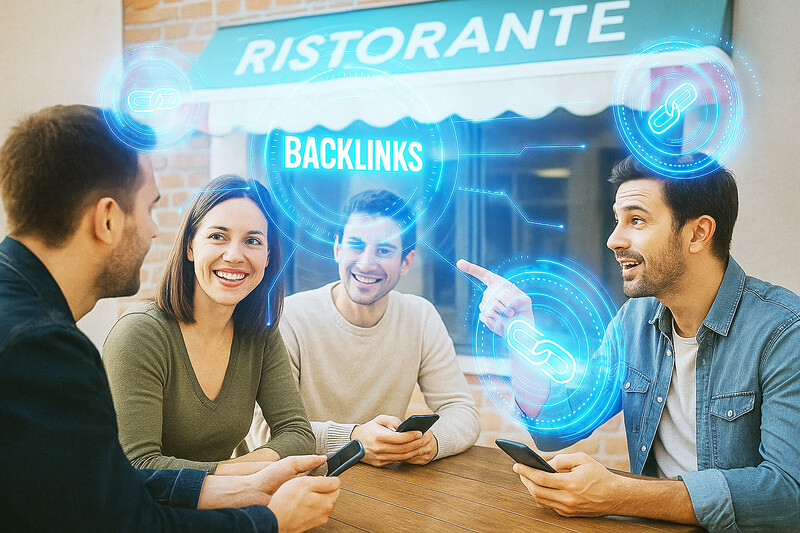
Backlinks are to the internet what recommendations are in real life. They show search engines who can be trusted.
Imagine this:
A new Italian restaurant opens in your city.
No one knows about it – so no one knows if it's any good.
But then the following happens:
- Your friends say that the food there is fantastic 🍝
- A food blogger writes an article about it 🍷
- A local newspaper mentions it in an article about “the best Italian restaurants in town” 📰
With each of these mentions, your confidence grows:
You think to yourself, “If so many people are talking about it, it must be good!”
This is how backlinks work online:
When other trustworthy websites link to your site, Google (and also AI models like ChatGPT or Bing) sees:
„Aha, this site is recommended – so it seems relevant and reliable.“
These are trust signals that help search engines decide who to give good rankings to.
In short:
🔗 Backlinks = recommendations.
📈 More recommendations = more trust.
🌍 More trust = better visibility – not only on Google, but also in LLM-based search results (e.g., in ChatGPT, Perplexity, or Bing Copilot).
Technical explanation:
Purchased or strategically placed backlinks are maximally relevant for a service website for several reasons – and their importance increases with the development of LLM-SEO and GEO-LLM models continue to:
- SEO Authority (Domain Authority & Trust):
Backlinks from reputable, thematically relevant sources are a central signal for Google and Bing. They show that other websites confirm your expertise. This strengthens ranking, especially for highly competitive service terms (e.g., „tax consultant Munich“ or „physiotherapist Dubai“). - Topic Relevance & Local GEO-Authority:
For service providers, it’s not just how many links, but where they come from. Local backlinks (e.g., from city portals, business directories, partners) strengthen geo-relevance, which helps Google and LLM-based systems (ChatGPT, Perplexity, Bing Copilot) more strongly associate the brand with a specific location and topic area. - LLM-SEO & Entity Linking:
Language models link entities (e.g., your company name) with topics, locations, and fields of expertise. Backlinks act as digital evidence that strengthens these connections. The more high-quality mentions (with links) exist, the more often your brand appears in LLM responses and AI search results. - Future-Proofing through Semantic Relevance:
Even if classic link metrics (e.g., PageRank) count less directly in the future, semantic networking via backlinks remains a central signal for „authenticity“ and „trust.“ AI models and search systems thus recognize your brand as a credible source of information.
In short:
Backlinks are no longer just SEO fuel – they are digital proofs of trust that make your expertise, geo-relevance, and brand authority visible to humans and machines.


 DE
DE