

CPL (Cost per Lead)

Effective digital marketing often revolves around numbers. One of the most important metrics companies track is CPL, also known as Cost per Lead. But what exactly does CPL mean, why is it so crucial, and how can you use it to your advantage? This comprehensive guide illuminates all aspects of CPL and offers practical tips for optimizing your campaigns.
What is CPL and why is it important?
CPL stands for „Cost per Lead“ and describes the costs incurred to acquire a potential customer (lead). In German: Kosten pro Anfrage.
A lead is typically someone who has shown interest in your product or service, for example by filling out a form, downloading a whitepaper, or signing up for a newsletter.
Why is CPL crucial?
- Measurability of marketing effectiveness: CPL gives you a clear idea of how efficiently your campaigns are working.
- Insights for budget allocation: A low CPL signals effective spending; a high CPL can be a sign that optimizations are needed.
- Relevance for specific industries: CPL is particularly important for industries such as e-commerce, SaaS, and education, where clear conversion paths are crucial.
In short, CPL helps companies find the balance between the quality and cost of a lead.
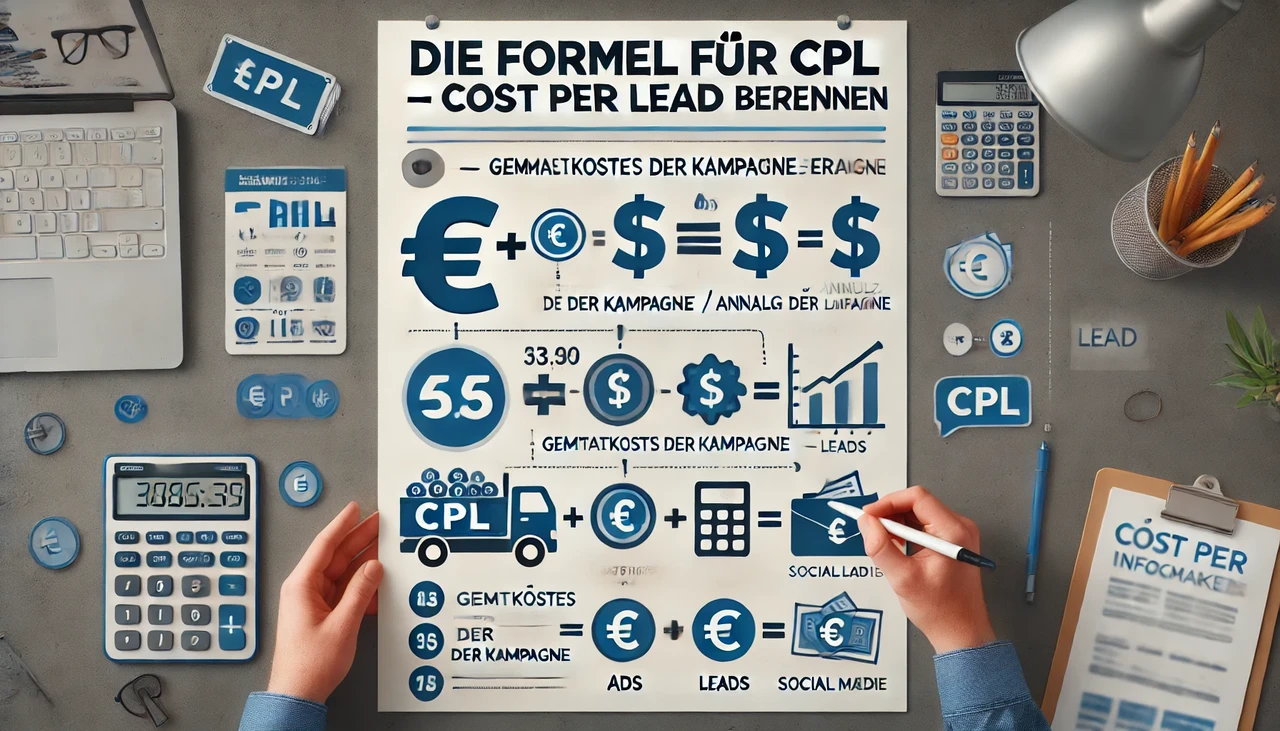
Understanding CPL: The Formula
Calculating the Formula for CPL – Cost per Lead
Calculating CPL is very simple:
CPL = Total Campaign Cost ÷ Number of Leads Generated
Example:
If you spend €1,000 on an ad campaign and generate 100 leads, the CPL is €10.
Factors Influencing CPL
- Campaign Quality: Relevance of ads and target audience approach.
- Landing Page: The conversion rate of the landing page plays a crucial role.
- Market and Competition: Highly competitive industries can drive up costs.
- Seasonality: Holidays or specific seasons also influence the CPL.
A thorough understanding of these factors helps in making targeted adjustments.
Strategies for CPL Optimization
Reducing your CPL requires a well-thought-out strategy. Here are some proven tips and tactics:
Become more visible on Google & Social Media?
In a free strategy consultation for data-driven online marketing, we uncover your untapped potential, review any existing ad accounts if necessary, examine your SEO ranking and visibility, and determine which strategy is appropriate for your budget and which active measures will lead to more inquiries or sales.

✅ More visibility & perception through targeted placement
✅ More visitors > prospects > customers > revenue
✅ Reach target groups scalably with SEA
✅ Act and grow sustainably with SEO
🫵 Maximum success with our hybrid strategy
💪 More than 15 years of experience across industries in over 1,000+ projects demonstrable!







1. Improve Ad Relevance and Quality Score
Platforms like Google Ads evaluate your ads based on relevance and user experience. A higher Quality Score often leads to lower click prices and a reduced CPL.
Tips:
- Use relevant keywords.
- Ensure compelling and clear ad copy.
- Use negative keywords to avoid irrelevant clicks.
2. Landing Page Optimization
A poor conversion rate can severely impact CPL. Ensure your landing page is user-friendly and clearly communicates the problem it solves.
Tips:
- Include compelling calls-to-action (CTAs).
- Keep the design clean and optimized for mobile devices.
- Add trust elements such as customer reviews and seals.
3. Refine Target Audience Targeting
Incorrect audience targeting can lead to spending money on unqualified clicks. Use audience segmentation to ensure your ads reach the right people.
Tips:
- Utilize precision with demographics and interests.
- Retargeting for users who have already shown interest.
- Experiment with Lookalike Audiences.
4. Conduct A/B Tests
Test different ad variations to find out which performs best. Even small changes can make a big difference.
Tips:
- Test different CTA formulations.
- Vary images and design elements.
- Analyze the results and only run the most successful variants.
Tools for CPL Tracking and Analysis
Precise CPL tracking is crucial to increase effectiveness. Here are some useful tools:
1. Google Analytics
With Google Analytics, you can track the traffic and conversions of your campaigns in detail. Use goals and UTM tracking to determine which channels generate leads.
2. CRM Software
A CRM system like HubSpot or Salesforce helps organize leads and evaluate their quality. You can also analyze and optimize the entire customer lifecycle.
3. Marketing Automation Platforms
Tools like Marketo and ActiveCampaign offer features for automating and tracking campaigns, saving time and providing accurate insights.
Realistic Examples and Case Studies
Success Stories
- E-commerce Shop X: By optimizing their target audience approach, the team was able to reduce CPL by 25% and increase leads.
- SaaS Company Y: With targeted A/B tests and an improved landing page, CPL was halved and the conversion rate doubled.
Common Mistakes
- Unclear target audience approach.
- Landing page loading times too long.
- No precise tracking of campaign performance.
These examples show the importance of continuous adaptation and monitoring.
Future Trends in CPL
1. The Role of AI and Machine Learning
AI-powered platforms like Jasper or Adobe Sensei help to automatically optimize ads and define target audiences more precisely.
2. Personalization
With the advancement of technologies, companies can now launch specific, hyper-personalized campaigns that increase relevance and thus the probability of conversion.
Your Path to Successful CPL Optimization
Optimizing CPL requires a combination of knowledge, strategy, and the right tools. From improving ad quality to utilizing data analysis platforms, there are many ways to make your campaigns more efficient.
Ready to take your CPL strategy to the next level?

Florian Ibe
CEO & Marketing Consultant
Your contact person: Florian Ibe


 DE
DE