

Meaning of Pagination
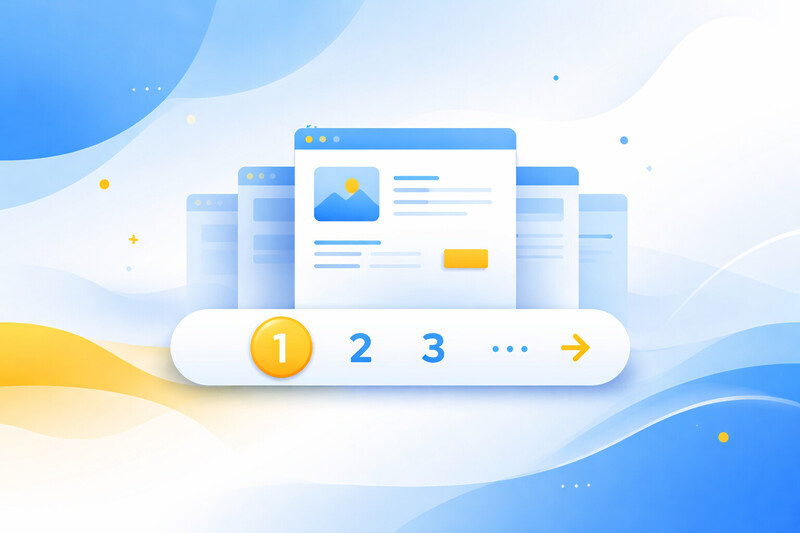
Pagination refers to the structured division of larger content volumes into several individual pages to present content clearly, user-friendly, and technically efficiently. Instead of loading all content on a single page, it is divided into logically numbered pages accessible via navigation elements.
Pagination Definition
Pagination is a navigation principle where content is organized page by page. Each page contains only a defined part of the total data, for example, a certain number of articles, products, or search results.
Typical Applications
Pagination is used wherever a lot of content needs to be displayed, including:
- Blogs and news sites
- Online shops (product lists, categories)
- Search results pages
- Forums and comment sections
- Knowledge bases and encyclopedias
How it works
The entire content is divided into several pages, e.g.:
- Page 1: Entries 1–10
- Page 2: Entries 11–20
- Page 3: Entries 21–30
Navigation is usually done via:
- Page numbers (1 | 2 | 3 | …)
- "Next" and "Back" buttons
- First and last page links
Advantages of pagination
For users
- Better clarity
- Faster orientation
- Targeted navigation to specific pages
For technology & performance
- Shorter loading times
- Lower resource consumption
- More stable rendering with large amounts of data
For search engines (SEO)
- Clearly structured content
- Indexing that is easier to control
- More efficient use of the crawl budget
Pagination compared to other methods
| Method | Description |
|---|---|
| Pagination | Content is clearly distributed across individual pages |
| Infinite Scroll | Content loads automatically while scrolling |
| „Load More“ button | Additional content is loaded by clicking |
It is considered the most classic and controlled solution, especially for structured content and SEO-oriented websites.
Pagination is the systematic division of content across multiple pages to improve clarity, performance, and structure. It is particularly important for websites with a lot of content and plays a central role in user-friendliness and search engine optimization.
Become more visible on Google & Social Media?
In a free strategy consultation for data-driven online marketing, we uncover your untapped potential, review any existing ad accounts if necessary, examine your SEO ranking and visibility, and determine which strategy is appropriate for your budget and which active measures will lead to more inquiries or sales.

✅ More visibility & perception through targeted placement
✅ More visitors > prospects > customers > revenue
✅ Reach target groups scalably with SEA
✅ Act and grow sustainably with SEO
🫵 Maximum success with our hybrid strategy
💪 More than 15 years of experience across industries in over 1,000+ projects demonstrable!







Pagination refers to the division of content across multiple pages instead of displaying everything on a single page.
Pagination briefly explained
- Content is displayed page by page
- Navigation is done, for example, via „Page 1 | 2 | 3 | … | Next“
- Typical for blogs, online shops, search results, forums
Examples
- A blog shows 10 articles per page → older articles are on page 2, 3, etc.
- An online shop shows 24 products per page → more products accessible via pagination
Why the number and numbering are important
- Better overview & usability
- Faster loading times
- SEO-relevant (clean page structure, crawl budget)
Distinction
- Infinite Scroll: Content loads endlessly when scrolling
- Load More Button: Content is loaded incrementally
→ Pagination is the classic, clearly structured variant
SEO Note
When implemented correctly, the page count ensures that:
- Content remains fully discoverable
- Duplicate content is avoided
- Search engines can logically categorize the pages
Clean internal linking and a consistent URL structure are crucial here.


 DE
DE