

R2R – Record-to-Report
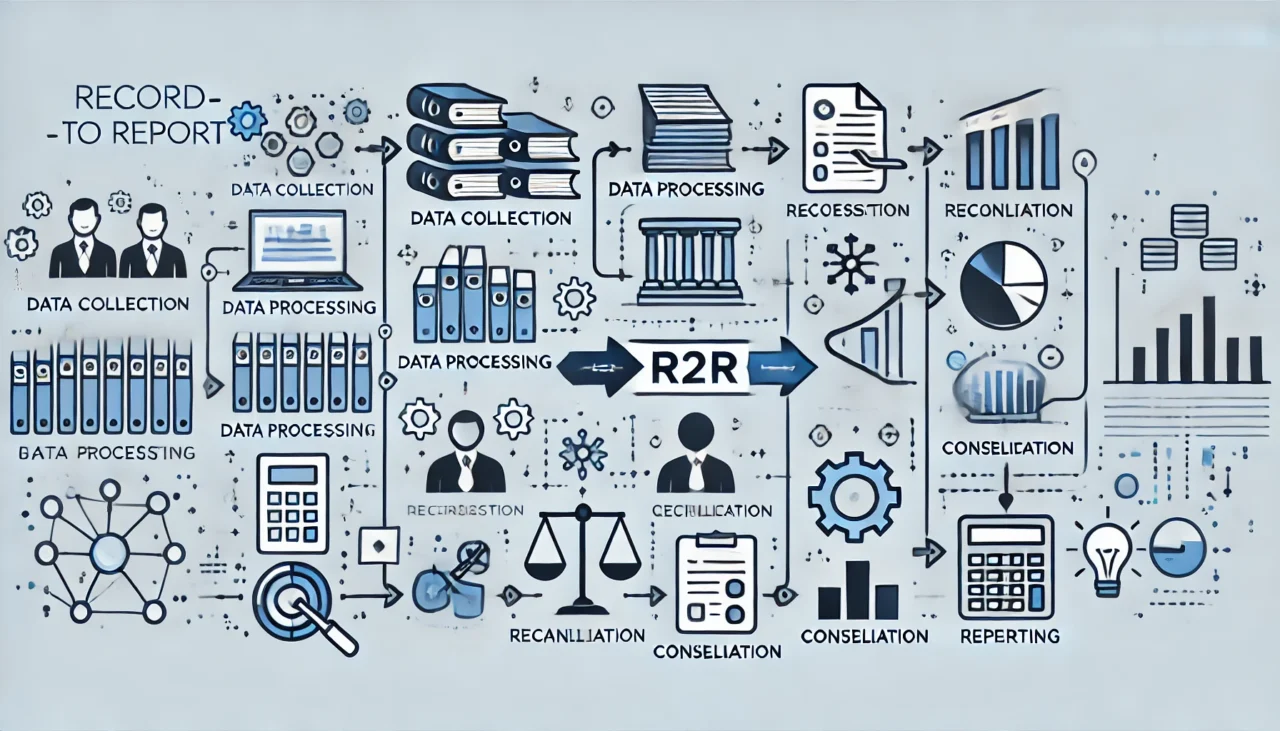
The Record-to-Report (R2R) process is an essential component of financial management in companies. It encompasses all operations from the recording of business transactions to the creation and provision of reports (reporting) on the company’s financial performance. Here is a more detailed look at the individual phases of this process:
Data Collection
In the first phase of the R2R process, all financial transactions are recorded. This includes purchases, sales, investments, and other business transactions. This data is collected from various sources, including POS systems, ERP systems, and other accounting systems.
Data Processing
After collection, the data is processed, which involves reviewing, classifying, and posting transactions to the general ledger. This is crucial to ensure that all financial records are accurate and comply with applicable accounting standards.
Reconciliation
In this step, all accounts are reconciled to identify and correct discrepancies. This ensures that the balances maintained in the books match the actual transaction data.
Consolidation
For companies with multiple entities, this step involves consolidating all financial data into a single, summarized reporting format. This is critical for preparing consolidated financial statements and for analyzing the overall performance of the company.
Reporting
The final step of the R2R process is reporting. Here, the processed and reconciled data is used to generate various financial reports, including income statements, balance sheets, and cash flow statements. These reports serve internal and external stakeholders, such as management, investors, and regulatory authorities, to assess the financial health and performance of the company.
Analysis
Although not always considered part of the traditional R2R process, analysis often completes the cycle by providing deeper insights into financial data, identifying trends, and enabling forecasts for future financial developments.
The R2R process is therefore a critical function that not only ensures the accuracy of financial information but also provides a decisive basis for strategic decision-making. Automating this process can lead to significant efficiency gains and cost savings by reducing manual errors and enabling faster access to financial insights.


 DE
DE