

ZUGFeRD
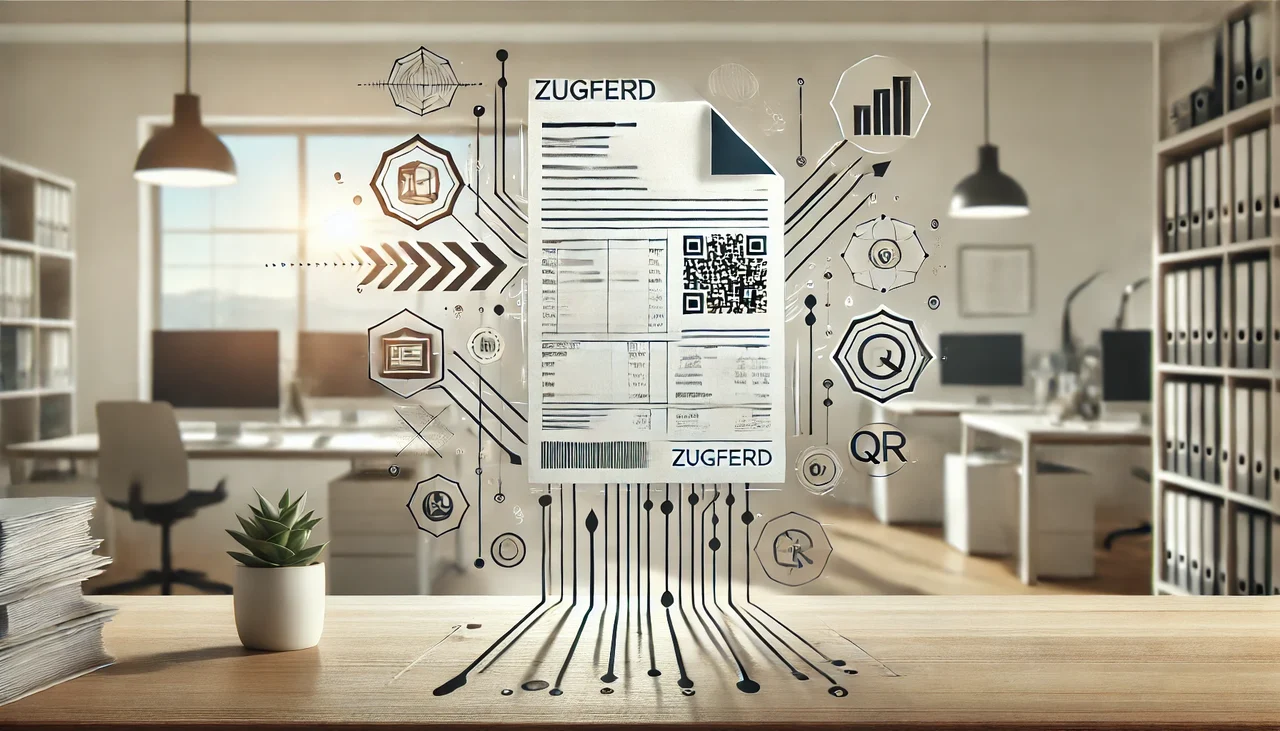
ZUGFeRD stands for „Zentraler User Guide des Forums elektronische Rechnung Deutschland“ (Central User Guide of the Forum for Electronic Invoicing Germany) and is a hybrid invoice format that contains both a visually readable PDF/A-3 file and machine-readable XML data. It is particularly practical as it combines the advantages of both paper and e-invoices.
Companies can view ZUGFeRD invoices like normal PDFs while simultaneously processing the structured data in XML format automatically.
Advantages of ZUGFeRD:
- Easy to implement, as the PDF file looks like a traditional invoice.
- No need to use special software for receiving invoices.
- Supports the international standard UN/CEFACT.
Target Group and Area of Application
ZUGFeRD is a standard for electronic invoices, primarily developed for use in Germany. However, it is not limited to a specific group of companies or organizations but applies to a wide range of users. Here is an overview of who ZUGFeRD is relevant for:
1. Companies (B2B)
ZUGFeRD is particularly interesting for companies that send and receive electronic invoices to and from other companies (B2B, Business-to-Business). It offers a standardized method to transmit invoice data in a structured and machine-readable format, while the PDF file remains human-readable at the same time. This enables more efficient invoice processing and minimizes manual intervention.
Advantages for companies:
- Automated invoice processing through structured XML data.
- Reduction of errors and costs in invoicing.
- Compatibility with common accounting systems and ERP software.
2. Public Administrations (B2G)
ZUGFeRD can also be used for invoices sent to public administrations (B2G, Business-to-Government). This is particularly relevant for companies that do business with public bodies, as ZUGFeRD complies with the requirements of the EU directive for electronic invoices.
Advantages for public administration:
- Faster and standardized invoice processing.
- Fulfillment of legal requirements for electronic invoice exchange.
- Improved traceability and archiving.
3. Small and Medium-sized Enterprises (SMEs)
For small and medium-sized enterprises (SMEs), ZUGFeRD is particularly interesting as it offers a simple way to take the step towards digitizing invoice processing without implementing complex systems. The Basic profile of ZUGFeRD is ideal for SMEs, as it contains only basic data and still meets all requirements for electronic invoicing.
Advantages for SMEs:
- Cost savings through digital invoicing.
- Simplified implementation thanks to hybrid PDF/XML structure.
- Easy integration into existing accounting processes.
4. Multinational Companies
Multinational companies operating in several countries can benefit from ZUGFeRD, as it is based on the international invoicing standard UN/CEFACT. The Extended profile offers sufficient flexibility to cover complex international requirements, making it a viable solution for cross-border business.
Advantages for multinational companies:
- International standard compliance.
- Detailed support for complex business processes.
- Automated invoice processing in various countries.
5. Private Consumers (B2C)
Although ZUGFeRD is primarily intended for business invoicing, private individuals can also benefit from it when receiving invoices from companies. Since ZUGFeRD invoices are in PDF format, they can be viewed and archived like traditional invoices, while the underlying XML data can be used for automated processing.
As of January 1, 2025, electronic invoices (e-invoices) are generally mandatory in Germany for business transactions between domestic companies (B2B). This also applies to online shops if they sell goods or services to other companies within Germany. In these cases, invoices must be issued, transmitted, and received in a structured electronic format that enables automatic processing. Formats such as XRechnung or ZUGFeRD meet these requirements.
It is important that simple PDF invoices or paper invoices are no longer recognized as electronic invoices from this date onwards. However, there are transitional provisions: Until December 31, 2026, companies may continue to send paper invoices, and other electronic formats (e.g. PDF) can be used with the recipient's consent.
Companies with an annual turnover of less than €800,000 are even permitted to use these formats until 31 December 2027.
For sales to private customers (B2C), there is no obligation to issue e-invoices. This means that online shops that sell exclusively to end consumers are not subject to this requirement. Nevertheless, such shops should also be able to receive electronic invoices, as they may be supplied by other companies that issue e-invoices.
Federal Ministry of Finance
In summary, the new e-invoicing requirement applies from 2025 to online shops in the B2B sector. There is no such obligation for the B2C sector. However, it is advisable to familiarize yourself with the new requirements early on and adapt your own systems accordingly.
Tool Tip: Convert PDF to ZUGFeRD for free
To convert a PDF file to the ZUGFeRD format for free, there are several tools and methods you can use. Here are some of the options:
- ZUGFeRD.org Converter: The official ZUGFeRD website offers various tools to create and validate invoices in ZUGFeRD format. There are also free tools for small businesses or individual users. An example is the open-source software Mustangproject.
- Mustangproject: With this open-source tool, you can create ZUGFeRD invoices for free and convert existing PDFs into the ZUGFeRD format. It offers a command-line application that is easy to use if you are somewhat familiar with technology.
- Factur-X/ZUGFeRD Online Converter: There are online tools that allow you to directly upload your PDFs and convert them to ZUGFeRD format. An example is factur-x.com or other similar websites that offer this conversion for free.
- factur-x.com: You can upload your PDF, and it will be automatically converted to the desired ZUGFeRD format.
- OpenZ: OpenZ is an ERP solution that also offers ZUGFeRD integration. With it, you can create ZUGFeRD invoices and convert PDFs, often also in the free version of the tool.
- PDF-Generator-API: If you already have technical knowledge or want to integrate an API, there are free APIs, such as pdf-generator-api.com, that support ZUGFeRD.

The ZUGFeRD Profiles
There are various ZUGFeRD profiles, such as „Basic“, „Comfort“, or „Extended“, which contain different levels of detailed data depending on the application.
The various ZUGFeRD profiles, „Basic“, „Comfort“, and „Extended“, offer different levels of complexity and are designed to meet various application requirements. These profiles define how extensive the data contained in the ZUGFeRD invoice is. Here are the details on the three main profiles:
1. ZUGFeRD Basic
The Basic profile is designed for simple invoices that contain only the most necessary information. It is primarily intended for use in the B2C (Business-to-Consumer) sector and for small businesses that do not have complex invoicing requirements.
Features:
- Includes only the most basic data fields.
- No multi-line items (no detailed breakdown of invoice items).
- Suitable for small businesses and simple invoicing processes where no in-depth details are required.
Use case:
- Standard invoices with few items and no complex additional information.
- Used for small amounts and less formal invoices.
2. ZUGFeRD Comfort
The Comfort profile offers extended information and is used in the B2B (Business-to-Business) sector. It covers more fields than the Basic profile and contains more precise data on individual invoice items. This profile is particularly suitable for companies that require more control over their invoice item details.
Features:
- Detailed information on invoice items (e.g., product descriptions, tax rates).
- Suitable for the majority of common invoicing processes between companies.
- Supports multi-line items, discounts, various currencies, and tax rates.
Use case:
- Typical B2B invoices that need to contain more detailed information.
- Companies that want to automate their accounting and optimize invoice processing through structured data.
3. ZUGFeRD Extended
The Extended profile is designed for complex invoices that need to contain comprehensive information, such as in specialized industries or for international business. It offers the greatest flexibility and the most detailed scope of all profiles.
Features:
- Includes all data fields of the ZUGFeRD standard.
- Support for very detailed invoices, including complex tax calculations, delivery terms, payment plans, and other specialized fields.
- Suitable for international invoices, industry-specific requirements, and complex business processes.
Use case:
- Large companies that require detailed and legally demanding accounting.
- Application in specialized industries or in international business with complex regulations.
Summary of application areas:
- Basic: For simple, basic invoices (B2C).
- Comfort: For typical B2B use with medium complexity.
- Extended: For demanding invoices with comprehensive details (B2B, international, industry-specific).
This flexibility allows companies to choose the ZUGFeRD profile that suits them best, depending on the complexity and requirements of their business.
Difference between ZUGFeRD and XRechnung:
- Format: ZUGFeRD is a hybrid format (PDF + XML), while XRechnung is purely XML-based.
- Distribution: ZUGFeRD is often used in the private sector, XRechnung is mandatory for invoices to public clients.
- Flexibility: ZUGFeRD is easier to read due to the PDF format, while XRechnung is more focused on automated, electronic processing.
ZUGFeRD applies to a wide range of users, from large corporations to small and medium-sized enterprises and public administrations. It is a versatile solution that covers both simple and complex invoicing processes, while meeting the requirements for electronic invoicing at the European level.
History and Development
ZUGFeRD was first introduced in 2014, when the first version of the standard was published. Since then, it has evolved, with the latest version 2.1 being released in 2019 to meet the new requirements of the European directive for electronic invoices.
Legal situation and deadlines:
- First Publication (2014): The first version of ZUGFeRD was released in 2014, but its use was initially voluntary. Companies could freely decide whether they wanted to use ZUGFeRD invoices.
- EU Directive 2014/55/EU: On April 16, 2014, the European Union adopted Directive 2014/55/EU, which mandates the use of electronic invoices in public procurement (Business-to-Government, B2G). This directive required member states to accept only electronic invoices that comply with European standards from April 18, 2020. ZUGFeRD 2.1 is compliant with this directive.
- Mandatory Use for the Public Sector (since November 2020): In Germany, with the implementation of the EU directive, XRechnung was introduced as a mandatory standard for the public sector. Since November 27, 2020, all invoices addressed to federal authorities must be submitted as electronic invoices. ZUGFeRD 2.1 (in profile EN 16931) and XRechnung are the approved formats.
- Public Administration and Federal States: The obligation to use electronic invoices also extends to the federal states and municipal administrative units, although they can set their own deadlines. Many states and municipalities have also set November 27, 2020, as the deadline for the mandatory introduction of electronic invoices.
Use in the Private Sector:
In the private sector (B2B and B2C), the use of ZUGFeRD remains voluntary. Companies decide for themselves when and whether to use ZUGFeRD invoices to benefit from the automated processing and hybrid structure of the format.
- Mandatory for public contracts (B2G) from November 27, 2020.
- Voluntary for the private sector (B2B and B2C), with ZUGFeRD being used by more and more companies to digitize and automate their invoicing processes.
ZUGFeRD, in its current version 2.1, has thus been considered a European standard for electronic invoices since 2019 and has been mandatory in the public sector in Germany since 2020.


 DE
DE