

BFSG (Barrierefreiheitsstärkungsgesetz – Accessibility Strengthening Act)

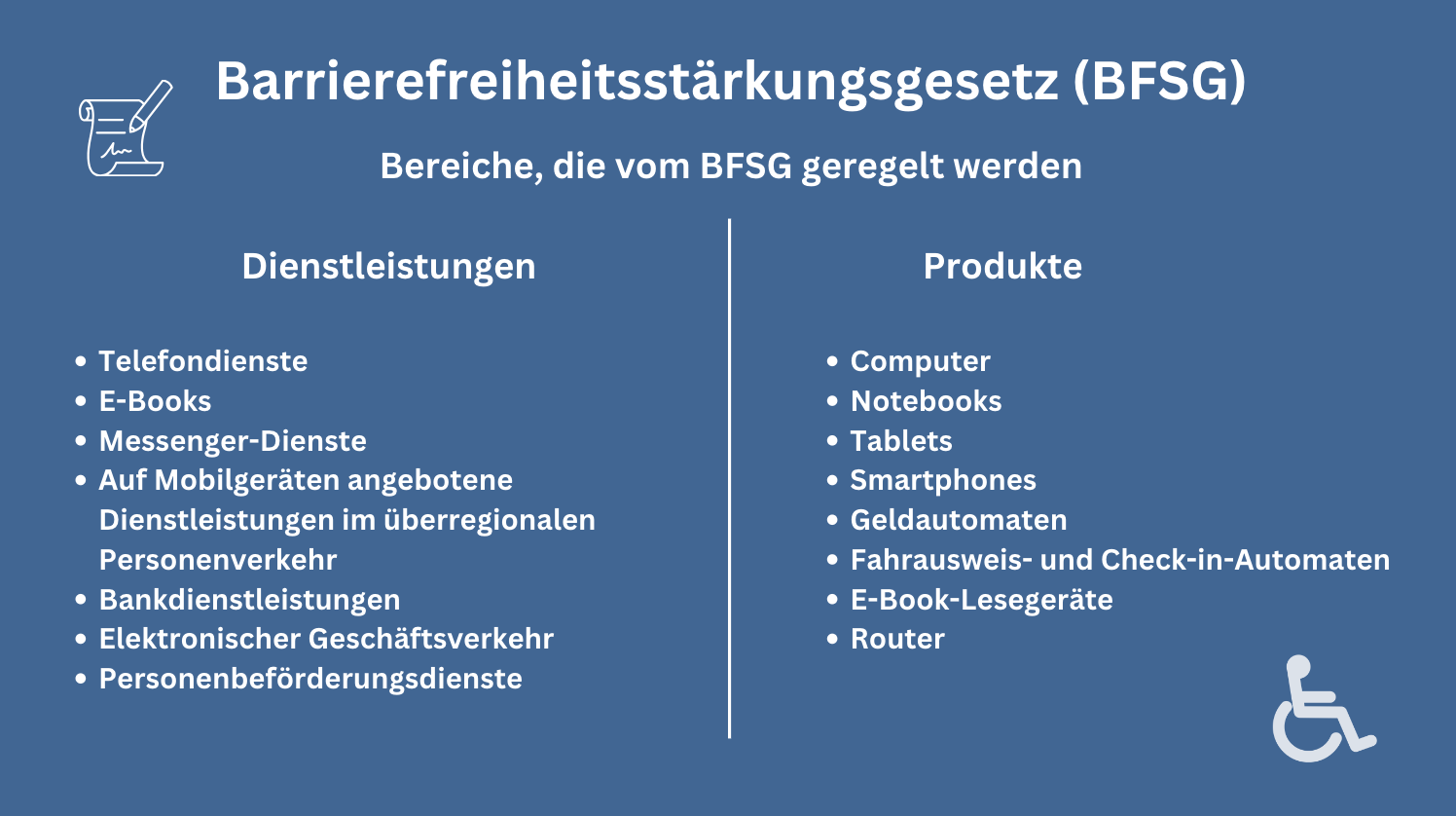
The Barrierefreiheitsstärkungsgesetz (BFSG) is a German law that improves accessibility for products and services and is based on European requirements, in particular EU Directive 2019/882. The aim is to reduce barriers for people with disabilities to enable equal access to goods and services. It applies in particular to areas such as public transport, banks, digital services, and retail.
Below you will also find a checklist for online shops and websites!
Here are some important points of the BFSG:
- Scope of application: The law concerns both physical products and digital services, such as websites, apps, and self-service terminals. Companies are obliged to ensure that their products and services are accessible.
- Deadlines: Companies must implement the new requirements by June 28, 2025 at the latest to ensure barrier-free access.
- Accessibility in practice:
- Websites and apps must be designed so that they can be used by people with visual or hearing impairments (e.g., through read-aloud functions or subtitles).
- ATMs and ticket machines must be accessible to people with physical disabilities.
- Monitoring and sanctions: There are regulations for monitoring compliance and potentially sanctions for violations of accessibility requirements.
The BFSG particularly affects companies that offer public services or operate digital offerings, and aims to improve the social participation of people with disabilities.
4 Core Principles of the Web Content Accessibility Guidelines (WCAG)
The four core principles of the Web Content Accessibility Guidelines (WCAG) – Perceivable, Operable, Understandable, and Robust – have a significant impact on how websites are designed to ensure accessibility:
- Perceivable: Ensures that all users can perceive the information on the website, regardless of sensory impairments.
- Operable: Facilitates interaction with the website through clear and accessible functions.
- Understandable: Promotes usability through easy-to-understand content and clear navigation aids.
- Robust: Guarantees the compatibility of the website with a variety of devices and assistive technologies.
These principles help ensure that digital content is accessible and usable for all user groups.
More information:
The German Accessibility Strengthening Act (BFSG) implements EU Directive 2019/882 in Germany and aims to improve the accessibility of products and services. From June 28, 2025, digital offerings such as websites, online shops, and self-service terminals, in particular, must be accessible to people with disabilities. The requirements include, among other things, clear operability, visual adjustments, and alternative sensory access. Exceptions apply to micro-enterprises.
There are transitional periods for some products and services until 2040.
Differences for B2B and B2C as well as non-commercial websites?
There are differences between B2B, B2C, and non-commercial websites with regard to accessibility requirements:
- B2B sites: The focus is often on more complex processes and tools for businesses. Accessibility also applies here, especially for digital offerings and documents.
- B2C sites: Accessibility must be particularly user-friendly, as they appeal to a broad audience. User-friendliness and clear accessibility are crucial here.
- Non-commercial sites: These sites must also be barrier-free, but the requirements may vary depending on the type of site and the target group.
Regardless of the business type, however, the aim is to ensure comprehensive accessibility.
In addition to the distinction between B2B, B2C, and non-commercial sites, the following points are important for accessibility:
- Legal Requirements: Check which laws apply in your country (e.g., BFSG in Germany), as these define the minimum requirements.
- User Experience (UX): An accessible site not only improves inclusion but also the general usability for everyone.
- Regular Tests: Use automated tools and manual tests to ensure that accessibility is continuously maintained.
Stay up to date with new best practices and standards!
What does EU Directive 2019/882 state?
EU Directive 2019/882, also known as the European Accessibility Act (EAA) or Accessibility Directive, sets requirements for the accessibility of products and services in the European Union. Its goal is to remove barriers for people with disabilities across Europe and promote social and economic integration. The directive builds on the UN Convention on the Rights of Persons with Disabilities, which was also signed by the EU.
Here are the essential points of the directive:
1. Scope of the Directive
EU Directive 2019/882 targets products and services intended to be accessible to the general public. This includes, in particular:
- Technical devices: Computers, smartphones, tablets, TV sets, ATMs, ticket machines, payment terminals.
- Services: E-commerce, electronic communication (e.g., telephony and internet services), banking services, public transport (including ticket purchase and real-time information), e-books, and audiovisual media services.
2. Accessibility Requirements
Products and services must be designed to be usable by people with disabilities. This means, for example:
- Technical support: Screen readers, audio descriptions, and Braille displays must be supported.
- Usability: Interfaces must be designed so that people with motor, sensory, and cognitive impairments can use them.
- Information: Information about the use and safety of products and services must be provided in accessible formats.
3. Implementation and Deadlines
The directive entered into force in June 2019. Member States had until June 28, 2022 to transpose the directive into national law. Companies must meet the accessibility requirements by June 28, 2025 at the latest. fulfill.
Recommendation for legal information and suitable legal texts for websites & online shops:

4. Exceptions
Small and micro-enterprises offering services (such as small webshops) may be exempt from certain obligations if implementation would incur disproportionately high costs. Nevertheless, all businesses are expected to strive to ensure accessibility where possible.
5. Monitoring and Enforcement
Member States are obliged to designate national monitoring authorities to ensure compliance with accessibility requirements. Violations of the requirements can lead to penalties.
Implement accessibility on your website, online shop or app today
The availability of content for people with special needs or difficulties in information perception is the most important part of operating any website.
Request an individual review with assistance and consultation now:
6. Objectives of the Directive
The directive aims to improve the quality of life for around 87 million people with disabilities in the EU by facilitating access to essential products and services. At the same time, it seeks to strengthen the internal market by creating common accessibility standards applicable to all EU countries.
EU Directive 2019/882 stipulates that many products and services must be made accessible to promote the inclusion of people with disabilities. It affects both physical products and digital services and sets a clear deadline for companies to meet these requirements.
More information: bfsg-gesetz.de
Checklist for reviewing the requirements of the Accessibility Strengthening Act (BFSG)
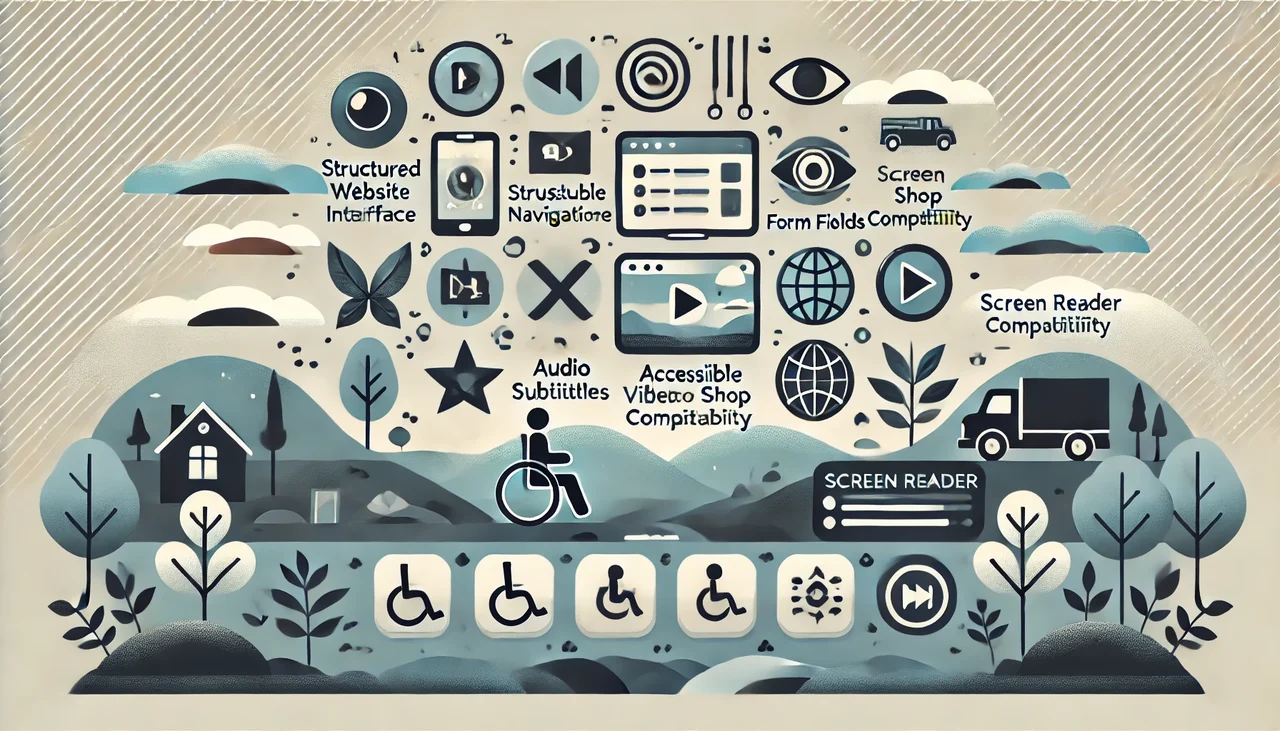
Here is a checklist for the accessibility of websitesandonline shops to comply with the requirements of the Accessibility Strengthening Act (BFSG):
1. Navigation and Usability:
- Clear, logical website structure.
- Easily accessible menus and links.
- Support for keyboard navigation.
2. Text and Content:
- Use of legible fonts and sufficient contrast.
- Provision of alternative texts for images (Alt-texts).
- Structured layout with headings and paragraphs.
3. Multimedia Content:
- Provision of subtitles and transcripts for videos.
- Audio description for visual content.
4. Forms:
- Forms must be accessible and easy to fill out, with clear instructions.
- All form elements must be labeled.
5. Technical Requirements:
- Compatibility with screen readers.
- Avoidance of Flash content, animations, or blinking effects.
6. Tests and Feedback:
- Regular accessibility checks (e.g., using automated tools).
- Option for users to report barriers.
Through these measures, you can ensure that your website or online shop meets accessibility requirements.

Florian Ibe
CEO & Marketing Consultant
Your contact person: Florian Ibe


 DE
DE