

A product with seemingly good margins can still end up in the red at the end of the month. The culprit is costs that are easily overlooked in quick calculations. A single metric reveals what actually remains per sale.
Understanding and correctly calculating the true contribution margin
What is the contribution margin?
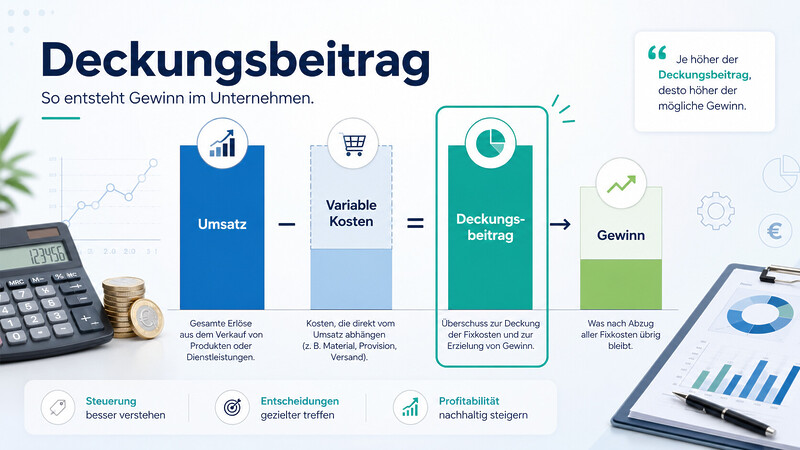
The contribution margin is the amount that remains from revenue after deducting all variable costs of a sale and contributes to covering fixed costs as well as generating profit. It shows how much an individual product or a single order actually contributes to a company’s results.
This makes it one of the most important metrics in controlling and cost calculation. It clearly separates variable costs, which are incurred with each sale, from fixed costs such as rent, personnel, or software, which exist regardless of sales volume.
If a positive amount remains after deducting variable costs, each unit sold contributes to the company’s results. This is exactly what the name of this metric refers to. It first covers ongoing costs and then fills the coffers for fixed costs and profit.
How is the contribution margin calculated?
The calculation follows a simple logic. From revenue, you subtract all variable costs; the result is the contribution margin. The more accurately you capture variable costs, the more reliable the result will be.
Contribution margin per unit and total contribution margin
At the product level, you calculate the per-unit contribution margin. It is derived from the selling price minus the variable unit costs. Multiply this value by the quantity sold, and you get the total contribution margin for a period.
All costs that rise or fall directly with the sale are considered variable. These include cost of goods, shipping, packaging, payment fees, and allocated fulfillment costs. Anyone who forgets items here calculates a value that is too high and therefore misleading.
Simple vs. true contribution margin in comparison
In practice, two variants of the metric are in circulation. The simple contribution margin merely calculates selling price minus purchase price. This view is quick but usually too optimistic because it ignores important cost types.
The real contribution margin, on the other hand, takes into account all variable costs that actually arise per order. Only this complete calculation shows whether a sale truly moves the company forward.
Become more visible on Google & Social Media?
In a free strategy consultation for data-driven online marketing, we uncover your untapped potential, review any existing ad accounts if necessary, examine your SEO ranking and visibility, and determine which strategy is appropriate for your budget and which active measures will lead to more inquiries or sales.

✅ More visibility & perception through targeted placement
✅ More visitors > prospects > customers > revenue
✅ Reach target groups scalably with SEA
✅ Act and grow sustainably with SEO
🫵 Maximum success with our hybrid strategy
💪 More than 15 years of experience across industries in over 1,000+ projects demonstrable!







Real Contribution Margin in E-Commerce
Especially in online retail, there is often a large gap between the two figures. Shipping, packaging, payment fees, and returns add up noticeably per order, so that an item with a good gross margin ultimately yields hardly anything. With targeted online shop optimization, precisely these variable costs can be reduced, which directly strengthens the value.
The following example shows how a net selling price of 100 euros, after deducting all variable costs, results in the real contribution margin.
| Item | Amount |
|---|---|
| Net selling price | 100 euros |
| Cost of goods sold | 50 euros |
| Shipping | 6 euros |
| Packaging | 2 euros |
| Payment fee | 3 euros |
| Return costs | 4 euros |
| True contribution margin | 35 euros |
From 100 euros in revenue, 35 euros thus remain to cover fixed costs and generate profit. The simple calculation would have shown 50 euros and thus significantly overestimated profitability.
How gross profit and contribution margin differ
Gross profit and contribution margin are often equated, but they do not mean the same thing. Gross profit results from revenue minus cost of goods sold and thus considers only the pure product costs.
The contribution margin goes further and deducts all variable costs, including shipping, packaging, payment fees, and returns. As a result, it is usually lower than gross profit and reflects profitability more realistically. Anyone who confuses the two terms plans with overly optimistic figures.
Continuously evaluating contribution margin per item
Modern shop systems can automatically report this metric per product or order. A WooCommerce agency sets up the necessary evaluations so that the variable costs per item are directly incorporated. This turns a theoretical figure into an ongoing management tool.
What the contribution margin is used for in a company
The contribution margin is more than a figure for the annual financial statements; it drives concrete decisions. From it, you derive the price floor. A price must not remain below variable costs in the long term.
The metric also helps with evaluating the product range. Products with a high contribution margin deserve more attention, weak positions can be specifically revised or discontinued. The break-even point, meaning the point at which all fixed costs are covered, can also be determined from it.
Contribution margin in retail and skilled trades
In retail, the contribution margin helps determine which items are advertised and which discounts are granted. In skilled trades, it is used for job costing, because every order must cover its variable costs and contribute to fixed costs.
Since 2010, we have been supporting retailers and service providers in switching their calculations from embellished to real contribution margins. In more than 1,000 completed projects, it has become clear that small cost items per order determine profitability. Professional conversion rate optimization also ensures that more visitors become profitable orders.
Frequently asked questions about contribution margin
What is a good contribution margin?
There is no universally valid target value for the contribution margin, as it depends heavily on the fixed cost block and the industry. What matters is that the sum of all contribution margins exceeds the fixed costs. The higher the value per sale, the more room remains for advertising and profit.
How do you calculate the contribution margin with an example?
You calculate the contribution margin by subtracting all variable costs from revenue. If a shop sells a product for 100 euros and variable costs of 65 euros are incurred, the contribution margin is 35 euros. This amount is available to cover fixed costs.
What is the difference between contribution margin and profit?
The contribution margin is determined before deducting fixed costs, while profit is determined only afterward. As long as their sum does not exceed the fixed costs, no profit is generated despite positive values. Only above the break-even point does a company become profitable.
What does a negative contribution margin mean?
A negative contribution margin means that the selling price does not even cover the variable costs. Every item sold then increases the loss. In this case, prices must be increased or variable costs reduced, otherwise the sale is not worthwhile.


 DE
DE