The Barrier-Free Strengthening Act (BFSG): Significance for Webmasters and Online Providers
The Barrier-Free Strengthening Act, or BFSG for short, marks a turning point in Germany’s digital landscape. It obliges providers of websites and online shops to make their services barrier-free. For webmasters and operators of digital platforms, this means a reorientation of their strategies and implementation processes. The following sections shed light on the far-reaching effects of the BFSG and offer practical insights into its implementation.

What is the Barrier-Free Strengthening Act (BFSG)?
The BFSG represents a milestone in legislation on digital accessibility. It is based on EU Directive 2019/882 and aims to enable people with disabilities to have equal access to products and services. The scope of application includes both physical and digital offerings, with the focus here being on the online aspects.
The core of the law is the creation of uniform standards for accessibility. This affects not only the technical implementation of websites and apps, but also the design of user interfaces and the provision of information in various formats. Companies must adapt their digital offerings so that they can be used by people with various disabilities without external help.
The BFSG stipulates that these requirements are to be implemented gradually. For many providers, this means a fundamental revision of their digital presence. The challenge is to establish accessibility as an integral part of web design and user guidance, without compromising functionality or aesthetics.
Background and Origin of the BFSG
The roots of the Barrier-Free Strengthening Act go back to the early 2000s. At that time, initial discussions began at EU level about the need for uniform accessibility standards. The path to the BFSG was characterized by intensive debates between interest groups, business representatives, and political decision-makers.
A decisive impetus came in 2015 with the European Commission’s proposal for a „European Accessibility Act“. After years of negotiations, the final Directive (EU) 2019/882 was adopted in 2019. Germany implemented this directive into national law with the BFSG, with the legislative process being accompanied by controversial discussions.
Disability associations welcomed the law as a long overdue step, while business representatives warned of excessive burdens. The compromise: a staggered timetable for implementation. Small businesses were given longer deadlines to meet the new requirements. This approach reflects the endeavor to promote accessibility without hindering economic development.
Core Objectives of the Barrier-Free Strengthening Act
The BFSG pursues several central objectives. First and foremost is the improvement of the participation of people with disabilities in social life. Through barrier-free products and services, they should be able to act more independently and participate fully in the market. This includes access to information, shopping opportunities, and digital services.
Another core objective is the harmonization of accessibility standards within the EU. Uniform regulations facilitate cross-border activities for companies and promote the internal market. At the same time, the law is intended to stimulate innovations in the field of assistive technologies. The demand for barrier-free solutions could open up new markets and favor technological progress.
Become more visible on Google & Social Media?
In a free strategy consultation for data-driven online marketing, we uncover your untapped potential, review any existing ad accounts if necessary, examine your SEO ranking and visibility, and determine which strategy is appropriate for your budget and which active measures will lead to more inquiries or sales.

✅ More visibility & perception through targeted placement
✅ More visitors > prospects > customers > revenue
✅ Reach target groups scalably with SEA
✅ Act and grow sustainably with SEO
🫵 Maximum success with our hybrid strategy
💪 More than 15 years of experience across industries in over 1,000+ projects demonstrable!







The BFSG also aims to raise awareness of accessibility in society. Companies are encouraged to incorporate accessibility into their product development and service design from the outset. In the long term, this should lead to a more inclusive design of the entire digital landscape.
Tip for always up-to-date information, legal texts, and security:

Impact of the BFSG on Digital Services
The introduction of the Barrier-Free Strengthening Act (BFSG) has far-reaching consequences for the entire digital service industry. Webmasters, website operators, and online shop owners are faced with the challenge of fundamentally rethinking and adapting their offerings. This affects not only the technical implementation, but also the content design and user guidance.
For many companies, the BFSG means a paradigm shift. Accessibility changes from an optional additional service to a legal obligation. This often requires significant investments in redesigning existing digital infrastructures. At the same time, however, it also opens up opportunities to reach new user groups and to improve the quality of the services offered overall.
The effects of the BFSG range from redesigning user interfaces and adapting content creation processes to training employees. Companies must ensure that their digital offerings are accessible to people with various disabilities. This includes visual, auditory, motor, and cognitive impairments.
Affected Online Services and Products
The BFSG covers a wide range of digital offerings. Websites and mobile applications are at the forefront. All publicly accessible online presences must meet the requirements of the law. This applies to corporate websites as well as online shops, blogs, and information portals.
E-commerce platforms are particularly challenged. Product descriptions, ordering processes, and payment processing must be designed to be barrier-free. Digital services such as online banking, streaming services, or booking portals also fall under the BFSG regulations. They must adapt their user interfaces and functionalities accordingly.
Electronic communication services form another focus. These include email services, messenger apps, and video conferencing tools. Hardware products with digital interfaces, such as self-service terminals or interactive information systems, must also comply with BFSG requirements. The breadth of affected services illustrates the comprehensive impact of the law on the digital landscape.
eRecht24's service also provides security:

Timeline for implementation
The BFSG provides for a staggered timetable for implementation. This takes into account the different resources and capacities of the companies concerned. Large companies and public institutions must meet the requirements earlier than smaller businesses. The legislator wants to avoid an excessive burden on the economy.
The first deadlines will apply as early as 2025. From this point on, new products and services must meet the accessibility requirements. For existing offers, a transitional period applies until 2030. Companies should use this time to gradually adapt their digital offerings. However, it is advisable to start implementation early in order to spread out the conversion process.
Special regulations apply to micro-enterprises. They are exempt from some obligations if implementation would constitute a disproportionate burden. Nevertheless, they should also consider the principles of accessibility in order to remain competitive in the long term. The timeframe offers all stakeholders the opportunity to integrate accessibility into their digital strategies gradually and sustainably.
Accessibility requirements for websites and online shops
The implementation of the Barrier-Free Strengthening Act (BFSG) presents website and online shop operators with complex tasks. The requirements include technical, content-related and design aspects. The aim is to make digital offerings accessible to all users, regardless of their individual limitations.
A central point is compatibility with assistive technologies. Websites must be programmed in such a way that they function smoothly with screen readers, Braille displays or voice controls. This requires a clean HTML structure and the use of semantically correct markups. Keyboard operability of all functions is also essential, as not all users can use a mouse.
Color contrasts and font sizes play an important role for visual accessibility. Texts must be easy to read, even for people with visual impairments. Alternative text descriptions for images and graphics are essential to make visual content accessible to blind users. Videos should be provided with subtitles and audio descriptions.

Technical requirements for accessible websites
The technical implementation of accessible websites requires a deep understanding of web standards. The BFSG is based on the internationally recognized Web Content Accessibility Guidelines (WCAG). These define criteria for the accessibility of web content at different levels.
A clear and logical structure of the HTML code forms the foundation. Headings, lists and tables must be correctly marked up to enable hierarchical navigation. Form elements require clear labels and error messages must be clearly communicated. The use of ARIA attributes can improve the accessibility of dynamic content.
Responsive design gains additional importance in the context of accessibility. Websites must remain functional on different devices and with different screen sizes. This also includes adaptability to individual user settings such as enlarged fonts or high-contrast displays. Performance optimization also contributes to accessibility, as long loading times can be problematic for some user groups.
Content adjustments for online shops
Online shops face particular challenges in implementing the BFSG. Accessibility must cover the entire purchasing process, from product search and selection to payment. Product descriptions must be precise and understandable, without assuming visual information. Detailed text descriptions of product images are essential.
Navigation in the shop must be intuitive and consistent. Filter and sorting functions should be easy to use and provide clear feedback. The shopping cart must be easy to find and editable at all times. Special care is required during the checkout process. Each step must be clearly communicated, and input errors must be precisely described and easily correctable.
Product ratings and customer reviews should be presented in an accessible format. Additional services such as size charts or care instructions must also be designed to be accessible. An accessible search function with autocomplete and fault tolerance can significantly improve the user experience. Overall, the online shop must offer an inclusive shopping experience that is equally accessible to all customers.
Accessible communication and customer service
An accessible digital offering extends beyond the website to all communication channels. The BFSG requires companies to adapt their customer service processes accordingly. This begins with the provision of contact information in various formats. In addition to telephone numbers, text-based contact options such as email or chat should also be offered.
Live chat functions must be compatible with screen readers. Chatbots should use simple, clear language and offer alternative communication channels if they cannot process the request. Telephone hotlines should be accessible via text relay services to enable access for deaf people.
FAQ sections and help pages must be presented in a structured, easily navigable form. Video tutorials should be provided with subtitles and transcripts. Training for customer service employees in dealing with people with disabilities is essential. They must be able to react flexibly to different communication needs. This may include the use of sign language interpreters during video conferences or the provision of information in Braille.
Newsletters and other regular forms of communication must also be designed to be accessible. HTML emails should have a text alternative, and all embedded images require meaningful alt texts. The ability to individually set communication preferences further increases user-friendliness.
Practical implementation of the BFSG for webmasters
The implementation of the BFSG requirements presents webmasters with various challenges. It is not enough to adapt individual elements; rather, a holistic approach is required. Accessibility must be integrated into the development process from the outset to create effective and sustainable solutions.
A first step is to conduct a comprehensive audit of the existing website. This identifies weaknesses in terms of accessibility. Based on this analysis, a detailed action plan can be drawn up. This should prioritize and divide the implementation into manageable stages.
Webmasters should familiarize themselves with the WCAG guidelines, which serve as the basis for the BFSG. Applying these standards often requires a re-evaluation of established design practices. For example, color schemes may need to be adjusted to ensure sufficient contrast. The structure of the HTML code also frequently requires revision.
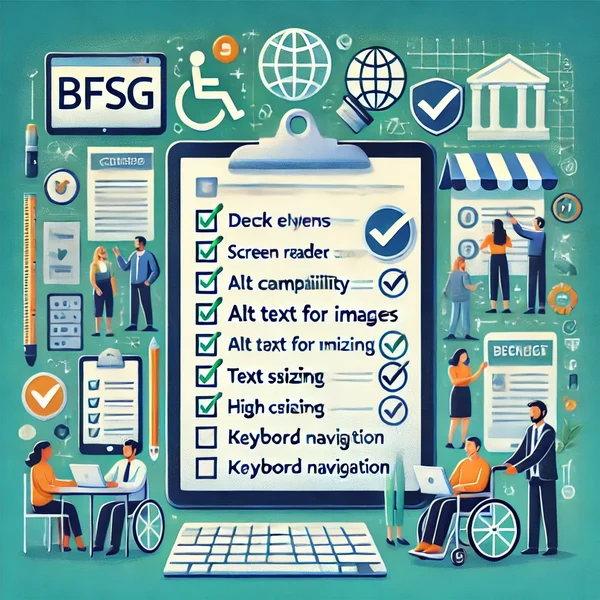
Checklist for BFSG-compliant Website Design
A structured approach facilitates the implementation of BFSG requirements. A checklist can serve as a useful tool. It should cover all relevant aspects of accessibility and be regularly updated. Important points include:
- Semantically correct HTML structure
- Scalable texts and adaptable layouts
- Sufficient color contrasts and alternative color schemes
- Full keyboard operability of all functions
- Meaningful alt texts for images and graphics
- Subtitles and transcripts for multimedia content
- Clear and consistent navigation
- Error-tolerant forms with clear labels
- Compatibility with common screen readers
- Provision of content in alternative formats
The implementation of these points often requires close cooperation between developers, designers, and content managers. Regular tests with various user groups can provide valuable insights and contribute to continuous improvement.
Tools and Resources for Accessibility Testing
Numerous tools support webmasters in implementing and testing accessibility. Automated testing tools can provide an initial overview of potential problems. They analyze the source code and identify common barriers such as missing alt texts or insufficient color contrasts.
Browser extensions allow websites to be viewed from the perspective of different user groups. For example, they simulate color blindness or show how the page is interpreted by a screen reader. These insights are valuable for developing empathy for the needs of different users.
Validation tools for HTML and CSS help identify technical errors that can impair accessibility. Special WCAG checklists and audit tools provide structured guidance for checking compliance with the guidelines. Online courses and webinars can support webmasters in further education in the field of accessibility.
Challenges and Opportunities through the BFSG
The introduction of the Accessibility Strengthening Act (BFSG) presents many companies with significant challenges. The effort required to adapt existing digital offerings can be considerable. Especially for smaller companies with limited resources, this can represent a financial and personnel burden.
Technical implementation often requires a fundamental revision of websites and applications. This can lead to conflicts with existing design concepts or functionalities. The integration of accessible solutions into complex e-commerce systems or content management systems can also be technically demanding.
At the same time, the BFSG also offers opportunities for innovation and growth. Accessible offerings open up new customer groups and can lead to increased user satisfaction. Companies that invest early in accessibility can gain a competitive advantage and position themselves as pioneers in their field.
Potential Hurdles in Implementation
One of the biggest challenges in implementing the BFSG is the lack of expertise in many companies. Accessibility requires specific knowledge that is not present in all development and design teams. Training employees or hiring specialists can take time and resources.
Adapting existing content, especially for extensive websites or online shops, can be very time-consuming. Every image, every text, and every function must be checked for accessibility and revised if necessary. This can lead to delays in other projects or require additional personnel capacity.
Technical compatibility issues can also arise. Older systems or third-party solutions may not be readily compatible with accessibility requirements. Integrating new, accessible components into existing infrastructures can be complex and costly.
Advantages of Accessible Digital Offerings
Despite the challenges, the long-term benefits of accessible digital offerings outweigh them. An inclusive approach significantly expands the potential customer base. People with disabilities represent a significant consumer group whose purchasing power is often underestimated. Accessible offerings enable companies to effectively address this target group.
Accessibility improves the user experience for all visitors, not just for people with disabilities. Clear structures, easily readable texts, and intuitive navigation benefit all users. This can lead to higher customer satisfaction and loyalty. In addition, accessible websites can often achieve better search engine results, as many aspects of accessibility are also relevant for SEO.
Companies that prioritize accessibility demonstrate social responsibility. This can positively impact the company’s image and strengthen brand perception. In an increasingly diverse society, inclusion becomes an important distinguishing feature. Accessible offerings can thus represent a competitive advantage and open up new business opportunities.
Legal Consequences of Non-Compliance with the BFSG
The Accessibility Strengthening Act provides for specific sanctions for violations. Companies that do not meet the requirements risk legal consequences. The range of possible measures extends from warnings to significant fines. The law aims to effectively enforce compliance with accessibility standards.
In addition to direct legal consequences, violations of the BFSG can also have indirect consequences. Affected users could file complaints or initiate legal action. This can lead to reputational damage and negative publicity. In an increasingly sensitized society, such incidents can have a significant impact on the company’s image.
Companies should therefore consider the implementation of the BFSG as a priority. A proactive approach can not only minimize legal risks but also offer long-term benefits. Early adaptation to legal requirements allows the process to be managed in a controlled and cost-effective manner.
Sanctions and Fines
The BFSG provides for a graduated system of sanctions. For minor violations, warnings may initially be issued. Repeated or serious violations can lead to fines. The amount of the fines can be considerable and depends on the severity of the violation and the size of the company.
In particularly serious cases, authorities can also order the cessation of certain services or the recall of products. This can lead to significant financial losses and disruptions to business operations. Claims for damages from affected users are also conceivable, especially if disadvantages have arisen due to a lack of accessibility.
Companies should note that non-compliance with the BFSG can also affect public tenders. Accessibility is increasingly being considered as a criterion for awarding public contracts. Violations of the BFSG could thus lead to exclusion from important business opportunities.
Monitoring and Enforcement of the BFSG
The monitoring of compliance with the BFSG is the responsibility of the competent authorities. These can carry out random checks or react to complaints from users. Companies must be able to demonstrate the conformity of their offerings with the BFSG requirements.
Authorities have various instruments for enforcing the law. They can issue orders to remedy defects and set deadlines for implementation. In case of non-compliance, coercive fines can be imposed. In serious cases, a ban on placing non-compliant products or services on the market is also possible.
To ensure effective enforcement, the BFSG also provides mechanisms for user complaints. Affected individuals can contact central points of contact, which review complaints and, if necessary, forward them to the responsible authorities. This increases the pressure on companies to take accessibility seriously and continuously work on improvements.
Conclusion: The BFSG as an Opportunity for Inclusive Web Design
The Accessibility Strengthening Act represents a turning point in the development of digital offerings. It forces companies and organizations to consider accessibility as an integral part of their online presence. Despite the initial challenges, the BFSG offers an opportunity to make the digital landscape fundamentally more inclusive and user-friendly.
The implementation of the BFSG requires a comprehensive re-evaluation of existing web design practices. Instead of treating accessibility as a subsequent adaptation, inclusive principles must be integrated into the development process from the outset. This promotes innovative solutions and can lead to an improvement in general usability.
For webmasters and online shop operators, the BFSG means an opportunity for professionalization and differentiation. Companies that invest early in barrier-free solutions can position themselves as pioneers and open up new target groups. Meeting the legal requirements can also serve as a quality feature and strengthen user trust.
In the long term, the consistent implementation of the BFSG will contribute to a more inclusive digital society. Accessible websites and online shops enable all people equal access to information and services. This not only promotes digital participation but also contributes to a general awareness of the needs of various user groups.




 DE
DE