
At the beginning of October, Google supplemented its guidelines on AI-generated content with a brief but consequential paragraph, without major announcement. We explain clearly what it says, what changes for your website, and how to review AI content so that it builds trust rather than risks.
Which AI texts Google accepts and what must now be reviewed
Whether AI texts convince Google has explicitly depended since October 2026 on human review before publication. The English version of the guidelines was updated on October 1, and the German translation followed on October 7. There was no official announcement, so relatively few website operators noticed the change.
Yet every company that creates texts, product descriptions, or metadata with language models is affected. We at VASTCOB work with these tools daily. That’s why we classify what’s new, what stays the same, and what meaningful review looks like in everyday practice.
What Google quietly added in early October 2026
The „Google Search guide to using AI-generated content on your website“ is a short page in Search Central. Until now, it mainly contained two things: generative AI can help with research and structure, but mass-produced pages without added value violate spam guidelines.
New is a separate section with the heading „Focus on accuracy, quality, and relevance.“ With this, Google’s guidelines treat AI-generated content much more concretely than before.
The new paragraph in full text
In the German version, the core reads as follows:
Remember that generative models don’t retrieve facts, but predict a likely sequence of words based on their training data. For this reason, generative AI outputs can contain errors (also called hallucinations). It is important to manually review all AI-generated content for accuracy and trustworthiness before publication. This review also applies to metadata such as
<title>elements, meta description elements, structured data, and alternative text for images that may appear in search results.
The word „manually“ stands out. Google describes the review not as a nice additional task, but as a prerequisite before publication. Immediately after comes the note to additionally validate structured data. So are unreviewed AI texts still acceptable to Google? According to this wording, no.
Why hallucinations are the trigger
Language models don’t look anything up. They calculate which word is most likely to come next. That’s exactly what Google is now stating openly. The result sounds fluent, but can be wrong: a fabricated study, an outdated price, a standard that never existed.
Such errors are called hallucinations. They are barely recognizable to readers because a false sentence is formulated just as convincingly as a correct one. For the question of which AI texts Google classifies as trustworthy, this is the decisive point.
Are AI texts penalized by Google?
The short answer is no. Google evaluates content based on its usefulness, not on whether a human or a machine wrote it. This has been stated since February 2023 in the FAQs on AI-generated content. The supplement hasn’t changed that.
Become more visible on Google & Social Media?
In a free strategy consultation for data-driven online marketing, we uncover your untapped potential, review any existing ad accounts if necessary, examine your SEO ranking and visibility, and determine which strategy is appropriate for your budget and which active measures will lead to more inquiries or sales.

✅ More visibility & perception through targeted placement
✅ More visitors > prospects > customers > revenue
✅ Reach target groups scalably with SEA
✅ Act and grow sustainably with SEO
🫵 Maximum success with our hybrid strategy
💪 More than 15 years of experience across industries in over 1,000+ projects demonstrable!







AI-generated text is not punished by Google as a rule because of the tool itself. What matters is how it is used.
What Scaled Content Abuse means
Since March 2024, Google explicitly mentions the abuse of large-scale generated content in its spam policies. In English, this is called Scaled Content Abuse. This refers to many pages that are created primarily for rankings and offer users little value, such as hundreds of location pages with nearly identical text.
The same rule applies if people manually duplicate such pages. Which AI texts Google classifies as spam is therefore decided by the purpose and not by the technology. AI merely makes this volume cheaper and faster, which is why Google encounters it more frequently today.
Where Google explicitly permits automation
Google itself points out that automation has been producing useful content for years, for example weather reports, sports results, or transcripts. No one expects every score to be typed in by hand. The line is only drawn where automatically generated pages no longer provide any added value. The fact that AI texts don’t fundamentally bother Google follows precisely from this logic.
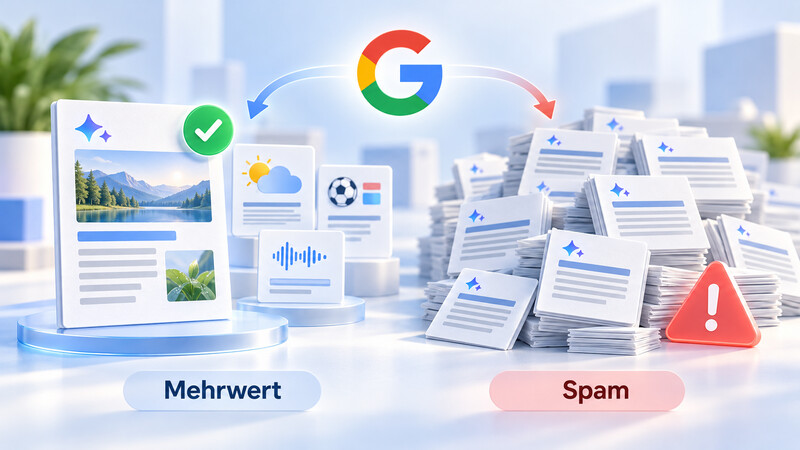
When AI texts convince Google and when they don’t
How good a page is is not only checked by algorithms. External Quality Raters evaluate search results according to a public set of rules, the Search Quality Rater Guidelines. Their judgments do not directly change rankings, but they help Google test its own systems. What the raters find good or bad therefore shows where the algorithms are heading.
When evaluating the main content of a page, they focus on four points:
| Criterion | Rater’s Guiding Question | What this means for AI content |
|---|---|---|
| Effort | Is there recognizable effort put into the page? | An unedited raw text shows no effort |
| Originality | Are there personal experiences, data, or perspectives? | Add examples and figures that no model knows |
| Talent or Skill | Does the content appear competent and well-thought-out? | Expert review by someone who masters the topic |
| Accuracy | Are the statements correct? | Check every number and every claim against a source |
The guidelines become particularly clear in sections 4.6.5 and 4.6.6. These deal with content that has been produced on a large scale, as well as main content with little to no effort, little originality, and little added value. Automatically generated content without recognizable human editing can receive the lowest rating there.
How Google classifies AI-generated text therefore does not depend on the tool, but on whether a person adds care and their own experience. The same principle is behind the Helpful Content System, which Google introduced in 2022. It also explains why interchangeable AI texts catch Google’s attention so quickly.
Does Google even detect AI-generated text?
Although this question concerns many people, it leads in the wrong direction. Google does not need to know how a text was created in order to recognize that it has little value. The spam systems, including SpamBrain, look for patterns such as thin content, mass production, and lack of usefulness, regardless of who caused them.
If Google detects AI-generated text in individual cases, this changes the rating little as long as the content is helpful. AI becomes noticeable mainly in quantity. Hundreds of pages with the same structure, the same phrases, and the same length create a pattern that is easy to recognize. That carefully revised AI texts don’t even appear to Google as such is, on the other hand, the rule. Instead of relying on detectors, it’s therefore worth asking a different question: Does the page offer something that doesn’t exist elsewhere?
The review obligation extends to title, meta, and alt text
When it came to quality control, most people so far only thought about body text. The new section explicitly mentions the elements that users see in the search result before they even click. For AI texts to convince Google where the first impression is created, three components belong in every review.
Title and meta description
Because language models tend to make big promises in titles, guarantees or made-up percentages often appear there. Precisely at this point, many AI texts make Google and users suspicious. The title must fit the page and must not claim anything that the text does not support. The same applies to the meta description, which Google often displays as preview text.
Validate structured data correctly
With structured data, Google additionally requires that the general guidelines and the rules of the respective search function are followed. Made-up ratings, incorrect prices, or FAQ answers that don’t actually appear on the page are not a minor matter.
If AI texts provide Google with false information in the markup, a page can lose its rich results. Therefore, check the markup with the Rich Results Test before a page goes live.
Alt text for images
Alternative text describes an image for people who cannot see it. In some cases, it also appears in image search. Automatically generated alt text often invents details or strings together keywords. A good alt text describes in one sentence what is actually visible. Therefore, spot-check whether the descriptions match the images.
Transparency toward readers and in the Merchant Center
The guide contains a second section that receives less attention: „Provide context for users.“ Google recommends openly explaining how content was created as soon as readers would reasonably ask this question. For an ordinary blog article, this is a recommendation, not a requirement. So how open should you be?
Author information and notes on how content was created
An author line with a real name helps everywhere readers want to know who is behind a statement. Google, however, does not consider the AI itself as the author to be the right approach. More sensible is a brief note on how automation was used. Many customers ask whether AI texts must be marked as such for Google. For organic search, there is no such requirement.
To be distinguished from this is the legal AI labeling requirement from the AI Act. It applies to certain content regardless of what Google recommends.
Special rules for online shops
For shops, it is not enough that AI-generated text convinces Google in organic search. In Merchant Center, separate guidelines apply: AI-generated images must contain the IPTC metadata DigitalSourceType with the value TrainedAlgorithmicMedia.
Product data created by AI, such as titles and descriptions, must be specified separately and marked as AI-generated. If you use an AI tool for product texts, your product feed should provide this labeling cleanly.
How to review AI content before publication
Does good review have to be complicated? No, but it does need a fixed sequence. Before AI-generated text encounters Google and your readers, you should check off these points:
- Facts: verify every number, every date, and every quote against a primary source
- Experience: add your own examples, customer questions, or measured values
- Search intent: clarify whether the page answers the question visitors come with
- Length: Remove filler sentences and repetitions
- Metadata: Read title, meta description, and alt texts against the content
- Markup: Check structured data with the test for rich search results
- Responsibility: Name a real author who stands behind the content
Download free PDF checklist now
The detailed checklist with 18 check points on two pages, ready to print and check off for each page. Enter your email address and we will send you the PDF immediately.
This is exactly how we work ourselves. Our outlines are approved first, then written, and only published after a professional review, including title and meta description. We take facts from customer data and primary sources, not from the memory of a model. Since 2010, this sequence has proven itself in over 1,000 projects because language models write faster than a human can find errors.
With this list, AI texts become Google-friendly without losing the time advantage. We show in the article on ChatGPT SEO how a language model can be meaningfully integrated into text creation. If you lack the time in your daily routine to review texts, our SEO text agency takes care of conception, text, and fact-checking.
How to revise existing AI texts to comply with Google standards
While many only think about new content, the formulation equally affects existing inventory. If you have created texts with AI in recent months, it is worthwhile to take a systematic look at these older pages. Start with pages that already bring visitors, with pages full of numbers and facts, and with page series that were created automatically.
If a page is weak, it does not have to disappear immediately. Often it makes more sense to merge similar pages, correct facts, and add your own experience. For existing AI texts to become Google-compliant, targeted interventions are often sufficient instead of a complete restart. The goal is for each page to answer a question better than before.
At its core, less has changed than the commotion suggests. As it was ten years ago, relevance and authority determine which pages rank at the top. AI changes how content is created, not the standard by which it is measured. On ProvenExpert, customers publicly describe how they experienced our work on their content. If you would like to have your inventory reviewed, you can reach us via our contact form.





 DE
DE