Reach without an advertising budget sounds like a promise that's too good to be true. In fact, it works, just according to different rules and on a different timeline than an ad campaign. This guide shows which channels are effective today, how long it takes to build them up, and how to recognize progress.
How to build organic marketing that works even without an advertising budget
Those who engage in organic marketing generate visibility without paying for every single contact. Because relevance, not budget, is the deciding factor, every piece of content ultimately counts on its own. How different this mindset is can be seen by comparing it to a campaign that starts in the morning and delivers the first clicks by noon.
Building it up takes longer. However, the effect remains even when no more money is flowing. Because this difference is regularly underestimated in practice, the following guide categorizes the channels, shows everyday examples, and names the key figures by which progress can be measured.
What defines organic marketing and where it begins
An advertisement buys attention; a good specialist article earns it. Although most definitions explain this in a cumbersome way, that is precisely the difference. When no media budget is involved, reach is only generated where content answers a question better than the alternatives on the screen.
Where misunderstandings arise, it is almost always about costs. Organic marketing is never free; it is just paid for differently. Instead of click prices, time, editorial work, and consistency over months are incurred. Those who factor this in from the beginning start with realistic expectations instead of disappointment after six weeks.
To keep the distinction clear, a simple test helps. Does visibility disappear as soon as a bill is no longer paid? Then it is paid reach. If it remains, the channel is working organically.
Reach through relevance instead of media budget
How search engines and platforms distribute visibility depends on signals that cannot be bought. How long someone stays, whether they bounce back, and whether they return counts just as much as external links. For organic marketing to take effect, content must actually generate these signals.
Just having a keyword in the right place is not enough. If no one reads a text to the end, even the cleanest technical optimization is useless. Substance is therefore not a matter of style, but the actual distribution mechanism.
How strong this connection is can be seen when comparing two articles on the same topic. One summarizes what is everywhere. The other answers a detailed question that no one else addresses and collects links precisely for that.
Why the term encompasses more than social media
When it comes to this topic, many people first think of Instagram posts without an advertising budget. That falls short. Those who search for organic online marketing usually mean the entire spectrum of search engines, specialist articles, newsletters, recommendations, and press.
Become more visible on Google & Social Media?
In a free strategy consultation for data-driven online marketing, we uncover your untapped potential, review any existing ad accounts if necessary, examine your SEO ranking and visibility, and determine which strategy is appropriate for your budget and which active measures will lead to more inquiries or sales.

✅ More visibility & perception through targeted placement
✅ More visitors > prospects > customers > revenue
✅ Reach target groups scalably with SEA
✅ Act and grow sustainably with SEO
🫵 Maximum success with our hybrid strategy
💪 More than 15 years of experience across industries in over 1,000+ projects demonstrable!





What are the consequences for planning? Because platform reach depends on algorithms that no one in the company can influence, a risky dependency arises there. Website and mailing list, however, remain under one's own control, regardless of what a platform changes next.
Which channels generate reach without an advertising budget
How a channel works differs considerably. Some bring quick attention that fades after two days, others work quietly for years. Because this distinction determines the use of resources, it belongs at the beginning of every plan.
In medium-sized businesses, six channels are particularly effective:
- Search engine optimization as the foundation with the longest lasting effect, because a ranking article brings visitors month after month. Its development is one of the core tasks of an SEO agency.
- Specialist articles and guides that answer specific questions along the purchasing decision process and build trust
- Social media marketing for visibility and dialogue, but with the shortest half-life of all channels
- Email and newsletters as the only way with direct access to one's own target group, without an intermediary
- Community, forums, and recommendations, which build trust faster than any self-statement
- Video and short formats with high reach, but also high production effort
The order is no coincidence. If capacities are limited, start with the first two points, because every hour invested there has the longest lasting effect. Short-lived formats are only worthwhile once the foundation is in place.
A second point is often overlooked. Because the channels do not compete, they reinforce each other. A specialist article provides the material for the newsletter, the newsletter brings the first readers, and their dwell time in turn supports the ranking. As soon as organic marketing is planned as a system instead of a collection of individual measures, the effort per channel decreases noticeably.
If only a few hours per week are available in the team, a simple rule applies. Better one channel consistently than four channels half-heartedly. Those who spread themselves too thin produce background noise everywhere and no effect anywhere.
The newsletter plays a special role. While search engines and platforms can change their rules at any time, a mailing list belongs to the company itself. As soon as a few hundred addresses are stored there, a channel is created that is independent of any algorithm adjustment. Furthermore, the occasion for the next issue can be derived from every well-read specialist article, without additional research effort.
Examples showing how the approach works in everyday life
Those looking for organic marketing examples usually find abstract lists of channels instead of concrete cases. The following three scenarios come from typical constellations in medium-sized businesses and show where the effect begins.
Local visibility in a craft business
If a business with a regional catchment area answers the ten same questions from customer conversations on its website, a permanent asset is created. Costs, process, duration, funding opportunities. After a few months, these pages rank for exactly the search queries that were previously expensively acquired through ads.
The side effect often outweighs the traffic. Inquiries come in much better prepared, because interested parties already know the most important points. This is how a craft business practices organic marketing, without anyone in the team ever having called it that.
Specialist articles along the purchasing decision in B2B
Since several people are involved in the decision-making process in B2B sales, a decision can take weeks. If an article clearly presents a comparison, it is forwarded internally and reappears in the decision-making round. This is precisely where organic marketing contributes to the closing, without ever being perceived as advertising.
Because this effect can hardly be measured by the last click, it usually remains invisible in reports. Those who only consider the attribution in the last step systematically underestimate the channel. As soon as the question is asked in the initial conversation how someone came across the company, the picture quickly corrects itself.
Guide content in the online shop
As soon as a shop explains material differences, care instructions, and sizing questions in its own articles instead of in brief product texts, it reaches a completely different group. This content attracts visitors who are not yet buying, but comparing. Through internal linking, they later end up in the appropriate category.
Because expectations before purchase are better aligned, returns also decrease. Organic marketing works doubly here, once on visibility and once on margin.
How organic marketing differs from paid advertising
A look at the timeline reveals the most important difference. While an ad campaign delivers visibility within a day, the first reliable results from organic work typically appear after three to six months. This gap is the most common reason for giving up prematurely.
Conversely, as soon as the budget stops, paid visibility also ends. Rankings and content remain. A HubSpot analysis estimates the cost per lead in the organic channel to be 61 percent lower than in the paid channel, but only after the initial phase.
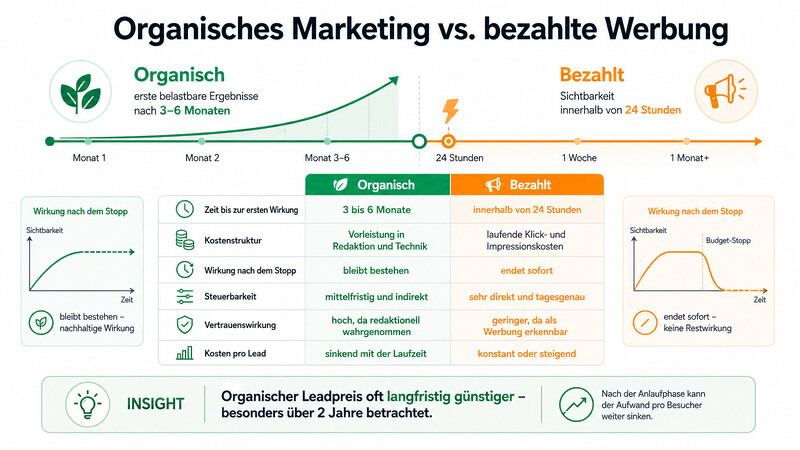
Comparison of organic and paid:
- Time until first effect – organic 3 to 6 months, paid within 24 hours
- Cost structure – organic upfront investment in editorial and technology, paid ongoing click and impression costs
- Effect after stopping – organic remains, paid ends immediately
- Controllability – organic medium-term and indirect, paid very direct and daily precise
- Trust effect – organically high, as perceived editorially, paid lower, as recognizable as advertising
- Cost per lead – organically decreasing over time, paid constant or increasing
Ads are therefore not a worse choice, but a different one. For product launches, seasonal peaks, and testing new target groups, they are clearly superior because they deliver data immediately. Organic marketing, on the other hand, is suitable for anything that should have a lasting presence.
How much lead time is realistic depends on the competition. If established providers with years of history are in your niche, a breakthrough will take longer than in a topic without strong competition. Honest planning means factoring in this lead time instead of arguing it away.
For calculation, it is worth looking at the total costs over two years instead of the monthly value. While paid clicks continue steadily during this time, the effort for a good guide article is distributed over a single period at the beginning. If the article then ranks stably, the calculated price per visitor continues to decrease each month. Exactly this calculation is missing in many budget discussions because it only becomes visible in the second year.
What has changed by 2026 due to AI search and answer engines
Visibility no longer ends in the classic hit list. Because users ask their questions in chatbots, read answers in AI overviews, and research in communities, clicking on a website is often eliminated entirely. This shifts the crucial question for organic marketing from position to quotability.
Although the content requirements are not new, they are becoming noticeably stricter. What a language model is supposed to cite must be clear, substantiated, and clearly attributed. Vague formulations will be rejected.
Where answers originate has also shifted. Where forums, specialist communities, and review platforms talk about a brand, they often shape its image more strongly than its own website. If a brand does not appear there, it will also be missing from the answers drawn from these sources.
Citable content instead of pure ranking optimization
For this to succeed, clear definitions at the beginning of a section, named sources, a clean structure, and recognizable authorship are needed. If a statement is hidden in three subordinate clauses, it will rarely be cited. For organic marketing to appear in AI answers, core sentences that can be extracted without loss of context are required.
From over 1,000 projects implemented at VASTCOB, an observation can be derived that surprises many. Pages with precise facts and clear structure gain in this environment, while general overview texts lose. Accuracy beats volume, more clearly than two years ago.
A practical side effect is added. Those who structure content in this way simultaneously improve the chances of featured snippets in classic search. Both goals require the same discipline.
How to plan the structure and measure progress
Since 2010, we have been assisting companies with precisely this question. Since the sequence is usually missing, the most common reason for a lack of results is rarely due to craftsmanship. Topics are chosen by gut feeling, publishing is irregular, and after four months, patience runs out.
A sustainable plan for organic marketing therefore does not begin with writing. First comes demand, followed by rhythm and measurement.
Select topics based on genuine demand
Where search queries, questions from sales, and open gaps of competitors converge, the topic list is created. If there is no demand, a topic remains invisible, even with excellent text. Therefore, anyone planning organic marketing checks every idea against real search data before effort is expended.
It is also helpful to honestly ask whether there is anything new to say on the topic. If not, the twelfth text on an already answered question will be created. It is precisely at this point that a content marketing agency distinguishes itself from mere text production.
Rhythm beats individual action
If twelve posts appear in one month and then silence reigns, it has a worse effect than one post per month over a year. Consistency is the underestimated lever because it simultaneously serves crawling, topic authority, and internal linking.
Existing content deserves more attention than it usually gets. As soon as an article ranks on page two, revising it yields faster results than an additional text on a blank slate. For organic marketing, maintenance is often more valuable than new content.
If internal capacity is lacking, a fixed responsibility helps more than a grand plan. One person, one appointment per month, one published post. This creates a sustainable inventory within a year.
Internal linking is underestimated. As soon as several posts on the same topic exist, they should refer to each other so that search engines recognize the connection. A new article noticeably benefits if two already established pages point to it. Because this step costs neither budget nor new content, it is one of the few measures with immediate effect.
These key figures show whether it works
Without measurement, organic marketing remains a matter of faith. These values are sufficient for a reliable assessment:
- How many search terms rank, because this number indicates growth before clicks come
- Impressions and clicks from the Search Console over time, not as a snapshot
- Dwell time and scroll depth as an indication of whether the content delivers what the headline promises
- Inquiries via form and phone, ideally with a question about directions to the company
- Returning visitors as an indicator of engagement rather than accidental traffic
- Mentions in AI responses, checked by random sampling
If you compare these values quarterly, you will recognize the trend early enough to make adjustments. Monthly individual values fluctuate too much to derive decisions from them.
Why the interplay with paid campaigns is most effective
If you calculate soberly, the either-or question is quickly answered. Ads bridge the months in which organic marketing does not yet deliver anything, and they also show which messages work. Because these insights flow directly back into the content, the research effort for each further topic decreases later.
For a product launch, this looks specifically like this: Campaigns generate demand from day one, while guide pages are created in parallel. As soon as these rank, the proportion of purchased traffic and thus the price per inquiry decreases. This exact approach describes our SEO and SEA Hybrid Strategy, which considers both sides as one budget instead of two departments.
To prevent the shift from happening too early, a simple trigger is recommended. If a guide page is stably in the top positions, the ad budget for this topic is reduced. Before that, both remain active in parallel.
How high the organic share should be in individual cases depends on margin, competition, and existing content. If you would like to have this assessed for your company, we will look at the initial situation before any budget is shifted. How we work is described by customers in their reviews on ProvenExpert, and for an initial assessment, you can contact us without obligation.
Conclusion
The question remains that stands at the beginning of every implementation. Which of the mentioned channels already exists in your company but is not consistently used?
Where the first step lies is rarely a new channel, but usually existing content that has never been touched again. Organic marketing rewards perseverance more than initial speed. Those who take their own topics seriously, publish regularly, and honestly measure the impact, build visibility that remains even if the advertising budget is tighter in the next quarter.



 DE
DE