AI/KI has been the topic since 2025, and SEO remains paramount. But why is this so important for AI search, and what do GEO or Search Everything/Everywhere Optimization mean? The most important points first: SEO as a foundation, answering specific questions, citable information units, own data/experiences, entities, topic clusters, technical SEO, measurement, and Schema/llms.txt myths.
AI Visibility in 5 Steps – How SEO & GEO Are Connected
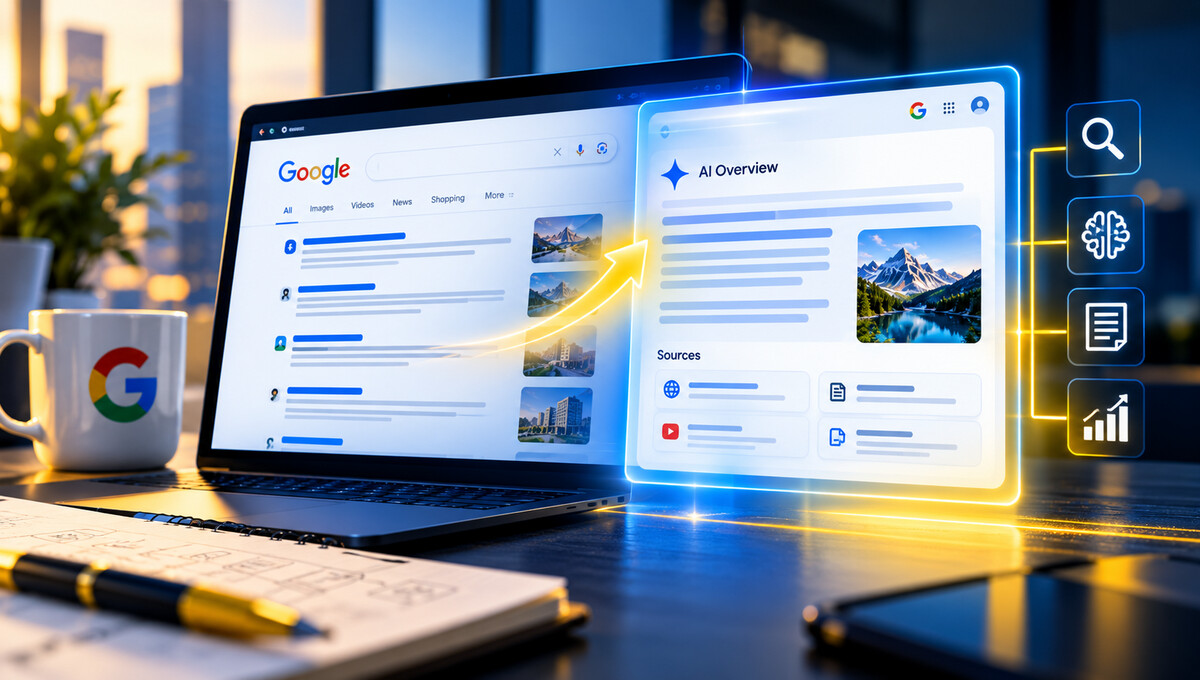
The way we search for information on the internet is undergoing a fundamental change. Google no longer just provides a list of classic search results. AI Overviews summarize information directly within the search, while AI mode can answer more complex questions and establish further connections. In parallel, ChatGPT, Perplexity, and other AI systems are increasingly being used for research, product search, and purchasing decisions.
For companies, this creates an additional challenge: In the long term, it is no longer sufficient to optimize exclusively for a classic Google position. Content must also be structured in such a way that search engines and AI systems can understand, classify, and consider it as a source in the appropriate context.
This is precisely where GEO – Generative Engine Optimization comes into play.
This by no means makes SEO obsolete. On the contrary: Many prerequisites for good AI visibility are already known from classic search engine optimization. GEO expands these fundamentals with the question of how information can be found, understood, and used within generative search experiences.
This affects almost every digital business model – albeit in different ways.
A B2B company, for example, wants to be considered when researching a suitable provider. A service provider wants to generate qualified leads. A B2C company wants to be present in recommendations. And an online shop wants to ensure that its products are even considered for specific purchase and comparison queries.
How this works can be explained in five steps.
1. SEO remains the foundation for GEO and AI visibility
Anyone currently dealing with GEO might quickly get the impression that the previous SEO rules suddenly no longer apply. That would be a dangerous conclusion.
Before Google can consider content within classic search results or an AI-generated answer, the search engine must first be able to find, crawl, understand, and classify the relevant page.
Become more visible on Google & Social Media?
In a free strategy consultation for data-driven online marketing, we uncover your untapped potential, review any existing ad accounts if necessary, examine your SEO ranking and visibility, and determine which strategy is appropriate for your budget and which active measures will lead to more inquiries or sales.

✅ More visibility & perception through targeted placement
✅ More visitors > prospects > customers > revenue
✅ Reach target groups scalably with SEA
✅ Act and grow sustainably with SEO
🫵 Maximum success with our hybrid strategy
💪 More than 15 years of experience across industries in over 1,000+ projects demonstrable!






A technically clean website, functioning internal links, clear information architecture, meaningful headings, clear page titles, and indexable content therefore do not lose their importance due to generative AI.
Search intent also remains crucial.
A page should not exist because a keyword, for example, has 2,000 search queries per month. It should exist because behind these search queries there is a specific information need that the page can answer as well as possible.
With classic SEO, this page then competes for a position within the search results.
With generative search, another possibility arises: The information on this page can additionally be considered as the basis or source for a generated answer.
GEO therefore does not begin where SEO ends. Both areas overlap considerably.
The most important thing:
- Technical SEO remains an essential foundation for AI visibility.
- Content must be crawlable, indexable, and clearly structured.
- Search intent remains more important than the mere use of a keyword.
- GEO expands SEO with additional forms of visibility.
- A good existing SEO structure is a significant head start.
2. Don’t (just) write for keywords, but answer the actual question behind them
Especially with generative search, one point becomes particularly important: users often don’t search for a single term, but want to solve a problem.
Let’s take a typical B2B query:
„Which cloud telephony system is suitable for a company with ten employees and Microsoft Teams?“
Behind this one question are numerous other information needs.
Which providers are there? Which of them support Microsoft Teams? What does a solution for ten employees cost? What hardware is needed? Are there contract terms? How complex is the migration of existing phone numbers?
Modern search systems can break down such complex queries into various sub-aspects and combine information from different sources. In the context of Google’s AI search, this is often referred to as Query Fan-out.
That’s precisely why it’s not enough to fill a page twenty times with the term „cloud telephony system“.
A truly helpful page instead answers the questions that arise during an actual purchase decision.
This applies equally to the B2C sector.
From:
„Which robot vacuum cleaner is suitable for a house with two floors, children, and pets?“
questions arise, for example, about obstacle detection, pet hair, wiping function, multiple maps, stairs, cleaning station, and follow-up costs.
Those who understand these connections automatically produce better content – for people as well as for search engines.
The Most Important:
- A search query can consist of several information needs.
- Content should fully understand the problem behind a keyword.
- B2B searches often involve technical requirements and decision factors.
- B2C searches more frequently contain specific use cases and comparisons.
- Good topic coverage is more important than an artificially high keyword density.
3. Structure content so that individual answers are understandable and usable
Here begins one of the most interesting differences between classic SEO and GEO.
A page can be excellently researched and still consist of long blocks of text where relevant information is difficult to find.
Therefore, I would not start artificially writing texts „for AI“. It is much more sensible to prepare information for people in such an unambiguous way that machines can simultaneously understand more easily what it is about.
An example from lead generation:
Instead of a page with the heading:
„Professional Solutions for Your Digital Success“
a specific question is much more meaningful:
„What does a professional SEO audit cost?“
This should not be followed by a 500-word introduction.
The actual answer should be as far forward as possible:
The costs of an SEO audit depend in particular on the size and technical complexity of the website, as well as the scope of the desired analysis.
This can then be followed by price examples, scope of services, typical problems, and differences between various types of audits.
The same principle works for an online shop.
Instead of:
„Discover our high-quality office chairs“
a guide could, for example, specifically answer:
„Which office chair is suitable for eight hours of daily work in a home office?“
Subsequently, ergonomics, body size, adjustment options, materials, load capacity, and suitable products can be discussed.
The crucial point is: An important statement should remain understandable even if only this section is read.
The most important things:
- Important questions should be answered as directly as possible.
- Headings must clearly indicate what information follows.
- Individual sections should be understandable even without the entire article.
- Tables, lists, and comparisons help with complex decisions.
- Good structure simultaneously improves user-friendliness and machine readability.
4. Original information beats interchangeable content
Here I see one of the biggest differences between truly good and merely „SEO-optimized“ content.
There are countless articles on almost every topic now. Generative AI has also made it extremely easy to produce another article from existing information.
This makes one question increasingly important:
What does my company know that isn’t already on a hundred other websites?
And almost every company has such information.
B2B Example
A provider of industrial software could publish:
„Analysis from 120 implementations: These five processes cause the most delays in ERP migrations.“
This is significantly more valuable than the hundredth generic article titled „10 Benefits of a Modern ERP System.“
B2C Example
A specialist retailer could actually test and document 15 products:
„15 Cordless Vacuum Cleaners in Practical Test: Runtime, Suction Power, and Weight in Direct Comparison.“
Own measured values create informational value that a generically generated product text does not possess.
Lead Generation Example
An SEO agency could anonymously evaluate real project data:
„What Does SEO Really Cost? Analysis of 50 Mid-sized SEO Projects.“
The article not only answers a common question but also demonstrates experience and creates a natural transition to an inquiry.
Online Shop Example
A retailer for outdoor furniture could not simply copy manufacturer texts but document:
„Which Garden Furniture Withstands Strong UV Radiation? Aluminum, Polyrattan, and Wood Compared After Two Years.“
This answers a real purchasing decision and simultaneously leads to suitable products.
I consider precisely such information to be the most interesting long-term GEO strategy.
The Most Important Things:
- Proprietary data and experiences differentiate content from the competition.
- B2B companies can leverage project experience and expertise.
- B2C companies particularly benefit from tests and concrete application scenarios.
- Lead generation works well through content with high decision value.
- Online shops should make their own product expertise visible beyond manufacturer texts.
5. Build topic expertise instead of publishing individual articles
A good article alone does not make a website a relevant source for an entire topic area.
Therefore, I would not consider content as a collection of individual keywords, but as a content network.
Let’s take a company that offers SEO services.
A central page deals with:
SEO Audit
This allows for content such as:
- What does an SEO audit cost?
- Do an SEO audit yourself
- Technical SEO audit
- SEO audit checklist
- Which SEO audit tools are useful?
- SEO audit for online shops
- SEO audit for international websites
These pages answer different questions within the same topic complex and are logically linked to each other.
For a B2B software provider, the same principle could look like this, for example:
ERP system → ERP selection → ERP costs → ERP migration → ERP for production → SAP alternative → ERP implementation checklist.
For an online shop:
Running shoes → Running shoes for beginners → Overpronation → Correct shoe size → Cushioning → Running shoes for heavy runners → Models compared.
This not only creates more content. It creates thematic depth.
The most important thing:
- Content should be planned in coherent topic clusters.
- A central page can be supported by specialized detailed content.
- Internal links should follow the next logical information need.
- Product and service pages can be linked with guide content.
- The goal is genuine topic expertise instead of as many isolated keywords as possible.
What GEO can look like specifically for B2B companies
In the B2B sector, I consider GEO particularly interesting because purchasing decisions often begin with extensive research.
A potential customer may not be looking for:
„Company XY CRM Software“
but asks:
„Which CRM is suitable for a mechanical engineering company with 50 sales representatives and SAP integration?“
This is precisely where a new form of visibility emerges.
Therefore, a provider should not exclusively publish product pages, but answer the questions that actually arise during a selection process.
These include, for example, costs, integrations, implementation duration, alternatives, industry requirements, migration, security requirements, and real application scenarios.
The goal is not to present one’s own product as the winner in every article. Precisely understandable limitations and honest comparisons can increase professional credibility.
The most important thing:
- B2B content should cover specific decision-making situations.
- Integrations, costs, and implementation are often more important than general product descriptions.
- Case studies and project experiences provide particularly valuable information.
- Comparison and alternative searches often have high commercial relevance.
- Technical depth can be more important than maximum reach.
How GEO can work for B2C companies
In the B2C sector, the questions differ, but the principle remains similar.
Consumers are increasingly searching in specific situations:
„Which stroller is suitable for air travel?“
„Which mattress is suitable for side sleepers?“
„Which automatic coffee machine is easy to clean?“
The decisive difference compared to a classic category page is the context.
A good B2C guide does not simply explain that product A is „high-quality“ and product B is „innovative“. It helps the customer understand which product is suitable for which application and why.
Precisely this type of information is suitable for both classic search and generative product recommendations.
The most important thing:
- B2C searches are often highly situation-dependent.
- Purchase advice should address specific use cases.
- Own product tests and comparisons create additional informational value.
- Pros and cons should be presented comprehensibly.
- Good advice can lead users directly towards a product decision.
GEO for lead generation: Create visibility where decisions begin
For service providers, not every search query is equally valuable.
An article about „What is SEO?“ can generate a lot of traffic. A visitor searching for „SEO agency costs for online shop“, however, is much closer to a concrete purchase decision.
For lead generation, content should therefore cover different phases of the decision journey.
Early research:
„Why is my website losing Google rankings?“
Problem awareness:
„How do I identify technical SEO problems?“
Solution search:
„Do an SEO audit myself or hire an agency?“
Purchase decision:
„What does a professional SEO audit cost?“
If a company provides well-founded content for all these questions, it increases the likelihood of being noticed already during the research phase.
The call-to-action then results from the content. For example, someone reading an article about SEO audit costs can directly request an analysis or initial consultation.
The most important thing:
- Not all traffic has the same economic value.
- Content should cover different phases before an inquiry.
- Comparison, cost, and problem-solving questions often have high lead value.
- The CTA should match the respective search intent.
- GEO can create visibility even before the actual provider search.
GEO for online shops: From product search to purchase decision
For online shops, the development is particularly exciting.
The classic optimization of a category like „Buy office chairs“ remains relevant. At the same time, users are asking increasingly detailed questions before deciding on a product.
For example:
„Which ergonomic office chair is suitable for tall people over 1.90 meters and eight hours of work per day?“
A shop has a decisive advantage over a general guide here: it can combine advice and specific products.
However, this requires more than just manufacturer descriptions.
Examples of useful content include:
- own product comparisons
- size and application recommendations
- real photos and videos
- measurements
- material comparisons
- compatibility information
- frequently asked customer questions
- advantages and disadvantages
- experiences from returns or support inquiries
- comprehensible selection criteria
A category or product page can thus become much more than just a sales area. It becomes a professional source of information.
The Most Important:
- Manufacturer texts alone hardly create an information advantage.
- Product data should be supplemented with your own advice.
- Guides and products should be meaningfully linked.
- Specific purchase and comparison questions are particularly interesting.
- The shop should show why a certain product is suitable for a certain application.
How Google can derive multiple search needs from a single question
This point is particularly important for content planning.
A complex question often contains several sub-questions.
Let’s take:
„Which photovoltaic system is suitable for a single-family house with a heat pump and an electric car?“
Among other things, it contains:
- required PV output
- power consumption of a heat pump
- additional consumption of the electric car
- battery storage
- roof area
- costs
- amortization
- wallbox
- funding opportunities
A single page does not necessarily have to answer every conceivable question. But companies should understand what information landscape exists around their product or service.
From this, individual pages and topic clusters can be developed.
Precisely for this reason, I believe GEO changes good SEO work less than is often claimed. Good SEOs have long since ceased to deal exclusively with keywords, but with search intent, entities, topics, and contexts.
The most important thing:
- Complex queries often contain numerous sub-questions.
- These sub-questions provide excellent ideas for content.
- Not all information needs to be on a single page.
- Internal linking connects different information needs.
- The overall topic coverage of a website gains importance as a result.
What role do entities play in AI visibility?
In addition to individual keywords, it is becoming increasingly important that it is clearly recognizable who and what a website is talking about.
A company, a product, a person, or a brand can be understood as an entity.
For a company website, it should therefore be understandable, for example:
Who is behind the company? What services are offered? In which subject areas does the company have expertise? Which authors write the content? Which products belong to the brand?
This does not mean that every website should suddenly be overloaded with as much schema markup as possible.
It’s about consistency first.
When companies, authors, services, and products are clearly named and linked to each other, a clearer overall picture emerges.
Structured data can contribute to this. However, it does not replace good content or professional credibility.
The Most Important Things:
- Companies, brands, products, and authors should be clearly named.
- Consistent information facilitates thematic classification.
- Author profiles can make professional responsibility more transparent.
- Structured data can help with machine understanding.
- Schema Markup is not a guaranteed path to an AI answer.
Five GEO Myths You Don’t Have to Believe
With every new marketing topic, supposed shortcuts emerge. GEO is no exception here.
„SEO is dead.“
No. Many fundamentals of classic search remain a prerequisite for organic and generative visibility.
„With Schema Markup, I automatically get into AI Overviews.“
That is also not a guarantee.
„Without llms.txt, AI systems cannot find my website.“
Such a blanket statement is not sustainable.
„I must publish as much AI content as possible now.“
The sheer volume of content creates neither expertise nor additional informational value.
„Only the website ranked #1 can be cited by an AI.“
Generative answers and classic ranking positions are not identical.
Precisely for this reason, GEO should not be understood as a collection of new tricks. It is much more sensible to view one’s own website from the perspective of an information system: Is it clearly recognizable what we are talking about, what we know, and why our information is helpful?
The most important thing:
- SEO remains relevant.
- There is no single GEO switch.
- Schema and llms.txt should not be overestimated.
- More content does not automatically mean more visibility.
- GEO should be understood as a long-term content and information strategy.
Measuring AI Visibility: Don’t Just Monitor Rankings
Measuring success becomes more challenging with generative search.
Classic SEO metrics remain relevant: rankings, impressions, clicks, organic landing pages, and conversions still belong in any reasonable monitoring.
Additionally, for important business areas, I would create a list of real user questions and regularly check them in relevant search and AI systems.
For a B2B provider, these could be ten to fifty central decision-making questions.
For a shop, these could be important product and comparison questions.
Documented, for example:
Is one’s own brand mentioned? Is one’s own domain linked as a source? Which competitors appear? Which external sources are used particularly frequently? Which questions even lead to generative answers?
Not every single query should be overvalued. The development over weeks and months becomes interesting.
The most important thing:
- Search Console and classic SEO data remain indispensable.
- Important AI questions should also be regularly monitored.
- Consider brand mentions and source linking separately.
- Competitors and frequently cited sources provide valuable insights.
- The trend is decisive, not a single query.
Conclusion: SEO brings content into search – GEO expands its role in the answer
Perhaps the most important insight is: SEO and GEO are not competing strategies.
The technical foundation remains SEO. Good content remains important. Search intent remains important. Expertise, internal linking, and a clear information architecture remain important.
What changes is the environment in which this information appears.
A website no longer competes exclusively for a place in a list of search results. Its content can additionally become part of a generated answer, a cited source, or the basis for a product or provider recommendation.
For a B2B provider, this can mean appearing during a complex provider selection process.
For a B2C company, it means being present in concrete everyday situations and purchasing decisions.
For service providers, AI visibility can reach qualified prospects long before they directly search for an agency or consultancy.
And for online shops, the opportunity arises to make products visible not only through categories and product names, but through the exact questions that customers actually ask before a purchase decision.
The five steps remain surprisingly down-to-earth:
- Create an SEO foundation.
- Answer real questions instead of just keywords.
- Structure information clearly and quotably.
- Publish your own experiences, data, and expertise.
- Build genuine subject matter expertise from individual pages.
Anyone who implements these points properly does not suddenly have to write their website „for AI“.
Above all, you have to make it a better source.
And that is probably the biggest commonality between good SEO and good GEO.




 DE
DE