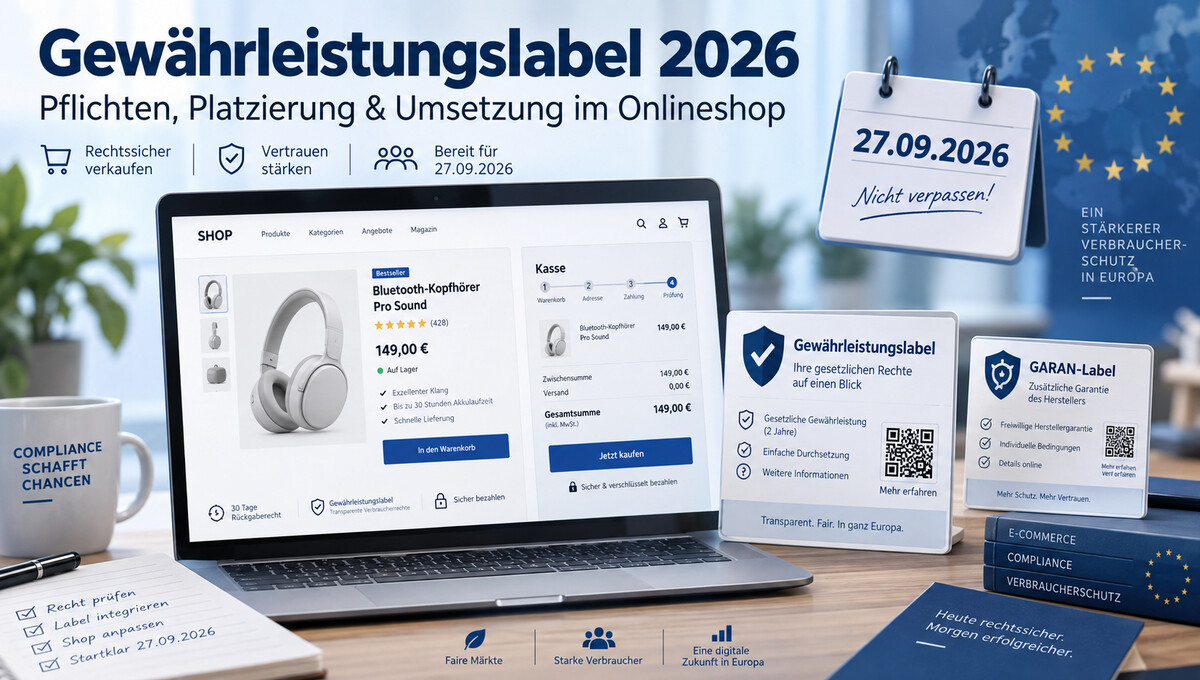
From 27 September 2026, every online shop that sells to consumers must display a fixed EU graphic in the ordering process. Retailers may not change the colour, text or QR code, and for some products a second label is even added. We show which graphic belongs where and where integration in the shop typically hits snags.
With the warranty label, an obligation comes into force on 27 September 2026 that affects almost every online shop with consumer customers. Unlike many information obligations, this time it is not a matter of a text module, but of a ready-made graphic from the EU Commission. The correct placement is therefore the decisive factor.
Added to this is a second label for products with a long manufacturer’s guarantee, which can easily be confused with the first. The following covers both graphics, the requirements for the product page, checkout and order confirmation, as well as implementation in WooCommerce and other shop systems. Binding information in individual cases can only be provided by a legal review; the information is current as of September 2026.
Obligations, placement and templates relating to the new warranty label
Warranty label and guarantee label in direct comparison
At first glance, the two new EU graphics appear like siblings, but legally they have little in common. With the warranty label, the EU reminds consumers of a right to which they are entitled anyway. The second label, by contrast, makes a voluntary promise by the manufacturer visible.
The warranty label as an obligation for everyone
Behind the graphic is the statutory warranty, which applies within the EU for at least two years. If goods are defective, the seller is liable, not the manufacturer.
Because this right exists with every purchase, the warranty label applies to every sale to consumers without any further conditions. A QR code in the graphic leads to detailed information from the EU.
The GARAN label only for durability guarantees
The guarantee label, which bears the title GARAN in the official templates, works differently. It identifies a guarantee that a manufacturer provides voluntarily and in addition to the statutory warranty. It only becomes mandatory once this promise meets certain conditions.
The most important differences at a glance:
| Feature | Warranty label | GARAN label |
|---|---|---|
| Legal background | statutory warranty of the seller | voluntary durability guarantee of the manufacturer |
| Obligation for | all retailers with consumer customers | Retailers whose goods have a free manufacturer’s guarantee of more than two years |
| Placement online | Product page or checkout before ordering | Product page |
| Collapsed display | not permitted | permitted |
| Minimum size in store | DIN A4 | 95 x 100 mm |
| Customizable content | none | Manufacturer, model identifier, guarantee duration |
Where the new labelling requirement comes from
The basis is Directive (EU) 2024/825, which tightens European consumer law in several places. The exact appearance of the warranty label is set out in Implementing Regulation (EU) 2025/1960. In official texts, the graphic is called a harmonised notice; some retailers also refer to it as a warranty notice.
While Germany has transposed the information obligation into consumer law, the design and content follow directly from the European regulation. Custom variants in corporate design are therefore ruled out for the warranty label. At VASTCOB, we see this as more of a relief, because retailers do not have to design anything, but simply integrate it correctly.
Become more visible on Google & Social Media?
In a free strategy consultation for data-driven online marketing, we uncover your untapped potential, review any existing ad accounts if necessary, examine your SEO ranking and visibility, and determine which strategy is appropriate for your budget and which active measures will lead to more inquiries or sales.

✅ More visibility & perception through targeted placement
✅ More visitors > prospects > customers > revenue
✅ Reach target groups scalably with SEA
✅ Act and grow sustainably with SEO
🫵 Maximum success with our hybrid strategy
💪 More than 15 years of experience across industries in over 1,000+ projects demonstrable!







The labelling is, however, only one part of a larger package of new consumer and advertising requirements. The same directive requires, among other things, information on repairability, provided manufacturers make it available. It also significantly restricts blanket environmental claims in advertising. Which additional mandatory information must appear in the shop in 2026 is summarised in our guide on legal texts for online shops.
Which retailers must display the warranty label
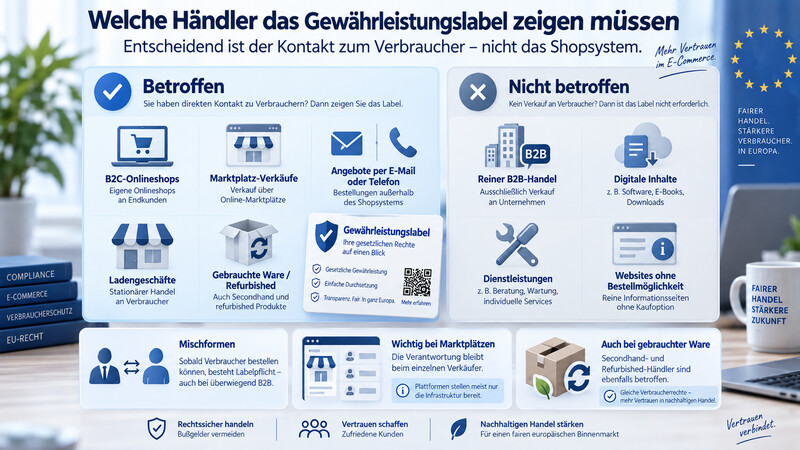
What matters is not the shop system, but contact with the consumer. The warranty label therefore belongs just as much in the classic online shop as in offers by email, on marketplaces and in physical sales rooms. Where only business customers order, the obligation does not apply:
- Affected: B2C online shops, sales via marketplaces such as Amazon, eBay or Etsy, offers by email or telephone, retail stores, used goods
- Not affected: pure B2B trade, digital content, services, websites without the option to order
What applies to mixed forms? A shop with business and private customers needs the label as soon as consumers can order, even if revenue is predominantly generated in the B2B business. Since 2010, we have supported mid-sized companies whose online shops are officially aimed at commercial customers and yet regularly receive private orders. The decisive factor is therefore the actual customer base, not the shop’s own description.
On marketplaces, responsibility remains with the individual seller, even if some platforms provide the warranty label centrally for their retailers. You should therefore check in your seller account whether the graphic already appears automatically in your listings. If it is missing, you should ask the platform operator rather than wait for a later solution.
Does this also apply to used goods?
Yes. When selling used items to consumers, there is a statutory warranty claim that can only be contractually reduced to one year. Second-hand shops and refurbished retailers need the warranty label just like providers of new goods.
How to correctly place the warranty label in your online shop
For the warranty label, the regulation requires that consumers can clearly recognize the graphic before they submit their order. This sounds simple, but it rules out some popular solutions.
Product page or checkout
Two locations are permitted: the product detail page or a clearly visible area in the checkout before the order button. The warranty label must appear there as a complete graphic and must not disappear behind a link, a mouseover, or an accordion. A collapsed display is reserved for the second label for manufacturer warranties.
For most shops, the checkout is the easier choice because the graphic is only integrated once centrally there. Since the order process is being adapted anyway, it is also worth taking a look at a second new obligation. Which button must additionally be in the shop since June 2026 is explained in the article on Withdrawal Button Requirement 2026.
Is a note in the footer sufficient?
No, at least not on its own. A separate information page with a link in the footer is useful as a supplement, but does not replace the visible placement in the order process. A paragraph in the terms and conditions does not fulfill the obligation either, because the warranty label is explicitly required as a graphic.
Language, color, and order confirmation
Online, only the colored version is permitted; there is no fixed minimum size. Although no dimensions are specified, the text in the warranty label should remain readable on a smartphone without zooming. The language depends on the shop language and not on the delivery country, so multilingual shops play out each version accordingly. Additionally, the graphic belongs on a permanent data carrier, in practice in the order confirmation by email.
For individual offers via email, the graphic is inserted directly into the message or attached in advance; a mere link is not sufficient. In the retail store, the warranty label is displayed prominently in at least DIN A4 format in the sales area or at the checkout.
When does the GARAN label become additionally mandatory?
This second obligation is triggered by a commercial durability guarantee from the manufacturer. Three conditions must be met: the guarantee is free for consumers, it covers the entire product, and it lasts longer than two years. If even one of these requirements is missing, the label may not be used. For each product, this can be clarified in four questions:
- Does the manufacturer grant its own guarantee on this exact model?
- Is it free of charge for the buyer?
- Does it cover the complete product and not just individual components?
- Does it apply for longer than two years?
Where does the classification most often fail in practice? Usually in the details. A ten-year guarantee covering only the motor of a washing machine does not trigger the label, nor does a paid guarantee extension. A separate dealer guarantee is something different and must not be presented in a way that customers confuse it with the EU label.
Once all conditions are met, the retailer personalizes the label with the manufacturer name, model identifier, and guarantee duration in years, while the title, symbols, and QR code remain unchanged. Note that the obligation arises solely from the existence of the guarantee, even if the shop does not advertise it at all. Online, the label appears in color on the product page and may initially appear collapsed there, unlike the warranty label.
In the store, a minimum size of 95 by 100 millimeters applies on the product, packaging, or shelf. By the time of delivery at the latest, the customer receives the guarantee declaration in permanent form, such as an email or a printout in the package.
Where do the necessary information come from? Manufacturers usually publish their guarantee terms in data sheets or in the retailer portal; some provide the finished GARAN label directly. If such a template is missing, the retailer creates the label themselves based on the official file. According to the assessment of the IHK Cologne, retailers do not have to conduct their own research but may rely on the manufacturer’s information.
Technical implementation in WooCommerce and other shop systems
Technically, the two graphics differ fundamentally. Because the warranty label is identical in every shop, it belongs centrally in the template, for example via a hook in the checkout or a fixed block on the product page.
The guarantee label, on the other hand, is tied to the individual product. Without its own data fields, it quickly becomes unmanageable with several hundred items, especially since manufacturers occasionally change their guarantee terms.
Official templates instead of custom design
The EU Commission provides guides and high-resolution vector files in all official languages free of charge. The warranty label must not be recreated in your own design or adjusted in color; a newly generated QR code is also not permitted.
Some shop systems have responded. JTL includes the graphic from Shop 5.8 onwards; for Shopware, Shopify, and WooCommerce there are extensions or theme modules that display it at a central location. Nevertheless, check the integration against the official template, as not every solution implements color and placement correctly.
Maintain guarantee data per product and variant
For the GARAN label, each affected product requires three pieces of information: manufacturer, model identifier, and guarantee duration. In WooCommerce, you can create your own product fields for this, whose values the template automatically writes into the graphic. For variable products with different guarantees depending on the version, the fields belong at the variant level.
That mandatory information tends to disappear during the next theme or plugin update rather than during initial installation is a pattern we’ve observed across our more than 1,000 web and shop projects. Our team therefore stores such fields in a separate plugin rather than in the theme to ensure they survive updates. If you need support for the integration, we handle this as a WooCommerce agency from data structure to testing.
Loading time, accessibility, and email templates
If the graphic is delivered in compressed format, loading time is hardly an issue, but an unedited export of the vector file noticeably slows things down. Additionally, the warranty label needs meaningful alternative text so that screen readers can read out the notice. Whether your shop meets such requirements overall becomes clear when you have your website checked for accessibility.
In WooCommerce, both graphics also belong in the templates of order confirmation emails, which can be customized via the theme or an extension for email templates. These points should be completed by September 27:
- Warranty label displayed in color on the product page or at checkout, visible without clicking or hovering
- Template obtained exclusively from the official EU Commission website
- Graphic integrated in every language version of the shop
- Warranty fields maintained for all products with more than two years of manufacturer warranty
- both graphics included in the order confirmation and tested again after the next update
Frequently asked questions about the warranty label
Can the seller refer to the manufacturer?
This is not permitted under statutory warranty. The contact person for a defect remains the seller; the manufacturer is only obligated as part of a voluntary guarantee. This is exactly the difference that the warranty label should make visible to consumers.
What happens if the label is missing after the deadline?
If the warranty label is missing or incorrectly placed, this constitutes a violation of a statutory information obligation. Competitors and consumer associations can issue a cease-and-desist letter. Compared to such a dispute, integrating the template is usually considerably less effort.
Must a dealer's own guarantee be marked?
It will not receive a GARAN label because the label exclusively marks manufacturer durability guarantees. However, the known requirements continue to apply to the guarantee declaration itself: clearly worded, with the name and address of the guarantor, duration and scope of validity, as well as the notice that the customer’s statutory rights remain unaffected.
Does the obligation also apply in Austria and Switzerland?
As an EU member state, Austria is bound by the same deadline; the warranty label belongs in shops there just as it does in Germany. Since Switzerland is not an EU member, it has not adopted this requirement. If a Swiss shop is specifically targeting consumers in the EU, the question should be clarified with a lawyer.
May the label be integrated before the deadline?
The warranty label may already be in the shop now, provided the official template remains unchanged. Because placement, email templates, and guarantee data can then be tested without time pressure, this advance notice is worthwhile, especially for large product ranges.
What remains open until the deadline
Some questions cannot be conclusively answered in September 2026. How the major marketplaces will technically roll out the label for their merchants is not clarified everywhere. Which placements courts will still accept in borderline cases will only become apparent with the first cease-and-desist letters.
Waiting is still not a good strategy, however, because the core obligation is clear: From 27 September, the warranty label must be visibly included in every checkout process with consumer customers. Open details concern peripheral areas, not the basic rule. Therefore, it makes sense to integrate the warranty label now and keep an eye on further developments.
How shop operators experience working with us is shown by the positive reviews on ProvenExpert. For a quick review of your shop, a message to our team is sufficient.



 DE
DE