A single outdated paragraph in the imprint is enough to receive a letter from a lawyer today. Since July 2025, a previously mandatory link has suddenly become a risk itself; since June 2026, many shops are missing a completely new button. This guide shows which documents are mandatory and where expensive gaps arise. At the end, there is a checklist for one hour.
Anyone who wants to know which legal texts online shop operators must have in place by 2026 cannot avoid a series of information obligations that shift almost every year. Two of these have recently moved in opposite directions. One piece of information became newly mandatory, while another has had to disappear from all documents since last summer.
Hardly any shop fails at the legal source text. If something no longer fits later, usually no one has checked whether the documents still match the assortment and the legal situation. This guide categorizes the mandatory documents, identifies current problem areas, and concludes with a checklist that requires no prior legal knowledge. It does not replace legal advice; the legal status is August 2026.
These mandatory documents belong in every shop
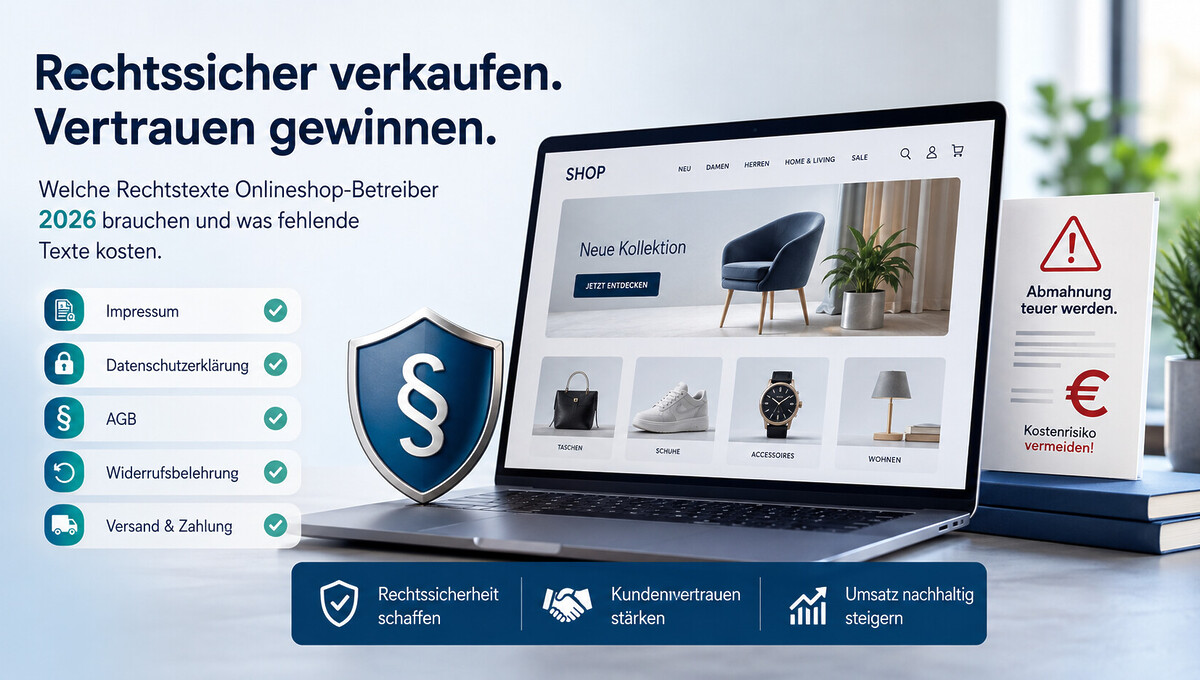
Under the keyword „online shop legal texts,“ most providers summarize four documents: imprint, privacy policy, terms and conditions, and right of withdrawal. However, these four only form the core. As soon as one of them is changed individually, contradictions arise with the others.
Is that enough for every shop? The assortment determines the rest. Because digital products require different passages regarding the right of withdrawal than clothing, freight goods require specific information on delivery time and delivery, and services require a different wording for the start of the service, no off-the-shelf template will fit. Where a text fits a neighboring shop, it rarely fits your own.
Although product-related information is also subject to warnings, many retailers do not even count it among the mandatory documents. This includes the total price, unit price, and shipping costs, as well as the manufacturer’s information according to the EU Product Safety Regulation. To ensure nothing is overlooked, a clear breakdown helps:
- Imprint with complete provider identification, legal form, and authorized representation
- Privacy Policy, which precisely names the services actually running in the shop
- Terms and Conditions (AGB), tailored to the assortment, target group, and payment methods
- Right of Withdrawal Information including a sample withdrawal form and, since 2026, the withdrawal button
- Shipping and Payment Terms with traceable delivery times
- Price and Product Information including base price and mandatory product safety information
Why Legal Texts for Online Shop Projects are Never Permanently Finished
Many retailers treat legal texts for online shop projects as a one-time purchase. When they are created at the shop’s launch, they are placed on four pages of the content management system and then not opened again for years. During this time, laws, plugins, and the shop’s own product range change.
What is usually the reason then? The second classic mistake is copying from other shops. Foreign texts belong to foreign product ranges and automatically include their exceptions, plus there is the copyright risk. Since we at VASTCOB have implemented over 1,000 projects, we hardly know of any case where the original text itself was the problem.
Where the problem almost always lies is in the maintenance that online shop operators should plan for legal texts after launch. A payment service has long been replaced, an analysis tool does not appear in any privacy policy, a delivery time has been incorrect for three years.
These innovations shops had to implement in 2025 and 2026
Three points have created the greatest need for action in recent months. Because all three are already in force and apply regardless of shop size, they directly affect legal texts for online shop operators in the frontend.
Become more visible on Google & Social Media?
In a free strategy consultation for data-driven online marketing, we uncover your untapped potential, review any existing ad accounts if necessary, examine your SEO ranking and visibility, and determine which strategy is appropriate for your budget and which active measures will lead to more inquiries or sales.

✅ More visibility & perception through targeted placement
✅ More visitors > prospects > customers > revenue
✅ Reach target groups scalably with SEA
✅ Act and grow sustainably with SEO
🫵 Maximum success with our hybrid strategy
💪 More than 15 years of experience across industries in over 1,000+ projects demonstrable!







The withdrawal button as a new obligation since June 2026
Since June 19, 2026, legal texts for online shop systems must include an additional button through which consumers can directly revoke their contract. The extent of the obligation results from EU Directive 2023/2673: It affects online contracts for goods, services, and digital content with a statutory right of withdrawal.
The button must be accessible without login, clearly labeled "Revoke Contract", and require a second confirmation. This is followed by a confirmation of receipt. A mandatory field for the reason for withdrawal is inadmissible.
Exceptions apply to custom-made products, perishable goods, and purely B2B trade. Technical details and implementation are described in the article on the Withdrawal Button Obligation 2026.
The link to the OS platform must disappear
The opposite is true for the reference to the European Online Dispute Resolution (OS) platform. Because the EU repealed the legal basis, the platform was taken offline on July 20, 2025. A link that was mandatory for years has since led to nowhere and is now considered misleading information for consumers.
This has simply turned a classic warning letter reason on its head. Hardly any other point shows so clearly how permanently legal texts keep online shop operators busy. In addition to the imprint and terms and conditions, you should also check the footer, order confirmations, email signatures, app views, and social media profiles.
Accessibility and product safety as new areas of scrutiny
Because online shops provide services in electronic commerce, the Accessibility Strengthening Act has also applied to them since the end of June 2025. Where deficiencies appear, it is often not only alternative texts or sufficient contrasts that are missing, but also the accessibility statement as a separate mandatory disclosure. If a business has fewer than ten employees and a maximum of two million euros in revenue, the exemption for micro-enterprises applies.
The requirements in detail are set out under BFSG Accessibility. In parallel, the Product Safety Regulation requires visible information on the manufacturer, EU responsible person, and warning notices for physical products. This expands the list of points that online shop operators must keep in view alongside the four core documents.
The most common warning letter reasons in online shops
Under the search term warning letter reasons online shop, you will mainly find lists that weight everything equally. The data paint a clearer picture. Just how significantly the situation has shifted is shown by the 2025 warning letter study by the Händlerbund: 18 percent of surveyed retailers were affected, compared with 12 percent two years earlier. A good quarter now perceive that warning letters are being issued more frequently than before.
Among the risk areas, competition law leads with 42 percent, closely followed by the Packaging Act with 40 percent. Although many do not regard either as a text-related topic, they hit precisely the information that is publicly visible in the shop.
| Risk Area | Typical Trigger | Affected Area in the Shop |
|---|---|---|
| Competition Law | misleading advertising claims, strikethrough prices without reference | Product texts, category pages |
| Packaging Act | missing registration, missing notice | Legal notice, shipping terms |
| Price Indications | missing unit price, unclear shipping costs | Product and shopping cart page |
| Right of Withdrawal | outdated instruction, missing button | Withdrawal policy, customer account |
| Data Protection | undisclosed services, banner without effect | Privacy policy, cookie banner |
| Product Safety | missing manufacturer and warning notices | Product detail page |
| Accessibility | missing declaration, inoperable forms | Shop frontend, checkout |
What a warning letter really costs
How such a letter is structured becomes apparent quickly: a cost statement plus a pre-formulated cease-and-desist declaration. The amount of the invoice depends on the disputed value assigned, the declaration on the violation complained of. The second part is dangerous, even though it initially costs nothing.
With search queries such as warning letter online shop costs, the concern about the invoice is almost always in the background. Anyone who receives such a letter should first look at competition law. If a competitor complains about violations of information and labeling obligations in electronic commerce or against data protection law, reimbursement of costs does not apply for businesses with fewer than 250 employees. Many of the classic text errors therefore do not trigger any reimbursable legal costs at all.
Does that mean it is all half as bad? Because a signed cease-and-desist declaration has unlimited effect over time, the contractual penalty applies in the event of a repeat offense. Since 2010 we have been supporting shop projects technically, and the most expensive variant was never the first invoice, but the second violation after a hastily signed declaration. Before you react, have it reviewed.
| Item | When it applies | Order of magnitude |
|---|---|---|
| Legal fees of the warning letter sender | only outside the exception for information obligations | mid three- to four-figure range |
| own legal review | advisable for every warning letter | manageable in relation to the risk |
| Contractual penalty | in the event of repetition after a cease-and-desist declaration | significantly higher than the initial demand |
| Technical rectification | as soon as adjustments are needed in the shop | a few hours depending on the effort required |
| Lost revenue | if offers temporarily go offline | difficult to calculate |
What free legal texts do for online shop operators and where their limits lie
Providing free legal texts to online shop operators has long been standard practice among providers such as Trusted Shops. Provided the configuration is correct, the legally drafted documents immediately cover the four core areas. If something later turns out to be wrong, it is rarely due to the source text.
What a free generator is sufficient for
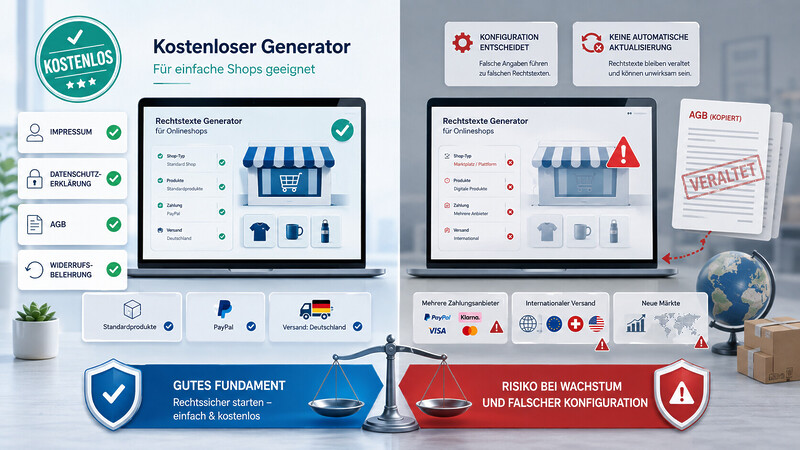
Where a simple shop operates with a standard range, one payment service provider and no international shipping, this is entirely sufficient. Anyone searching for „free legal texts for online shop“ who is in this situation gets a solid foundation. The generator guides users through the configuration, and the result matches the common cases.
From when the free version becomes a risk
It becomes critical in two places. Because the configuration determines the outcome, online shop operators make these decisions themselves without legal consultation. As soon as a checkbox under the withdrawal exceptions is set incorrectly, a well-worded but substantively incorrect text is produced.
In addition, a text that has been copied once does not update itself. As soon as the range, payment methods or target markets grow, it is worth switching to a maintained solution or having it reviewed by a lawyer.
How warning-letter protection actually helps online shop operators
Warning-letter protection offers for online shops mean three very different things that are often blurred in marketing: the ongoing updating of documents, an assumption of liability in the event of a dispute, and a pure insurance solution. Only the first variant prevents errors. The other two merely mitigate the consequences after the letter has already landed in the mailbox.
What does such a package actually cover?
- Covered: Updates for legal changes, assortment-appropriate sample wording, initial legal review of the configuration
- Not covered: incorrectly configured settings, price and product information at item level, technical defects such as missing accessibility, violations of the Packaging Act
For a protection promise to take effect, updated versions must reach the shop. Providers such as Trusted Shops Legal Text Generator therefore work with interfaces instead of sending PDFs. Anyone who instead obtains „Rechtstexte Online Shop kostenlos“ and maintains the documents manually bears the update risk entirely alone.
How legal texts are technically integrated into an online shop in a clean manner
This is where the responsibility of the text providers ends. This is precisely where most gaps arise. Because a manually inserted text remains in place until someone replaces it, it ages unnoticed. With an interface connection, however, changes are automatically placed on the respective page, usually within a few hours of the update at the provider.
The second construction site is placement. If a correct text is in the wrong place, it does not fulfill the information obligation. As soon as a customer orders, the cancellation policy and terms and conditions must be accessible and must be included in the order confirmation; the cancellation button belongs on a permanently linked, publicly accessible page. A checkout plugin with its own text modules regularly undermines this structure without anyone noticing.
Which errors are particularly common in WordPress shops? Cookie banners name different services than the privacy policy, old legal text pages from an earlier theme remain online, and Germanized settings no longer take effect after an update. So that the versions that online shop operators have approved for legal texts are actually displayed, this check is part of the standard for every shop maintenance we provide, whether as a WooCommerce agency or under an ongoing maintenance contract. Our customers confirm this on ProvenExpert. If your shop has not been checked since the last relaunch, please feel free to contact us.
The inspection plan for your next shop check
Because the following order is based on actual risk, it is not designed for completeness. Seven points are enough for the first pass. They cover exactly the gaps that online shop operators most frequently overlook in legal texts in everyday practice. None of them requires specialist knowledge:
- Cancellation button present, visible and accessible without login
- no reference and no link to the old OS platform, including in order confirmations
- Date of the last update of the terms and conditions, cancellation policy and privacy policy
- Total price, unit price and shipping costs at product and category level
- Manufacturer and warning notices for all physical products
- Accessibility statement present, provided no exception applies
- Cookie banner and privacy policy name the same services
What you should start with this week
Where do you start when time is short? Two points from the review plan cost hardly any effort and cover most of the acute risk: the missing cancellation button and the superfluous OS link. Both can be done in a single morning without a developer having to get involved.
So that nothing is left undone, everything else belongs in a fixed cycle rather than a one-off action. Where backups and updates have their fixed place in the calendar, online shop operators should also regularly put the legal texts on the agenda, with a date and clear responsibility.





 DE
DE