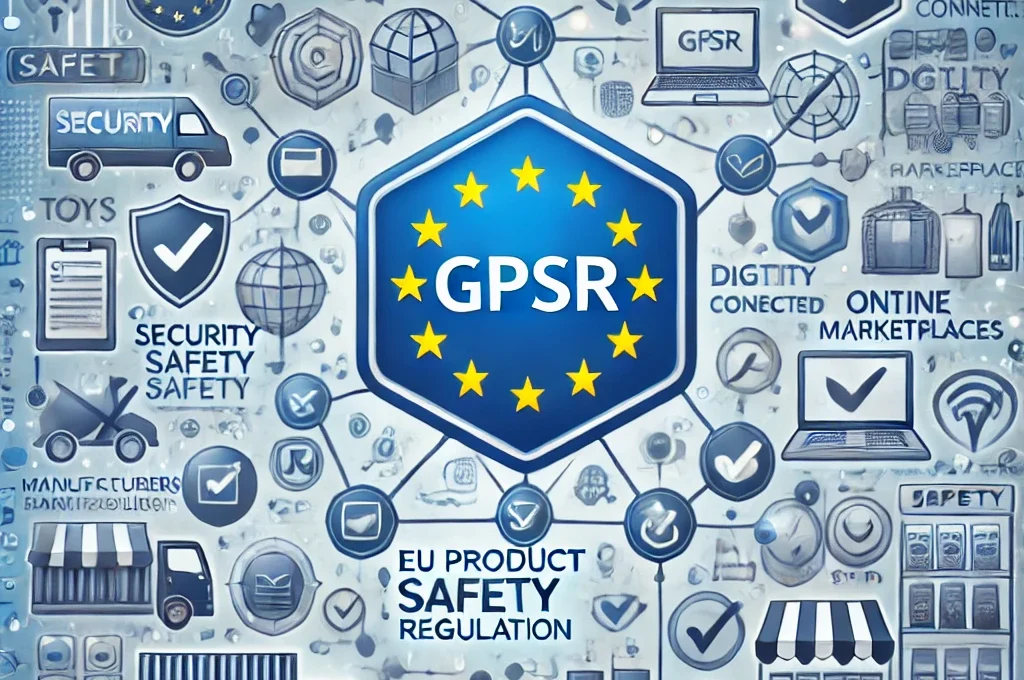
Retailers, manufacturers, and importers are now faced with the challenge of familiarizing themselves with the new regulations. Particular focus is placed on extended information obligations and stricter requirements for risk assessment. With the entry into force on December 13, 2024, companies still have time to make necessary adjustments. The European Union’s Product Safety Regulation, known as the General Product Safety Regulation (GPSR), ushers in a new era in product safety. This regulation brings profound changes and replaces the previously applicable Directive 2001/95/EC. For companies in Germany and throughout the EU, this means adapting their processes and practices.

The EU Product Safety Regulation (GPSR) – A New Chapter in Product Safety
The GPSR aims to create a uniform safety standard for consumer products. It applies to both B2B and B2C businesses and covers products that were not previously subject to specific EU safety requirements. Interestingly, the regulation also applies to already regulated products.
What is the GPSR? Fundamentals of the New Product Safety Regulation
The GPSR regulation represents a milestone in European product safety legislation. It goes beyond previous regulations and creates a comprehensive framework for the safety of consumer products in the EU internal market. The core of the regulation is the endeavor to ensure a high level of protection for consumers.
The Product Safety Regulation 2024 brings new obligations for economic operators. It defines clear responsibilities along the entire supply chain, from manufacturing to sale. A central aspect is the traceability of products, which is now to be significantly improved.
Also new is the expanded scope. The GPSR covers not only physical products but also digital and networked devices. This takes into account the increasing digitalization and the associated security risks. For companies, this means an extension of their due diligence obligations to new product categories.
The EU Product Safety Regulation also relies on increased market surveillance and harsher sanctions for violations. It gives authorities more powers to effectively enforce compliance with the regulations. Companies must therefore intensively deal with the new requirements to ensure compliance.
From Directive to Regulation: The Evolution of EU Product Safety Law
The transition from Directive 2001/95/EC to the GPSR marks a significant turning point in EU product safety law. This step reflects the recognition that a regulation, compared to a directive, has a more direct and uniform effect in all member states. The Product Safety Regulation Germany, for example, does not first have to be transposed into national law but applies directly.
The development towards the GPSR was driven by various factors. On the one hand, experience with the old directive revealed gaps and weaknesses that needed to be closed. On the other hand, new technologies and business models required an adaptation of the legal framework. The GPSR regulation takes these developments into account and creates a contemporary set of rules.
A significant advance of the new regulation lies in its detail and precision. While the old directive often left room for interpretation, the GPSR defines clear requirements and procedures. This is intended to lead to more uniform application in all EU countries and minimize distortions of competition.
Become more visible on Google & Social Media?
In a free strategy consultation for data-driven online marketing, we uncover your untapped potential, review any existing ad accounts if necessary, examine your SEO ranking and visibility, and determine which strategy is appropriate for your budget and which active measures will lead to more inquiries or sales.

✅ More visibility & perception through targeted placement
✅ More visitors > prospects > customers > revenue
✅ Reach target groups scalably with SEA
✅ Act and grow sustainably with SEO
🫵 Maximum success with our hybrid strategy
💪 More than 15 years of experience across industries in over 1,000+ projects demonstrable!







The EU Product Safety Regulation also sets new standards for transparency and consumer information.
It obliges companies to communicate more comprehensively about product risks and safety aspects. This strengthens the position of consumers and promotes trust in the European market.
Tip for always up-to-date information, legal texts, and protection:

Timeline and Entry into Force: When Does the Product Safety Regulation 2024 Apply?
The timeline for the introduction of the GPSR is clearly defined. The Product Safety Regulation 2024 will enter into force on December 13, 2024. This deadline marks the beginning of a new era in European product safety law. From this date, all affected companies must fully implement and comply with the new provisions.
However, the path to entry into force is a process. The EU Commission has already adopted the regulation, and the transition phase is now underway. Companies should use this time to adapt their internal processes and structures. This involves training employees, revising documentation, and, if necessary, introducing new control mechanisms.
For some aspects of the GPSR, different deadlines apply. For example, certain obligations for online marketplaces will come into force earlier. Companies should therefore carefully study the timeline and plan their preparations accordingly. A gradual adjustment can facilitate the transition and avoid overburdening.
The time until the Product Safety Regulation Germany comes into force should also be used for exchange with authorities and industry associations. Many questions regarding practical implementation will only become clear over time. A proactive approach and participation in information events can help companies start the new era well-prepared.
eRecht24's service also provides protection:

Scope of the GPSR: Which Products Are Affected?
The scope of the GPSR is deliberately broad. The regulation generally covers all consumer products, regardless of whether they are intended for the B2B or B2C sector. This represents a significant expansion compared to previous regulations. Products that were previously not subject to specific EU safety regulations will now also be covered by the GPSR.
It is particularly noteworthy that the Product Safety Regulation also applies to already regulated products. It complements existing product-specific regulations and thus creates an additional safety net. Companies must therefore examine to what extent the GPSR affects their products, even if they are already subject to other EU regulations.
The GPSR regulation explicitly includes digital and connected products. This is a response to increasing digitalization and the associated new risks. Software, apps, and other digital goods are therefore covered by the regulation, as are classic physical products. Companies in the tech sector must therefore intensively deal with the new requirements.
Only a few specific product categories, such as food or medical devices, which are already comprehensively regulated by other EU regulations, are excluded from the scope. For the vast majority of consumer products, however, the GPSR will become the new standard for product safety in the EU.

New Requirements of the EU Product Safety Regulation in Detail
Extended Information Obligations for Manufacturers and Retailers
The GPSR introduces significantly extended information obligations. Manufacturers and retailers must now inform consumers more comprehensively about product risks and safe use. This includes detailed instructions for use, warning notices, and information on product lifespan. The information must be easy to understand and clearly visible.
A new aspect is the obligation to provide information on reparability and the availability of spare parts. This promotes product longevity and supports consumers in sustainable use. Manufacturers must also clearly state contact details for consumer inquiries.
The Product Safety Regulation Germany also requires improved traceability. Products must be marked with unique identification features. Manufacturers and importers must provide their contact details on the product or packaging. This facilitates quick recall actions in an emergency.
Special requirements apply to online retailers. They must ensure that all relevant safety information is easily accessible in the online shop. The GPSR places great emphasis on consumers having the same level of information when purchasing online as when purchasing in brick-and-mortar stores.
Risk Assessment and Prevention Measures
The GPSR regulation places increased demands on the risk assessment of products. Manufacturers must now conduct a more comprehensive analysis of potential risks that goes beyond previously common standards. This assessment must consider the entire life cycle of the product, from manufacturing to disposal.
An important aspect is the consideration of new risk categories. The EU Product Safety Regulation explicitly requires the inclusion of cybersecurity risks for connected products. Risks from artificial intelligence or machine learning must also be assessed. This presents many companies with new challenges.
Based on the risk assessment, companies must take appropriate prevention measures. This may include technical adjustments, design changes, or additional safety features. The GPSR emphasizes that safety must be considered already in the development phase of a product.
The Product Safety Regulation 2024 also requires continuous monitoring and updating of the risk assessment. Companies must react to new findings or changed usage patterns and, if necessary, implement additional safety measures. This requires proactive risk management throughout the entire product life cycle.
Traceability of Products in the Supply Chain
The GPSR places great importance on the seamless traceability of products. Every actor in the supply chain must be able to trace the origin and path of a product. This requires the implementation of robust systems for documentation and data management.
Manufacturers must provide their products with unique identification features. This can be done through serial numbers, QR codes, or other technical solutions. The Product Safety Regulation Germany requires that this information is easily accessible and machine-readable. This facilitates quick and targeted recall actions in an emergency.
Traceability also extends to components and raw materials. Companies must be able to prove the origin of all product components. This poses a particular challenge, especially with complex supply chains. The GPSR regulation thus indirectly promotes closer cooperation between the various actors in the supply chain.
A new aspect is the obligation for digital traceability. The EU Product Safety Regulation requires the use of digital technologies to exchange information quickly and efficiently. This may require the introduction of new IT systems or the adaptation of existing processes. Companies should invest in appropriate solutions early on.
Reporting Obligations for Product Safety Issues
The GPSR significantly tightens reporting obligations for product safety issues. Companies must now react more quickly and comprehensively when safety defects become known. The deadline for reporting to the competent authorities has been shortened to enable a rapid response.
An important aspect is the expansion of the scope of reporting. The Product Safety Regulation 2024 requires detailed information not only about the problem itself but also about planned remedial measures. Companies must present a clear action plan on how they intend to ensure the safety of the affected products.
The EU Product Safety Regulation also introduces a uniform European reporting system. This is intended to improve the exchange of information between member states and enable a faster response to cross-border safety problems. Companies must familiarize themselves with this system and adapt their internal processes accordingly.
Also new is the obligation for proactive monitoring. The GPSR requires companies to actively search for potential safety problems. This may include evaluating customer feedback, market observations, or conducting regular safety tests. Companies must be able to demonstrate that they take this monitoring obligation seriously.
Online Marketplaces: New Responsibilities in E-commerce
The Product Safety Regulation Germany brings significant changes for online marketplaces. These are now held more accountable for ensuring the safety of products sold through their platforms. They must implement robust systems to identify and remove unsafe products.
A central aspect is the verification of retailers. Online marketplaces must ensure that sellers on their platform are identifiable and have the necessary permits. This requires the introduction of strict verification processes and may lead to a reduction in the number of third-party providers.
The GPSR regulation also obliges online marketplaces to actively participate in recall actions. They must be able to quickly inform affected customers and immediately stop the sale of recalled products. This requires close cooperation with manufacturers and authorities.
Also new is the obligation to provide a system for consumer complaints. Online marketplaces must create easily accessible mechanisms through which customers can report safety concerns. These reports must be taken seriously and processed promptly.
The GPSR Regulation in the Context of Existing EU Law
The introduction of the GPSR marks a significant development in the EU legal framework for product safety. It complements and strengthens existing regulations, but also creates new obligations. Companies must carefully analyze the interactions between the GPSR and other relevant EU regulations.
An important aspect is the relationship with CE marking. The EU Product Safety Regulation does not change the fundamental principles of CE marking but increases the requirements for the underlying conformity assessment. Companies may need to adapt their CE marking processes to account for the extended safety aspects of the GPSR.
The GPSR is also closely related to the Market Surveillance Regulation (EU) 2019/1020. Both regulations aim to improve the safety of products on the EU internal market. Companies must integrate the requirements of both regulations into their compliance strategies.
For specific product categories already regulated by sectoral EU legislation, the GPSR acts as a supplementary regulation. It fills gaps and creates an overarching safety framework. Companies must examine how the GPSR interacts with the specific regulations applicable to their products.
Impact of the Product Safety Regulation on German Companies
The introduction of the GPSR has far-reaching consequences for companies in Germany. The German Product Safety Regulation requires a comprehensive review and adaptation of existing processes and structures. This affects not only large corporations but also small and medium-sized enterprises.
A central aspect is the need to revise internal compliance systems. Companies must ensure that they can meet the extended requirements of the GPSR. This may require investments in new technologies, employee training, and the adaptation of quality management systems.
The GPSR regulation also brings opportunities for German companies. The increased focus on product safety can be used as a competitive advantage. Companies that implement the new requirements early and comprehensively can position themselves as trustworthy partners in the European market.
The GPSR poses a particular challenge for importers. They must ensure that imported products comply with the new EU requirements. This requires closer cooperation with foreign suppliers and possibly a reorientation of supply chains.
Preparing for the GPSR: Checklist for Companies
To optimally prepare for the introduction of the GPSR, companies should proceed systematically. A structured checklist can help to consider all relevant aspects:
- Analysis of the product portfolio: Check which of your products are affected by the GPSR.
- Gap analysis: Identify gaps between your current practices and the GPSR requirements.
- Adaptation of risk assessment processes: Implement extended methods for assessing product risks.
- Revision of product documentation: Update user manuals, warning notices, and technical documents.
- Employee training: Ensure that all relevant employees are familiar with the new requirements.
The Product Safety Regulation 2024 also requires an adaptation of IT systems. Check whether your existing systems can meet the new requirements for traceability and information exchange. If necessary, invest in new software solutions or databases.
An important point is the review and adaptation of supplier contracts. The EU Product Safety Regulation requires closer cooperation along the entire supply chain. Ensure that your contracts reflect the new requirements for information exchange and risk management.
Finally, companies should develop an emergency plan for potential product safety issues. The GPSR requires quick and effective responses to safety risks. A well-prepared emergency plan can save time and resources in an emergency.
Challenges and Opportunities of the New Product Safety Regulation
The introduction of the GPSR brings both challenges and opportunities for companies. One of the biggest challenges is the complexity of the new requirements. The German Product Safety Regulation requires a deep understanding and careful implementation. This can be a significant burden, especially for smaller companies.
Another critical point is the time pressure. With the entry into force of the GPSR regulation on December 13, 2024, companies have only limited time for implementation. The necessary adjustments can be extensive and may require significant investments in processes, technologies, and personnel training.
On the other hand, the GPSR also offers opportunities. An increased level of safety can strengthen consumer confidence and lead to differentiation in competition. Companies that implement the new requirements early and comprehensively can position themselves as pioneers in product safety.
The EU Product Safety Regulation also promotes innovation in product safety. It creates incentives for the development of new technologies and methods for risk assessment and mitigation. This can lead to safer products and more efficient processes in the long term.
GPSR and Digitalization: New Requirements for Digital Products and Services
The GPSR takes into account increasing digitalization and sets specific requirements for digital products and services. This is a novelty in EU product safety legislation and presents many companies with new challenges.
A central aspect is the consideration of cybersecurity risks. The German Product Safety Regulation requires manufacturers of digital products to identify potential vulnerabilities and implement appropriate protective measures. This includes regular security updates and clear information for consumers about potential risks.
The GPSR regulation also addresses issues of data protection and privacy. Digital products must be designed to protect consumers‘ rights regarding their personal data. This requires close coordination between product development, IT security, and data protection officers.
Special attention is paid to products with artificial intelligence (AI). The EU Product Safety Regulation requires a careful assessment of the risks that can arise from AI systems. Companies must demonstrate that their AI-based products are safe and reliable.
International Implications: The GPSR and Global Trade
The introduction of the GPSR has far-reaching implications for global trade. As one of the strictest product safety regulations worldwide, it sets new standards that are also observed outside the EU.
For companies exporting to the EU, the Product Safety Regulation 2024 represents a significant challenge. They must adapt their products and processes to the new EU standards to maintain access to the European market. This can lead to increased costs and longer development times.
The GPSR could also serve as a model for other countries. It is likely that other regions will introduce similar regulations to protect their markets and strengthen consumer confidence. This could ultimately lead to a global harmonization of product safety standards.
For European companies, the GPSR regulation offers the opportunity to position themselves as global pioneers in product safety. Compliance with strict EU standards can be used as a quality feature to gain competitive advantages in international markets.
Enforcement and Control: How is GPSR compliance ensured?
The effective enforcement of the GPSR is crucial for its success. The EU Product Safety Regulation provides for increased control mechanisms and harsher sanctions for violations.
National market surveillance authorities will be given extended powers. They can carry out unannounced inspections, take product samples and prohibit the sale of unsafe products. The Product Safety Regulation Germany also provides for closer cooperation between the authorities of the various EU member states.
An important instrument is the Safety Gate system (formerly RAPEX). It enables the rapid exchange of information on dangerous products between EU countries. Companies must expect that violations will be detected more quickly and communicated throughout the EU.
The GPSR also introduces a system of graduated sanctions. In the event of serious violations, companies can be subject to significant fines. In particularly serious cases, exclusion from the EU market is even threatened. This underlines the importance of a careful compliance strategy.
Conclusion: The future of product safety in the EU
The introduction of the GPSR marks a turning point in the European product safety landscape. It presents companies with significant challenges, but also offers opportunities for innovation and competitive differentiation.
The Product Safety Regulation 2024 will lead to safer products and increased consumer protection. It promotes a culture of prevention and continuous improvement in companies. In the long term, this could lead to a paradigm shift in product development, where safety is an integral part from the outset.
The GPSR regulation will also drive digitalization and technological innovation. Companies will have to invest in new technologies and processes to meet the extended requirements. This could lead to a surge of innovation in areas such as traceability, risk assessment and consumer information.
For the EU, the EU Product Safety Regulation means strengthening its position as a global standard setter. It underlines the EU’s commitment to consumer protection and sustainable economic practices. In the long term, this could strengthen the competitiveness of European companies on the world market.





 DE
DE