Building an engaged and dynamic online community is an art form that requires both vision and strategic planning. In the digital age in which we live, community software and community management tools provide the necessary infrastructure and tools to make this vision a reality. These technologies enable us to come together across geographic and cultural boundaries, share knowledge, provide support, and build comprehensive networks that enrich both at the individual and collective level. This article is intended to present the possibilities in great detail.
Build a Community: Community Software & Community Management Tool
A Community Software serves as the foundation upon which online communities emerge. It provides the platform for interactions, discussions, and content exchange, enabling members to forge deep connections and pursue shared interests. From forums and social networks to specialized platforms tailored to specific niches or industries, community software varies in functionality and design to meet the diverse needs of communities.
Community Management Tools complement this software by providing community managers and moderators with the tools they need to communicate effectively, engage members, and promote community growth. These tools include features for event management, content moderation, engagement data analysis, and much more, making it possible to maintain a healthy, active, and thriving online community.
The successful building of a community requires, however, more than just selecting the right software and tools. It requires a deep understanding of the people who make up this community, their needs and desires, as well as the goals the community pursues. In this context, the role of the community manager is becoming increasingly important – as a leader, moderator, and supporter who turns the community's vision into reality.

In this guide as a blog article, we will thoroughly explore the topic of community building: from selecting the right community software and management tools to developing strategies for member retention and best practices for growing and nurturing your online community. Our goal is to provide you with the knowledge and tools you need to build a vibrant, engaged, and sustainable community that creates real value beyond the digital realm.
These tools and platforms are designed to support the creation, management, and growth of online communities. They offer a variety of features to promote interaction between members, share content, measure engagement and participation, and improve the overall community experience.
Some of the core features found in community software and management tools include:
- Forums and discussion groups: Enable members to exchange ideas, ask questions, and conduct discussions.
- Member Management: Tools for managing member profiles, registrations, group memberships, and privacy settings.
- Content Management System (CMS): Enables the creation, publication, and management of content such as articles, blogs, and news.
- Event Management: Features for planning and promoting events within the community.
- Analytics and Reporting: Provides insights into member behavior and engagement to inform and optimize community management.
- Integrations: Ability to connect with external platforms and services, such as social media platforms, email marketing tools, and CRM systems.
- Moderation Tools: Support moderators in monitoring content, handling abuse, and maintaining community guidelines.
There are a variety of community software solutions, ranging from open-source platforms to commercial products, including Discourse, vBulletin, phpBB for forums; and more comprehensive platforms such as Mighty Networks, Khoros, or Higher Logic, which offer a broader range of community management features.
The selection of the right community software depends on the specific needs and objectives of your community, including the size of the community, budget, required functionalities, and integration requirements. More information here in the blog article.
Community software refers to digital platforms and tools specifically developed to support the formation, management, and growth of online communities. This software enables users to network, share content, communicate, and participate in discussions, with a focus on promoting interaction and engagement within a defined group or area of interest.

Become more visible on Google & Social Media?
In a free strategy consultation for data-driven online marketing, we uncover your untapped potential, review any existing ad accounts if necessary, examine your SEO ranking and visibility, and determine which strategy is appropriate for your budget and which active measures will lead to more inquiries or sales.

✅ More visibility & perception through targeted placement
✅ More visitors > prospects > customers > revenue
✅ Reach target groups scalably with SEA
✅ Act and grow sustainably with SEO
🫵 Maximum success with our hybrid strategy
💪 More than 15 years of experience across industries in over 1,000+ projects demonstrable!






Reasons for community software
- Promoting interaction: Enables members to communicate effectively, share knowledge, and receive support.
- Strengthen brand loyalty: Helps companies build a closer relationship with their customers, leading to increased customer loyalty.
- Collect feedback and ideas: Provides a platform for user feedback that can be used to improve products or services.
- Reduce Support Costs: An active community can provide peer-to-peer support, which reduces the burden on traditional support channels.
- Centralize Content and Knowledge: Create a central point of contact for information and resources shared by the community.
How to build your community
- Define Goals and Target Audience: Create clear ideas about the community's objectives and target audience.
- Choose the right platform: Decide on community software that meets your requirements.
- Create structures and rules: Establish how the community should be organized and what behavioral rules apply.
- Encourage Content and Discussions: Create and promote content that invites interaction.
- Moderation and Support: Ensure that the community is moderated and members receive the support they need.
- Promote and Measure Growth: Use marketing strategies to acquire new members and deploy analytics to measure engagement.
Difficulties in building
- Generating Engagement: It can be challenging to foster initial and ongoing engagement.
- Moderation: Maintaining a positive and constructive community environment requires constant attention.
- Scaling: As the community grows, challenges such as member and content management can increase.
- Content Quality: Ensuring that shared content is valuable and relevant can be difficult.
Essential Features
- Discussion Forums and Groups: For exchange and discussion among members.
- Member Management: Tools for managing member profiles and settings.
- Content management: For creating and sharing content within the community.
- Search functions: Enable quick finding of information and discussions.
- Analytics and Reporting: To monitor engagement and activity.
- Mobile Accessibility: Ensures that the community is accessible across different devices.
- Security and Data Protection: Protection of member data and ensuring platform security.
Building and maintaining a successful online community requires careful planning, the right tools, and ongoing effort to create and maintain an engaged and active environment.

What is community software & a community management tool?
Community software and community management tools are digital solutions designed to facilitate the formation, management, and engagement within online communities. Although the terms are often used synonymously, they cover different aspects of managing an online community. Here is a detailed look at both:
Community Software
Community software refers to the platforms that serve as the foundation for creating and growing online communities. This software enables users to create profiles, interact with each other, share content, and participate in discussions. Typical examples of community software are forums, social networks, content management systems (CMS), and specialized platforms tailored to specific interest groups or industries. The main objectives of community software are:
- Promoting interaction and engagement among members.
- Provision of a platform for the exchange of knowledge and information.
- Support for members in networking and building relationships.
Community management tools
Community Management Tools are specifically designed to support community managers and moderators in managing and maintaining online communities. These tools include features for content moderation, member management, engagement and activity tracking, as well as analytics and reporting. They can also include tools for event management, surveys and polls, as well as notifications and communication. Community Management Tools aim to:
- To improve the efficiency of community management.
- Ensuring a positive and safe environment for all members.
- Gaining insights into the behavior and preferences of community members to optimize the community experience.
While community software provides the basic platform on which an online community is built and operated, community management tools focus on managing and optimizing these communities. Both are crucial to the success of an online community by providing the technical infrastructure and necessary management functions to create and maintain an engaged and flourishing community environment.

The 10 most popular community software & community management tools
The popularity of community software and community management tools can vary depending on the specific needs of users, the size and type of community, and industry trends. We have compiled a list of modern SaaS community tools above and supplemented it with classic alternatives below.
1. Mighty Networks

Mighty Networks enables you to create a vibrant community around your brand. It offers a platform where you can share content, offer online courses, and manage paid memberships. The ability to create your own apps strengthens brand loyalty and engagement.
- Target Audience: Brands, Creatives
- Features: Personalized feed, topics, articles, direct messages, public/private/paid membership, analytics tools
- Advanced Features:
- Website Builder
- Membership management
- Event Planning
- Mobile apps for iOS and Android
- Personalized feed for members
- Topics, articles, and direct messages
- Price: Free up to $23/month
- Features: Own website builder, online courses, membership pages
- Advantages:
- Versatile platform for various content
- Strong community engagement tools
- Simple monetization options
- Comprehensive analytics tools
- Intuitive User Interface
- Disadvantages:
- Limited customization options in the free plan
- Transaction fees for sales
- Can be overwhelming for beginners
2. coapp

coapp is a German platform specifically developed for coworking spaces, coaches, and small to medium-sized companies. It promotes the exchange and networking of members through a variety of features such as event management and room planning.
- Target audience: Coworking space owners, coaches, consultants, enterprises
- Features: Posts, comments, private messages, group chat, community search, room management, events, payment options
- Advanced Features:
- Complex event management
- Group and private messages
- Profiles, groups, pages and events
- Payment Automation
- Price: From €29/month plus 15% platform fees
- Special Features: German provider, exchange among users with profiles, groups, events, pages
- Advantages:
- Specifically designed for the German market and GDPR-compliant
- Comprehensive event and room management
- Simple member management
- Integrated Payment Solutions
- Modern and clear user interface
- Disadvantages:
- Limited feature set compared to international platforms
- Platform fees in addition to subscription
- Focus primarily on coworking spaces
3. Memberspot

Memberspot offers a platform for coaches and course creators to create a member area with integrated community features. It supports the creation of thematic spaces for discussions and knowledge sharing, with data protection and GDPR compliance at the forefront.
- Target Audience: Coaches, Course Creators, Enterprises
- Features: Thematic Spaces, Post Content, FAQ Sections, Answer Questions, Coordinate Schedules, Introduce Members, Emoji Reactions
- Advanced Features:
- E-Learning Modules
- Interactive spaces for discussions
- Complex Scheduling
- Spaces for Interaction
- DE provider and GDPR-compliant
- Price: From €39/month
- Features: German provider, GDPR-compliant, member area with community features
- Advantages:
- GDPR compliance for the European market
- Strong focus on educational content and e-learning
- Easy to use and set up
- Good integration of community and learning content
- Support for multimedia content
- Disadvantages:
- Limited customization options in design
- Missing integrations with third-party tools
- Primarily oriented towards the German-speaking market
4. Skool.com

Skool is a community platform specifically developed for content creators. It supports the creation of online courses, subscriptions, and fan forums, with a strong focus on interaction and member engagement.
- Target audience: Creators (YouTubers, Instagrammers, TikTokers)
- Features: Personal feed, interaction with followers, online courses, subscriptions, fan forums
- Advanced Features:
- Member Management
- Course and Content Creation
- Interactive forums and groups
- Leaderboards and gamification
- Own Feed
- Unlimited members
- Price: $99/month
- Features: Unlimited members, suitable for online courses and fan forums
- Advantages:
- Specifically developed for creators and influencers
- Unlimited Member Count
- Strong community engagement tools
- Easy monetization of content
- Intuitive user interface and easy operation
- Disadvantages:
- Relatively high price
- Limited integrations with other platforms
- Focus primarily on English-speaking users
Detailed article on a Skull alternative:
Skool.com Alternatives for Community Building & Online Learning as a Platform
5. Heartbeat.chat

Heartbeat.chat is a tool specifically developed for creating online courses, memberships, and exclusive content. It offers community engagement through feeds, groups, and chats and supports member networking through match-up features.
- Target audience: Online courses, memberships, exclusive content
- Features: Feed feature, groups, chats, match-up for internal interaction, affiliate program, reporting & analytics
- Advanced Features:
- Integrations (e.g. Zapier, Zoom)
- Feed Feature, Groups, Chats
- Price: $40/month
- Special Features: Unlimited members, for exclusive content
- Advantages:
- Strong community engagement features
- Unlimited Member Count
- Diverse monetization options
- Comprehensive analytics and reporting tools
- Easy setup and operation
- Disadvantages:
- Limited customization options
- Focus on English-speaking users
- Can be complex for beginners
6. Circle

Circle is a flexible and customizable platform for creating online communities. It is particularly suitable for coaching, newsletters, and online courses. Circle supports the creation of large communities with extensive customization options and integrations.
- Target audience: Educational courses, coaching, products, brands, startups
- Features: Custom domain, integrations (Zapier, Integrately), widgets, direct messaging, moderation tools
- Advanced Features:
- Scalable up to 100,000 members
- iOS App
- Price: $39 to $199/month
- Special features: 1,000 to 100,000 members, demo version available
- Advantages:
- High customizability and branding options
- Scalable up to 100,000 members
- Intuitive operation and versatile applications
- Extensive integrations with other tools
- iOS App available
- Disadvantages:
- Relatively high costs compared to other providers
- Video uploads can be slow
- App currently only available for iOS
7. Bettermode (formerly Tribe)

Bettermode is an enterprise community platform that helps companies of all sizes and industries build engaged communities. It offers extensive customization options and integrations to seamlessly integrate the platform into existing processes.
- Target audience: All industries and enterprises
- Features: Customizable, Spaces, Collections, Tags
- Advanced Features:
- SEO optimization
- Google Analytics Integration
- Member Networking
- GDPR Compliance
- Price: From $599
- Features: Focus on connections between users, versatile use cases
- Advantages:
- High scalability and adaptability
- Supports more than 25 languages
- GDPR/DSGVO-compliant and high security standards
- Free plan available
- Simple international deployment options
- Disadvantages:
- High costs for advanced features
- Limited functionality in the free plan
- Customization mainly limited to colors and graphics
8. Thinkific

Thinkific is a leading platform for creating and selling online courses. It enables individuals and businesses to effectively monetize their knowledge with powerful tools for course development, marketing, and sales.
- Target Audience: Independent consultants, online course creators
- Features: Live sessions, videos, community functions, quizzes, surveys, exams, certificates
- Advanced Features:
- Drag-and-Drop Editor
- Comprehensive course functions (videos, audio, quizzes)
- Landing page creation
- Integration into existing websites
- Live sessions, videos, community features
- Price: From $39
- Features: Unlimited members, suitable for online courses
- Advantages:
- Permanent free access possible
- Unlimited courses and students in the paid plan
- High flexibility and extensibility through apps
- Easy creation and marketing of online courses
- Disadvantages:
- Marketing and selling the courses is the responsibility of the user
- No proprietary email marketing tool
- Support mainly via email
9. Webex Events (formerly Socio Events)

Webex Events is a comprehensive solution from Cisco for virtual events and webinars. It enables companies to interact with their target audience through high-quality video and audio communication, with the platform offering numerous tools for engagement and feedback.
- Target audience: Freelancers, small to large enterprises
- Features: Communication tools, simultaneous translation into 100 languages, surveys, anonymous questions, automatic transcriptions
- Advanced Features:
- Audio optimization and background noise suppression
- Price: Upon Request
- Features: Focus on events and meetings, high security standards
- Advantages:
- Broad target audience from freelancers to large enterprises
- High security standards
- Diverse communication options
- Limited but free plan available
- Disadvantages:
- Partially outdated user interface
- Audio quality issues may occur
- Moderators require their own license
10. Higher Logic

Higher Logic offers a comprehensive platform for community management and engagement. It is aimed at medium-sized and large companies as well as associations that want to strengthen customer loyalty through direct communication and community interactions.
- Target Audience: Medium-sized and large enterprises, associations
- Features: Email campaigns, custom customer tools, A/B testing, user, role and access management
- Advantages:
- Strong customer loyalty through direct communication
- Simple implementation of A/B testing
- High customizability for branding
- User-friendly and beginner-friendly
- Disadvantages:
- Complex onboarding for some features
- Not multilingual
- Contains some bugs (but they are fixed quickly)
11. Hivebrite

Hivebrite is a versatile community management platform specifically developed for alumni networks, educational institutions, and non-profit organizations. It enables the development of complex networks with extensive interaction possibilities.
- Target audience: Alumni networks, educational institutions, non-profit organizations
- Features: Network building similar to Facebook, profiles, videos, messages, images, job offers
- Advantages: Customizable, community app, easy to use and maintain
- Disadvantages: No pricing information available, limited customization options
- Advantages:
- Developed specifically for alumni networks
- Easy to use and maintain
- Comprehensive analytics tools
- Job offers can be posted and shared
- Disadvantages:
- No transparent pricing information
- Limited customization options
- Media Center with limited functionality
This summary provides a comprehensive overview of the various community software options available on the market, taking into account different target audiences and requirements. Each software offers unique features and pricing models that enable organizations to select the platform best suited to their specific needs.
For all WordPress enthusiasts:
Online Learning Platform with WordPress for Education (Education, eLearning & Online Courses)
Popular community software (classic!)
- Discourse: A modern forum software known for its comprehensive discussion and moderation features.
- vBulletin: A widely used forum software with extensive customization options and a strong support community.
- phpBB: A free and open-source forum software appreciated for its flexibility and extensibility.
- XenForo: Offers an intuitive user interface and strong community engagement tools.
- Mighty Networks: Enables the creation of community-driven networks with a variety of engagement tools.
- Invision Community (formerly known as IPS Community Suite): A comprehensive suite for forums, e-commerce, and more, with strong customization and management features.
- Khoros (formerly Lithium): Offers advanced solutions for larger enterprises to manage customer communities and social support.
- Higher Logic: Specializes in community platforms for associations, non-profits, and enterprises.
- BuddyPress: A free, open-source software integrated into WordPress that enables the creation of a social networking platform.
- Telligent (Verint Community): Offers advanced community features and analytics tools for enterprises.
Popular community management tools (classic and hybrid)
- Hootsuite: Popular for managing social media accounts and interacting with community members across various platforms.
- Sprout Social: Offers detailed analytics and management tools specifically for social media.
- Buffer: Another tool for managing social media posts and analytics, with a focus on planning and publishing content.
- Zapier: Enables automation of workflows between different apps and services, including community management tasks.
- Asana: Often used for project management and organizing community-related projects and campaigns.
- Trello: A visual tool for project management, frequently used for planning and coordinating community events and content.
- Slack: While primarily known as a communication tool for teams, many communities use Slack for internal exchange and organization.
- Discord: Originally developed for gamers, it is increasingly used by various types of communities as their primary communication platform.
- Mailchimp: Popular for email marketing and communicating with community members through newsletters.
- Google Analytics: Used to track and analyze engagement and interaction on community websites.
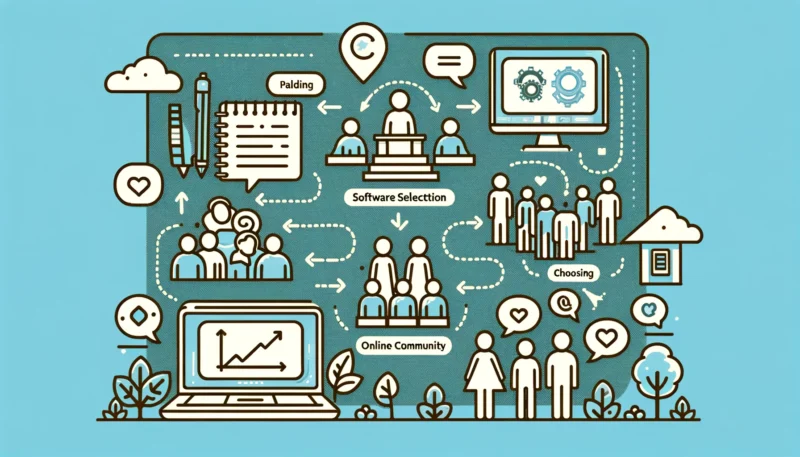
How can one build a community?
Advance notice: The new trend since 2023 for 2024 and the future is: CAAS Community as a Service (with added value to added value)
Planning and implementing the development of an online community requires strategic thinking, patience, and commitment. Here are key steps and best practices that can help you build a successful and engaged community:
1. Define your purpose and target audience
- Purpose: Determine why you are founding the community and what you want to achieve with it. A clear purpose will help you attract the right members and unite the community around shared goals.
- Target Audience: Understand who your potential members are. Consider what interests them, what needs they have, and how your community can provide value to them.
2. Choose the right platform
- Based on the needs and preferences of your target audience, choose a platform that best supports them. Consider factors such as user-friendliness, range of features, and customization options.
3. Develop clear guidelines and structures
- Guidelines: Create clear rules of conduct and community guidelines to foster a positive and welcoming atmosphere.
- Structure: Develop an intuitive structure for the discussions and content of your community. Categories and tags can help keep information accessible and organized.
4. Promote engagement and interaction
- Content: Share valuable and relevant content regularly to spark discussions and encourage members to participate.
- Activities: Organize events, competitions, or Q&A sessions to motivate members to participate actively.
5. Moderate actively
- Effective moderation is essential to minimize conflicts and maintain a positive environment. Respond proactively to feedback and be a role model for constructive communication.
6. Build Relationships
- Foster personal relationships and networks within your community. Recognize and reward active members for their contributions to create a sense of belonging and appreciation.
7. Use data and feedback
- Use analytics to understand member engagement and behavior. Collect feedback regularly to continuously improve the community experience.
8. Promote growth
- Use social media, content marketing, and partnerships to acquire new members. Remember that quality is often more important than quantity – focus on members who are truly interested in the value your community offers.
9. Be patient and persistent
- Building an engaged community takes time. Stay true to your purpose, be actively involved, and adjust your strategy as needed.
The key to success lies in the combination of a strong, dedicated foundation, engaged leadership, active moderation, and the ability to adapt to the needs and feedback of community members. With time and dedication, you can build a vibrant and supportive online community.

Florian Ibe
CEO & Marketing Consultant
Your contact person: Florian Ibe

What makes a good online community?
A good online community is characterized by several key features that together create a supportive, engaged, and sustainable environment. Here are the most important factors that make a good online community:
1. Clear objectives and values
- Purpose-driven: A strong community is built on a clear purpose or goal that unites members and gives them a common direction.
- Shared Values: The best communities have a core set of values that guide behavior and interactions within the group.
2. Engaged members
- Active participation: Members participate regularly through posts, discussions, and other forms of interaction.
- Diversity: A good community includes members from different backgrounds and with different perspectives, which enriches discussions.
3. Effective communication and moderation
- Open and respectful communication: An environment where members can express themselves freely while maintaining respect and kindness.
- Effective Moderation: Moderators play a crucial role in maintaining order and a positive atmosphere by enforcing guidelines and resolving conflicts.
4. Valuable content and resources
- Informative and Relevant Content: Providing valuable information, resources, and learning opportunities attracts members and keeps them engaged.
- Member contributions: A good community encourages members to share their knowledge and experiences, which increases the collective value of the community.
5. Strong Leadership and Vision
- Committed Leadership: Community leaders or administrators who are dedicated to advancing the community's vision and being there for its members.
- Strategic Development: A vision for the growth and development of the community, including plans to promote engagement and expand the membership base.
6. Supportive and positive environment
- Support and Empathy: An environment where members support each other, provide advice, and build positive relationships.
- Security and Trust: Measures to protect member privacy and ensure their safety contribute to a trustworthy environment.
7. Adaptability and innovation
- Open to feedback: The best communities listen to the feedback of their members and adapt to their needs.
- Innovative: Introduction of new technologies, features, or activities to keep the community fresh and engaged.
A good online community not only provides a platform for exchange and networking, but also becomes a place where members feel valued, heard, and supported. Through the combination of these elements, dynamic and flourishing online communities emerge that create genuine value for their members.
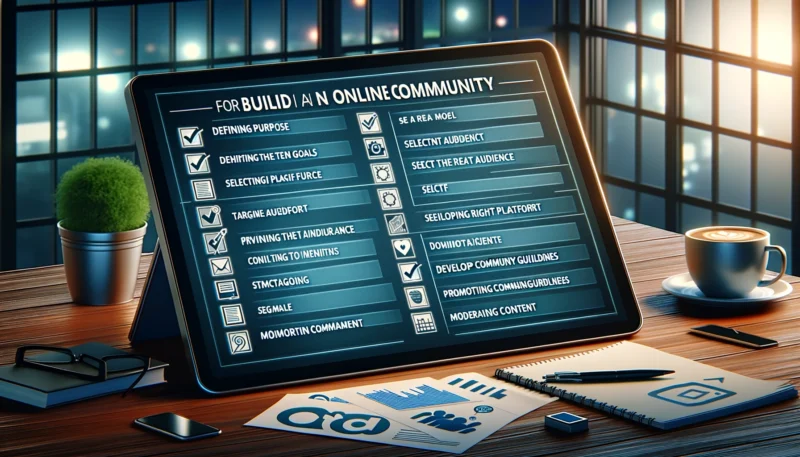
A well-thought-out checklist can be crucial both for structuring the community building process and for selecting the right software that meets your needs. Here is a detailed checklist that covers both aspects:
Community building checklist
- Define purpose and objectives
- ✅ Determine the primary purpose of your community.
- ✅ Set specific, measurable goals for community development.
- Identify target audience
- ✅ Define who your target audience is.
- ✅ Understand the needs and interests of your target audience.
- Develop community guidelines
- ✅ Create code of conduct and moderation guidelines.
- ✅ Define how conflicts and issues are handled.
- Select platform and software
- ✅ Research available community platforms and management tools.
- ✅ Compare features, prices, and customization options.
- Plan structure and navigation
- ✅ Develop a clear and intuitive structure for your community.
- ✅ Plan how content is organized and categorized.
- Engagement and content strategy
- ✅ Design a strategy for regular and engaging content.
- ✅ Consider how you can encourage members to participate actively.
- Promotion and Growth
- ✅ Develop a plan to promote your community and attract new members.
- ✅ Use social media, email marketing, and other channels for promotion.
- Monitoring and adjustment
- ✅ Implement tools for tracking and analyzing engagement.
- ✅ Schedule regular reviews to assess progress and make adjustments.
Checklist for selecting the right software
- Functionality and features
- ✅ Verify that the platform offers the features necessary for building and managing your community.
- ✅ Ensure that the software is scalable and can grow with your community.
- User-Friendliness
- ✅ Rate the user-friendliness for yourself and the community members.
- ✅ Check whether there is support and resources available for users.
- Adaptability
- ✅ Check to what extent the platform can be customized to your design and functionality requirements.
- ✅ Investigate whether there are integrations with other tools and services.
- Security and data protection
- ✅ Review the security features and privacy policies of the platform.
- ✅ Ensure that the software complies with legal requirements.
- Cost
- ✅ Compare the pricing models and consider your budget.
- ✅ Pay attention to hidden costs such as additional features or support.
- Support and Community
- ✅ Check what type of customer support is offered (e.g. live chat, email, phone).
- ✅ Research whether there is an active user community or forums for support and exchange.
- Reviews and references
- ✅ Read reviews and case studies to gain insights into the experiences of other community managers.
- ✅ Consider using a demo or trial version to test the platform.
This checklist is intended to serve as a guide to help you approach the development of your community strategically and choose a software solution that supports your goals and promotes the growth and engagement of your community.




 DE
DE