Your positive customer reviews are scattered across Google, Trustpilot, Facebook, and other platforms – potential buyers only see fragments of them. While you painstakingly collect social proof, its impact dissipates because prospects never find your best reviews. A central review page on your website solves this problem and brings several advantages: better rankings through user-generated content, higher conversion rates through bundled trust, and optimal utilization for AI search engines. Learn how to properly bundle reviews, integrate them correctly from a technical perspective, and optimize them for maximum impact.
Bundling Customer Reviews – How a Central Review Page Boosts SEO and Conversions
Before making a purchase decision, prospects conduct thorough research. They look for testimonials, read reviews, and check the credibility of a provider. This information is scattered across various platforms – from Google reviews to specialized portals and social networks.
A central review page on your website brings all these voices together. Instead of sending potential customers on a time-consuming search, you offer them a transparent overview in one place. At the same time, you benefit from measurable advantages for your visibility in search engines and paid ads.
Bundling customer reviews is more than just a service. It builds trust, facilitates purchasing decisions, and strengthens your position against competitors. Additionally, these pages gain relevance due to the increasing importance of AI-powered search systems. Large language models use structured information to make recommendations – a well-prepared review page increases your chances of being mentioned in these results.
What does "bundling customer reviews" mean?
Bundling customer reviews means bringing together reviews and testimonials from various external platforms on a dedicated subpage. This central hub displays reviews from different sources in a clear format. This is not a copy, but a structured presentation with links to the original sources.
The idea behind it is simple: your customers are already reviewing you on various portals. Some leave their opinion on Google, others use specialized review platforms or social networks. However, this valuable feedback often goes unnoticed because it is scattered across the internet. A review page collects these voices and makes them directly accessible to visitors to your website.
Technically, this can be implemented in several ways. Many review platforms offer official widgets or interfaces that enable automatic integration. Alternatively, selected quotes can be manually entered and provided with source references. Authenticity is important: every review should be traceable and verifiable. This creates a trustworthy overview that is valuable for both human visitors and search engines.
Which review platforms are there?
In German-speaking countries, there is a multitude of review portals that differ in their orientation and target group. The selection of the right platforms strongly depends on your industry:
Universal review portals collect opinions from almost all industries. They are suitable for online shops, service providers, and local businesses alike. These platforms often offer seals and certifications that create additional trust.
Industry-specific portals focus on specific areas. Medical professions use specialized health portals, while hotels and restaurants rely on tourism-oriented platforms. Employers benefit from review portals that focus on corporate culture and working conditions.
Become more visible on Google & Social Media?
In a free strategy consultation for data-driven online marketing, we uncover your untapped potential, review any existing ad accounts if necessary, examine your SEO ranking and visibility, and determine which strategy is appropriate for your budget and which active measures will lead to more inquiries or sales.

✅ More visibility & perception through targeted placement
✅ More visitors > prospects > customers > revenue
✅ Reach target groups scalably with SEA
✅ Act and grow sustainably with SEO
🫵 Maximum success with our hybrid strategy
💪 More than 15 years of experience across industries in over 1,000+ projects demonstrable!






Aggregators do not collect their own reviews but bundle existing reviews from various sources. They offer an overall overview and can increase credibility by comparing opinions from multiple portals.
Also social media profiles play an important role, as many companies use review functions there. For your central review page, you should select the three to five most relevant portals in your industry and display them transparently.
Advantages of a Central Review Page for Your Customers
Transparency builds trust – this principle applies especially to online retail and services. Customers want to get a comprehensive picture before making a decision. A central review page offers several specific advantages:
- Time-saving: All relevant opinions in one place, without extensive research
- Credibility: Multiple independent sources appear more authentic than single reviews
- Comparability: Different perspectives enable a well-founded assessment
The multi-source principle plays a decisive role here. Reviews from only one platform often appear one-sided. However, if you show reviews from various sources, credibility increases significantly. Prospects recognize that you have nothing to hide and present authentic feedback.
Convenience is another factor that should not be underestimated. Nobody wants to visit five different websites to get an overall picture. At the same time, you benefit from the social proof effect: people are guided by the experiences of others. Positive reviews in a bundled form reinforce this effect and can measurably increase the conversion rate.
SEO Advantages of a Review Subpage
Keyword Potential through Customer Testimonials
Customer reviews use natural, unfiltered language that differs significantly from marketing texts. People describe their experiences in their own words – exactly how other users search for information on search engines. Phrases like „fast processing“ or „competent support“ correspond to real search queries and organically expand your keyword spectrum.
These authentic formulations automatically generate long-tail keywords that are specifically searched for. Search queries that combine your brand name with terms are particularly valuable:
- „[Brand name] experiences“
- „[Brand name] reviews“
- „Is [Brand name] reputable?“
Users who enter such terms are already in an advanced stage of their purchasing decision. A well-positioned review page captures these queries and delivers the desired information directly. Additionally, regularly new reviews ensure fresh content. Search engines prefer websites that are continuously updated. Your review page grows with every new review and signals freshness.
Rich Snippets and Star Ratings
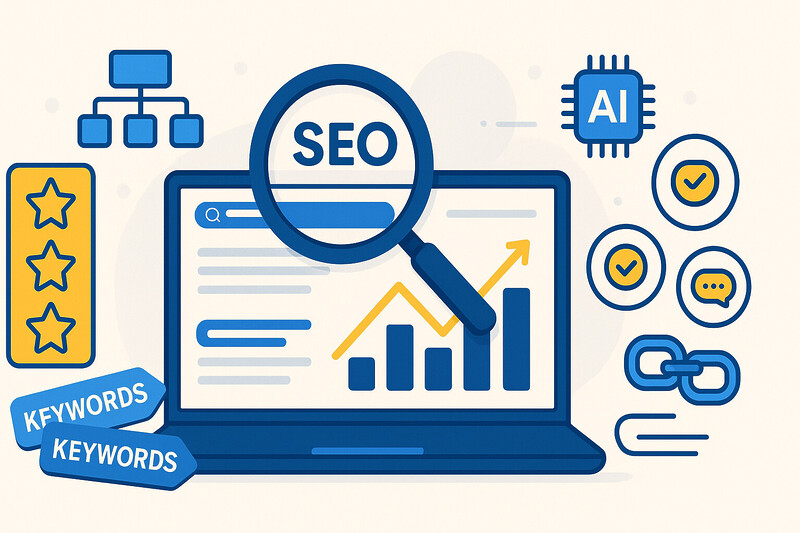
Search results with star ratings immediately catch the eye. These enhanced snippets – also known as rich snippets – stand out from ordinary text entries and attract significantly more attention. Studies show that results with stars achieve a higher click-through rate, even if they are not in position one.
The technical implementation is done via structured data according to Schema.org:
| Schema type | Purpose | Advantage |
|---|---|---|
| AggregateRating | Display overall rating | Star rating in SERPs |
| Review | Individual customer opinions | Detailed reviews |
| Organization | Company information | Linking with reviews |
Correct implementation is important: reviews must actually be visible on the page and must not merely be stored technically. Search engines check this and penalize manipulative practices. However, when used properly, you benefit from significantly more clicks from organic search results.
Regular content growth
Websites that are rarely updated lose relevance. Search engines interpret a lack of updates as a signal that a page may no longer be maintained. A review page solves this problem elegantly: with every new customer review, fresh content is created automatically, without you having to do anything yourself.
This continuous growth has several positive effects. First, you signal activity and vitality. Second, with each review your semantic profile expands — new terms, phrasings, and thematic aspects are added. Third, a natural incentive arises for search engines to crawl your page more frequently.
The authenticity of this content is particularly valuable. While blog posts or product descriptions obviously come from the company itself, customer reviews are independent opinions. Search engines weight such user-generated content positively, as it offers genuine added value for searchers. Your review page thereby becomes a continuously growing resource that generates more and more organic traffic in the long term.
Importance for search engine advertising (SEA)
Paid ads benefit considerably from reviews. If your company has enough positive reviews, star ratings can appear directly in the ads. These so-called seller ratings are displayed automatically once certain thresholds are reached. The visual highlighting through stars makes your ad more attractive and increases the likelihood that users will click on it.
The effects on campaign performance are measurable:
- Higher click-through rate (CTR) through visual highlighting with stars
- Better quality score through increased user interaction
- Lower cost per click as a result of the improved quality score
- More trust among new target groups
Reviews play an important role, especially in campaigns that address new target groups. Users who do not yet know your company look for trust signals. Star ratings in the ad provide this confirmation immediately and lower the barrier to a click. The combination of a better click-through rate, lower costs, and higher conversion makes reviews an indispensable element of successful SEA strategies.
Relevance for AI search systems and large language models
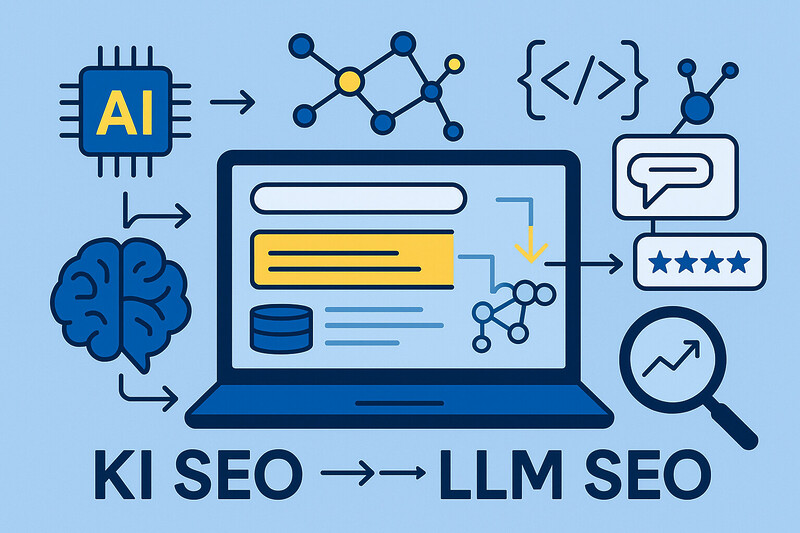
Artificial intelligence is changing the way people search for information. Instead of entering individual keywords, users increasingly ask AI systems complex questions. These language models search the internet for relevant information and summarize it in their answers. In doing so, they prefer sources that are structured, authentic, and informative.
A central review page fulfills precisely these criteria. It offers bundled, verifiable information in one place. For AI systems, it is a valuable source for assessing a company’s reputation. If a user asks, for example, about a provider’s reliability, the language model can draw on your review page and include concrete customer opinions in its answer.
The linguistic diversity of genuine customer voices also helps AI systems. They learn how people talk about your company and which aspects are particularly highlighted. The more authentic content is available, the more precisely these systems can make recommendations. In the long term, visibility in AI-generated responses will be just as important as classic search engine rankings. Companies that now build structured review pages will gain an advantage for this development.
Best Practices for Implementation
Technical Foundations
The URL structure of your review page should be simple and self-explanatory. Short paths such as „/reviews“ or „/experiences“ are user-friendly and are well-indexed by search engines. Avoid complicated subfolders or cryptic parameters – clarity is crucial here.
Structured data forms the technical backbone of your review page. The Schema.org vocabulary offers standardized formats for review information:
- AggregateRating: Summarizes your overall rating (average, count)
- Review: Identifies individual customer opinions with author and date
- Organization: Links reviews to your company profile
Each review should contain information about the source, author, and review date. These metadata help search engines interpret the information correctly and implement it in rich snippets. When integrating reviews, you have several options: official platform widgets, API connections for automatic updates, or manual integration of selected quotes. It is important that the original reviews are linked so that interested parties can verify the source.
Design Recommendations
A clear design makes it easier for visitors to quickly orient themselves. Structure your review page by platforms or categories so that users can specifically search for certain information. Star ratings and logos of the review portals should be prominently placed – they immediately create visual orientation and trust.
Authenticity is paramount. Show genuine customer voices with names and dates, provided the reviewers have agreed. Both positive and negative reviews should be included – an exclusively perfect presentation appears incredible. Users expect a realistic picture and appreciate honesty more than embellished representations.
Design Elements for Maximum Impact:
- Highlight boxes for particularly impactful quotes
- Tile design for uniform, clear arrangement
- Sliders for space-saving display of many reviews
- Mobile optimization for seamless use on all devices
Each element should serve a clear purpose. Pay attention to readability and avoid clutter. Mobile users make up a large proportion of visitors – your review page must function flawlessly on all devices.
Ensure Timeliness
Reviews lose value if they are outdated. Visitors want to see current opinions that reflect the present performance of your company. Therefore, it is important to update your review page regularly. Automatic API integrations are the most elegant solution here: new reviews are automatically retrieved and displayed on your page without you having to intervene manually.
If automatic integration is not possible or too complex, establish a fixed rhythm for manual updates. Monthly updates ensure that the page does not stagnate. Document which platforms you last checked and when. This way, you keep track and avoid neglecting individual sources.
Also, pay attention to the consistency of the presentation. New reviews should follow the same format as existing ones. If you manually enter reviews, use templates or checklists to avoid errors. The investment in a well-maintained review page pays off in the long run – both for the user experience and for your SEO performance.
Conclusion
A central review page combines several strategic advantages in a single element of your website. For visitors, it creates transparency and facilitates purchasing decisions through bundled, authentic customer opinions. Instead of spending time searching for information, potential customers find all relevant reviews clearly organized in one place.
From an SEO perspective, the page continuously delivers fresh content with natural keywords. Rich snippets with star ratings increase your visibility in search results and lead to measurable improvements in click-through rates. At the same time, you unlock rankings for search queries directly related to your brand and trustworthiness. In paid search engine advertising, review stars improve both the performance and cost structure of your campaigns.
The increasing importance of AI-powered search systems further future-proofs structured review pages. Language models use such sources to make recommendations and answer questions. Companies that now invest in a professional review page position themselves optimally for this development and secure competitive advantages in a changing digital environment.
Frequently Asked Questions about the Review Page
Should negative reviews also be displayed?
Yes, negative reviews are part of an authentic representation. Perfect average ratings seem unrealistic and arouse mistrust. Users expect an honest picture and appreciate it when companies deal openly with criticism. Often, responses to negative reviews even show more about service quality than exclusively positive opinions. Constructive handling of criticism can strengthen rather than weaken your credibility.
How often should the page be updated?
The update frequency depends on the number of incoming reviews. With a high density of reviews, automatic integration via APIs is recommended. For smaller companies, monthly manual updates are sufficient. It is crucial that the page does not give the impression of being neglected. Timeliness signals commitment and professionalism.
Which platforms are relevant for my industry?
This depends on your target audience. Universal review portals are suitable across industries, while specialized platforms may be more important for niche industries. Medical professions, gastronomy, or hospitality each have their own established portals. Analyze where your competitors are reviewed and where your customers are active. These platforms should have priority on your review page.
How complex is the technical implementation?
The effort varies depending on the chosen solution. Simple widget integrations can be done in a few minutes. Individual designs with API connections require more development work. The implementation of structured data requires technical understanding, but is well feasible with appropriate instructions. Many content management systems offer plugins that simplify the process. In the long term, the investment pays off through the described advantages.




 DE
DE