Conversion Rate Optimization (CRO) is a process to improve the effectiveness of a website or online shop by increasing the number of visitors who perform a desired action. These actions can vary depending on the website, e.g., completing a purchase (sale),filling out a form (lead), or signing up for a newsletter, etc..
Conversion Rate Optimization (CRO) for websites or online shops for more inquiries and sales – Increase frequency
Conversion Rate Optimization (CRO) for a website or an online shop, with the goal of generating more inquiries and sales, requires a targeted strategy tailored to the needs and behavior of your target audience.
Fundamental Steps & Strategies for CRO to optimize, increase, and improve the conversion rate
1. User Analysis and Target Audience Understanding
- Analyze demographic data: Use tools like Google Analytics to learn more about your visitors. Understand which visitor segments convert the most and tailor your offers specifically to these groups.
- Behavioral analysis: Observe how users navigate your site, which pages they visit, and where they drop off. Tools like Hotjar or Crazy Egg can help you with this.
2. Optimizing User Experience (UX)
- Intuitive Navigation: Ensure that your website is easy to navigate. Users should be able to find the desired information or products with just a few clicks.
- Responsive Design: Your website must function well on all devices, especially on mobile devices, as many users shop via smartphones.
- Fast Loading Times: Optimize your website's loading time. Long loading times often lead to a higher bounce rate.
3. Optimizing Landing Pages
- Clear Call-to-Action (CTA): Every landing page should have a clear and visible CTA. Avoid distractions and focus on the main action you want the user to take.
- Incorporate Trust Signals: Display customer reviews, certificates, or guarantees to strengthen user trust.
- Engaging Headlines: The headline is the first thing visitors see. It should clearly communicate the benefit and value proposition of the product or service.
4. Optimizing the Purchase Process (Checkout)
- Simplify the checkout process: Reduce the number of steps in the checkout process. Offer guest checkout to lower the barrier for first-time customers.
- Transparent cost structure: Make all costs (shipping, taxes, etc.) visible early in the process to avoid surprises and abandoned purchases.
- Multiple payment options: Offer various payment methods to facilitate the purchase.
Especially with Shopify and WooCommerce, as the leading shop systems, there are very good and simple ways to increase the sales rate:
5. Content Optimization
- Improve product descriptions: Use precise and appealing product descriptions that clearly highlight the benefits and advantages for the customer.
- High-quality images and videos: Use visual content that best presents the product or service. 360-degree views or videos can significantly increase the conversion rate.
- SEO optimization: Improve the visibility of your products through targeted search engine optimization to bring more qualified traffic to your site.
6. Personalization and Segmentation
- Personalized Offers: Use the collected data to create personalized recommendations and offers. For example, you could offer special discounts to repeat buyers.
- Segmented Email Campaigns: Segment your email list by interests and behavior to send targeted and relevant messages that increase the likelihood of conversion.
7. Testing and Continuous Optimization
- Conduct A/B Tests: Test different versions of your website elements (CTA, layouts, texts) and analyze which variant performs best.
- Gather User Feedback: Directly ask users about their experience on your site and use the feedback for further optimization.
8. Trust-Building Measures
- Improve Customer Support: Offer easily accessible customer support, e.g., via live chat, to immediately address user questions or concerns.
- Money-Back Guarantee: A money-back guarantee can strengthen user trust and facilitate the purchase decision.
9. Retargeting and Remarketing
- Remarketing Campaigns: Use Google Ads and social media to display targeted ads to users who have visited your site but have not completed a conversion.
- Email Reminders: Send targeted emails to users who have abandoned the purchase process to bring them back to your site.
10. Analytics Tools and Success Measurement
- Conversion Tracking: Use conversion tracking to accurately measure which actions are successful and which need further optimization.
- Monitor KPIs: Continuously monitor key KPIs such as conversion rate, bounce rate, and average order value to evaluate the success of your optimization measures.
11. Offers and Incentives
- Exclusive Discounts: Offer time-limited discounts or special offers to increase urgency and encourage users to make a faster purchase decision.
- Free Shipping: Free shipping is a strong incentive that can increase the conversion rate. If possible, offer free shipping above a certain order value.
Conversion rate optimization requires patience and a systematic approach.
With the right tools and a data-driven strategy, you can significantly increase the effectiveness of your website.

Conversion Rate Increase through A/B Testing
A/B testing is an extremely effective method for increasing the conversion rate in an online shop or on a website. The process begins with identifying the elements to be tested. These elements should be those that can have the greatest impact on the conversion rate, such as Call-to-Action (CTA) buttons, headlines, images, forms, product descriptions, or the checkout or inquiry process. A thorough analysis of the current status using tools like Google Analytics or heatmaps helps to understand exactly which areas of the website need optimization, especially where users drop off or hesitate.
Become more visible on Google & Social Media?
In a free strategy consultation for data-driven online marketing, we uncover your untapped potential, review any existing ad accounts if necessary, examine your SEO ranking and visibility, and determine which strategy is appropriate for your budget and which active measures will lead to more inquiries or sales.

✅ More visibility & perception through targeted placement
✅ More visitors > prospects > customers > revenue
✅ Reach target groups scalably with SEA
✅ Act and grow sustainably with SEO
🫵 Maximum success with our hybrid strategy
💪 More than 15 years of experience across industries in over 1,000+ projects demonstrable!






After identifying these test objects, hypothesis formation takes place. Based on the analysis performed, assumptions are made about which changes could lead to an improvement in the conversion rate. For example, a hypothesis could be that changing the color of the CTA button increases the click-through rate. These hypotheses are prioritized to start with the tests that are expected to have the greatest impact.
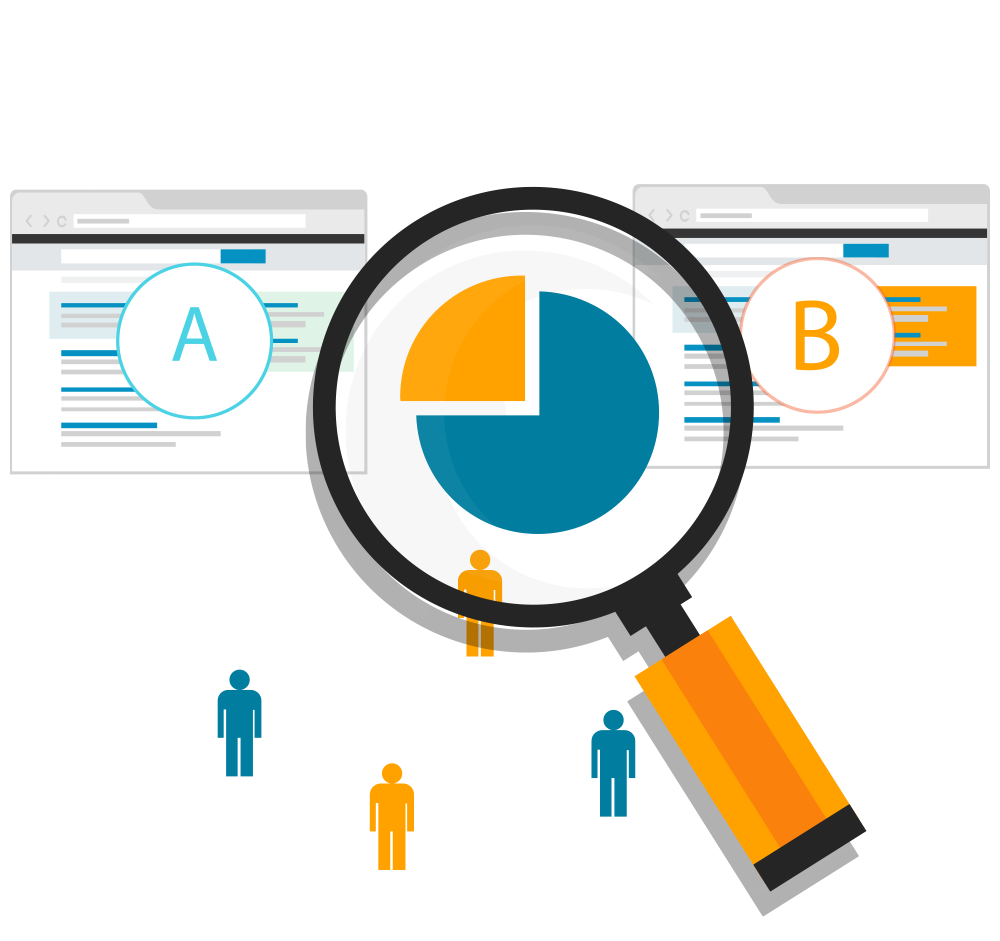
In the next step, the test variants are created. An original version (Version A) is compared with a modified version (Version B) that tests the hypothesis. It is important that only one element is changed per test to accurately measure the effects of this specific change. For more complex tests that examine multiple changes simultaneously, multivariate testing is used.

Florian Ibe
CEO & Marketing Consultant
Your contact person: Florian Ibe
Once the variants are created, the actual testing process begins. A detailed test plan specifies how long the test should run and how many visitors each version should see. It is crucial that the test runs long enough to achieve statistically significant results, which is particularly important with lower traffic. During the test, website traffic is evenly distributed between versions A and B to allow for direct comparisons.
After the test is completed, the results are analyzed. The collected data on the conversion rate of each version is evaluated, and it is checked whether the differences are significant. If one variant clearly performs better, this change is implemented on the website. But the process does not end here – A/B testing should be carried out continuously to constantly optimize further elements of the website and thus increase the conversion rate in the long term.
Typical A/B tests include changes to CTA buttons (e.g., color, text, size, placement),adjusting form length to reduce abandonment rates, testing different headlines or layouts on landing pages, and optimizing product images or pricing. For successful A/B testing, it is crucial that the tests are based on a sufficient sample size so that the results are statistically significant. In addition, only individual variables should always be tested to clearly understand which change made the difference. Patience is also important, as tests should run long enough to compensate for seasonal or weekly fluctuations in user behavior.
Summary of A/B Testing:
- Targeted Optimization: A/B testing allows for targeted optimization of individual website elements that have the greatest impact on the conversion rate.
- Hypothesis Generation: Successful A/B testing is based on clear hypotheses derived from thorough analyses and systematically tested.
- Continuous Process: A/B testing is not a one-time project but should be conducted continuously to improve the conversion rate in the long term.
- Statistical Significance: To achieve valid results, tests must be based on a sufficiently large sample size and run long enough.
- Step-by-Step Optimization: Changes should be made gradually, by varying only one variable per test, to clearly interpret the results.

What is a good conversion rate?
A „good“ conversion rate for an online shop can vary depending on the industry, product category, and target market. However, there are some general benchmarks and considerations that can help you classify your own conversion rate:
Average Conversion Rates
- Industry Average: The average conversion rate for online shops is often between 2% and 3%. This means that out of 100 visitors, approximately 2 to 3 actually make a purchase.
- Best-in-Class: Top performers among online shops often achieve conversion rates of 5% to 10% or higher. These shops continuously optimize their user experience, offer excellent customer services, and often have a very targeted approach to their audience.
- Niche Markets: In niche markets or for specialized products, conversion rates can be higher because the target audience is very specific and highly interested.
Factors Influencing the Conversion Rate
- Product type / service offering:
- High-priced products or those associated with a significant investment decision (e.g., furniture, electronics) often have lower conversion rates.
- Impulse purchases or low-priced products (e.g., fashion, accessories) tend to have higher conversion rates.
- Services with seasonal or temporary aspects
- Benefits of product & service
- Traffic quality:
- Targeted traffic, such as that generated by specific marketing campaigns, SEO, or remarketing, generally has a higher conversion rate than more general visitor streams.
- Website Usability:
- A user-friendly, well-navigable, and mobile-optimized website increases the likelihood that visitors will become buyers.
- Trust and Security:
- User trust in the brand, transparent information, customer reviews, and security certificates play a major role in the purchasing decision and thus in the conversion rate.
- Offers and Incentives:
- Offers such as free shipping, discounts, or bundles can significantly increase the conversion rate.
Setting Goals for a Desired Conversion Rate
- Evaluate Current Performance: If your current conversion rate is below the industry average, this may indicate that there is potential for optimization.
- Gradual Improvements: Set realistic goals for increasing the conversion rate. Small improvements (e.g., from 0.5% to 1%) can make a big difference in absolute numbers.
- Benchmarking: Regularly compare your conversion rate with industry benchmarks and your own historical data to evaluate the success of your optimization measures.
A „good“ conversion rate for an online shop is typically between 2% and 3%. Anything above that is exceptionally good. However, it is important that the conversion rate is not considered in isolation, but always in the context of the overall business and the specific target group. Continuous optimization and adaptation to customer needs are crucial to achieve the highest possible conversion rate.
Conversion Optimization Checklist for a Lead Generation Website and an Online Shop for More Sales
Boost the performance of your website and online shop with our comprehensive conversion optimization checklist! Whether for generating valuable leads or maximizing your sales figures – our checklist offers practical, immediately implementable tips and strategies to improve your conversion rate and achieve more success. Don’t leave any potential untapped and turn visitors into enthusiastic customers!
Checklist for a Lead Generation Website
[ ] Understand who your target audience is, what problems they have, and what solutions they are looking for. Use tools like Google Analytics and customer surveys to collect demographic data and behavioral patterns. Document these insights and adjust your content accordingly.
[ ] Clearly communicate why visitors should use your service or product. Develop a compelling headline and subheadline that directly conveys the benefit of your offer. Place these prominently on the homepage and landing pages.
[ ] The Call-to-Action (CTA) should be clearly visible and action-oriented. Use active language and place the CTA in multiple locations, such as in the header, in the body text, and at the end of the page. Test different colors and positions to achieve the best results.
[ ] Lead forms should be simple and short to minimize abandonment rates. Reduce the number of fields to the minimum. Consider what information is truly necessary. Test different placements of the form, such as in the sidebar or as a pop-up.
[ ] Trust is crucial for lead generation. Add customer reviews, testimonials, certificates, or logos of partners and awards. Place these near the lead form or CTA.
[ ] The content should directly address the visitor and cater to their needs. Create targeted content that addresses the pain points of your target audience. Use clear, concise texts and high-quality images or videos.
[ ] Good search engine visibility brings qualified traffic to your site. Optimize the website for relevant keywords, optimize meta tags, and ensure fast loading times.
[ ] Mobile users must have an experience as good as desktop users. Ensure that the website is easily readable and navigable on mobile devices. Regularly test the mobile version.
[ ] Test different versions of your website to find out what works best. Conduct A/B tests for your CTAs, forms, headlines, and layouts. Analyze the results and implement the better variants.
[ ] Automated follow-ups can significantly increase lead conversion. Set up automated email sequences that are triggered immediately after lead generation to offer further information and build trust.
Checklist for an Online Shop to Increase Sales
[ ] Product pages must provide all the information a customer needs to make a purchase decision. Provide detailed descriptions, high-quality images and videos, customer reviews, and relevant FAQs. Also offer cross-selling and upselling options.
[ ] The Call-to-Action (CTA) should clearly and directly encourage the user to buy. Place highly visible „Add to Cart“ buttons that stand out in color from the rest of the page. Test different texts such as „Buy Now“ or „Order Now“.
[ ] A smooth checkout process minimizes purchase abandonments. Reduce the number of steps in the checkout process. Offer guest checkouts and clearly display all payment options.
[ ] Hidden costs often lead to purchase abandonments. Communicate shipping costs, taxes, and other fees clearly and transparently early in the ordering process.
[ ] Trust is key to the purchase decision. Display customer reviews, security certificates, and guarantees directly on the product page and in the checkout process. Emphasize your return and exchange policies.
[ ] Fast loading times are crucial to not lose users. Optimize your site through image compression, caching, and a Content Delivery Network (CDN) to ensure fast loading times.
[ ] A large proportion of users access online shops via mobile devices. Ensure that your shop is optimally displayed on all devices. Regularly test usability on mobile devices.
[ ] High visibility in search engines brings more traffic and potential customers. Optimize all pages for relevant keywords, provide structured data, and ensure clear internal linking.
[ ] Stay in touch with your customers and bring them back to the shop. Implement automated email campaigns for abandoned carts, product recommendations, and special offers. Use retargeting ads to re-engage visitors who have not converted.
[ ] Continuous optimization of your site is crucial for long-term success. Regularly test different elements of your shop (e.g., CTA buttons, layouts, product descriptions) and analyze the results to implement the best variants.



 DE
DE