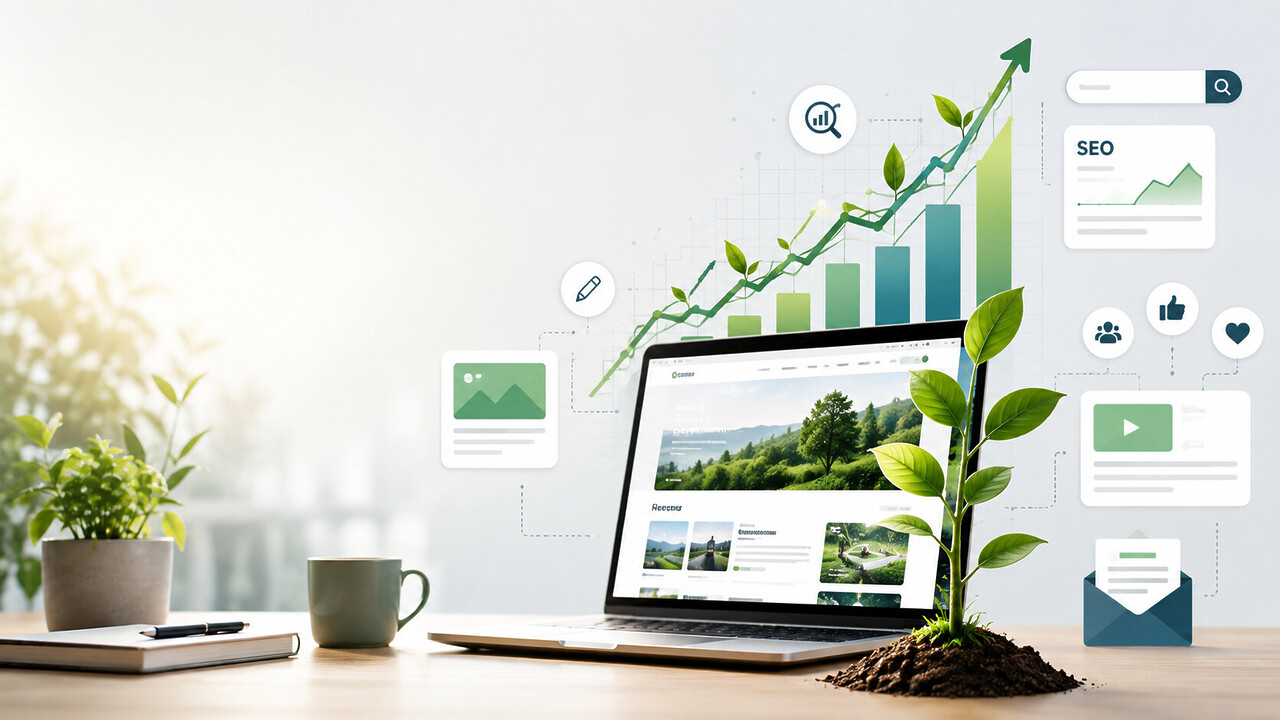
How many entrepreneurs/companies do you know today that don’t have an internet presence? Probably not many. Regardless of the industry, it is now considered good practice to operate a website, i.e., a digital business card. A variety of website builders make it relatively easy to create your own website without in-depth IT knowledge.
What is the difference between a website and a sales funnel?
But have you ever wondered what these websites really achieve? How many customers were acquired through the website? How much revenue can be attributed to these customers and thus to the website?
These questions already make it much more complicated. Even the question of what the actual goal of the website is, is usually answered with „you need it nowadays“, „you can’t do without it“ or „so that I can be found on Google“.
Structure and content of a classic website
A classic website usually consists of about five to twenty or more different pages with all sorts of information about your company and its history, your employees, your products or services, your partners, your contact information, and sometimes a blog that is updated more or, more often than not, less regularly.
Visitors to a website, often referred to as traffic, can therefore jump back and forth between the most diverse information. Some are more interested in your company’s history, others prefer to inspect the product catalog, and still others scroll through your latest blog posts. Some also don’t find the information they are looking for and leave the page immediately.
What information website visitors see and between which pages they navigate is beyond the influence of the website operator and often left to chance. Did your core message reach the interested party? Did the visitor even see the information about your product/service?
Sales Funnel as an alternative to the website
In contrast to a website, where visitors can „jump“ to any area at any time, a funnel is an exactly coordinated sequence of information, each with exactly one clearly defined goal. Depending on what the goal is in the initial steps of the funnel, one then speaks of different funnel types, such as a sales funnel, a lead funnel, or a webinar funnel. Basically, all funnel types follow a very similar principle. The term sales funnel is most commonly used, even if, strictly speaking, a lead funnel is meant, for example.
There are many different answers to the question of the definition of a funnel. A simple definition is:
A funnel is a marketing strategy to convert interested parties into loyal customers through a multi-stage process.
Unlike a purely informational website, a funnel focuses on a clearly defined goal.
Let’s take a plumbing company as an example. A website would typically contain the information mentioned above. When was the company founded, what services are offered, who are the employees, where is the company located, etc.
Become more visible on Google & Social Media?
In a free strategy consultation for data-driven online marketing, we uncover your untapped potential, review any existing ad accounts if necessary, examine your SEO ranking and visibility, and determine which strategy is appropriate for your budget and which active measures will lead to more inquiries or sales.

✅ More visibility & perception through targeted placement
✅ More visitors > prospects > customers > revenue
✅ Reach target groups scalably with SEA
✅ Act and grow sustainably with SEO
🫵 Maximum success with our hybrid strategy
💪 More than 15 years of experience across industries in over 1,000+ projects demonstrable!





A funnel in this area would focus on a very specific sub-area of the service. Let’s take „sparkling white grout in the bathroom“ as an example. The company could, for example, create a small brochure (e-book) with the 10 best tips & tricks for sparkling white grout in the bathroom and offer it to interested parties either for free or for a few euros. The free version is usually referred to as a lead magnet. The only goal in the first step of the funnel would therefore be to exchange the interested party’s email address for the e-book. In a second step of the funnel, the same tips could be offered for purchase in the form of a detailed video guide. In yet another step, the appropriate materials (grout brush, grout pen, etc.) are included. Presumably, as a final step in the funnel, the actual execution of the „grout refresh“ can also be offered by the company or a partner company.
The products within a funnel are usually built upon each other and follow a pricing strategy that, in the simplest case, can range from very inexpensive to very expensive. It is important here that the perceived value, i.e., what the customer receives, should always be significantly higher than the actual price.
The primary goal of a funnel strategy is therefore not to close a (single) sale as quickly as possible, but to generate loyal, recurring customers with a high customer lifetime value (CLV).
The funnel basically consists of a precisely defined sequence of different „web pages“, offers, and email marketing. This way, customers who only secured the lead magnet in the first step can still be converted into paying customers later.
A funnel strategy is suitable for almost all types of business models and companies, as long as the number of leads or sales/transactions is to be increased. There are examples of extremely successful funnels in every conceivable industry, regardless of whether they are services, digital, or physical products.
The Funnel Strategy for your Business
As an entrepreneur dealing with building a (sales) funnel for the first time, you will probably be overwhelmed and, without a proper concept, won’t know how to start. Now it’s time to be pragmatic. Why reinvent the wheel? Russell Brunson, the founder of ClickFunnels and essentially the inventor of funnel strategies, coined the term Funnel Hacking. Funnel Hacking is imitating (not copying!) successful strategies. This involves analyzing the entire sales and marketing process of the most successful players in the market and adapting and optimizing their approach for your own strategy.
Orient yourself to what works and don’t make the same costly mistakes that others have already made before you.
Funnel Hacking is one of the easiest and fastest strategies to implement to help an (online) business succeed. Every detail can play a role.
- What does the landing page look like?
- How are interested parties addressed?
- What is their pricing structure?
- What colors do they use?
- What does the logo look like?
- How are the texts written?
- What emails do they send?
- What advertising do they run?
- etc.
Instead of starting from scratch, which can be a lengthy process, the first attempts begin very close to the goal, as it is known that the competition is successful. This significantly improves your chances of success.
If you want to achieve success, all you need to do is find a way to model those who have already succeeded. – Tony Robbins
Anyone who wants to unleash the full potential of their company should definitely look into this topic. Russell Brunson, the founder of ClickFunnels (market leader in funnel software builders), offers a 30-day funnel training (One Funnel Away Challenge -> more information about the challenge can be found HERE) for only 100 USD. The feedback on the training is phenomenal. Your thinking about your company and its possibilities will change through the coaching. Guaranteed.


 DE
DE