Companies that want to be found on Google face the challenge that potential customers need to discover them online. Over 90 percent of all internet users begin their search for products and services with a query on Google. Those who do not appear in the search results remain practically invisible to this huge user group.
Visibility in the search engine is a decisive factor for the success of a website. Studies show that companies on the first Google page receive significantly more visitors and inquiries than those that appear on later pages. Various strategies are available: from long-term search engine optimization to paid advertisements and local presence.
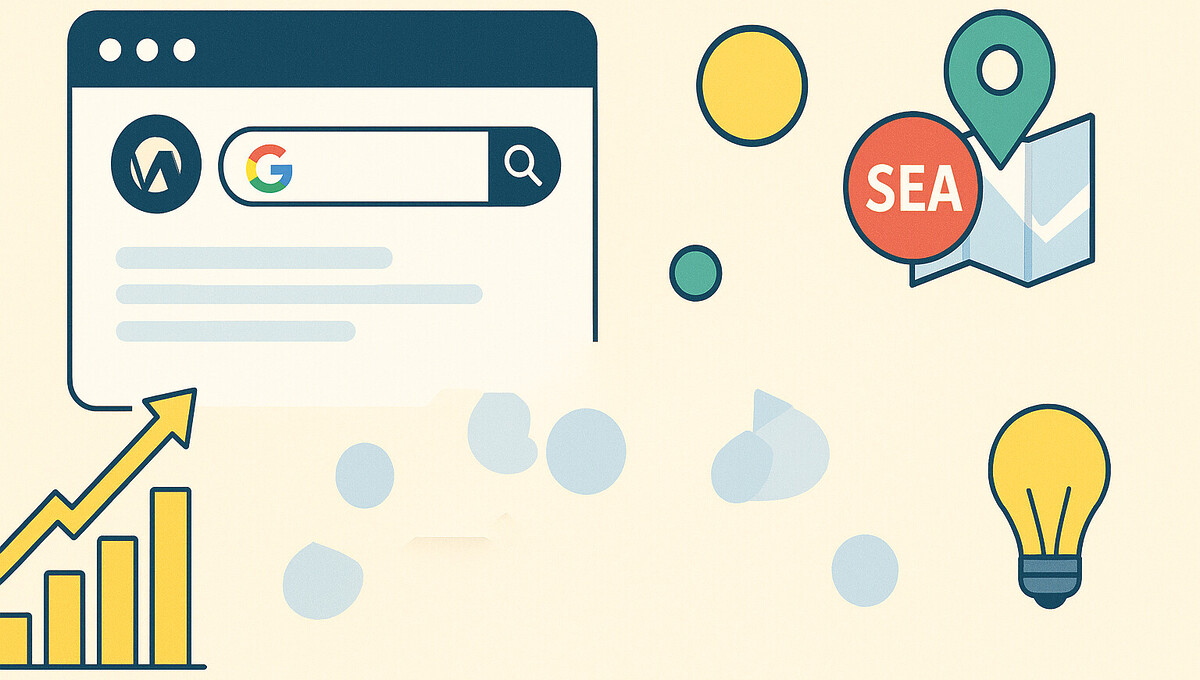
Successful online marketing combines several approaches. SEO (Search Engine Optimization), SEA (Search Engine Advertising), and GEO (Generative Search Optimization) form the three cornerstones of a comprehensive Google strategy. This combination makes it possible to achieve both short-term and sustainable success and to be found better on Google.
Being Found on Google: Strategies for More Online Visibility
The Basics: How Does Being Found on Google Work?
Google presents search results in various areas and formats. Organic search results are generated by Google’s algorithm naturally evaluating websites. These placements cannot be bought directly but must be achieved through quality optimization.
Paid ads appear above and below the organic results. They are marked with „Sponsored“ and allow for immediate visibility in exchange for payment per click. In addition, there are specialized areas:
- Google Shopping for product ads
- Google Maps for local businesses
- "People also ask" boxes for common user queries
- Featured Snippets in Position Zero
Each area requires specific optimization strategies. Successful companies use several of these channels in parallel to maximize their overall presence and ensure they are found on Google. Combining different approaches reduces dependence on individual strategies.
Why are some websites not found on Google?
Many websites are not found on Google because of fundamental technical or content issues. Missing or poorly optimized metadata prevents Google from properly categorizing the content. Slow loading times, non-mobile-optimized designs, or structural deficiencies lead to poor ratings by the algorithm.
Often, there is a lack of relevant, high-quality content that meets users‘ search intent. Websites without a clear thematic structure or with thin content have little chance of good rankings. The absence of backlinks and local signals can also severely impair discoverability.
Many companies also underestimate the importance of continuous maintenance and updating. Google prefers up-to-date, regularly maintained websites. Without ongoing optimization and fresh content, even once successful pages lose visibility and are overtaken by the competition.
SEO: The key to being found better on Google in the long term
Keyword Research and Strategy
The basis of successful search engine optimization lies in the systematic analysis of relevant search terms. Companies must understand how their target audience searches for their products or services. These keywords form the foundation of all further SEO measures and determine whether you will be found better on Google.
Become more visible on Google & Social Media?
In a free strategy consultation for data-driven online marketing, we uncover your untapped potential, review any existing ad accounts if necessary, examine your SEO ranking and visibility, and determine which strategy is appropriate for your budget and which active measures will lead to more inquiries or sales.

✅ More visibility & perception through targeted placement
✅ More visitors > prospects > customers > revenue
✅ Reach target groups scalably with SEA
✅ Act and grow sustainably with SEO
🫵 Maximum success with our hybrid strategy
💪 More than 15 years of experience across industries in over 1,000+ projects demonstrable!






Professional keyword tools provide important data on search volume, competition, and related terms. A balanced keyword set of 20 to 30 terms is completely sufficient for a start. Both highly competitive main terms and more specific long-tail keywords should be considered.
The selection of the right keywords determines future success. Too general terms are often excessively competitive, while too specific terms have little search volume. Successful strategies find the optimal balance between relevance, search volume, and realistic ranking chances to be found better on Google.
On-Page Optimization for Better Discoverability
After the relevant keywords have been identified, their strategic integration into the website structure follows. Title tags and meta descriptions are the most important on-page elements. Each page requires a unique, keyword-optimized title tag with a maximum of 55 characters.
Meta descriptions, up to 155 characters long, serve as ad copy in search results. They should contain the main keyword and at the same time pique curiosity about the content. Well-formulated descriptions increase the click-through rate and signal the page’s relevance to Google.
Content optimization includes the natural integration of keywords into:
- H1 and H2 headings
- Body text and paragraphs
- Image captions and alt tags
- URL structures
The focus here is on user-friendliness – excessive keyword stuffing does more harm than good. High-quality, helpful content that offers real added value forms the basis for long-term ranking success.
Getting WordPress found on Google
WordPress websites offer excellent conditions for successful SEO. The content management system automatically generates search engine friendly URL structures and allows for easy adjustments of technical SEO parameters. With the right plugin extensions, more complex optimizations can also be implemented to optimize WordPress to be found on Google.
Specialized SEO plugins assist in optimizing metadata, creating XML sitemaps, and analyzing content quality. They provide evaluations and improvement suggestions directly in the backend. However, it is important not to rely solely on plugin reviews, but to understand the basic SEO principles.
Being found on Google with WordPress requires regular updates and maintenance. Outdated themes or plugins can cause security vulnerabilities and performance issues. Fast loading times, mobile optimization, and a clean code structure are crucial factors for ranking success with WordPress websites.
SEA: Be found faster on Google immediately with Google Ads
Setting up Google Ads campaigns correctly
Google Ads makes it possible to be found faster on Google without having to wait months for organic rankings. Paid ads appear immediately after the campaign launch in the relevant search results. This strategy is particularly suitable for new websites, time-sensitive promotions, or highly competitive keywords.
The successful setup begins with the precise definition of the target audience and geographical targeting. Campaigns should be clearly structured and thematically separated. A daily budget of at least 10 to 15 Euros per campaign ensures sufficient data for optimization.
Ad copy must be persuasive and stand out from the competition. It should contain the advertised keyword and communicate a clear added value. Ad extensions such as sitelinks or location information enlarge the ad space and increase attention in the search results.
Google Shopping for Online Shops
Online retailers can present their products directly in Google search results. Shopping ads display product images, prices, and reviews before the click on the website. This visual presentation increases attention and leads to qualified visitors with a concrete purchase intent.
The technical setup is carried out via the Google Merchant Center, where a structured product feed is uploaded. This feed contains all relevant product information and must be updated regularly. Linking it to the Google Ads account enables the management of the campaigns.
| Success Factor | Description | Impact |
|---|---|---|
| Product Images | High-quality, professional photos | Higher click-through rates |
| Pricing | Competitive prices | Better performance |
| Product Data | Complete, accurate descriptions | Improved relevance |
Successful shopping campaigns begin with a small test budget and are optimized based on performance data. Functional conversion tracking helps to measure campaign success.
Local Visibility: Be found regionally on Google
Optimally utilize Google Business Profile
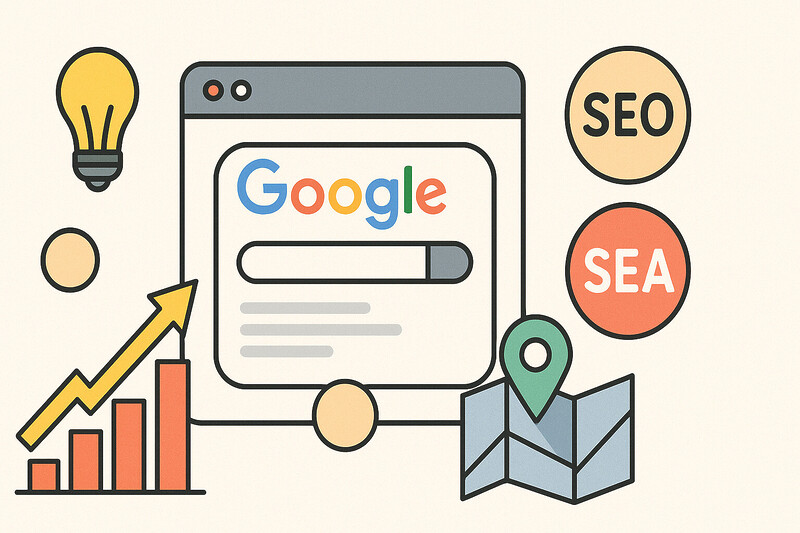
Local businesses such as craftsmen, doctors, or retailers depend on being visible regionally. The Google Business Profile forms the basis for successful Local SEO. It enables businesses to be found not only for their company name but also for industry-specific search queries in their region.
A complete profile contains all relevant company information: opening hours, contact details, descriptions, and high-quality photos. Regular posts and active communication with customers through reviews and questions increase local relevance. Google evaluates the activity and completeness of the profile as an important ranking factor.
Positive Customer Reviews have an enormous impact on local visibility and the trust of potential customers. Businesses should actively solicit reviews and respond professionally to all feedback. Even negative reviews offer an opportunity to demonstrate professionalism and customer service.
Appear in Google Maps
Mobile users use Google Maps daily for local searches. Businesses that are not present here miss out on enormous potential. Presence in Google Maps is automatically achieved through an optimized Google Business Profile, but requires continuous maintenance for maximum impact.
Location accuracy is crucial for discoverability in Maps. Incorrect or inaccurate address information leads to poorer rankings and frustrates potential customers. The consistency of business data across all online directories strengthens local ranking signals.
Categories and attributes help Google assess relevance for specific search queries. Businesses should select all applicable categories and specify relevant attributes:
- Accessibility
- Payment methods
- Service offerings
- Opening hours
These details improve the user experience and increase the conversion rate.
Special Google Features Conquer
Featured Snippets and Position Zero
Position Zero, also known as Featured Snippet, displays direct answers to user questions above the regular search results. This privileged position generates an above-average number of clicks and strengthens a website’s authority. Companies that appear here are perceived as experts in their field.
Structured, user-friendly content significantly increases the chances of appearing in Featured Snippets. Question-and-answer formats, numbered lists, and precise definitions are preferred by Google. The answers should be between 40 and 60 words and answer the question directly and completely.
Pages that already rank well have the best chances for Position Zero. Optimizing existing top-10 rankings for Featured Snippets is often more successful than trying to position entirely new content. Regular analysis of the „People also ask“ sections provides valuable insights into relevant snippet opportunities.
Utilizing the "People also ask" section
Google’s „People also ask“ feature expands the original search query with related questions. Websites that appear here can generate additional traffic and strengthen their thematic authority. This expansion of search results offers great opportunities, especially for information-oriented content.
FAQ sections on your own website are ideal candidates for this feature. The questions should reflect genuine user concerns and be answered with precise, helpful responses. A clear structure with the question as a heading and a direct answer in the following paragraph optimizes the chances of selection.
Thematic depth and completeness of a website positively influence selection for „People also ask.“ Google prefers pages that comprehensively inform about a topic area. The integration of related keywords and linking between thematically similar content strengthen relevance signals.
Google for Jobs
Since 2019, Google has been integrating job advertisements directly into search results. Companies can place their open positions for free in this feature, reaching job-seeking users directly on Google. This presence appears before traditional job boards and significantly increases visibility.
The technical integration requires structured data on the company website. Each job posting needs its own URL and must be marked up with Schema.org. The job should be fully described on the company’s own website, not hosted on external platforms.
Optimized job titles, detailed descriptions, and local information improve discoverability in Google for Jobs. The job title should be used consistently in the URL, title tag, and main heading. Regular updates and removal of expired jobs prevent problems with outdated entries.
Generative Search Optimization (GEO): The Future of Search
Understanding AI-Powered Search Results
Artificial intelligence is changing the way Google generates and presents search results. The Search Generative Experience (SGE) creates summary answers from various sources and presents them directly in the search results. This development requires new optimization strategies that go beyond traditional SEO methods.
Generative answers prefer authoritative, well-structured content with high information density. Websites must not only optimize for keywords but also provide answers to complex questions. The quality and comprehensibility of the content become even more important as AI systems evaluate these factors for source selection.
Companies should adjust their content strategy accordingly and create content that can serve as reliable sources of information. Fact-based articles, expert opinions, and comprehensive guides have a better chance of being considered in AI-generated answers.
Content Strategies for AI Answers
Successful GEO requires content that is optimized for both human readers and AI systems. Clearly structured articles with unambiguous headings, interim conclusions, and precise answers to frequently asked questions increase the probability of selection. The content should be complete and self-explanatory.
Expert knowledge and unique insights differentiate content from the competition. AI systems prefer sources with demonstrable expertise and originality. Quotes from experts, proprietary studies, or practical industry experience strengthen a website’s authority.
The integration of various media formats supports the selection for generative answers:
- Videos and Tutorials
- Infographics and Diagrams
- Interactive Elements
- Downloadable Resources
Multimedia content offers various levels of information and can present complex topics more understandably. Regular updates and fact-checking ensure the topicality and reliability of the content.
Preparation for Search Generative Experience
The implementation of SGE changes user behavior and click-through rates of traditional search results. Companies must adapt their metrics and develop new KPIs that consider visibility in AI-generated answers. Brand mentions and authority scores become more important than pure ranking positions.
Technical optimizations such as structured data and Schema.org markup are gaining importance. AI systems use this machine-readable information for a better understanding of the content. Companies should optimize their website structure accordingly and implement all relevant data types.
The diversification of traffic sources becomes essential, as organic search is fundamentally changing. Email marketing, social media, and direct website visits are gaining importance as alternative traffic channels. A balanced online marketing strategy reduces dependence on individual search engine features.
Holistic strategy: combining SEO, SEA, and GEO
The three pillars of Google visibility
Successful online marketing is based on the intelligent combination of SEO, SEA, and GEO. These three strategies complement each other and cover different user intentions and timeframes. SEO forms the long-term foundation, SEA ensures immediate visibility, and GEO prepares for the future of search.
SEO data provides valuable insights for keyword selection in Google Ads campaigns. Successful organic keywords can be reinforced with paid advertising to maximize overall presence. Conversely, ads campaigns show which keywords have the highest conversion potential and should be prioritized for SEO development.
The budget allocation between the three pillars depends on various factors:
| Factor | SEO focus | SEA focus | GEO preparation |
|---|---|---|---|
| New companies | Long-term | Immediate visibility | Future-proofing |
| Established brands | Build on strengths | Strengthen in a targeted way | Foster innovation |
| Budget | Continuously | Flexibly controllable | Investment |
Success Measurement and Monitoring
Professional success measurement requires the definition of clear KPIs for each channel. Organic visibility, paid click-through rates, and brand mentions in AI responses must be individually evaluated and put into relation with each other. Dashboard tools enable central monitoring of all relevant metrics.
Regular analysis of the competitive situation uncovers new opportunities and threats. Competitors can conquer successful keywords or develop new content strategies. Monitoring tools warn of ranking losses and identify new keyword opportunities for all three channels.
Continuous optimization is based on data-driven decisions, not assumptions. A/B tests for ad texts, content variations for SEO, and different GEO approaches provide objective insights into the most successful strategies. Monthly reviews and strategy adjustments ensure sustainable success.
Conclusion: Your Path to More Visibility on Google
Being found on Google requires a well-thought-out combination of different strategies. SEO forms the long-term foundation through quality content and technical optimization. Google Ads enable immediate visibility for important keywords and target groups. Local businesses particularly benefit from optimized Google Business Profiles and Maps presence.
Special Google features such as Featured Snippets, „People also ask,“ and Google for Jobs offer additional visibility opportunities. The emerging Search Generative Experience changes the rules of the game and requires new content strategies. Successful companies prepare early for these developments and adapt their content accordingly.
The integration of all available channels maximizes overall presence and reduces risks. Companies that rely exclusively on one channel become dependent and miss out on potential. A balanced strategy considers both short-term and long-term goals.




 DE
DE