Understanding and Correctly Applying Marketing Abbreviations
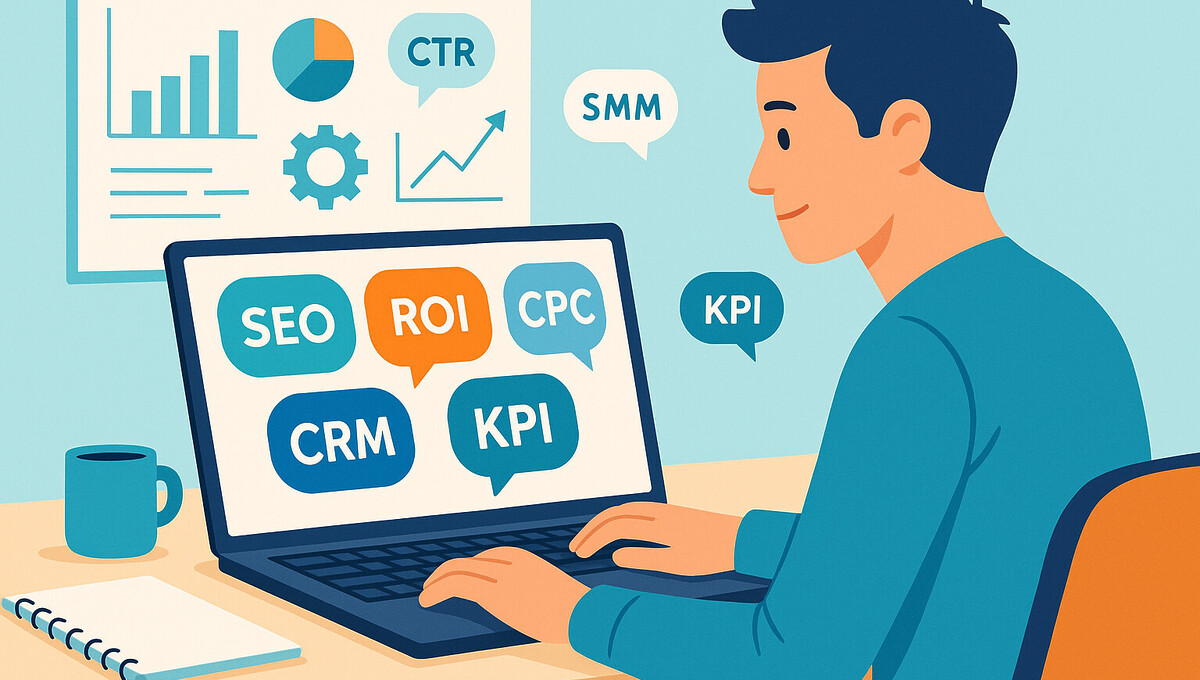
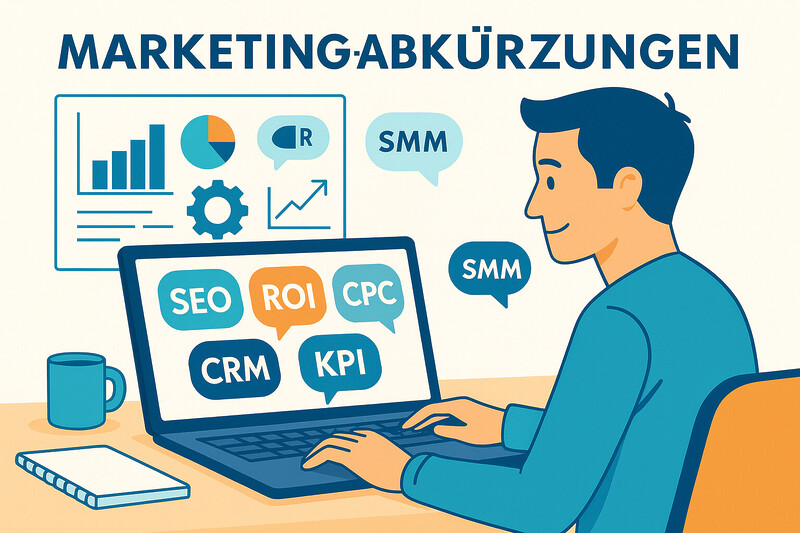
ROI, CTR, CPA – you encounter these letter combinations daily when dealing with modern marketing. Marketing abbreviations shape professional terminology and enable efficient communication between experts, agencies, and companies. Without solid knowledge of these terms, navigating marketing strategies, reporting, and professional discussions becomes considerably more difficult.
Professionals use these compressed terms to convey complex concepts quickly and accelerate work processes. At the same time, the confident use of the correct abbreviation for marketing terms signals competence and professionalism. Meetings become more productive when all participants speak the same language and misunderstandings are avoided through clear terminology.
Professional handling of these abbreviations opens doors to better career opportunities and successful business relationships. You communicate on equal footing with colleagues, understand analyses faster, and make informed decisions based on clear metrics. This linguistic competence forms the foundation for successful marketing work.
The Most Important Basic Abbreviations in Marketing
Business Models and Strategic Analysis
Successful marketing strategies are based on a clear understanding of fundamental business concepts and analysis methods. The following overview shows you the most important marketing abbreviations you need for strategic decisions:
| Abkürzung | Bedeutung | Erklärung |
|---|---|---|
| B2B | Business to Business | Geschäftsbeziehungen zwischen Unternehmen |
| B2C | Business to Consumer | Geschäftsbeziehungen zwischen Unternehmen und Endverbrauchern |
| ROI | Return on Investment | Verhältnis zwischen Gewinn und investiertem Kapital |
| USP | Unique Selling Proposition | Alleinstellungsmerkmal eines Produkts oder einer Dienstleistung |
| SWOT | Strengths, Weaknesses, Opportunities, Threats | Analyse von Stärken, Schwächen, Chancen und Risiken |
| KPI | Key Performance Indicator | Schlüsselkennzahl zur Erfolgsmessung |
| CTA | Call to Action | Handlungsaufforderung an den Nutzer |
| CRM | Customer Relationship Management | System zur Verwaltung von Kundenbeziehungen |
| SOW | Statement of Work | Detaillierte Projektbeschreibung |
| WOM | Word of Mouth | Mundpropaganda und Empfehlungsmarketing |
B2B companies sell their products or services to other companies, while B2C providers address end consumers directly. This distinction significantly determines your communication channels, approach, and sales cycles. In the B2B sector, customers expect detailed information, rational arguments, and measurable benefits for their business.
Decision-making processes often extend over months and involve multiple stakeholders. B2C marketing, on the other hand, appeals to emotions, leverages impulse purchases, and focuses on individual consumer needs. Both models require specific strategies and adapted metrics for success.
Success Measurement and Performance Tracking
Return on Investment measures the financial success of your marketing activities and is one of the most critical metrics. An ROI of 200%, for example, means that for every euro invested, you generate two euros in profit. Marketing managers use ROI for budget allocation and strategy optimization.
KPIs transform vague marketing objectives into measurable, traceable success metrics. Define specific metrics for each campaign, each channel, and each quarter. Avoid the temptation to track too many KPIs simultaneously – focus on five to seven key metrics that directly influence your business objectives.
SWOT analyses structure strategic planning through systematic consideration of internal and external factors. Executives and marketing teams use this methodology for strategy development and decision-making. Update your SWOT analysis at least annually or when significant market changes occur.
Online Marketing Abbreviations for Digital Success
Understanding SEO and Search Engine Marketing
Search engine optimization forms the backbone of successful online presence. You should know and understand these online marketing abbreviations:
| Abkürzung | Bedeutung | Erklärung |
|---|---|---|
| SEO | Search Engine Optimization | Suchmaschinenoptimierung für organische Reichweite |
| SEA | Search Engine Advertising | Bezahlte Suchmaschinenwerbung |
| SEM | Search Engine Marketing | Überbegriff für SEO und SEA |
| SERP | Search Engine Results Page | Suchergebnisseite bei Suchmaschinen |
| SERM | Search Engine Reputation Management | Verwaltung des Online-Rufs in Suchergebnissen |
| CTR | Click-Through Rate | Verhältnis von Klicks zu Impressionen |
| DA | Domain Authority | Bewertung der Autorität einer Domain |
| PA | Page Authority | Bewertung der Autorität einer einzelnen Seite |
| NAP | Name, Address, Phone Number | Konsistente Unternehmensangaben für lokale SEO |
SEO improves your organic visibility through technical optimization, high-quality content, and strategic link building. Keywords, meta descriptions, loading times, and mobile optimization are among the most important optimization factors. SEA delivers immediate results but incurs ongoing costs and stops when the budget runs out.
Become more visible on Google & Social Media?
In a free strategy consultation for data-driven online marketing, we uncover your untapped potential, review any existing ad accounts if necessary, examine your SEO ranking and visibility, and determine which strategy is appropriate for your budget and which active measures will lead to more inquiries or sales.

✅ More visibility & perception through targeted placement
✅ More visitors > prospects > customers > revenue
✅ Reach target groups scalably with SEA
✅ Act and grow sustainably with SEO
🫵 Maximum success with our hybrid strategy
💪 More than 15 years of experience across industries in over 1,000+ projects demonstrable!






Intelligently combine both approaches for maximum reach and efficiency. Use SEA for quick testing of new keywords and markets, while simultaneously expanding your SEO strategy. The synergy of both channels multiplies your visibility and establishes a dominant position in search results.
Technical Fundamentals and Systems
Modern marketing work requires understanding technical components and systems. You encounter these abbreviations when working daily with digital tools and platforms:
| Abkürzung | Bedeutung | Erklärung |
|---|---|---|
| API | Application Programming Interface | Schnittstelle für Anwendungsprogrammierung |
| CMS | Content Management System | Software zur Website-Verwaltung |
| HTML | Hypertext Markup Language | Auszeichnungssprache für Webseiten |
| XML | Extensible Markup Language | Datenformat für strukturierte Daten |
| CSS | Cascading Style Sheets | Gestaltungssprache für Webseiten |
| SSL | Secure Sockets Layer | Verschlüsselungsprotokoll für sichere Datenübertragung |
| URL | Uniform Resource Locator | Webadresse einer Internetseite |
| ALT | Alternative Text | Bildbeschreibung für Suchmaschinen und Barrierefreiheit |
APIs enable the connection of various marketing tools and automate data exchange between systems. Your CRM communicates via APIs with email marketing platforms, analytics tools, and social media channels. These integrations create seamless workflows and improve data quality through automatic synchronization.
Content Management Systems form the technical foundation of your online presence. Modern CMS solutions offer far more than pure content management – they integrate SEO tools, performance optimization, and marketing automation. The choice of the right system significantly influences your digital flexibility and scalability.
Conversion Optimization and User Experience
Metrics for Digital Success
Click-Through Rate and Conversion Rate Optimization are among the most critical metrics in digital marketing. CTR measures the percentage of users who actually click after seeing your ad or search result. A high CTR signals relevant, engaging content that motivates your target audience to take action.
| Abkürzung | Bedeutung | Erklärung |
|---|---|---|
| CRO | Conversion Rate Optimization | Optimierung der Konversionsrate |
| UX | User Experience | Nutzererfahrung auf Websites oder Apps |
| SMM | Social Media Marketing | Marketing über soziale Netzwerke |
| CAC | Customer Acquisition Cost | Kosten zur Neukundengewinnung |
| CLV | Customer Lifetime Value | Gesamtwert eines Kunden über die Geschäftsbeziehung |
CRO focuses on converting visitors into customers or leads. A/B tests, user flow analysis, and landing page optimization systematically increase your conversion rate. Even small improvements of a few percentage points can result in significant revenue increases.
User Experience significantly determines the success of your digital presence. Fast loading times, intuitive navigation, and seamless processes keep visitors on your site. Mobile-first design is no longer a trend but a necessity – over 60% of web traffic comes from mobile devices.
Social Media and Community Management
Social Media Marketing requires more than sporadic posting on various platforms. Develop a coherent strategy that supports your business objectives and reaches your target audience where they are. LinkedIn is suitable for B2B communication, Instagram appeals to visually oriented target groups.
Community Management forms the heart of successful social media marketing. Respond promptly to comments, answer questions, and moderate discussions. These interactions build trust and transform followers into brand ambassadors. Social Listening Tools help you track mentions of your brand.
Calls-to-Action transform passive viewers into active participants. Formulate clear, action-oriented requests that precisely communicate what users should do next. Personalized CTAs perform significantly better than generic requests – tailor your calls-to-action to the customer journey stage.
Cost Models and Billing Types in Detail
Understanding the Most Important Billing Models
Digital marketing offers various billing models for different campaign objectives and budgets. This overview helps you choose the right abbreviation for marketing costs:
| Abkürzung | Bedeutung | Erklärung |
|---|---|---|
| CPA | Cost per Action | Kosten pro definierte Aktion (z.B. Download) |
| CPC | Cost per Click | Kosten pro Klick auf eine Anzeige |
| CPL | Cost per Lead | Kosten pro generiertem Interessenten |
| CPM | Cost per Mille | Kosten pro tausend Impressionen |
| CPO | Cost per Order | Kosten pro abgeschlossener Bestellung |
| PPC | Pay per Click | Bezahlmodell nach Klicks |
| TKP | Tausender-Kontakt-Preis | Deutsche Variante von CPM |
| KUR | Kosten-Umsatz-Relation | Verhältnis zwischen Kosten und erzieltem Umsatz |
CPA models charge costs only upon successful conversions such as purchases or registrations, thereby minimizing risk for advertisers. CPM, on the other hand, bills per thousand impressions and is particularly suitable for branding campaigns with a reach focus. CPC falls in between and charges for each individual click on your ad.
Each model has specific advantages and disadvantages for different campaign objectives. CPA guarantees measurable results but can incur higher individual costs. CPM offers predictable costs for reach campaigns but does not guarantee interactions. Choose the appropriate billing model based on your campaign objectives.
Budget Planning and Cost Control
Cost Per Thousand Impressions represents a fundamental metric for media planning and enables comparison of different advertising media. This metric calculates the cost to reach one thousand people with your advertising message, regardless of the medium chosen. Print, online, TV, or radio – CPM creates comparability.
Always consider the quality of the contacts reached when evaluating CPM. A low CPM does not automatically mean efficient marketing if the target audience reached does not match your offering. Precise targeting often justifies higher CPMs through better conversion rates.
Customer Acquisition Cost and Customer Lifetime Value determine the sustainability of your business model. The relationship between these two metrics shows whether your new customer acquisition is profitable. Create detailed budget plans that account for fixed and variable costs, and reserve 10-15% for testing new channels.
Practical Tips for Handling Marketing Abbreviations
Improve Team Communication
Establish a shared glossary of all marketing abbreviations used in your company. New employees receive this overview during onboarding, and regular updates integrate new terms. A central wiki or intranet document creates a reliable reference for all team members.
Moderate meetings consciously and explain technical terms when new participants or colleagues from outside the field are present. Avoid abbreviation overload in presentations and documents. Three to five key terms per document are sufficient and prevent confusion.
Promote a learning culture in which continuous professional development is valued. Organize regular lunch-and-learn sessions where team members present new concepts. These informal formats break down knowledge barriers and strengthen team cohesion.
Apply online marketing abbreviations correctly
Context-based usage distinguishes professional communication from jargon overload. Adapt your language to your audience: technical teams understand API discussions, while management is interested in ROI and ROAS. Customer-oriented documents largely avoid abbreviations.
Use online marketing abbreviations consistently and correctly. CPM means Cost per Mille, not Cost per Million. CTR is expressed as a percentage, not as an absolute number. Such details may seem trivial, but they signal competence or its absence.
International collaboration requires special sensitivity. English abbreviations dominate digital marketing, but local variants exist. German companies may use TKP instead of CPM. Clarify the terminology used in advance for cross-border projects.
Avoid common mistakes
Excessive use of abbreviations complicates communication instead of simplifying it. Avoid sentences like „The CRO-optimized CTA improved our CTR and lowered our CPA“ if your counterpart is unfamiliar with these terms. Clear, spelled-out formulations are often more effective.
Confusion between similar terms leads to costly misunderstandings. CPC and CPM differ fundamentally, as do SEO and SEM. Bounce Rate and Exit Rate measure different aspects of user behavior. Invest time in thoroughly understanding each abbreviation.
Update your knowledge continuously, as digital marketing evolves rapidly. New platforms bring new metrics, technologies create new terms. Subscribe to industry publications, attend conferences, and exchange ideas with colleagues.
Conclusion: Success through the right knowledge
Summary of key insights
Marketing abbreviations form the foundation of professional marketing communication and enable efficient collaboration within teams and with external partners. From basic terms like ROI and USP to digital metrics like CTR and CRO to specialized online marketing abbreviations – each term has its meaning and place in marketing practice.
Successful marketing requires more than theoretical knowledge of abbreviations. Practical application, continuous measurement, and data-driven optimization transform terms into measurable business success. Use the concepts presented as tools, not as ends in themselves.
The integration of different marketing disciplines amplifies their individual impact. SEO and content marketing, social media and email marketing, paid and organic – successful marketers understand the synergies between different channels.
FAQ
What is the most common abbreviation for marketing?
The most common abbreviation for marketing is „MKT“. This short form is used internationally in the business world and facilitates communication in documents, presentations, and reports. Alternatively, you will also find „Mktg“ in English-language contexts.
Which marketing abbreviations should I definitely know as a beginner?
The most important marketing abbreviations for beginners are ROI (Return on Investment), CTR (Click-Through Rate), CPA (Cost per Action), SEO (Search Engine Optimization), and KPI (Key Performance Indicator). These terms form the basic framework for your understanding of modern marketing strategies and enable professional communication within your team.
What does CRO mean in digital marketing?
CRO stands for Conversion Rate Optimization and refers to all measures to increase the conversion rate. This important online marketing abbreviation describes the systematic process of converting more website visitors into paying customers – through A/B testing, improved user guidance, and optimized landing pages.
Are there differences between German and English marketing abbreviations?
Yes, some marketing abbreviations differ depending on the language region. While CPM (Cost per Mille) is used internationally, German marketers often use TKP (Tausender-Kontakt-Preis). Both refer to the same billing model. In an international context, it is advisable to use English terms for clear communication.
Which online marketing abbreviations are particularly relevant for SEO?
The most important online marketing abbreviations for SEO are SERP (Search Engine Results Page), DA (Domain Authority), PA (Page Authority), CTR (Click-Through Rate), and NAP (Name, Address, Phone Number). These metrics help you evaluate and improve the visibility and authority of your website in search engines.



 DE
DE