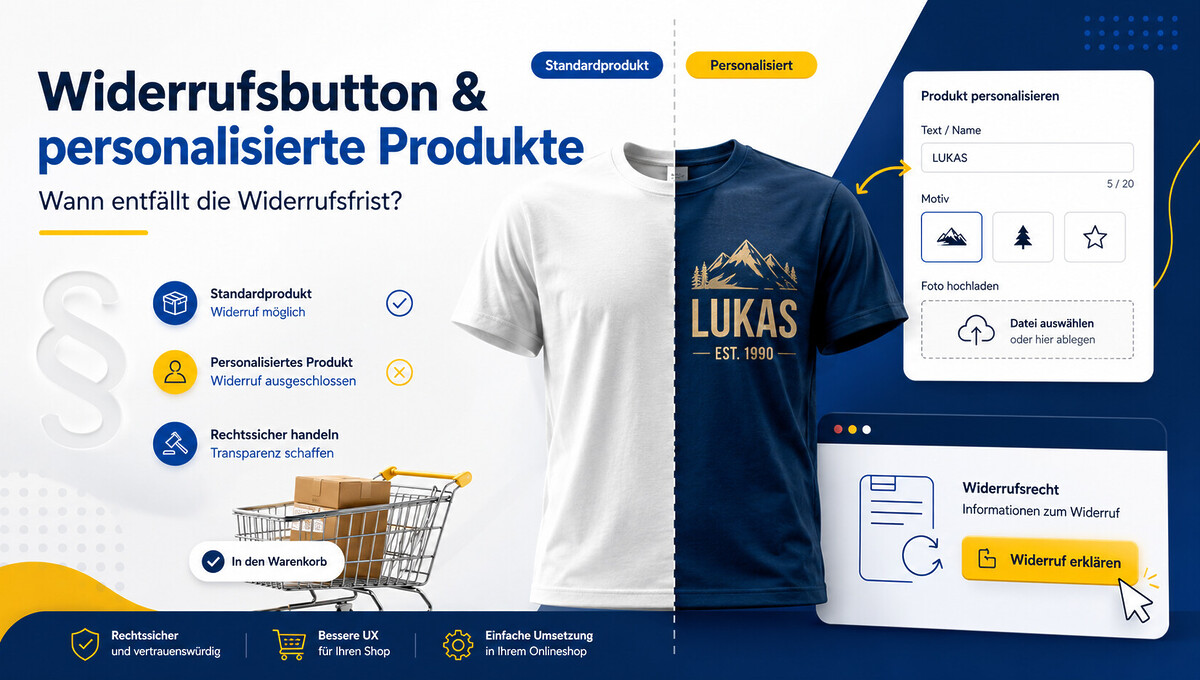
For personalized products, the right of withdrawal depends heavily on the individual case. Not every selection automatically makes a product a custom order. Color, size, or standard variants are usually normal product selections. Individual details such as name, engraving text, photo, fingerprint, paw print, prescription strength, or custom fitting, however, can lead to the cancellation of the withdrawal period.
For shop operators, it is therefore important to make a clean technical distinction: Is the product truly custom-made for the customer, or is it merely a normal additional option such as gift wrapping or express shipping?
Especially with WooCommerce, this check should be automated per order item. Because the same product can sometimes be withdrawable and sometimes excluded from withdrawal.
The question is, therefore, from when is there no right of withdrawal for individually personalized products according to § 312g Abs. 2 Nr. 1 BGB?
Withdrawal button for personalized products: When does the withdrawal period really lapse?
The withdrawal button is becoming an important technical and legal issue for many online shops. It becomes particularly challenging with products that are not always clearly withdrawable or non-withdrawable.
A classic example is a T-shirt.
Without personalization, the T-shirt is usually standard withdrawable goods. However, if the same T-shirt is provided with a name, an individual engraving, a photo, or a custom text, it can become a custom order. In this case, the right of withdrawal may be excluded according to § 312g Abs. 2 Nr. 1 BGB.
Therefore, it is not always the product itself that is decisive, but the specific execution of the ordered goods.
Please also read our general article on the topic of revoking a contract via a withdrawal button:
Become more visible on Google & Social Media?
In a free strategy consultation for data-driven online marketing, we uncover your untapped potential, review any existing ad accounts if necessary, examine your SEO ranking and visibility, and determine which strategy is appropriate for your budget and which active measures will lead to more inquiries or sales.

✅ More visibility & perception through targeted placement
✅ More visitors > prospects > customers > revenue
✅ Reach target groups scalably with SEA
✅ Act and grow sustainably with SEO
🫵 Maximum success with our hybrid strategy
💪 More than 15 years of experience across industries in over 1,000+ projects demonstrable!







The legal basis: § 312g para. 2 no. 1 BGB
In principle, consumers have a right of withdrawal for online orders. This right of withdrawal is intended to protect customers because they cannot inspect the goods before purchase as they would in a retail store.
However, § 312g para. 2 no. 1 BGB regulates an important exception. According to this, the right of withdrawal does not apply, among other things, to goods that are not prefabricated and for the production of which an individual selection or determination by the consumer is decisive or which are clearly tailored to the personal needs of the consumer.
Simply put: If a product is individually manufactured, modified, or personalized only through specific customer specifications, the right of withdrawal may be forfeited.
This applies, for example, to products with engraving, custom text, name printing, photo upload, individual configuration, or custom-made items.
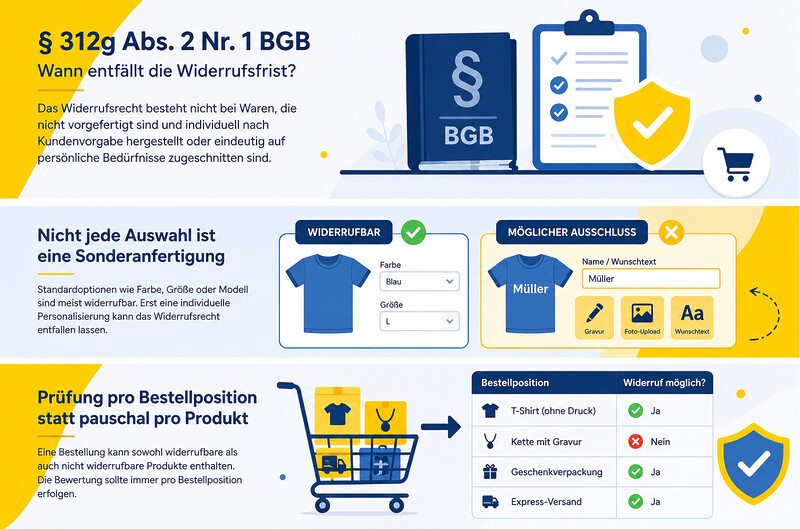
Not every selection is a custom-made item
A common mistake in online shops is the assumption that every product selection is automatically a custom-made item. This is too general.
Standard options such as color, size, material, or model do not automatically make a product individual. A blue T-shirt in size L is usually still normal returnable goods if it is a regular variant that can also be sold to other customers.
It is different if the customer makes a personal specification that clearly individualizes the product.
Examples:
- A T-shirt with a standard color and standard size is usually returnable.
- A T-shirt with a custom name print may be excluded from the right of withdrawal.
- A necklace without engraving is usually returnable.
- A necklace with a personal engraving may be excluded from the right of withdrawal.
- A piece of jewelry with a fingerprint, paw print, or handwriting is regularly a custom-made item.
- A product with a photo upload for printing or engraving is regularly personalized.
- Glasses with individual prescription strength can be a custom-made item.
- Custom-made furniture or individually manufactured CNC parts may be excluded from the right of withdrawal.
- Gift packaging alone, however, usually does not make the product a custom-made item.
- Express shipping is also not a product-related customization.
Why the exclusion should not be made across the board for each product
Many shops manage the exclusion of the right of withdrawal on a product-by-product basis. This sounds logical at first, but is often inaccurate for customizable products.
This is because a product can be treated differently in two different orders.
Example:
- A customer orders a T-shirt without print.
- Another customer orders the same T-shirt with a personalized name.
The product is identical. However, the legal assessment can be different.
The first order is likely to be standard returnable goods. The second order may be a custom-made item.
Therefore, a return button should not only check which product was purchased. It should check whether the specific order item contains personalized data.
This is particularly important for WooCommerce shops that use product options, add-ons, configurators, upload fields, or engraving fields.
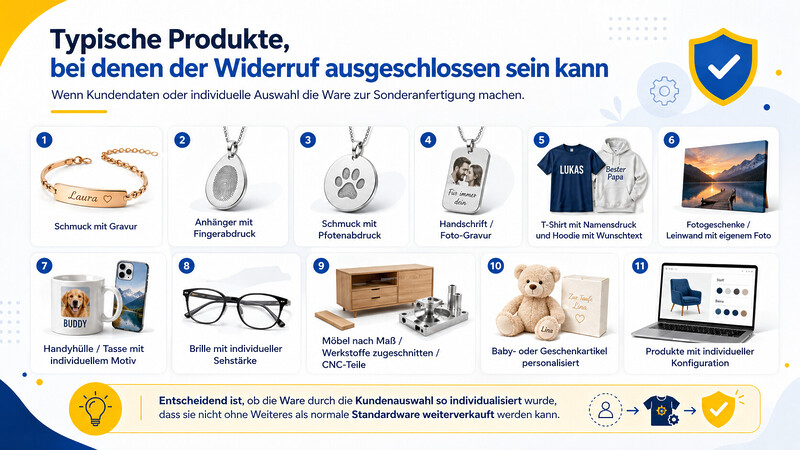
Typical products for which the right of withdrawal may be excluded
In practice, the exclusion of the right of withdrawal often affects products that are modified by customer data or individual selection.
Typical examples are:
- Jewelry with engraving
- Pendants with fingerprints
- Jewelry with paw prints
- Jewelry with handwriting
- Jewelry with photo or motif engraving
- T-shirts with name print
- Hoodies with custom text
- Photo gifts
- Canvases with your own photo
- Phone cases with individual design
- Mugs with custom image
- Glasses with individual prescription strength
- Custom-made furniture
- Cut-to-size panels or materials
- CNC-manufactured individual parts
- Personalized baby or gift items
- Products with individual configuration
It is always important whether the goods have been individualized by the customer’s selection in such a way that they can no longer be sold as normal standard goods without further ado.
Typical options that are unlikely to justify an exclusion of the right of withdrawal
Not every additional option is sufficient to exclude the right of withdrawal.
Typical examples that do not automatically lead to a custom order are:
- Standard size
- Standard color
- Normal variant selection
- Gift wrapping
- Express shipping
- Standard accessories
- Regular packaging options
- Normal delivery options
- Selection from ready-made stock products
- Standard designs without personal customization
While these options may be part of the order, they usually do not change the product in a way that clearly customizes it for the customer.
Video on probably the best revocation button plugin:
The technical problem in WooCommerce
WooCommerce often stores personalizations as so-called order item data. This data can originate from very different plugins.
One shop might use an engraving field. Another shop might use an upload field. Yet another shop works with a complex product configurator.
This results in technically very different data structures.
Examples of such fields are:
- Engraving text
- Desired name
- Desired date
- Photo upload
- File upload
- Paw print
- Fingerprint
- Handwriting
- Motif selection
- Configurator selection
- Measurements
- Special Request
- Custom Product Option
- Product Add-on
- Extra Product Option
The problem: This data is not named the same in every shop. Depending on the plugin, it is stored differently. Sometimes as simple text, sometimes as an array, sometimes as JSON, sometimes as serialized data or as an upload URL.
A clean revocation button must therefore be able to do more than just check a product identifier!
It must recognize whether personalized content is present for the specific order item.

For WordPress & WooCommerce, we have already developed the perfect solution as a revocation plugin:
Why an intelligent revocation button is important
A revocation button should give the customer an easy way to declare a revocation. At the same time, however, the shop must not display incorrect revocation options for products for which the right of revocation is legally excluded.
This is particularly important for mixed orders.
Example:
A customer orders:
- a standard T-shirt without personalization
- a necklace with name engraving
- gift wrapping
- express shipping
Here, it would be incorrect to treat the entire order as generally revocable or non-revocable.
A check per order item is correct.
The standard T-shirt may be revocable.
The necklace with name engraving may be excluded from revocation.
Gift wrapping does not automatically make the product a custom order.
Express shipping is not product-related personalization.
This is precisely why a WooCommerce shop needs a differentiated technical solution.
Plugin Note: WooCommerce Revocation Button with Automatic Personalization Detection
For WooCommerce shops, a revocation button is particularly useful if it can automatically detect personalized products.
The WooCommerce Revocation Button Plugin by Vastcob was developed precisely for such cases. It automatically detects personalized order items and can thus distinguish whether an order contains standard revocable goods or a possible custom order.
Particularly important here is that the detection does not only occur rigidly via a specific product, but via the concrete data of the order item.
Among other things, the plugin can work with the following recognition logics:
- Meta-key patterns with wildcards
- Presets for known custom field plugins
- Universal marker via CSS class or ID
- Keyword recognition in option name
- Whitelist for exceptions
- Recognition of uploads, engravings, and individual configurator values
This allows for a technical representation of what is legally decisive: not every product is automatically excluded, but only the specific personalized version.
This is particularly helpful for shops with engravings, photo uploads, individual print data, jewelry personalization, configured products, or custom-made items.
Why a whitelist is important
Automatic detection should not be too aggressive. Otherwise, there is a risk that harmless options will be mistakenly classified as custom-made.
Example:
A meta field contains the word "gift wrapping".
This is an additional service, but not a customization of the actual product.
Or:
A field contains "express shipping".
This also concerns delivery, not the manufacture of the goods.
Therefore, a good system should also be able to define exceptions.
Typical whitelist examples are:
- Gift wrapping
- Express shipping
- Greeting card without product modification
- Delivery note
- Internal notes
- Packaging options
- Standard accessories
This prevents normal additional options from being accidentally classified as an exclusion from the right of withdrawal.
What shop operators should legally consider
Shop operators should not use the exclusion from the right of withdrawal blindly or generally.
A clear classification is important:
- Is the product truly custom-made?
- Is the customer’s selection decisive for the production?
- Is the product clearly tailored to personal needs?
- Can the product still be sold regularly after return?
- Is it a genuine product modification or just an additional service?
- Was the customer transparently informed about the exclusion of the right of withdrawal?
The last point in particular is important. The customer should be able to clearly recognize before ordering when personalization leads to the right of withdrawal being forfeited.
This applies not only to the cancellation policy, but ideally also to notices directly at the product option, in the shopping cart, or at checkout.
Practical examples for shop operators
Example 1: Jewelry with engraving
A customer orders a necklace with an individual name engraving.
Since the piece of jewelry is individually customized with the customer’s name, the right of withdrawal may be excluded.
Example 2: Jewelry without engraving
A customer orders the same necklace without engraving.
There is no individual customization here. The product is generally standard returnable goods.
Example 3: T-shirt with standard motif
A customer chooses a ready-made standard motif from the shop.
If the motif is predefined and the product is not individually tailored to the customer, the product may still be revocable.
Example 4: T-shirt with custom text
A customer enters their own name or slogan.
This may constitute a custom order because the product is manufactured individually according to customer specifications.
Example 5: Gift wrapping
A customer chooses gift wrapping.
The product itself is not individually manufactured as a result. Therefore, gift wrapping alone should normally not trigger an exclusion of the right of withdrawal.
Example 6: Photo upload
A customer uploads their own photo, which is printed or engraved on a product.
This regularly constitutes clear personalization.
Example 7: Custom-made item
A customer provides individual measurements for a piece of furniture, a panel, or a component.
If the goods are manufactured specifically according to these measurements, the right of withdrawal may be excluded.
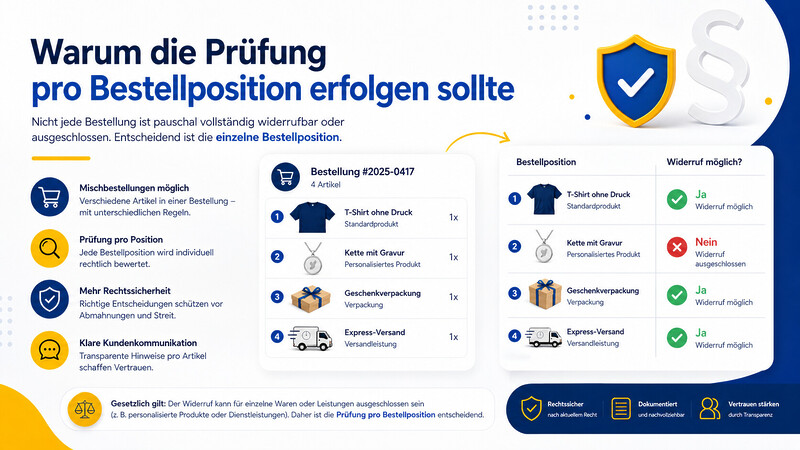
Why the check should be performed per order item
In WooCommerce, orders can consist of multiple products. Some of them may be revocable, others not.
Therefore, a check at the order level is often too broad.
A check per order item is better.
This allows the shop to distinguish:
- Which products are normal returnable goods?
- Which products are personalized?
- Which options are only additional services?
- Which items may be displayed in a return form?
- Which items should be excluded from the right of withdrawal?
This differentiation reduces errors and ensures better user guidance.
The withdrawal button from June 2026
From June 19, 2026, the withdrawal button will become relevant for many online contracts. Consumers should be able to digitally withdraw from contracts concluded online more easily in the future.
For shop operators, this means: The withdrawal option must be technically sound and easily accessible.
At the same time, the shop must still correctly distinguish whether a right of withdrawal even exists.
Especially with personalized products, this creates an interface between law and technology.
A withdrawal button is not just a form. Ideally, it must also recognize which products are returnable and which may be excluded due to individual customization.
Recommendation for WooCommerce Shops
Shop operators with personalized products should carefully review their product logic.
The following questions are particularly important:
- Are engravings offered?
- Are there upload fields?
- Can customers enter their own texts?
- Are configurators available?
- Are products custom-made?
- Are personal motifs, names, or dates used?
- Are fingerprints, paw prints, or handwriting processed?
- Are there harmless additional options that should not lead to the exclusion of the right of withdrawal?
- Is the exclusion technically checked per order item?
If these questions are relevant, the withdrawal button should not just be statically integrated. It should be able to evaluate the actual order data.
Therefore, it is essential to use our WooCommerce plugin for clear revocation.
Conclusion on revocation for individual and personalized products
The exclusion of revocation for personalized products is not a blanket product status. The decisive factor is whether the specific goods were individually manufactured, modified, or tailored to personal needs according to customer specifications.
A normal product generally remains revocable. However, the same product with engraving, name print, photo upload, fingerprint, paw print, custom text, spectacle prescription, or custom-made design may be excluded from the right of revocation.
For WooCommerce shops, this means: The revocation button should not only check per product, but per order item, whether a relevant personalization is present.
A plugin with automatic detection of engravings, uploads, configurator fields, meta-data, keywords, and whitelist exceptions can help to implement this check technically cleanly.
Nevertheless, it remains important: Shop operators should have their specific revocation logic, revocation policy, and product configuration legally reviewed. This article does not replace legal advice but shows the most important technical and legal basics for personalized products in a WooCommerce shop.
Disclaimer: This article is for general information purposes only and does not constitute legal advice. The legal assessment of whether a product is actually excluded from the right of revocation always depends on the specific individual case, the product design, and the respective shop implementation. Shop operators should have their revocation policy, product texts, checkout notices, and technical implementation reviewed by qualified legal counsel in case of doubt.



 DE
DE