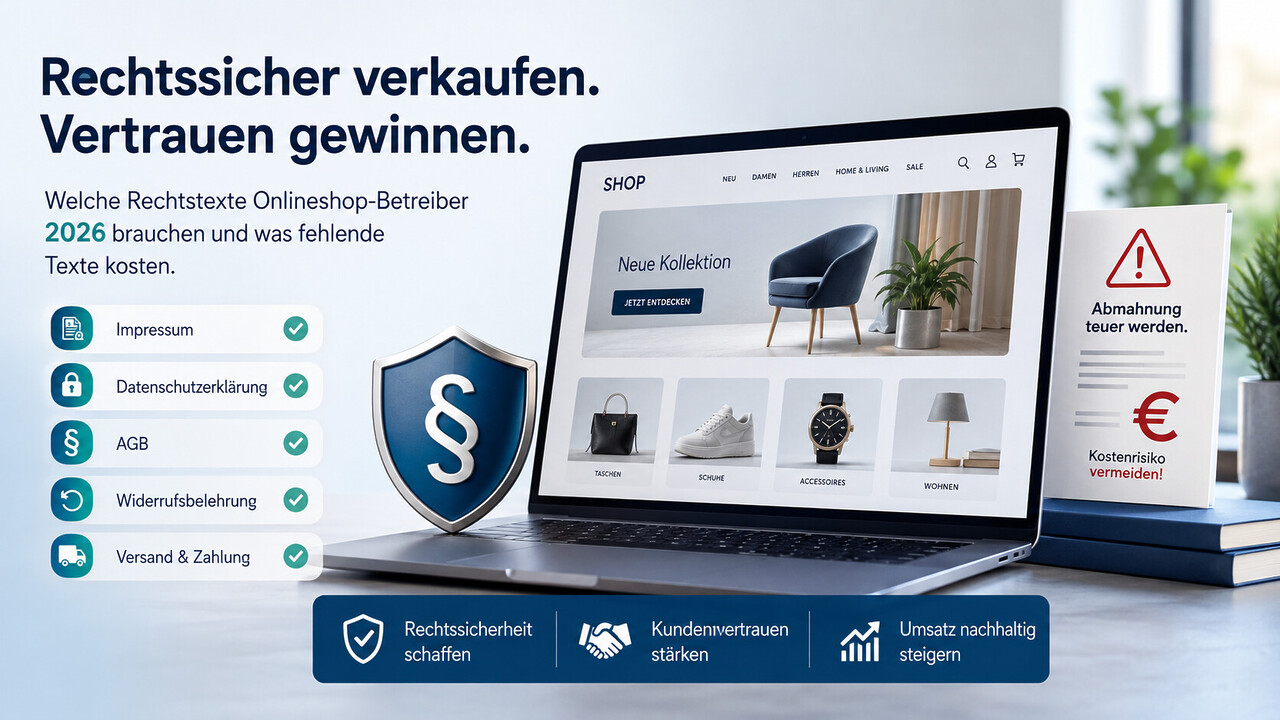
As of June 19, 2026, § 356a BGB requires every online shop to have an electronic cancellation button. For many shop operators, this raises the uncomfortable question of what happens with partial cancellations in WooCommerce when custom-made products or other legally excluded products are combined with standard goods in one order.
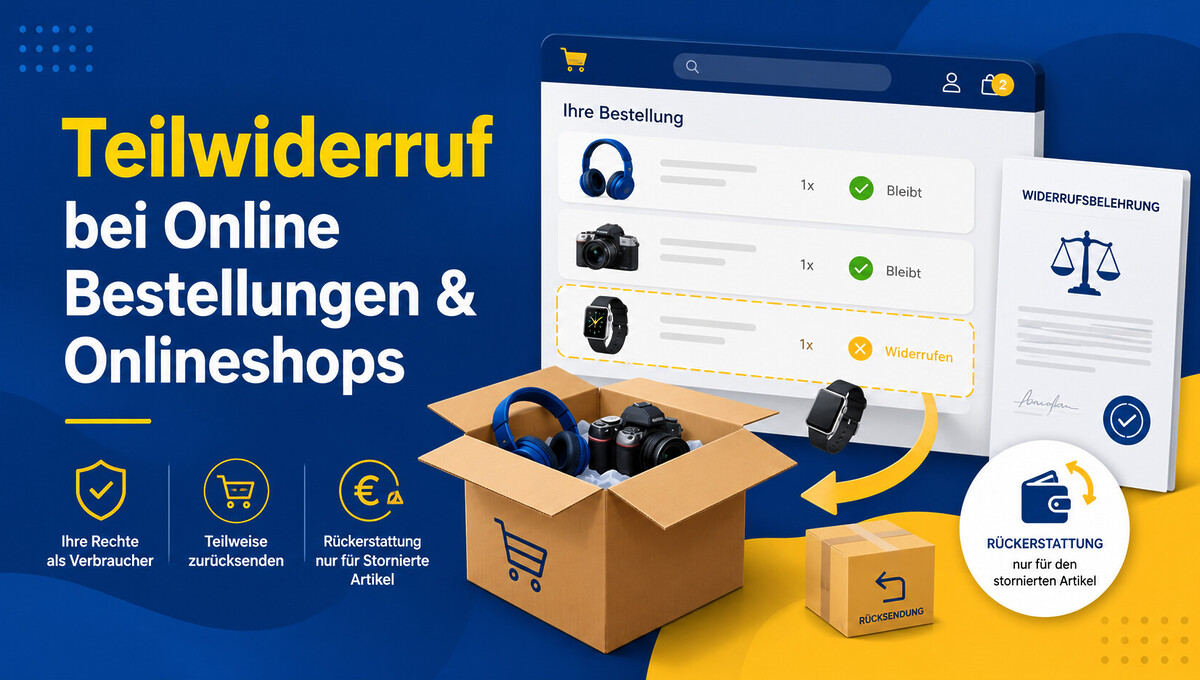
Partial Cancellation for Online Orders & Online Shops
We show you which legal requirements apply, why a blanket cancellation button does not solve mixed orders, and how you can technically implement the special case in your shop without encountering legal difficulties.
What does partial cancellation mean in online retail?
A partial cancellation occurs when a consumer cancels not the entire order, but only individual items. This is always practically relevant when an order contains both cancellable standard goods and legally excluded products. In our consulting practice at VASTCOB, we see this case in almost every shop that sells custom-made products, personalized goods, or sealed products.
With the electronic cancellation option according to § 356a BGB, which becomes mandatory for every shop from June 19, 2026, the term gains additional urgency. The button creates a clear expectation for the customer, who intuitively understands it as a full cancellation for the entire order. If your assortment is partly cancellable and partly excluded, there is a gap between user expectation and legal reality.
It is important to distinguish this from voluntary returns or goodwill. The statutory partial cancellation only applies to genuinely cancellable items and does not change the fact that other recognized forms of cancellation, such as email, telephone, or letter, will continue to exist alongside the button after 2026. The button is an additional option, not a replacement.
Tip: Always up-to-date legal texts with IT-Recht-Kanzlei.
Alternative: eRecht24
Which products are excluded from the right of cancellation?
The German legislator has stipulated eight exceptions to the right of cancellation in § 312g Paragraph 2 BGB. Not every product can be returned free of charge after the contract has been concluded, and for many assortments, precisely this separation is the core of the business model.
In practice, five main categories emerge. Custom-made products such as a blackboard with a custom text engraving, individually printed T-shirts, or custom furniture fall under number 1, perishable goods under number 2, sealed hygiene articles and data carriers under number 3, activated software under number 9, and unsealed audio recordings under number 6. Anyone who carries one of these assortments has some of their products legally outside the classic cancellation path.
It is crucial that this exclusion only applies if it has been clearly communicated in the cancellation policy before the conclusion of the contract. Art. 246a § 1 Paragraph 3 EGBGB explicitly requires this prior information. Those who technically exclude but have not adapted the cancellation policy accordingly run the risk of the exclusion being ineffective. We therefore recommend in every project to obtain the cancellation policy texts from a specialized source such as the IT-Recht-Kanzlei.
Become more visible on Google & Social Media?
In a free strategy consultation for data-driven online marketing, we uncover your untapped potential, review any existing ad accounts if necessary, examine your SEO ranking and visibility, and determine which strategy is appropriate for your budget and which active measures will lead to more inquiries or sales.

✅ More visibility & perception through targeted placement
✅ More visitors > prospects > customers > revenue
✅ Reach target groups scalably with SEA
✅ Act and grow sustainably with SEO
🫵 Maximum success with our hybrid strategy
💪 More than 15 years of experience across industries in over 1,000+ projects demonstrable!







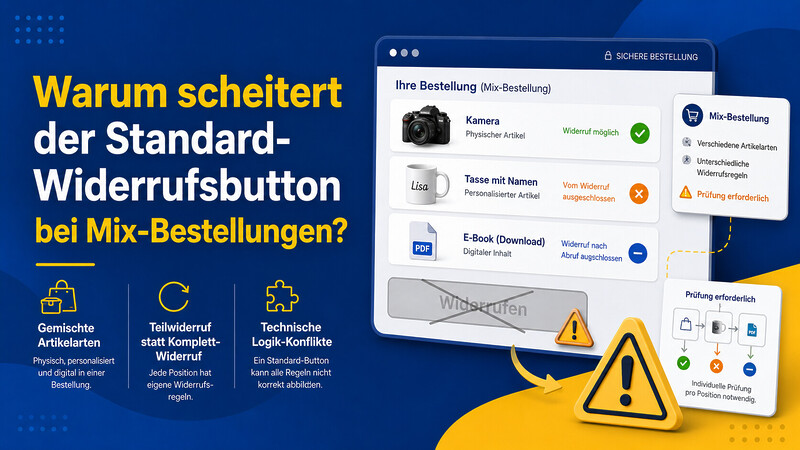
Why does the standard cancellation button fail for mixed orders?
Most WooCommerce plugins that already implement § 356a BGB treat the cancellation button as a mere mandatory mechanism. A click, a form, an email dispatch. This works for shops with exclusively standard goods, but leaves open precisely the case that is commonplace in mixed assortments.
Imagine a shop that sells handcrafted chalkboards with individual engraving and also has standard chalkboard paint in its assortment. If a customer orders both in one transaction, the blanket button records both items. This signals to the customer that they can cancel the entire order. Legally, however, this does not apply to the engraved chalkboard.
Three order types must be technically distinguishable for the button to work legally. The purely standard order is uncomplicated; here, the button works as intended. For a purely custom order, the button must not be offered at all, as it would suggest a right that does not exist. The mixed order is the actual hard case and precisely the case where most plugins fail. Ignoring it risks misleading instructions and thus warnings.

The better plugin solution for the WooCommerce cancellation button with Germanized or German Market independently:
How does a WooCommerce plugin automatically detect excluded products?
A clean solution recognizes excluded products across multiple configuration levels, because no shop setup is like another. At the product level, a checkbox on the individual product is sufficient for special cases. At the assortment level, multi-select options apply to entire categories or tags, such as a category like „Personalized“ or „Custom Order“. For individual business logic, a developer filter remains, with which any product properties can be checked.
When the cancellation page is called up, the plugin analyzes the order items in the background and assigns them to one of the three order types. Pure standard goods get the button. Pure custom orders instead receive a clear notice according to § 312g Paragraph 2 BGB. Mixed orders are divided into two clearly separated lists, one for excluded and one for cancellable products, supplemented by contact options for partial cancellation.
From our experience as a specialized WooCommerce agency, we see that the category solution is the most low-maintenance approach in most shops. Once a category for excluded products has been created and linked in the plugin, all future products automatically inherit the status. This saves ongoing maintenance effort and prevents manual configuration from being forgotten for every new special product.
How does a partial cancellation work in practice?
The legislator does not provide for automated partial cancellation in § 357 BGB. The reversal is carried out manually, usually by the customer contacting the shop, subsequent checking and partial refund. Anyone who wanted to automate this would assume legal responsibility, which § 357 BGB explicitly leaves with the shop operator.
Technically, this means for mixed orders that the electronic button is deliberately not offered here, because it would only cover the entire order. Instead, the customer sees the two divided product lists and a clearly formulated notice with the contact options for partial cancellation. The notice text works with placeholders for shop email and phone, so you can store it once and the plugin automatically inserts the correct data.
This creates a clean handover point between self-service and manual customer service. The customer immediately understands which products can be automatically revoked and for which they need to contact customer service. As a shop operator, you retain legal control over the reversal of mixed orders and do not have to correct errors afterwards that a too general button might have caused.
What obligations apply to the right of withdrawal information?
Art. 246a § 1 Paragraph 3 EGBGB is clear. An exclusion of the right of withdrawal only applies if it is communicated in the right of withdrawal information before the contract is concluded. A plugin alone is not enough, no matter how cleanly the technical detection of the products works.
From our consulting experience, this is precisely the most common practical error. The technical exclusions are set in the plugin, but the information still contains the standard text without any reference to custom-made products, hygiene articles, or other excluded assortments. The consequence is a legally ineffective exclusion that is of no help in case of a dispute and potentially proves to be a warning template.
A built-in compliance check that draws the shop operator’s attention to this point is useful. As soon as an exclusion is configured somewhere, the plugin should remind the user in the backend to adapt the information accordingly and document the one-time confirmation with a date. For the information texts themselves, we recommend obtaining them from the IT-Recht-Kanzlei or a comparable specialized source. Ongoing maintenance fits thematically into our service package WordPress Maintenance, where we regularly check such compliance checks.
How do you configure the exclusion of the right of withdrawal in five steps?
Let’s take the chalkboard shop from the introductory example and go through the configuration in detail. The same procedure can be applied to any other shop with a mixed assortment, from printed T-shirts to custom-made furniture.
The following five steps lead to a functioning setup:
- Create a product category such as "Personalized" or "Custom-made" and assign all engraved or printed products to it.
- In the plugin tab for exclusions, select the category via multi-select so that all products in the category are automatically recognized as excluded.
- Adjust the hint text for mixed orders and include the phone number and email using the provided placeholders.
- Check the right of withdrawal information in the shop’s terms and conditions and update it if necessary, then confirm acceptance in the plugin’s compliance tab.
- Place three test orders, one purely standard, one purely custom-made, and one mixed, and verify the compliance score and the respective displays.
If your shop has a larger product catalog or covers special constellations such as configurator products or hybrid bundles, an individual review of the configuration is worthwhile. We would be happy to advise you on which detection path is easiest to maintain for your assortment and where the filter mechanism for developers is the better choice compared to the category solution.
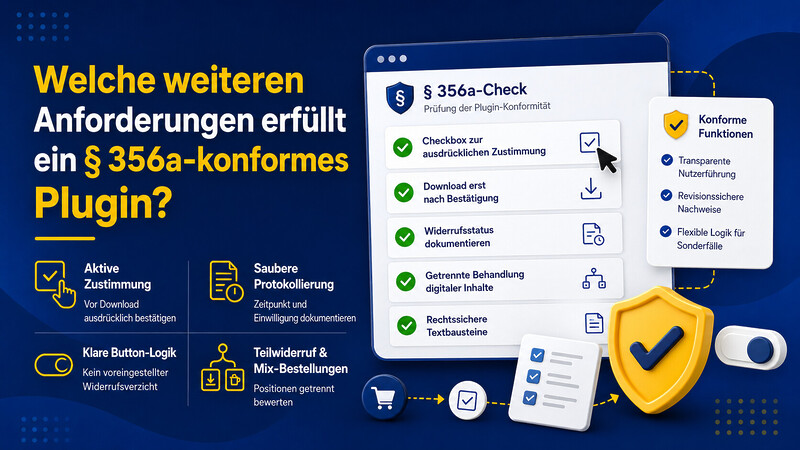
What other requirements does a § 356a-compliant plugin fulfill?
Beyond the logic for mixed orders, § 356a paragraph 4 BGB imposes specific obligations on the electronic revocation process. Mandatory is an automatic confirmation of receipt via email with the revocation as a PDF attachment, an order note with a unique reference number, and ideally an optional dropdown for the reason for revocation for evaluation purposes.
In practice, many plugins overlook the security and architectural requirements that a production-ready setup must meet. Protection against brute-force order number enumeration through rate-limiting is one such requirement, as is compatibility with WooCommerce’s HPOS architecture, an awareness of multilingual shops via WPML or Polylang, and clean integration with common page builders such as Elementor, Divi, WPBakery, Bricks, or Oxygen.
One detail that regularly causes annoyance in accounting is the status change after revocation. By default, there should be no automatic status change here, because interfaces such as Lexoffice or sevDesk can react sensitively to such changes and trigger unwanted bookings. Configurable and clearly documented is much better than forced. As a Trusted Shops Qualified Expert with over ten years of WooCommerce experience, we have seen exactly such pitfalls multiple times in live operation and incorporated them into our recommendations for ongoing online shop optimization.
Conclusion
The electronic revocation button can also be legally implemented for shops with custom-made products if the plugin used clearly distinguishes between the three order types and creates a clearly documented handover point to customer service for mixed orders. The button supplements the existing revocation methods; it does not replace them. Precisely this separation is the point where many standard plugins fall short.
If you are looking for a solution that covers exactly this special case, you can find our plugin at software.vastcob.com/woocommerce-widerrufsbutton. For individual configuration in more complex shop setups or for shops with mixed assortments, we would be happy to advise you without obligation.
Frequently Asked Questions
What is a partial revocation?
A partial revocation occurs when a customer revokes only individual items of an order, for example, because other items are excluded from revocation according to § 312g paragraph 2 BGB. This is legally permissible but technically not achievable by the electronic revocation button alone, as it operates per order. In practice, processing is done via customer service with subsequent partial reimbursement.
Do custom-made products have to be offered in the revocation button?
No. If custom-made products are excluded from revocation according to § 312g paragraph 2 number 1 BGB and are stated as such in the revocation policy, they must not be revoked via the button. A suitably configured plugin automatically recognizes such products and hides the button for orders consisting purely of custom-made products. Instead, a clear notice according to § 312g paragraph 2 BGB appears.
What happens with a mixed order including excluded products?
The customer sees two clearly separated product lists, one with excluded and one with revocable items. The display is supplemented by a configurable notice text with contact options for partial revocation. The button is deliberately not offered in this constellation because it would only cover the entire order and thus send a misleading signal.
How do I configure the revocation exclusion in WooCommerce?
Three methods are available. A product checkbox at the individual product level for special cases, a multi-select option for entire categories or tags in the plugin backend, and a developer filter for individual business logic. The category solution is the easiest to maintain in most shops because new products automatically inherit the category’s status.
Is it sufficient to technically set exclusions?
No. The exclusion is legally effective only if it is communicated in the revocation policy before the contract is concluded, according to Art. 246a § 1 paragraph 3 EGBGB. A good plugin will point out this obligation to you in the backend and allow you to confirm once that the policy actually reflects the exclusion. Without this adjustment, the technical exclusion is ineffective.
This article is for general information purposes only and does not constitute legal advice. For a binding legal assessment in individual cases, please contact a specialized law firm. We recommend IT-Recht-Kanzlei.



 DE
DE