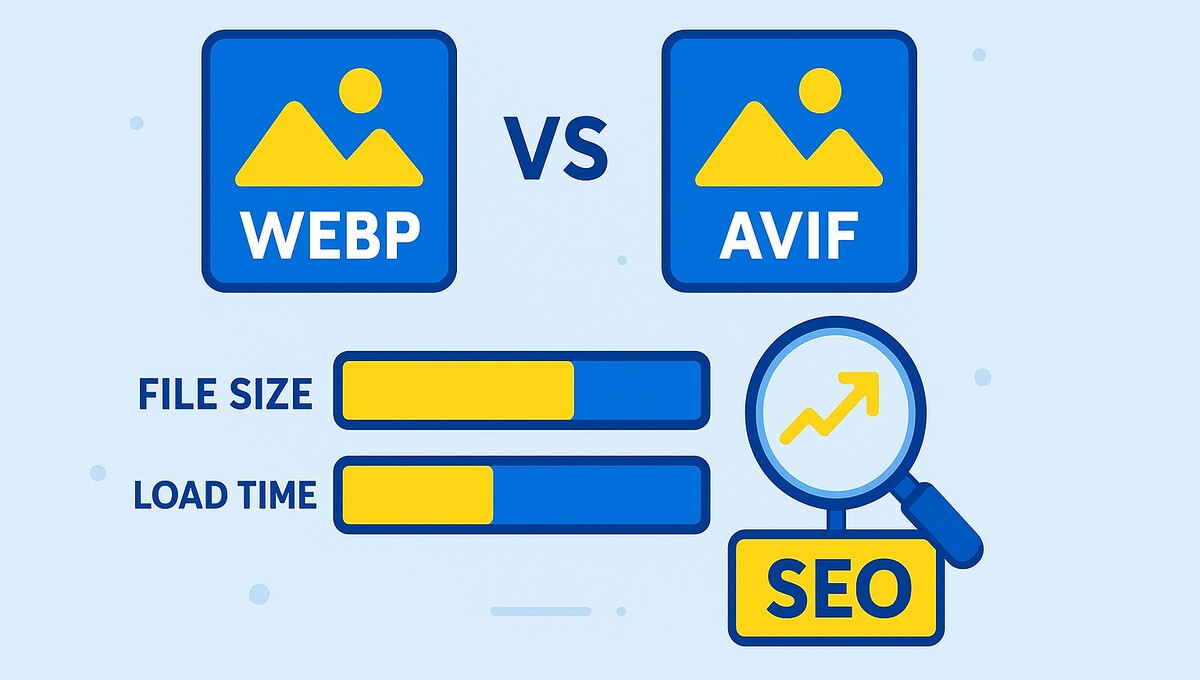
Die Wahl des richtigen Bildformats kann den Unterschied zwischen einer blitzschnellen Website und einer trägen Ladezeit ausmachen. Mit WebP und AVIF stehen zwei moderne Formate zur Verfügung, die gegenüber klassischen Formaten wie JPEG und PNG bis zu 50% kleinere Dateigrößen versprechen. Doch welches Format ist besser für SEO? Und solltest du auf WebP oder AVIF setzen?
In diesem umfassenden Vergleich erfährst du alles über beide Formate, ihre Vor- und Nachteile, Browser-Kompatibilität und konkrete Empfehlungen für verschiedene Website-Typen.
WebP vs. AVIF: Which image format is better for SEO?
Die Bedeutung von Bildformaten für SEO (Suchmaschinenoptimierung) und Sichtbarkeit in der KI-Suche
Page Speed as a ranking factor
Seit dem Page Experience Update ist die Ladegeschwindigkeit ein offizieller Google-Ranking-Faktor. Bilder machen typischerweise 50-70% der Gesamtgröße einer Webseite aus. Durch optimierte Bildformate kannst du:
- Ladezeiten reduzieren: Bis zu 50% schnellere Seiten
- Core Web Vitals verbessern: Bessere LCP-Werte (Largest Contentful Paint)
- Mobile Performance steigern: Weniger Datenverbrauch
- Bounce Rate senken: Nutzer warten nicht auf langsame Seiten
Google's recommendations + Chat GPT readability aid
Google PageSpeed Insights empfiehlt explizit moderne Bildformate und warnt bei der Verwendung veralteter Formate. Websites mit optimierten Bildern erhalten bessere Scores, was indirekt das Ranking beeinflusst.
WebP: The established standard
What is WebP?
WebP wurde 2010 von Google entwickelt und ist seit Jahren der Standard für moderne Bildkompression. Das Format unterstützt sowohl verlustbehaftete als auch verlustfreie Kompression sowie Transparenz und Animationen.
Technical Specifications
Compression:
- Lossy: 25-35% smaller than JPEG
- Lossless: 26% smaller than PNG
- Supports 24-bit RGB and 8-bit alpha channel
Advantages: ✅ Hervorragende Browser-Unterstützung (98%+) ✅ Etabliert seit über 10 Jahren ✅ Breite Tool-Unterstützung ✅ Gute Balance zwischen Qualität und Dateigröße ✅ Unterstützt Transparenz und Animation ✅ Schnelle Encoding/Decoding-Geschwindigkeit
Disadvantages: ❌ Kompression schlechter als AVIF ❌ Keine HDR-Unterstützung ❌ Begrenzte Farbtiefe (8-Bit)
Browser Compatibility WebP
Vollständig unterstützt (Stand November 2025):
- Chrome: Since version 23 (2012)
- Firefox: Since version 65 (2019)
- Edge: Since version 18 (2018)
- Safari: Since version 14 (2020)
- Opera: Since version 12.1 (2012)
Mobile Browser:
Become more visible on Google & Social Media?
In a free strategy consultation for data-driven online marketing, we uncover your untapped potential, review any existing ad accounts if necessary, examine your SEO ranking and visibility, and determine which strategy is appropriate for your budget and which active measures will lead to more inquiries or sales.

✅ More visibility & perception through targeted placement
✅ More visitors > prospects > customers > revenue
✅ Reach target groups scalably with SEA
✅ Act and grow sustainably with SEO
🫵 Maximum success with our hybrid strategy
💪 More than 15 years of experience across industries in over 1,000+ projects demonstrable!







- Chrome Android: Complete
- Safari iOS: Since iOS 14 (2020)
- Samsung Internet: Complete
Marktabdeckung: ~98% aller Nutzer weltweit
Performance data WebP
Benchmark-Vergleich bei gleicher visueller Qualität:
| Format | File size | Comparison to JPEG |
|---|---|---|
| JPEG | 100 KB | Baseline |
| PNG | 180 KB | +80% |
| WebP (lossy) | 68 KB | -32% |
| WebP (lossless) | 132 KB | +32% vs JPEG |
AVIF: The future of image compression
What is AVIF?
AVIF (AV1 Image File Format) ist das neueste Bildformat, entwickelt von der Alliance for Open Media. Es basiert auf dem AV1-Video-Codec und wurde 2019 offiziell veröffentlicht.
Technical Specifications
Compression:
- Lossy: 50% smaller than JPEG
- Up to 20-30% better than WebP
- Supports HDR and Wide Color Gamut
Advantages: ✅ Beste Kompression aller modernen Formate ✅ HDR-Unterstützung ✅ Höhere Farbtiefe (10-Bit und 12-Bit) ✅ Bessere Detailerhaltung bei starker Kompression ✅ Unterstützt Transparenz ✅ Royalty-frei und Open Source
Disadvantages: ❌ Langsamere Encoding-Geschwindigkeit ❌ Höherer CPU-Aufwand beim Dekodieren ❌ Noch nicht flächendeckende Browser-Unterstützung ❌ Weniger Tool-Support als WebP ❌ Größere Dateien bei verlustfreier Kompression
Browser Compatibility AVIF
Vollständig unterstützt (Stand November 2025):
- Chrome: Since version 85 (2020)
- Firefox: Since version 93 (2021)
- Edge: Since version 121 (2024)
- Opera: Since version 71 (2020)
- Safari: Seit Version 16.1 (2022) – macOS Ventura+
Limited/Not supported:
- Safari iOS: Since iOS 16 (2022)
- Older browsers: No support
Marktabdeckung: ~88% aller Nutzer weltweit (Tendenz steigend)
Performance data AVIF
Benchmark-Vergleich bei gleicher visueller Qualität:
| Format | File size | Comparison to JPEG |
|---|---|---|
| JPEG | 100 KB | Baseline |
| WebP | 68 KB | -32% |
| AVIF | 50 KB | -50% |
Wichtig: Bei hochauflösenden Bildern und komplexen Motiven ist der Vorteil von AVIF noch deutlicher (bis zu 60% Ersparnis).
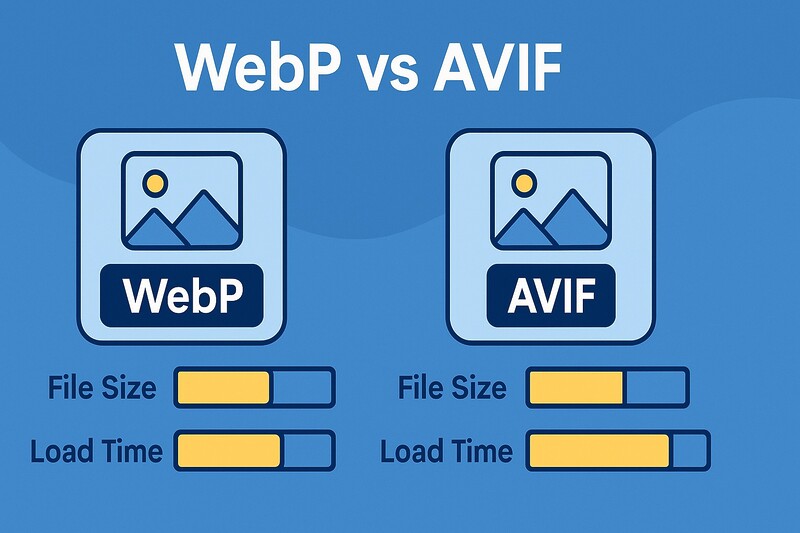
The direct comparison: WebP vs. AVIF
Compression Efficiency
Test-Szenario: Produktfoto 1920x1080px, hohe Qualität
Original JPEG: 856 KB
WebP (Qualität 85): 542 KB (-37%)
AVIF (Qualität 85): 398 KB (-54%)
Gewinner: AVIF (20-30% besser als WebP)
Visual Quality
With the same file size:
- WebP: Gute Qualität, leichte Artefakte bei starker Kompression
- AVIF: Bessere Detailerhaltung, weniger Blocking-Artefakte
Bei starker Kompression (unter 30% der Originalgröße):
- WebP: Deutlich sichtbare Qualitätsverluste
- AVIF: Still acceptable quality
Winner: AVIF
Encoding Speed
Test-System: Intel i7, 1920x1080px Bild
JPEG: 0,3 Sekunden
WebP: 1,2 Sekunden
AVIF: 8,5 Sekunden
Winner: WebP (7x faster than AVIF)
Decoding speed (browser)
Desktop:
- WebP: ~50ms
- AVIF: ~120ms
Mobile (mid-range hardware):
- WebP: ~180ms
- AVIF: ~450ms
Winner: WebP (2-3x faster)
Browser Support
WebP: 98% Marktabdeckung AVIF: 88% Marktabdeckung
Gewinner: WebP (10% mehr Nutzer erreicht)
Tool ecosystem
WebP:
- Adobe Photoshop: Native Support
- WordPress Plugins: 100+ Plugins
- CDNs: All major providers
- Image editing tools: Broad support
AVIF:
- Adobe Photoshop: Beta support
- WordPress Plugins: ~20 plugins
- CDNs: Cloudflare, Cloudinary, ImageKit
- Image editing tools: Limited support
Winner: WebP (significantly more tools)
SEO impact in detail
Core Web Vitals
Largest Contentful Paint (LCP):
- WebP can improve LCP by 15-25%
- AVIF can improve LCP by 25-40%
Cumulative Layout Shift (CLS):
- Both formats do not directly affect CLS
- Schnellere Ladezeiten reduzieren Layout-Shifts indirekt
First Input Delay (FID) / Interaction to Next Paint (INP):
- WebP: Minimal CPU load
- AVIF: Höhere CPU-Last kann INP leicht verschlechtern
PageSpeed Insights Score
Typical improvement through modern formats:
Before (JPEG/PNG):
- Mobile: 45-55 points
- Desktop: 75-85 Points
After (WebP):
- Mobile: 65-75 points (+20)
- Desktop: 90-95 Points (+10)
After (AVIF):
- Mobile: 70-80 points (+25)
- Desktop: 92-98 Points (+12)
Mobile-First Indexing
Google crawlt primär mit mobilen Bots. Bei mobilen Verbindungen sind kleinere Dateien noch wichtiger:
3G Connection (1.5 Mbps):
- 100 KB JPEG: ~0.5 seconds
- 68 KB WebP: ~0.36 seconds (-28%)
- 50 KB AVIF: ~0.27 seconds (-46%)
Image Search Ranking
Google prefers websites with:
- Fast loading times ✅
- Modern image formats ✅
- Good Mobile Performance ✅
Beide Formate erfüllen diese Kriterien, AVIF hat einen leichten Vorteil durch kleinere Dateien.
Practical Scenarios: Which Format When?
E-Commerce / WooCommerce Shops
Recommendation: WebP with AVIF fallback
Reasons:
- Produktbilder werden häufig aktualisiert (schnelles Encoding wichtig)
- Mobile Nutzer dominieren (kleinere Dateien wichtig)
- Broad Browser Compatibility Required
- High number of images per page (consider CPU load)
Implementation:
<picture>
  <source srcset="produkt.avif" type="image/avif">
  <source srcset="produkt.webp" type="image/webp">
  <img src="produkt.jpg" alt="Produktname">
</picture>
Blog / Content websites
Empfehlung: WebP (mit optionalem AVIF für Hero-Images)
Reasons:
- Many images per article
- SEO traffic dominates (PageSpeed important)
- Easy integration with WordPress
- Low server load during conversion
WordPress plugins:
- ShortPixel (WebP + AVIF)
- Imagify (WebP + AVIF)
- EWWW Image Optimizer (WebP + AVIF)
Portfolio / Photography
Recommendation: AVIF with WebP fallback
Reasons:
- Image quality has highest priority
- Fewer images, but high resolution
- Target audience uses modern browsers
- Showcase Character
Corporate Websites
Recommendation: WebP
Reasons:
- Maximale Kompatibilität (auch mit älteren Firmen-PCs)
- Simple Implementation
- Stable performance
- IT departments prefer established standards
Landing Pages / Performance Marketing
Recommendation: AVIF with WebP fallback
Reasons:
- Conversion-Rate hängt stark von Geschwindigkeit ab
- Usually only a few, but important images
- Every millisecond counts
- Modern image important
News portals / magazine pages
Recommendation: WebP with CDN optimization
Reasons:
- Hundreds of Images Uploaded Daily
- Fast encoding essential
- Traffic spikes require low server load
- Breaking news must be online immediately
Implementierung: So stellst du auf moderne Formate um
Variant 1: WordPress plugins (simplest solution)
Recommended plugins:
1. ShortPixel (Recommendation)
- WebP + AVIF support
- Automatic conversion
- Bulk Optimization
- CDN integration
- From €9.99/month
2. Imagify
- WebP + AVIF
- 3 Quality Levels
- Backup function
- From €9.99/month
3. EWWW Image Optimizer
- Free basic version
- WebP + AVIF (Premium)
- Local or Cloud
- Premium from €7/month
ShortPixel Guide:
1. Plugin installieren & aktivieren
2. Settings → ShortPixel
3. "Create WebP versions" aktivieren
4. "Create AVIF versions" aktivieren (optional)
5. "Deliver next-gen versions via .htaccess" aktivieren
6. Bulk-Optimierung starten
Variant 2: .htaccess Method (advanced)
Automatische Auslieferung basierend auf Browser-Support:
<IfModule mod_rewrite.c>
  RewriteEngine On

  # AVIF Support prüfen
  RewriteCond %{HTTP_ACCEPT} image/avif
  RewriteCond %{REQUEST_FILENAME} \.(jpe?g|png)$
  RewriteCond %{REQUEST_FILENAME}.avif -f
  RewriteRule ^ %{REQUEST_FILENAME}.avif [T=image/avif,E=accept:1,L]

  # WebP Support prüfen (Fallback)
  RewriteCond %{HTTP_ACCEPT} image/webp
  RewriteCond %{REQUEST_FILENAME} \.(jpe?g|png)$
  RewriteCond %{REQUEST_FILENAME}.webp -f
  RewriteRule ^ %{REQUEST_FILENAME}.webp [T=image/webp,E=accept:1,L]
</IfModule>

<IfModule mod_headers.c>
  Header append Vary Accept env=REDIRECT_accept
</IfModule>

# Korrekte MIME-Types setzen
<IfModule mod_mime.c>
  AddType image/webp .webp
  AddType image/avif .avif
</IfModule>
Variant 3: Picture element (maximum control)
Manual HTML:
<picture>
  <source
    srcset="bild-320.avif 320w, bild-640.avif 640w, bild-1024.avif 1024w"
    type="image/avif"
    sizes="(max-width: 640px) 100vw, 640px">
  <source
    srcset="bild-320.webp 320w, bild-640.webp 640w, bild-1024.webp 1024w"
    type="image/webp"
    sizes="(max-width: 640px) 100vw, 640px">
  <img
    srcset="bild-320.jpg 320w, bild-640.jpg 640w, bild-1024.jpg 1024w"
    sizes="(max-width: 640px) 100vw, 640px"
    src="bild-640.jpg"
    alt="Bildbeschreibung"
    width="640"
    height="480"
    loading="lazy">
</picture>
Advantages:
- Full control over breakpoints
- Art direction possible
- Optimal for performance
Disadvantages:
- Elaborate manual maintenance
- More Code per Image
Variant 4: CDN with automatic conversion
Cloudflare Polish:
1. Cloudflare aktivieren
2. Speed → Optimization
3. "Polish" auf "Lossless" oder "Lossy"
4. "WebP" aktivieren
5. Automatische Auslieferung
Cloudinary:
<img src="https://res.cloudinary.com/demo/image/upload/f_auto,q_auto/sample.jpg">
f_auto automatically selects AVIF, WebP or JPEG
ImageKit:
<img src="https://ik.imagekit.io/demo/sample.jpg?tr=f-auto,q-auto">
Variant 5: PHP Conversion (for Developers)
WebP conversion:
function convert_to_webp( $source, $destination, $quality = 85 ) {
    $info = getimagesize( $source );

    if ( $info['mime'] == 'image/jpeg' ) {
        $image = imagecreatefromjpeg( $source );
    } elseif ( $info['mime'] == 'image/png' ) {
        $image = imagecreatefrompng( $source );
    } else {
        return false;
    }

    imagewebp( $image, $destination, $quality );
    imagedestroy( $image );

    return true;
}
AVIF-Konvertierung (erfordert ImageMagick):
function convert_to_avif( $source, $destination, $quality = 85 ) {
    $imagick = new Imagick( $source );
    $imagick->setImageFormat( 'avif' );
    $imagick->setImageCompressionQuality( $quality );
    $imagick->writeImage( $destination );
    $imagick->clear();
    $imagick->destroy();

    return true;
}
Performance optimization: Best Practices
1. Responsive images with srcset
Generiere mehrere Größen für verschiedene Viewports:
<picture>
  <source
    media="(max-width: 640px)"
    srcset="mobile-small.avif 320w, mobile.avif 640w"
    type="image/avif">
  <source
    media="(max-width: 640px)"
    srcset="mobile-small.webp 320w, mobile.webp 640w"
    type="image/webp">
  <source
    srcset="desktop.avif 1024w, desktop-large.avif 1920w"
    type="image/avif">
  <source
    srcset="desktop.webp 1024w, desktop-large.webp 1920w"
    type="image/webp">
  <img
    srcset="mobile.jpg 640w, desktop.jpg 1024w"
    src="desktop.jpg"
    alt="Responsive Bild">
</picture>
2. Enable lazy loading
<img src="bild.webp" alt="Beschreibung" loading="lazy">
For WordPress (automatic in Gutenberg):
add_filter( 'wp_lazy_loading_enabled', '__return_true' );
3. Prioritize critical images
<!-- Hero-Image: Nicht lazy, high priority -->
<img src="hero.avif" alt="Hero" fetchpriority="high" loading="eager">

<!-- Below-the-fold: Lazy laden -->
<img src="content.webp" alt="Content" loading="lazy">
4. Specify dimensions (avoid CLS)
<img src="bild.webp" alt="Beschreibung" width="800" height="600">
WordPress macht das automatisch, wenn in der Mediathek hochgeladen.
5. Optimize quality settings
WebP:
- Photos: 80-85 quality
- Screenshots/Graphics: 90-95 quality
- Thumbnails: 75-80 quality
AVIF:
- Photos: 65-75 quality (equivalent to WebP 80-85)
- Screenshots/Graphics: 80-90 quality
- Thumbnails: 60-70 quality
6. Configure Caching
.htaccess:
<IfModule mod_expires.c>
  ExpiresActive On
  ExpiresByType image/webp "access plus 1 year"
  ExpiresByType image/avif "access plus 1 year"
</IfModule>
Nginx:
location ~* \.(webp|avif)$ {
    expires 1y;
    add_header Cache-Control "public, immutable";
}
Common problems and solutions
Problem 1: AVIF images are not displayed
Ursache: Server sendet falschen MIME-Type
Solution (.htaccess):
<IfModule mod_mime.c>
  AddType image/avif .avif
  AddType image/avif-sequence .avifs
</IfModule>
Problem 2: Images appear blurry
Cause: Overly aggressive compression
Solution: Increase Quality
- WebP: From 75 to 85
- AVIF: From 60 to 70
Problem 3: Long conversion times
Ursache: AVIF-Encoding ist ressourcenintensiv
Solution:
- WebP for bulk content
- AVIF only for important images
- Use CDN with automatic conversion
- Conversion asynchronously in the background
Problem 4: Old browsers do not display images
Cause: Missing fallback images
Solution: Always JPEG/PNG as fallback:
<picture>
  <source srcset="bild.avif" type="image/avif">
  <source srcset="bild.webp" type="image/webp">
  <img src="bild.jpg" alt="Fallback">
</picture>
Problem 5: Google indexes wrong image version
Cause: Missing Vary headers
Solution:
<IfModule mod_headers.c>
  Header append Vary Accept env=REDIRECT_accept
</IfModule>
Problem 6: High Server Load
Ursache: On-the-fly Konvertierung überlastet CPU
Solution:
- Convert images on upload
- Enable Caching
- Use CDN
- Implement conversion queue
Cost-benefit analysis
WordPress plugin costs (annual)
ShortPixel:
- Starter: €119/year (10,000 images/month)
- Business: €239/year (30,000 images/month)
Imagify:
- Infinite: €119/year (Unlimited)
EWWW Premium:
- Executive: €84/year (Unlimited)
In-house Development
Development effort:
- Basic Implementation: 8-16 Hours
- Testing & Optimization: 4-8 Hours
- Total: 500-1,200€ (at €50/hour)
Ongoing costs:
- Server resources: +10-20% CPU
- Storage: +30-50% (3 formats)
ROI example e-commerce
Initial situation:
- 1,000 Visitors/Day
- Conversion rate: 2%
- Average: €50 cart value
- Bounce Rate: 45%
After WebP conversion:
- PageSpeed: +20 points
- Load time: -1.5 seconds
- Bounce rate: -10% (to 35%)
- Conversion rate: +0.4% (to 2.4%)
Invoice:
Vorher: 1.000 × 0,55 × 0,02 × 50€ = 550€/Tag
Nachher: 1.000 × 0,65 × 0,024 × 50€ = 780€/Tag

Mehreinnahmen: 230€/Tag = 6.900€/Monat
Plugin-Kosten: 119€/Jahr = 10€/Monat

ROI: 690:1 (69.000%)
ROI Example Blog
Initial situation:
- 10,000 visitors/month
- Ad revenue: 5€ RPM (Revenue per Mille)
- Bounce Rate: 65%
After AVIF conversion:
- PageSpeed: +25 points
- Bounce Rate: -15% (to 50%)
- Page views/visit: +25%
Invoice:
Vorher: 10.000 × 0,35 × 1,5 × 5€/1000 = 26,25€/Monat
Nachher: 10.000 × 0,50 × 1,875 × 5€/1000 = 46,88€/Monat

Mehreinnahmen: 20,63€/Monat
Plugin-Kosten: 10€/Monat

Break-Even: Sofort
Profit: +10,63€/Monat
Testing and monitoring
Test before switching
1. Create baseline:
- PageSpeed Insights: Desktop & Mobile Score notieren
- Google Analytics: Document load times
- Core Web Vitals: LCP, CLS, INP capture
2. Conduct A/B Test:
- 50% users WebP/AVIF
- 50% users JPEG/PNG
- Compare metrics
Tools:
- Google Optimize (free)
- VWO (from $199/month)
- Optimizely (Enterprise)
Monitor after migration
Google Search Console:
- Core Web Vitals → Check Improvement
- Page Experience → Track score
- Mobile Usability → Identify issues
PageSpeed Insights:
- Test most important pages weekly
- Track score development
Analytics:
- Average loading time
- Bounce rate
- Pages per Session
- Conversion rate
Testing Checklist
✅ Browser Compatibility:
- Chrome, Firefox, Safari, Edge tested
- iOS Safari, Chrome Android tested
- Fallback works in older browsers
✅ Performance:
- PageSpeed score improved
- LCP reduced
- File size reduced
✅ Functionality:
- Images are displayed correctly
- Lazy loading is working
- Lightbox/galleries compatible
✅ SEO:
- Images indexed in Google Image Search
- Structured data validated
- XML sitemap updated
Future outlook: JPEG XL and other formats
JPEG XL: The next step?
Properties:
- Even better compression than AVIF
- Faster encoding
- Progressive Decoding
- Lossless conversion of JPEG
Status (2025):
- Chrome: Experimental
- Firefox: Behind Flag
- Safari: No Support
- Recommendation: Wait a bit longer
WebP 2
Google is working on a WebP successor with:
- 30% better compression
- Modern algorithms
- HDR Support
Status: Early development phase
Recommendation for the future
2025-2026:
- WebP as Standard
- AVIF for premium content
- JPEG as Fallback
2027+:
- AVIF as new standard
- JPEG XL for specialized applications
- WebP as legacy fallback
Praxis-Checkliste: Deine Schritt-für-Schritt-Anleitung
Phase 1: Analysis (Day 1)
- [ ] Document current image formats
- [ ] Create PageSpeed Insights Baseline
- [ ] Determine total size of all images
- [ ] Identify key pages
Phase 2: Strategy (Day 1-2)
- [ ] Select format (WebP, AVIF, or both)
- [ ] Decide on plugin or custom solution
- [ ] Set budget
- [ ] Create rollout plan
Phase 3: Testing (day 3-5)
- [ ] Set up test installation
- [ ] Test conversion on 10 sample images
- [ ] Check browser compatibility
- [ ] Measure performance
Phase 4: Implementation (Day 6-10)
- [ ] Install plugin or implement code
- [ ] Convert existing images (Bulk)
- [ ] Automatische Konvertierung für neue Uploads aktivieren
- [ ] Configure Caching
Phase 5: Monitoring (week 2-4)
- [ ] Check PageSpeed daily (first week)
- [ ] Check Core Web Vitals weekly
- [ ] Monitor conversion rate
- [ ] Collect user feedback
Phase 6: Optimization (From week 4)
- [ ] Adjust quality settings
- [ ] Implement Responsive Images
- [ ] Prioritize critical images
- [ ] Create documentation
Conclusion and recommendation
The clear answer: It depends
Wähle WebP wenn: ✅ Du maximale Kompatibilität brauchst ✅ Schnelles Encoding wichtig ist (viele tägliche Uploads) ✅ Du einen etablierten, stabilen Standard willst ✅ Dein Hosting begrenzte CPU-Ressourcen hat ✅ Du viele ältere Nutzer hast (B2B, Corporate)
Wähle AVIF wenn: ✅ Performance absolute Priorität hat ✅ Du hochauflösende Bilder nutzt ✅ Deine Zielgruppe moderne Browser verwendet ✅ Weniger, aber qualitativ hochwertige Bilder ✅ Du bereit bist, mehr Server-Ressourcen zu investieren
The optimal hybrid solution for 2025:
<picture>
  <source srcset="bild.avif" type="image/avif">
  <source srcset="bild.webp" type="image/webp">
  <img src="bild.jpg" alt="Optimales Bild" loading="lazy">
</picture>
Why?
- AVIF users (88%) get best quality
- WebP users (98%) get good quality
- All others (2%) get JPEG fallback
- You are future-proof
Quick-Wins: Immediately implementable
- Install Plugin (30 minutes)
- ShortPixel, Imagify or EWWW
- Enable WebP + AVIF
- Start bulk optimization
- Enable lazy loading (5 minutes)
- Already integrated in WordPress
- Or
loading="lazy"in img tags
- Use CDN (1 hour)
- Cloudflare Free
- Enable automatic format conversion
- Responsive Images (2 hours)
- WordPress generates automatically
- Check if theme uses srcset
What you should NOT do
❌ Beide Formate ohne Fallback ausliefern ❌ Qualität unter 60 (AVIF) / 75 (WebP) setzen ❌ Alle Bilder manuell konvertieren ❌ Auf JPEG XL warten (noch zu früh) ❌ Bilder ohne Testing umstellen
Summary: The key points
WebP:
- 98% browser support
- 30% smaller files than JPEG
- Fast Encoding
- Established Standard
- Perfekt für: E-Commerce, Blogs, Corporate
AVIF:
- 88% browser support
- 50% smaller files than JPEG
- Best image quality
- HDR Support
- Perfekt für: Portfolios, Landing Pages, Premium-Content
Hybrid approach:
- Best performance for all users
- Future-proof
- Minimal additional effort with modern tools
- Recommended for: Most websites
SEO Impact:
- WebP: +15-25% PageSpeed improvement
- AVIF: +25-40% PageSpeed improvement
- Both: Better Core Web Vitals
- Both: Higher ranking potential
Next Steps
Bereit für die Umstellung? Hier sind deine nächsten Aktionen:
- Heute: PageSpeed Insights Baseline erstellen
- Diese Woche: Testing mit Plugin auf Staging-Site
- Next week: Rollout to live site
- After that: Monitoring and optimization
Du brauchst Unterstützung bei der Implementierung oder hast spezifische Fragen zu deiner Website? Kontaktiere mich gerne!

Florian Ibe
CEO & Marketing Consultant
Your contact person: Florian Ibe
About the author
Florian von VASTCOB ist WordPress-Entwickler und WooCommerce-Spezialist mit Fokus auf technisches SEO und Performance-Optimierung. Mit über 10 Jahren Erfahrung hilft er E-Commerce-Unternehmen, ihre Websites schneller und erfolgreicher zu machen.
Sources and further information:
- Google Web Fundamentals: Image Optimization
- Can I Use: WebP / AVIF Browser Support
- Cloudinary: State of Visual Media Report 2025
- Alliance for Open Media: AVIF Specifications




 DE
DE