Repetitive tasks consume valuable time that should be better spent on strategy and creativity. From email campaigns to social media and reporting, there are numerous processes that can be efficiently automated. This article shows you the most important tools, methods, and practical examples.
Successfully Implementing Workflow Automation in Online Marketing
Workflow automation changes the way companies conduct their online marketing. Instead of manually processing recurring tasks, intelligent systems take over execution, while marketing teams can focus on strategic decisions. According to industry data, companies using marketing automation achieve an average ROI of 544 percent.
As a digital agency with over ten years of experience in consulting and implementation, VASTCOB supports companies in introducing automated marketing processes. In this guide, we show you which workflows can be automated, which tools are suitable for this, and how you can get started even without programming knowledge. The global market for marketing automation is growing from 6.65 billion US dollars (2024) to a projected 15.58 billion US dollars by 2030.
What is Workflow Automation in Online Marketing?
Workflow automation in online marketing describes the use of software to execute recurring marketing tasks based on rules and without manual intervention. The basic principle follows a simple logic. A defined trigger starts one or more actions that run automatically and deliver a specific result.
A typical example is the automated email after a newsletter subscription. The trigger is the registration, the action is sending a welcome message, and the result is an activated contact in the database. Such processes can be designed to be arbitrarily complex, for example, through branching based on user behavior or by connecting multiple tools.
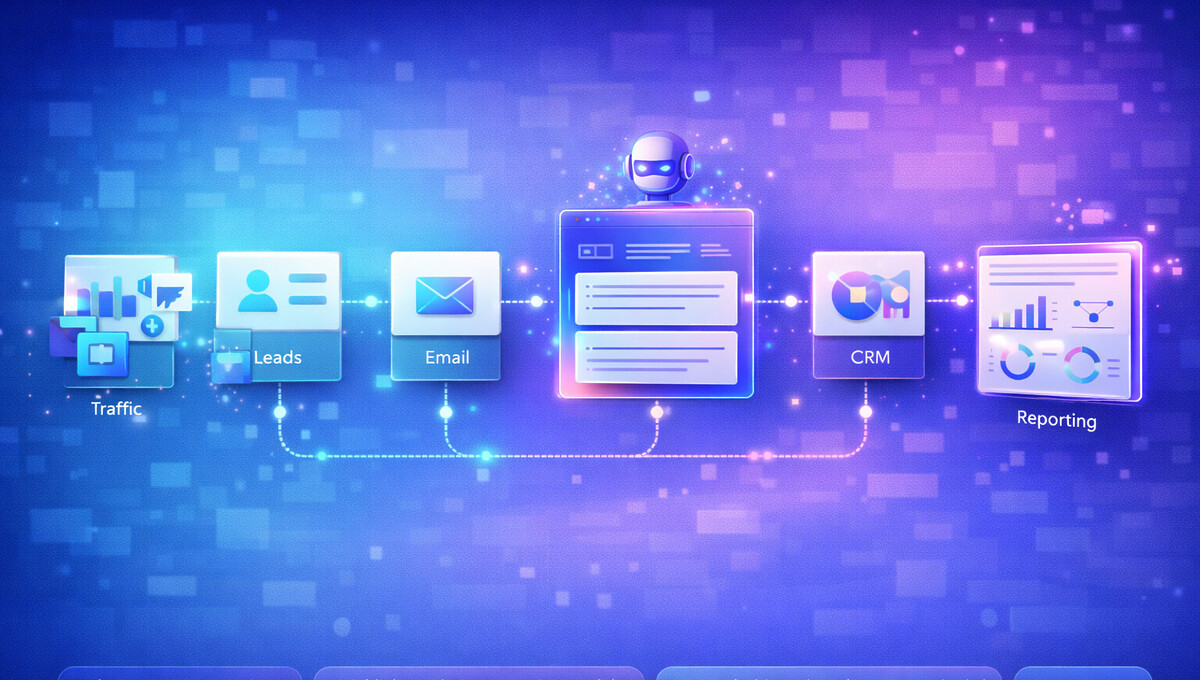
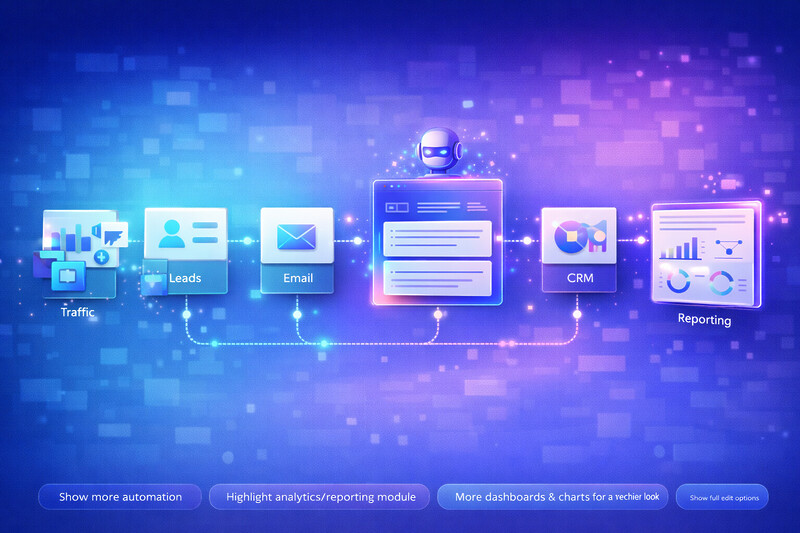
The crucial difference from simple tool usage lies in linking several steps into a coherent process. While a single tool performs one task, workflow automation connects multiple tools and actions into a continuous process chain. This eliminates manual handovers between systems, reduces error sources, and significantly increases speed.
Which Marketing Processes Can Be Automated?
The range of automatable marketing processes is vast. Basically, any task that runs based on rules, is repetitive, and requires little creative decision-making is suitable for automation. The following three areas offer the greatest potential.
Email Marketing and Lead Nurturing
Email marketing is the classic example of workflow automation. Welcome sequences, abandoned cart reminders, birthday emails, and re-engagement campaigns run fully automatically. Through lead scoring, contacts are evaluated based on their behavior and automatically fed into appropriate nurturing tracks. Studies show that automated email workflows generate 451 percent more qualified leads than manual campaigns.
Social Media Management and Content Planning
The planning, publishing, and evaluation of social media content can be largely automated. Cross-posting on multiple platforms, automatic recycling of evergreen content, and the evaluation of engagement data save significant time. Tools handle publishing at optimal times and collect interaction data centrally.
Reporting, Tracking, and Data Analysis
Automated dashboards pull data from Google Analytics, Google Ads, social media, and CRM systems, providing daily reports without manual effort. Anomaly detection automatically reports unusual changes in KPIs, allowing you to react faster.
Become more visible on Google & Social Media?
In a free strategy consultation for data-driven online marketing, we uncover your untapped potential, review any existing ad accounts if necessary, examine your SEO ranking and visibility, and determine which strategy is appropriate for your budget and which active measures will lead to more inquiries or sales.

✅ More visibility & perception through targeted placement
✅ More visitors > prospects > customers > revenue
✅ Reach target groups scalably with SEA
✅ Act and grow sustainably with SEO
🫵 Maximum success with our hybrid strategy
💪 More than 15 years of experience across industries in over 1,000+ projects demonstrable!





The Most Important Tools for Workflow Automation
The market offers numerous solutions for workflow automation in marketing. The tools can be broadly divided into two categories, each pursuing different approaches.
Integration Platforms
Zapier, Make (formerly Integromat), and n8n connect different apps and tools. Zapier offers over 6,000 app integrations and is particularly suitable for beginners due to its ease of use. Make scores with more complex workflow possibilities at a better price-performance ratio. n8n, as an open-source solution, is particularly interesting for technically savvy teams and companies with high data protection requirements, as it can be self-hosted.
All-in-One Marketing Platforms
HubSpot, ActiveCampaign, and Brevo combine CRM, email marketing, and automation in one platform. HubSpot offers the most comprehensive overall package but is also the most expensive option. ActiveCampaign impresses with the best automation logic for SMEs. Brevo positions itself as a budget-friendly and GDPR-compliant alternative.
| Tool | Typ | Preis ab (monatlich) | Am besten für |
|---|---|---|---|
| Zapier | Integration | 19,99 USD | Einsteiger, einfache Workflows |
| Make | Integration | 9 USD | Komplexe Workflows, Preis-Leistung |
| n8n | Integration (Open Source) | Kostenlos (Self-Hosted) | Technische Teams, Datenschutz |
| HubSpot | All-in-One | 45 EUR | Umfassendes Marketing + CRM |
| ActiveCampaign | All-in-One | 29 USD | KMU, E-Mail-Automation |
| Brevo | All-in-One | 25 EUR | Budget, DSGVO-Konformität |
Automating Workflows in Email Marketing
Email marketing offers the quickest entry into workflow automation, as processes are clearly definable and deliver immediately measurable results. Four types of workflows have proven particularly effective.
Welcome sequences start automatically after newsletter registration and gradually introduce new contacts to your brand. A typical sequence includes three to five emails over a period of two weeks. Abandoned cart workflows automatically remind customers who have abandoned their shopping carts in e-commerce and can increase the conversion rate by up to 77 percent.
Re-engagement campaigns identify inactive contacts and try to win them back through targeted incentives. The trigger is often a defined period of inactivity, such as 90 days without opening or clicking. Lead scoring workflows automatically evaluate each contact based on their behavior and forward high-quality leads directly to sales.
The key to success lies in clean segmentation and continuous optimization of trigger conditions. Test different timings, subject lines, and content to constantly improve the performance of your automated email workflows.
Automate Social Media Workflows
Managing multiple social media channels is one of the most time-consuming tasks in online marketing. Targeted workflow automation can significantly reduce the effort without compromising content quality.
Content scheduling tools like Buffer, Hootsuite, or Later allow for pre-planning posts for weeks or months. Content is created once and automatically published on all platforms at the optimal time. Cross-posting workflows adapt the content to the respective platform requirements, such as different image formats or text lengths.
Content recycling is an often underestimated automation possibility. Evergreen content is re-published at regular intervals without the need for manual intervention. By combining it with social media management software, social listening workflows can also be set up to automatically capture and process brand mentions and industry-relevant topics.
Automate Content and E-commerce Workflows
Content creation and optimization have traditionally been among the most manual tasks in marketing. Thanks to AI-powered tools, content workflows can now also be effectively automated, from text generation to SEO optimization.
In e-commerce, product description is a classic bottleneck. With hundreds or thousands of products, manual text creation is hardly economical. This is where FLAVOR Descriptions comes in, a WordPress and WooCommerce plugin that automatically generates SEO-optimized product descriptions using AI models such as GPT-4, Claude, and Gemini. Instead of writing each description individually, online retailers can perform bulk generations, thus massively accelerating the content workflow. FLAVOR SEO complements this process as an Enterprise WordPress SEO Plugin with over 200 features, AI integration, and WooCommerce support, all in a file size of only 1.9 MB. Automated SEO optimization from meta tags to structured data and other on-page factors is thus directly mapped in the WordPress backend.
Content repurposing workflows automatically transform a single blog article into multiple formats. Social media posts, newsletter teasers, and short videos are generated from a long-form text. SEO monitoring can also be automated by regularly checking keyword rankings, visibility changes, and technical errors and summarizing them in a report.
Workflow Automation Without Programming Knowledge
One of the most common reservations about workflow automation is the assumption that technical knowledge is required. In fact, no-code and low-code platforms now enable entry without any programming knowledge.
Visual workflow builders work on the drag-and-drop principle. Triggers, conditions, and actions are assembled with a mouse click and saved as a workflow. Tools like Zapier, Make, or HubSpot also offer pre-built templates for the most common marketing workflows, which can be activated in a few minutes. For SMEs that want to embark on the path of digital transformation, these solutions are the ideal entry point.
The effort required to set up a first automated workflow is minimal. A simple workflow, such as the automatic forwarding of form entries to a CRM system, can be implemented in under 30 minutes. More complex automations with branching and multiple tool connections require more planning but can also be realized without developers.
AI and the Future of Workflow Automation
Artificial intelligence elevates workflow automation to a new level. While traditional automation is based on fixed rules, AI-powered systems can recognize patterns, make predictions, and independently make decisions within defined parameters.
Hyper-personalization is one of the strongest trends. AI analyzes individual user behavior and automatically adapts content, timing, and channels to each individual contact. According to Gartner, over 80 percent of marketing teams are already using AI-powered automation or planning its introduction. At the same time, privacy-first automation is gaining importance, embedding GDPR-compliant data processing directly into the workflow logic.
The change also affects the role of marketing teams themselves. Instead of performing operational tasks, strategic control and optimization of automated systems become core competencies. Those who deal with AI-powered automation early on secure a sustainable competitive advantage. From our consulting practice, we see that companies that strategically combine AI and automation multiply their marketing efficiency.
Frequently Asked Questions about Workflow Automation (FAQ)
What does Marketing Automation cost?
The costs vary greatly depending on the tool and scope. Entry-level solutions like Brevo or Make start from 9 to 25 Euros per month. All-in-one platforms like HubSpot start at 45 Euros per month. Integration tools like Zapier offer free entry-level tariffs with limited functionality. Open-source solutions like n8n are completely free with self-hosting.
Is workflow automation worthwhile for small businesses?
Yes, small businesses in particular benefit greatly, as they work with limited resources. Even simple automations like welcome emails or social media scheduling save several hours per week. Getting started is easily possible with free or inexpensive tools.
Do I need programming skills for Marketing Automation?
No. No-code platforms like Zapier, Make, or HubSpot allow you to set up workflows via drag-and-drop. Pre-built templates make getting started even easier. Programming skills only become relevant for very complex, individual automations with API connections.
What is the difference between workflow automation and CRM?
A CRM system manages customer data and contact histories. Workflow automation actively controls processes and performs actions based on triggers. Many modern platforms like HubSpot or ActiveCampaign combine both functions, so CRM data can directly serve as triggers for automated workflows.
Conclusion
Workflow automation in online marketing is not a luxury for large companies, but a strategic necessity for businesses of all sizes. The combination of powerful tools, no-code platforms, and AI-powered optimization makes getting started easier than ever before. Start with a single, clearly defined workflow and gradually expand automation.
Whether it’s email marketing, social media, content creation, or e-commerce, there are proven automation solutions for every area. Define your recurring tasks, choose the right tools, and reclaim valuable time for the strategic development of your marketing.


 DE
DE