Investing child benefits offers an excellent opportunity to build significant wealth for your child’s future. Through strategic child benefit investment, child benefits can grow into a substantial amount of over 54,000 euros over the years, completely tax-free even up to the age of 25. Learn how to optimally utilize this potential and create a solid financial foundation for your child through smart investment decisions.
First of all: No one needs to be a financial professional to take advantage of such opportunities for child benefit investment for their child and themselves. By the way, this is also ideally usable if grandparents want to do something for their grandchildren. This increases the savings rate and thus the overall return. Savings plans are possible from just €25 per month! Example calculation at the bottom of the article!

Invest in child benefits and save over 54,000 euros tax-free for the child and make more than 100,000 euros in returns – smart child benefit investment
This detailed blog article is intended as a guide to one of the most significant financial decisions that parents and grandparents can make: investing child benefits and, with the help of grandparents, making an investment for the grandchild to save a significant sum for the child’s/grandchild’s future. In this article, we will examine how, through strategic investment of child benefits in Germany, a considerable amount of over 54,000 euros and more can be saved tax-free for the child and grandchild.
Child benefit is a state benefit in Germany designed to reduce the financial burden on families raising children. Many families use these funds for the ongoing costs associated with raising children. However, there is also the option of investing these funds in a long-term savings or investment product to increase capital and give the child a financial head start.

In this article, you will learn which investment strategies are particularly effective as child benefit investments to invest child benefit profitably. We discuss various forms of investment such as ETFs, savings accounts and fixed-term deposit accounts, as well as the importance of the compound interest effect. In addition, we explain how these investments can be handled in a tax-optimized way so that the saved money fully benefits your child without being eaten up by taxes.
Also at the bottom of the article: Additional – Invest parental allowance as well as child benefit!
Our goal is to provide you with practical information and tips so that you can make an informed decision about how to best invest child benefit to build up wealth for your child in the long term.
This guide is ideal for parents and grandparents who plan to ensure the financial well-being of their youngest family members.
First: Important terms briefly explained:
- p.a. = Abbreviation for „per annum“, which translated from Latin means „per year“ and is often used in finance to indicate annual rates or percentages.
- Return = The return is the financial yield from an investment, expressed as a percentage of the invested capital. It takes into account both the profits generated and any increases in the value of the investment.
- Interest = Interest is the amount paid or received for borrowing money. In the case of an investment, interest is the amount the investor receives as compensation for lending their money.
- Compound interest effect = The compound interest effect describes the phenomenon that interest paid on an investment in turn generates interest. Over time, this can lead to exponential growth of the investment capital.
- ETF = ETF stands for „Exchange Traded Fund,“ which is an exchange-traded fund. ETFs typically track the performance of a specific index, such as the DAX or the S&P 500, and can be traded during stock market hours.
- Savings Plan = A savings plan is an investment strategy where a fixed amount is regularly (e.g., monthly) deposited into an investment, such as an ETF or a savings account.
- Custody Account = A custody account is an account where securities, such as stocks or bonds, are securely held and managed. Custody accounts are offered by banks or other financial institutions.
- Tax Exemption (Saver’s Allowance) = The saver’s allowance is a tax-free allowance in Germany that exempts capital gains up to a certain amount (801 euros for individuals, 1,602 euros for jointly assessed married couples) per year from taxation.
- Inflation = Inflation refers to the process or phenomenon of an increase in the general price level of goods and services in an economy, leading to a reduction in the purchasing power of money.
- Diversification = Diversification is an investment strategy that aims to minimize risk by spreading investments across different asset classes, markets, or geographical regions. This is intended to mitigate the impact of negative developments in one area on the overall portfolio.
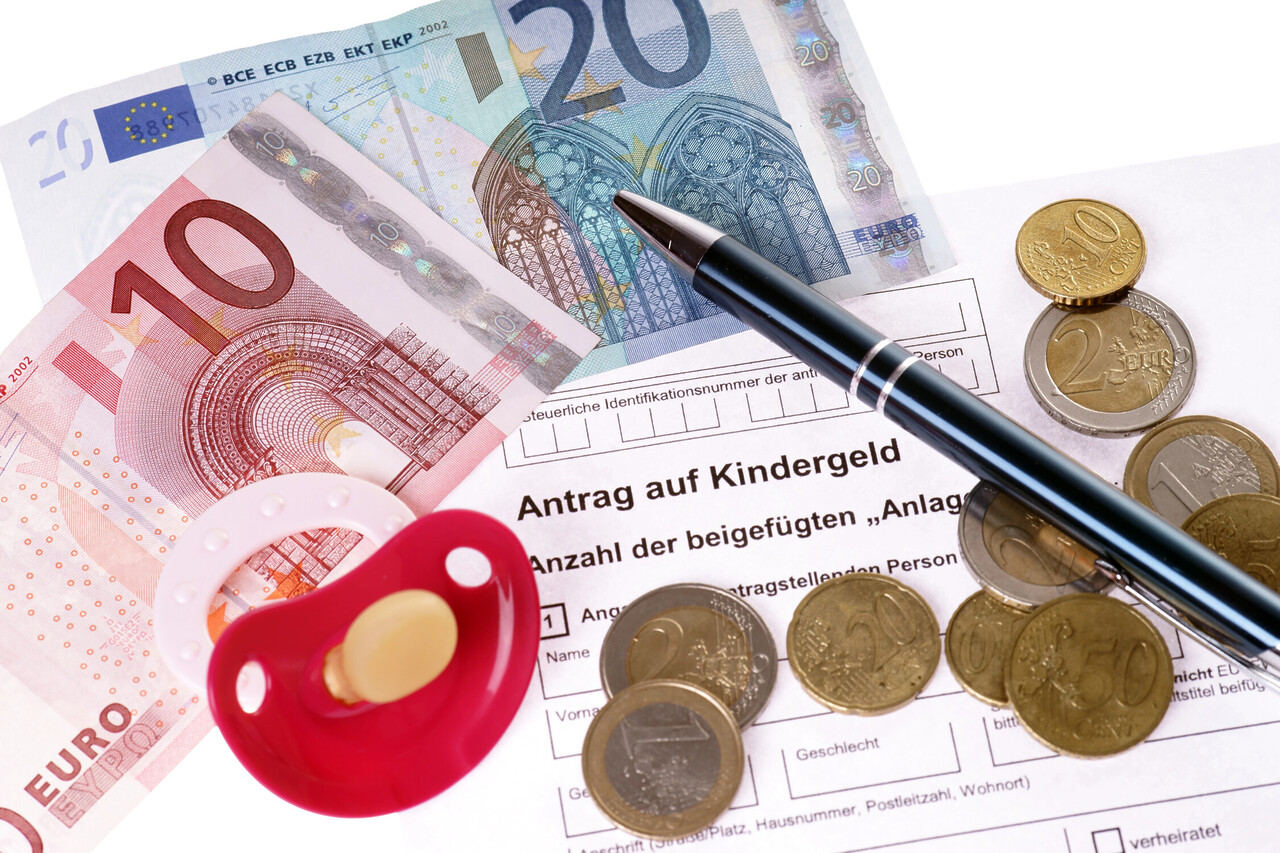
What is child benefit, how much is it and who receives it?
In Germany and Austria, child benefit is a state benefit granted to parents as financial support for raising their children. Here are the most important aspects of child benefit in both countries:
Child Benefit in Germany
- Purpose: Child benefit is intended to ensure the child’s basic needs are met and to ease the financial burden on parents.
- Eligibility: All parents who live in Germany or are liable for tax here are entitled to child benefit for children who live in the household and have not yet reached the age of 25 (provided they are in education or meet other requirements).
- Amount: From January 2021, child benefit amounts to 219 euros per month for the first and second child, 225 euros for the third child, and 250 euros per month for the fourth and each additional child.
- Payment: Child benefit is paid monthly by the Family Benefits Office of the Federal Employment Agency.
Child Benefit in Austria
- Purpose: Similar to Germany, child benefit in Austria serves to provide financial support to families.
- Eligibility: Parents who have their residence or habitual abode in Austria are entitled to child benefit. Child benefit is granted until the child’s 18th birthday, but can be extended until the child’s 24th birthday under certain conditions (e.g. further education).
- Amount: The amount of child benefit in Austria varies depending on the child’s age and the number of children. For example, child benefit for one child up to 3 years is 114 euros per month, from 3 to 10 years 121.90 euros, from 10 to 19 years 141.50 euros and from 19 years 165.10 euros.
- Payment: In Austria, child benefit is paid monthly by the Austrian social insurance.
In both countries, child benefit is an important financial support for families and helps to cover the costs of raising and educating children.
Tip:
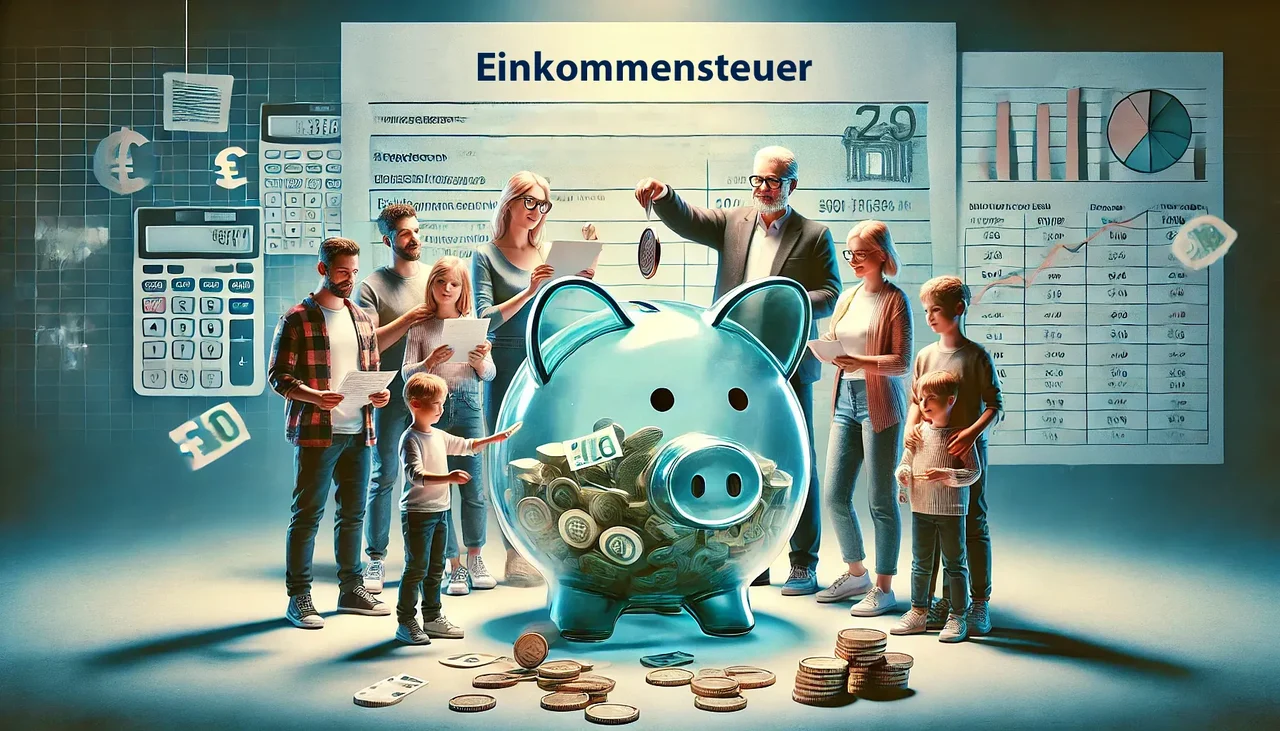
Why is the investment tax-free? Which tax allowances apply?
Investments made with child benefit are not inherently tax-free; the child benefit itself is tax-free, as it constitutes a social benefit. This means that child benefit is not considered income of the parents and is therefore not subject to income tax. However, the returns from investments of the child benefit, such as interest, dividends, or capital gains, may be taxable, depending on the type of investment and the applicable tax laws.
Tax allowances in Germany (2024)
In Germany, there are various allowances that are relevant for children:
- Child allowance: This amount is intended to make a child’s subsistence minimum tax-free. For the year 2024, the child allowance in Germany is 8,496 euros per child (this amount refers to the entire year and applies per parent, meaning a total of 16,992 euros per child if both parents are assessed jointly).
- Education allowance: For children who are accommodated away from home and are in education, parents can claim an additional allowance of 924 euros per year.
- Allowance for childcare, upbringing, or education needs: This amounts to an additional 2,928 euros per year on top of the child allowance.
Tax allowances in Austria (2024)
In Austria, there are similar tax allowances that benefit children and their parents:
- Child Tax Credit (Kinderabsetzbetrag): For each child for whom family allowance (Kindergeld) is granted, a child tax credit of 58.40 Euros per month is available (which corresponds to 700.80 Euros annually).
- Single Earner or Single Parent Tax Credit (Alleinverdiener- bzw. Alleinerzieherabsetzbetrag): Depending on the situation, single earners or single parents can claim additional tax relief. The amount varies depending on the number of children and other conditions.
These tax allowances are intended to reduce the tax burden on families and ensure that the children’s subsistence level remains tax-free. The exact amounts and conditions may change, and it is advisable to obtain current information directly from the responsible tax authorities or a tax advisor.
As you can see, tax allowances, especially in the first 10 years, can hardly be utilized with returns from investments. Through clever tax-saving strategies, you can even get a lot more out of it. More on that later…
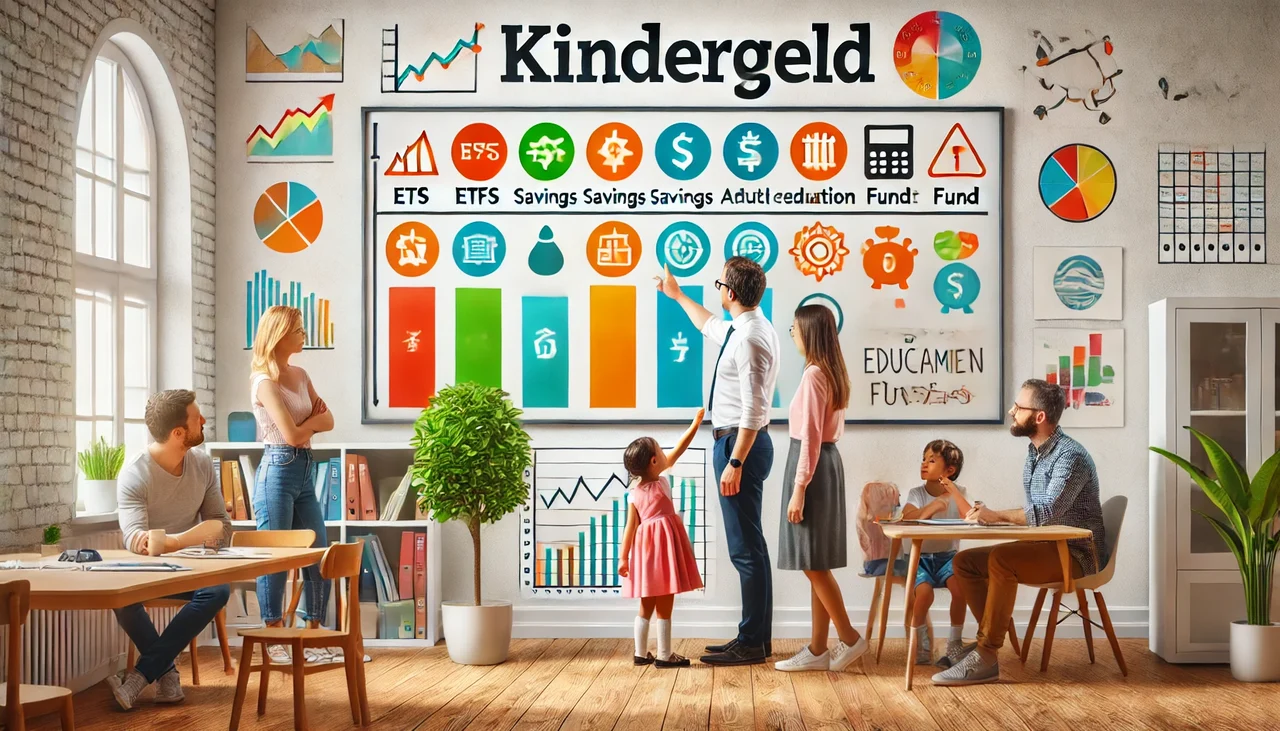
The Most Popular Child Benefit Investments & Investments for Child Benefit
Child benefit can be a good way to invest in your child’s future. There are various ways you can invest child benefit wisely. Here are some ideas:
- Savings account or call money account: A simple and secure option is to deposit the child benefit into a savings account or a call money account. Although interest rates are often low, the money remains secure and accessible at all times.
- Education fund or education savings: Investing in your child’s education can be very rewarding in the long term. This includes special education funds or setting up an education savings account that can later be used for tuition fees, training costs, or similar expenses.
- Stocks or ETFs: For a long-term investment, it is advisable to invest in stocks or ETFs (Exchange Traded Funds). These can offer higher returns than traditional savings methods, but also carry a higher risk.
- Retirement provision: You could also use the child benefit to build up a private retirement provision for your child, such as a child pension or a life insurance policy.
- Real estate funds: Another option is to invest in open-ended real estate funds. These often offer a stable return and are a good way to invest in the real estate market without having to directly purchase a property.
It is important that you choose an investment form that suits your financial capabilities and goals. Consulting a financial advisor can help you make the best decision for your situation.
Further down in the article, we also show alternatives to targeted child benefit investment.
The children’s depot – probably the best investment of child benefit
A children’s depot is a custody account that is set up specifically for minors and is usually managed by the parents or legal guardians until the child reaches adulthood.
Here are some steps and considerations you should take into account if you want to set up a children’s depot:
1. Choosing the right provider
- Banks and online brokers: Many banks and online brokers offer special children’s depots. Compare the conditions, such as fees, available investment products, and the user-friendliness of the platform.
- Offers and conditions: Some providers have special offers for children’s depots that offer lower fees or better conditions for young investors.
2. Opening the depot
- Documents: To open a child’s custody account, the child’s birth certificate, the identification documents of the legal representatives, and other documents are usually required.
- Identification: Identification is usually carried out by the parents via the PostIdent or VideoIdent procedure.
3. Selection of Investment Products
- Risk Profile: Decide which type of investments suit the child’s goals and risk profile. Long-term and broadly diversified investments such as ETFs are often a good choice.
- Savings Plan: Many providers allow setting up savings plans, where smaller amounts are invested regularly. This can be an effective method to build wealth and benefit from compound interest.
4. Tax Aspects
- Saver's lump sum allowance: Children, like adults, have an annual saver’s lump sum allowance of 801 euros in Germany and 700.80 euros in Austria (as of 2024), up to which capital gains are tax-free. It may be advisable to apply for a non-assessment certificate from the tax office to avoid the deduction of capital gains tax.
- Exemption order: An exemption order can also be set up to utilize the saver’s lump sum allowance.
5. Management and Monitoring
- Monitoring investments: As a legal guardian, you should regularly review the portfolio and make adjustments if necessary to ensure that the investments continue to meet the objectives.
- Handover: When the child reaches adulthood, the portfolio can be transferred to them. It is advisable to introduce the child to the basics of investing early on, so that they are able to manage their portfolio independently.
By setting up a children’s portfolio, you can start your child’s financial education early and give them a financial head start for the future.

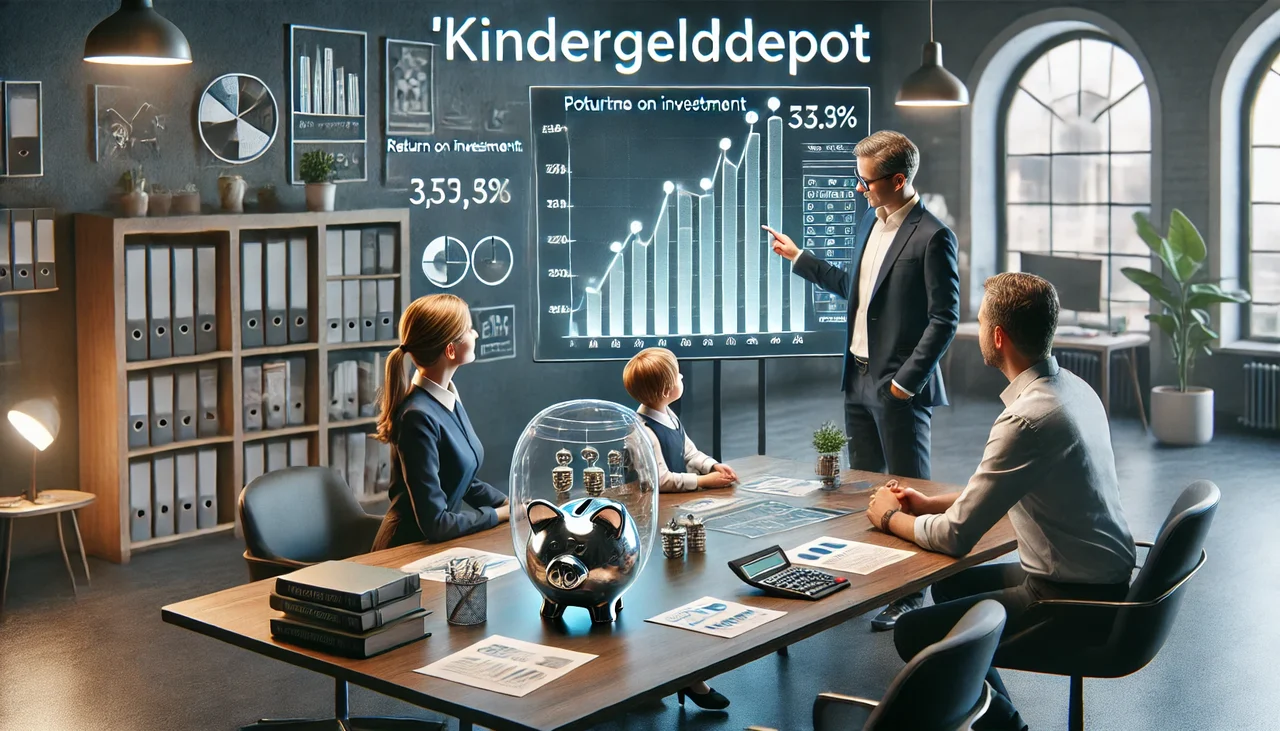
Example children’s depot with return calculation – The KinderGeldDepot (child benefit investment)
For our example, we invest 250 euros monthly in a globally diversified ETF that tracks the MSCI World Index. This index represents approximately 1,600 stocks from 23 industrialized nations and reflects the price development of these stocks. For our forecast, we consider three scenarios with different return expectations:
- Poor return: 1.85% per year
- Medium return: 6.55% per year
- High return: 11.25% per year
Reading tip:
Globale Aktien 1970-2023: Das Renditedreieck für den MSCI World Index
Estimated results by returns:
Below are the estimated final capital values after 18 years of investing 250 euros per month, taking into account the different annual returns:
| Year | Total Deposit | Final Capital at 1.85% | Final Capital at 6.55% | Final Capital at 11.25% |
|---|---|---|---|---|
| 1 | €3,000 | €3,057 | €3,203 | €3,353 |
| 2 | €6,000 | €6,144 | €6,514 | €6,873 |
| 3 | €9,000 | €9,262 | €9,947 | €10,588 |
| 4 | €12,000 | €12,412 | €13,515 | €14,522 |
| 5 | €15,000 | €15,594 | €17,227 | €18,697 |
| 6 | €18,000 | €18,810 | €21,093 | €23,140 |
| 7 | €21,000 | €22,061 | €25,123 | €27,874 |
| 8 | €24,000 | €25,349 | €29,328 | €32,924 |
| 9 | €27,000 | €28,673 | €33,719 | €38,314 |
| 10 | €30,000 | €32,036 | €38,308 | €44,071 |
| 11 | €33,000 | €35,439 | €43,106 | €50,220 |
| 12 | €36,000 | €38,882 | €48,125 | €56,790 |
| 13 | €39,000 | €42,367 | €53,377 | €63,808 |
| 14 | €42,000 | €45,896 | €58,872 | €71,302 |
| 15 | €45,000 | €49,469 | €64,622 | €79,301 |
| 16 | €48,000 | €53,088 | €70,639 | €87,834 |
| 17 | €51,000 | €56,754 | €76,934 | €96,932 |
| 18 | €54,000 | €60,470 | €83,521 | €106,626 |
Important to note: Child benefit generally also increases. Of course, we cannot seriously include this effect in any calculation.
Conclusion on the child benefit depot:
This table clearly shows how different the results can be, depending on the return on the investment. While with a low return of 1.85% the final capital is 60,470 euros, with a medium return of 6.55% it already reaches 83,521 euros and with a high return of 11.25% even 106,626 euros. This underlines the importance of choosing the right investment strategy, especially when it comes to long-term investments for significant goals such as a child’s financial future.
For comparison: A savings book earns at regional and normal banks (not pure online banks) generally only up to a maximum of 1.50% per year!

Invest child benefit until the child’s 25th year of life? Yes, that works!
In Germany, child benefit can be received under certain conditions until the child’s 25th year of life.
Annual capital development and total deposits from the 18th to the 25th year of life
The return expands once again to a completely different level:
| Year | Total deposit | Final capital at 1.85% | Final capital at 6.55% | Final capital at 11.25% |
|---|---|---|---|---|
| 18 | €54,000 | €60,470 | €83,521 | €106,626 |
| 19 | €57,000 | €64,240 | €91,746 | €121,529 |
| 20 | €60,000 | €68,161 | €100,463 | €137,628 |
| 21 | €63,000 | €72,239 | €109,724 | €155,081 |
| 22 | €66,000 | €76,480 | €119,584 | €174,060 |
| 23 | €69,000 | €80,891 | €130,100 | €194,748 |
| 24 | €72,000 | €85,478 | €141,332 | €217,343 |
| 25 | €75,000 | €90,251 | €153,344 | €241,955 |
This table shows the annual capital growth as well as the continuous increase of the total deposit through the savings amounts. It illustrates the effects of the different returns over a longer period.
How do I get child benefit until age 25?
Here are the most important criteria for receiving child benefit until age 25:
- Education: Child benefit can be paid until the child’s 25th birthday if the child is still in school or vocational training. This includes general education schools, vocational schools, technical schools, colleges, and universities.
- Studies: Child benefit continues to be granted during a first or second degree program as long as the child is not older than 25.
- Voluntary services: If the child completes a voluntary social or ecological year or federal voluntary service, child benefit is also paid until the child’s 25th birthday.
- Internships: Certain mandatory internships required as part of vocational training or studies can also lead to continued child benefit payments.
- Transition period: A transition period of up to four months between two training phases is also taken into account. During this time, child benefit continues to be paid as long as the child is actively looking for a training position or waiting for a university place.
- Unemployment: If the child is unemployed after completing their training or between two training phases and is registered as seeking work with the employment office, child benefit can continue to be received until the age of 25.
It is important that the relevant proof of training, studies, service, or unemployment is submitted to the Family Benefits Office to confirm eligibility for continued child benefit payments.

Grandchildren depot? Grandparents give their grandchildren money? What happens with the child depot in terms of returns?
Annual capital development and total deposits from age 0 to 25
| Year | Total Deposit | Final Capital at 1.85% | Final Capital at 6.55% | Final Capital at 11.25% |
|---|---|---|---|---|
| 1 | €7,200 | €3,600 | €3,600 | €3,600 |
| 2 | €10,800 | €7,267 | €7,436 | €7,605 |
| 3 | €14,400 | €11,001 | €11,523 | €12,061 |
| 4 | €18,000 | €14,805 | €15,878 | €17,017 |
| 5 | €21,600 | €18,678 | €20,518 | €22,532 |
| 6 | €25,200 | €22,624 | €25,461 | €28,667 |
| 7 | €28,800 | €26,643 | €30,729 | €35,492 |
| 8 | €32,400 | €30,735 | €36,342 | €43,085 |
| 9 | €36,000 | €34,904 | €42,323 | €51,531 |
| 10 | €39,600 | €39,150 | €48,694 | €60,929 |
| 11 | €43,200 | €43,474 | €55,484 | €71,383 |
| 12 | €46,800 | €47,878 | €62,712 | €83,014 |
| 13 | €50,400 | €52,364 | €70,398 | €95,953 |
| 14 | €54,000 | €56,933 | €78,564 | €110,348 |
| 15 | €57,600 | €61,586 | €87,240 | €126,362 |
| 16 | €61,200 | €66,325 | €96,461 | €144,177 |
| 17 | €64,800 | €71,152 | €106,249 | €163,997 |
| 18 | €68,400 | €76,069 | €116,634 | €186,047 |
| 19 | €72,000 | €80,976 | €127,650 | €210,577 |
| 20 | €75,600 | €85,976 | €139,331 | €237,867 |
| 21 | €79,200 | €91,070 | €151,712 | €268,227 |
| 22 | €82,800 | €96,260 | €164,831 | €302,003 |
| 23 | €86,400 | €101,549 | €178,733 | €339,578 |
| 24 | €90,000 | €106,937 | €193,471 | €381,381 |
| 25 | €93,600 | €112,426 | €208,991 | €427,886 |
This table shows the development of invested capital assuming a constant monthly contribution of €300 over a period of 25 years at various return rates. It illustrates how the additional deposit of €50 per month significantly influences the final values, especially at higher returns.
Grandchildren’s Depot: An Investment in the Future
A grandchildren’s depot is an excellent way for grandparents to actively participate in their grandchildren’s financial future. By setting up such a depot, they can regularly invest sums of money that grow over the years and later provide the grandchildren with financial support when they start their adult lives. This can be used, for example, for education, the purchase of a first car, or even a contribution toward buying a house.
The Role of Grandparents
Grandparents often choose to pay their own savings contribution in the form of a monthly amount into a depot, in addition to child benefit or the parents‘ savings efforts. This additional contribution can significantly accelerate the growth of the invested capital. For example, the additional €50 per month that flows into a well-managed depot with a solid return significantly increases the final capital.
Effects on Returns
Investing in a child’s or grandchild’s depot is particularly effective because it benefits from the principle of compound interest. Through long-term investment – often over two decades or more – and the regular deposit of additional amounts, even moderate returns can grow into considerable sums. Let us take, for example, an assumed annual return of 6.55% in a globally diversified ETF: A total monthly amount of €300 (€250 from the parents and €50 from the grandparents) could grow to over €200,000 in 25 years, depending on market conditions and the chosen investment strategy.
The ETF savings plan for grandchildren alone or together with the parents is therefore a great investment for grandchildren.
What Happens to the Depot?
The child’s or grandchild’s depot is generally maintained until the child reaches the age of majority or even longer. The management of the depot usually lies with the parents or grandparents until the child is old enough to decide on the use of the funds. It is also common for control of the depot to pass to the child at an agreed point in time, such as reaching the age of majority. This can be accompanied by financial education to provide the young adult with the necessary knowledge for further management of their capital.
A grandchildren’s depot is more than just a financial investment; it is an investment in the opportunities and potential of the next generation. Through the additional support of grandparents and the use of financial instruments such as ETFs, these depots can play a significant role in the long-term financial planning and security for grandchildren.

Why a grandchild & child account is the much better savings book for the child?
A child account offers several advantages over a classic savings book, especially when it comes to long-term saving and wealth accumulation. Here are some reasons why a child account is often the better choice:
1. Higher Return Potential
- Stocks and ETFs: In contrast to the savings book, which offers only very low interest rates, a child account enables investment in stocks, ETFs, and other securities that have historically achieved higher average returns.
- Long-Term Horizon: Since child accounts are generally used for a long-term investment horizon (often until the child reaches legal age or even longer), the higher volatilities of the stock market can often be offset. In the long term, stock markets have proven to be robust and offer the opportunity to benefit from economic growth.
2. Inflation Protection
- Preserving purchasing power: In times of higher inflation, savings accounts lose real value, as the interest is often not enough to offset the loss of purchasing power. Securities investments such as stocks and ETFs, on the other hand, have the potential to outperform inflation and to preserve or increase the purchasing power of the invested money.
3. Flexibility and variety
- Diversification: In a child’s depot, you can diversify a broad range of investments, which spreads the risk and increases the chance of better performance. You can invest in different markets, regions, and sectors.
- Savings plans: Many depots offer the option to set up regular savings plans, which enables a disciplined and automated investment strategy. This is ideal for building wealth over the long term.
4. Tax advantages
- Saver’s allowance: As already mentioned, children in Germany have an annual saver’s allowance of 801 euros. This can be used to keep capital gains tax-free up to this amount. With a savings book, the interest is so low that this advantage is often not fully utilized.
5. Financial education
- Learning opportunity: Managing a child’s account also offers an excellent opportunity to introduce children to financial topics at an early age. They can learn how to handle money, the concept of investing, and the importance of saving, which is of great benefit for their future financial independence.
While a savings book barely earns any interest and can be useful more as a safe reserve, a child’s account offers significantly better opportunities for long-term wealth accumulation and a better financial future for the child.
Of course, one should always consider the risk profile and ensure that the investments match the family’s risk tolerance and goals.

Is it possible to invest money for grandchildren without parental access?
There are ways for grandparents to invest money for their grandchildren without the parents having access to it. This can be useful if grandparents want to ensure that the funds are used exclusively for certain purposes or directly for the grandchildren. Here are some options:
1. Trust Account
A trust account offers one of the safest methods for investing money for grandchildren without the parents having access to it. Grandparents can act as trustees or appoint an independent trustee. The funds and their use are then governed according to the instructions in the trust agreement. These accounts offer flexible structuring options regarding payout conditions, such as payouts for educational costs or as financial support from a certain age.
2. Education Savings Plan (e.g., 529 Plan in the USA)
In some countries, there are special education savings plans that allow grandparents to invest money for their grandchildren’s education. These plans are often tax-advantaged and can be set up so that only the beneficiary (the grandchild) can access the money for educational purposes.
3. Insurance Policies
Life or education insurance policies can be taken out in the grandchild’s name, with the grandparents acting as policyholders and/or beneficiaries in the event of death. These policies can be structured so that payouts go directly to the grandchildren.
4. Own Accounts in the Grandchildren’s Names
In some countries, it is possible to open accounts directly in the grandchildren’s names, especially if they are already somewhat older. Although the grandparents can manage the account, legally the funds belong to the grandchildren.
5. Savings Books or Fixed-Term Deposit Accounts
Similar to own accounts, savings books or fixed-term deposit accounts can be set up in the grandchildren’s names. Grandparents can deposit money, but only the grandchildren (often from a certain age) can access it.
Legal and Tax Considerations
With each of these options, it is important to also consider the legal and tax implications. It may be advisable to consult a lawyer or tax advisor to ensure that all aspects are handled correctly and are in the best interest of the grandchildren.
These various methods offer grandparents flexible and secure ways to invest in their grandchildren’s future without the parents having access to it.

Additional Investment Opportunities to Invest the Child Benefit
When it comes to investing child benefit, there are some considerations and specific investment options tailored to the needs and future of your child. Here are some more detailed considerations regarding the various investment opportunities:
Education Investments
- Education Savings Plans: Some banks and financial service providers offer special savings plans designed to save money for your child’s future education costs. These plans can also offer tax advantages.
- Education Funds: These special funds are designed to generate returns that can then be used for higher education such as college or university.
Provision for the Future
- Pension insurance for children: These products are designed to pay out after a term of e.g. 18 or 25 years and can additionally include term life insurance.
- Flexible life insurance policies: These can be structured to provide a payout at a specified point in the future, e.g. upon reaching legal adulthood.
Real estate investments
- Open-ended real estate funds: These funds invest in real estate and offer a way to invest in the real estate market without having to buy an entire property. They are more liquid than direct real estate investments and often less volatile than stocks.
- REITs (Real Estate Investment Trusts): REITs offer another way to invest in real estate, with the trust’s shares traded on a stock exchange.
Safety-oriented investments
- Savings books and fixed-term deposit accounts: These classic forms of investment offer security and are particularly suitable if you want to minimize risk. They do offer lower returns, but the capital is protected and the interest rate is guaranteed.
Tips for investing child benefit
- Start early: The earlier you begin investing, the more the compound interest effect can accelerate the growth of the invested money.
- Risk diversification: Don’t put all your money into one type of investment; choose a good mix of high-risk and safe investments.
- Regular review: Regularly review and adjust the investment strategy, especially when your financial situation or goals change.
A good strategy could be to put part of the child benefit into safe investments to build a foundation, and another part into higher-opportunity investments such as stocks or ETFs, in order to benefit from potentially higher returns. Advice from a financial expert can be very helpful in developing a strategy tailored to your family’s needs.
Addition: Parental allowance and child benefit are investments
In Germany, there is both child benefitandparental allowance, and both are financial supports that differ in their goals and conditions:
Child Benefit
Child benefit is a benefit that serves to financially support families for the basic needs of their children. It is usually paid until the child’s 18th birthday, but can be extended under certain circumstances (e.g., during an apprenticeship or studies) until the child’s 25th birthday. Child benefit is paid by the family benefits office and the amount depends on the number of children in the family.
Parental Allowance
Parental allowance is a benefit that aims to financially support parents who wish to spend time with their child after birth and therefore interrupt or reduce their professional activity. The parental allowance is intended to partially replace the lost income. It is usually paid for the first 12 to 14 months after the child’s birth, with the exact duration and amount of the parental allowance depending on various factors such as previous income and the chosen parental allowance option.
Both benefits are specifically designed to support families in different phases of child-rearing. Child benefit serves more as a long-term financial contribution to the upbringing and care of the child, while parental allowance is specifically designed for the early childhood phase to give parents the opportunity to care for their newborn without great financial pressure.

Investing Parental Allowance Tax-Free?
Parental allowance in Germany is considered an income replacement benefit and is tax-free itself. However, this does not mean that it has no impact on the recipients‘ tax burden. Parental allowance is subject to the so-called progression clause. This means that although parental allowance is not directly taxed, it is taken into account when calculating the tax rate applied to other income. This can lead to an increase in the personal tax rate and thus an increased tax burden on other income.
Investment of Parental Allowance
Regarding the investment of parental allowance, parents can, of course, invest this money just as they would with other parts of their income. The returns or interest generated from such investments would then be subject to taxation according to the usual tax regulations for capital gains. In Germany, the saver’s lump sum allowance is 801 euros per person. Returns up to this amount per year are tax-free. Anything beyond that is subject to capital gains tax of 25% plus solidarity surcharge and, if applicable, church tax.
Strategies for Investing Parental Allowance
If parents plan to invest parental allowance, they could consider the following:
- Establishing an emergency fund: Before investing in riskier assets, a portion of the parental allowance could be used to create a financial buffer for unforeseen expenses.
- Long-term investments: For long-term goals, such as children’s education or property acquisition, investments in stocks, ETFs, or other forms of investment could be sensible. A diversified investment strategy is recommended here to minimize risks.
- Retirement provision: A part of the parental allowance could also flow into private retirement provision, for example, by purchasing annuity insurance or saving in a Riester contract, for which state subsidies are available.
Disclaimer: The information in this article is for general informational purposes only. It does not constitute financial advice, legal advice, or any other professional advice and should not be construed as such. The content of this article merely reflects the author’s opinion at the time of writing. While we strive to keep the information current and correct, we make no representations or warranties of any kind, express or implied, about the completeness, accuracy, reliability, suitability, or availability with respect to the website or the information, products, services, or related graphics contained on the website for any purpose. Investments in financial markets are subject to risks, including the possible loss of capital. The historical performance of an investment is no guarantee of future results. Potential investors should be aware that investments always carry the risk of financial loss. We recommend that you seek advice from an independent financial advisor before making any financial decisions. By using this website, you acknowledge that you use the information at your own risk and that no liability rests with the author or provider of this information.



 DE
DE