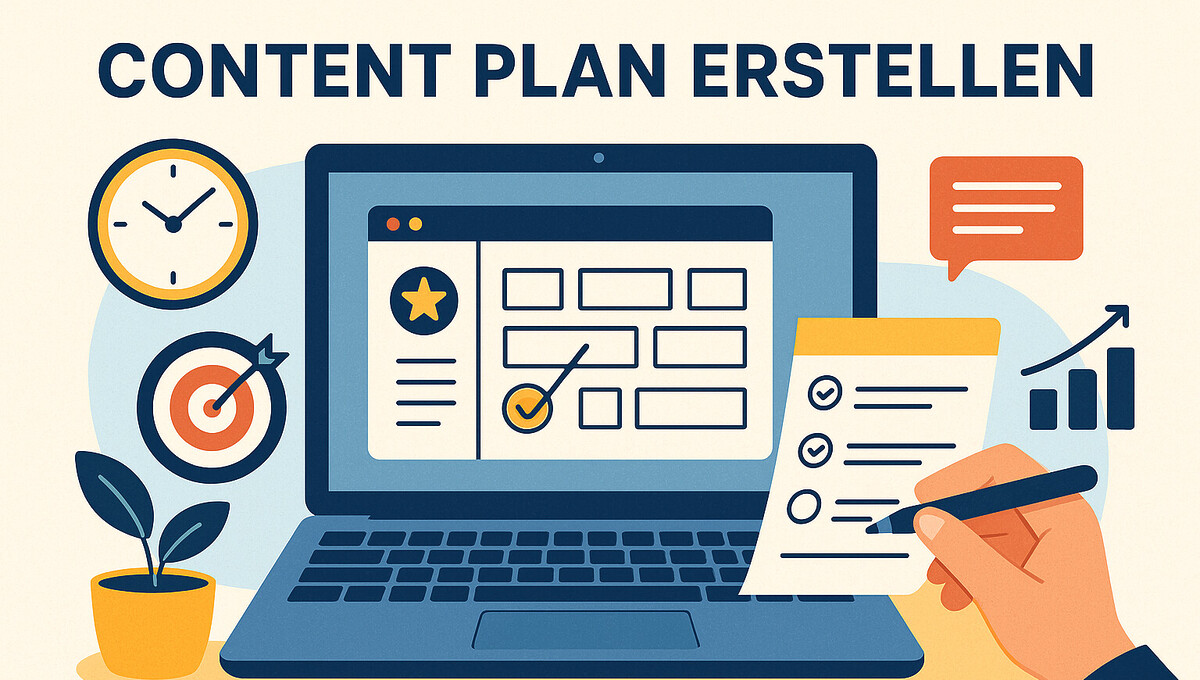
Create a Content Plan – Successfully Implement Content Marketing
Is your content marketing strategy set and your head full of ideas? Then it’s time to briefly pause and create a structured content plan. Similar to a project plan, this defines activities, progress, and important dates. Knowing when which content will be published brings structure to marketing and reduces stress. Deadlines also motivate you to actually implement tasks. Your target audience will appreciate this commitment, as regular, interesting content retains readers. Below, you will learn how to create an effective content plan and what benefits it offers.
What is a Content Plan?
A content plan forms the foundation of a well-thought-out content marketing strategy. The plan functions similarly to a detailed project plan, defining activities, progress, and key deadlines for your content team. From the initial brainstorming to publication, it creates clear structures. Contrary to popular belief, such a plan does not restrict creativity; rather, it provides the team with an organized framework for developing creative ideas. This fosters a balanced equilibrium between creative freedom and systematic, continuous planning.
A well-designed content plan also prevents you from losing track. Different buyer personas are interested in different topics, content must address various stages of the customer journey, and current news should be published promptly. Additionally, editing requires sufficient time. As a central organizational document in the content area, the editorial plan brings all important information together in one place and makes it accessible to all involved – from planning and creation to publication.
The Advantages of a Well-Thought-Out Content Plan
Through a structured content plan, you create regularity – a crucial factor for a growing readership and successful content marketing. The set deadlines ensure commitment and make content creation a priority. Joint brainstorming within the framework of the plan also significantly facilitates the often challenging task of finding topics.
With a content plan, you always keep track of already planned topics and can quickly identify missing relevant content. You can seamlessly build on existing topics and expand planned content with new formats such as white papers. You never lose sight of important events that are interesting for your target audience, which simplifies strategic publication planning.
Another significant advantage lies in the central bundling of information. Instead of searching for keywords, titles, and briefings in various documents, you will find all information directly in the content plan or at least links to the relevant documents. This saves valuable time and ensures that all necessary information is always at hand. Furthermore, long-term planning allows for early consideration of factors such as vacations or resource bottlenecks, ensuring a smooth publication process.

5 Steps to a Successful Content Plan
1. Choose the Right Format for Your Content
After you have already defined target groups and topic areas through your content marketing strategy, it is now time to select the appropriate formats for your content. Written formats such as articles, e-books, whitepapers, or interviews often form the backbone of a content strategy. Additionally, you can use podcasts, videos, or infographics to provide variety and cater to different user preferences.
The different formats can be excellently combined – for example, infographics can visually enhance an article and make complex issues more understandable. To offer your target audience a versatile experience, it is recommended to use multiple formats. Some topics are better suited for visual representations, while others are better conveyed through detailed texts.
Nevertheless, you should not get lost in too many different formats. Focus on those that best suit your company, your resources, and, most importantly, your content. When creating a content plan, this focus helps you strategically use your formats and optimally align them with your topics and target audiences.
2. Determine the Content Orientation
Choosing the right format goes hand in hand with determining the content orientation of your content. Depending on the topic, certain formats are better suited than others. For blog articles, for example, opinion-based or current content works particularly well. The content orientation can be diverse: entertaining content for pure entertainment, personal content with insights into your team, or company-related updates on news from your business.
Become more visible on Google & Social Media?
In a free strategy consultation for data-driven online marketing, we uncover your untapped potential, review any existing ad accounts if necessary, examine your SEO ranking and visibility, and determine which strategy is appropriate for your budget and which active measures will lead to more inquiries or sales.

✅ More visibility & perception through targeted placement
✅ More visitors > prospects > customers > revenue
✅ Reach target groups scalably with SEA
✅ Act and grow sustainably with SEO
🫵 Maximum success with our hybrid strategy
💪 More than 15 years of experience across industries in over 1,000+ projects demonstrable!







Other possibilities include community content, which comes directly from your target audience, sales-oriented content for presenting your products or services, and evergreen content with timeless, always relevant information. Search content is specifically optimized for search engines to rank well in search results and attract new readers.
When selecting your content orientation, you should always keep your strategic goals in mind. A well-thought-out mix of different content types allows you to address different interests of your target audience and cover various stages of the customer journey. When creating a content plan, this diversity helps to plan and implement in a structured way.
3. Define the Quality of the Content
Regardless of the chosen format – be it podcast, video, or blog article – you must determine the quality level of your content. This is less about the intrinsic quality of the content and more about its scope and detail. Generally, three categories are distinguished: Quality Content includes text contributions of up to approximately 1,000 words and solves a specific problem. High Quality Content, with up to 2,500 words, offers a comprehensive overview through background information and conveys deeper knowledge.
The most elaborate type is Skyscraper Content, with up to 10,000 words, usually designed as a comprehensive guide or e-book, which exhaustively covers a topic or summarizes an entire article series. These different quality levels require different resources and planning efforts, which must be taken into account in the content plan.
Strategically consider how detailed you want to make a topic. Sometimes, not enough information can be gathered on a topic, or it might be more advantageous for your business model not to immediately reveal the complete solution. When creating a content plan, a balanced mix of different quality levels allows you to offer both quickly consumable content and more in-depth expert articles.
4. Define the Content Frequency
After you have determined the format, content orientation, and quality level, you need to decide how often and when you want to publish new content. This decision should primarily depend on your available resources. Honestly consider how much time and effort you can dedicate to content creation alongside your daily business. A content plan helps to define realistic timeframes for research, creation, revision, and publication.
Regularity is more important than high frequency. Whether you publish weekly, bi-weekly, or monthly – maintain a consistent rhythm. This reliability signals professionalism and builds trust with your target audience. Users get used to your publication rhythm and await new content, which strengthens engagement.
Strategically plan fixed weekdays and times for your publications. Studies show that certain time windows achieve better resonance depending on the industry and target group. When you create a content plan, you can record these optimal times and consistently use them. Don’t forget to also consider seasonal fluctuations or special events in your planning.
5. Structure and Create the Content Plan
With the preceding decisions regarding format, orientation, quality, and frequency, you can now create a comprehensive content plan. For each planned content piece, this plan should contain at least the following information: publication date, responsibilities, deadline, topic, format, quality level, and content orientation. Additionally, you should document relevant calls-to-action, central keywords, and the current status of the project.
For an even more comprehensive plan, you can add overarching campaign goals, details about buyer personas, relevant KPIs, and information on the past success of similar content. These extensions help maintain a strategic overview and link content creation with overarching marketing goals.
Digital solutions are particularly practical for your content plan. From simple spreadsheets to specialized content management tools, numerous options are available. It is important that the plan is accessible to all team members and is regularly updated. A well-structured content plan serves as a central source of information and a control instrument for your entire content marketing, minimizing misunderstandings and maximizing efficiency in content creation.
Helpful Tools for Your Content Plan
Numerous helpful tools are available for creating and managing a content plan. The simplest solution is spreadsheet programs, which allow you to create structured overviews. This option is cost-effective and flexibly adaptable. For teams with more complex requirements, specialized project management tools like Trello or Asana are suitable. They enable the visual representation of workflows and the real-time status of all content projects.
Specific content management systems often offer direct publishing capabilities in addition to planning functions. This integration saves time and reduces sources of error. For planning social media content, dedicated planning tools exist that enable previews and automated publications.
When selecting the right tool, you should pay attention to user-friendliness, adaptability, and collaboration options. The best tool is the one that your team actually uses consistently. Test different options and decide based on your specific requirements. A well-thought-out content plan, managed with the right tool, becomes the linchpin of successful content marketing.
These Mistakes You Should Avoid When Creating a Content Plan
When creating a content plan, certain mistakes can significantly impair its effectiveness. Unclear goals lead to an unstructured plan without a clear focus. Therefore, precisely define what you want to achieve with each piece of content. A lack of target audience analysis results in content that does not appeal to the right people or misses their needs. Take your time to thoroughly understand your target audience.
Focusing on too few content formats can limit reach and become boring in the long run. Diversify your formats to cater to different preferences. At the same time, you should not neglect SEO aspects – even brilliant content remains ineffective if it cannot be found.
Another common mistake is an unbalanced publication frequency. Too much content in a short time overwhelms your audience, while too infrequent publications cause interest to wane. Find a balance that considers both your resources and your target audience’s capacity for absorption.
Also, avoid a plan that is too rigid without flexibility for current developments and an excessive focus on quantity at the expense of quality. Finally, you should create your content plan with regular analysis and adapt it based on data and feedback to continuously improve.
Content Guidelines: Ensuring Consistency
Content guidelines are a crucial element when creating a content plan. They ensure a consistent appearance of your content, regardless of who creates it. These guidelines define clear standards regarding tone, formatting, and stylistic elements. Especially in larger teams or when collaborating with external authors, they ensure consistency and strengthen your brand identity.
Fundamental aspects of your content guidelines should include specifications for text length, general style, and address (informal „du“ or formal „Sie“). Detailed spellings for brand names, technical terms, or English expressions create clarity. The consistent presentation of numbers, percentages, and bullet points also contributes to a professional appearance.
Other important elements concern the formatting of highlights, linking practices, and the handling of abbreviations or emojis. A well-maintained word list with consistent spellings for frequently used terms completes the guidelines. Consider this document as living – supplement and update it as needed to always ensure current guidelines.
Measuring Success: KPIs for Your Content Plan
To evaluate the success of your content plan, you need meaningful key performance indicators (KPIs). Various KPIs help quantify the effectiveness of your content and optimize future activities. Basic metrics include website traffic, time on page, and bounce rate. These numbers show whether your content attracts visitors and sparks their interest. Engagement metrics such as comments, shares, and likes provide insights into the resonance with your target audience.
For business-oriented goals, conversion rates are crucial. They measure how many readers actually perform desired actions, such as subscribing to a newsletter or purchasing a product. Additionally, analyze the performance of various content types and formats to identify your most successful approaches.
Continuity is important when measuring success. Create regular reports that show developments over longer periods. Use analytics tools like Google Analytics to collect and evaluate data. The insights gained should directly feed into the further development of your content plan. The process of „creating a content plan“ should therefore always include the component of continuous learning and optimization. However, maintain flexibility – sometimes content fulfills important strategic functions, even if it doesn’t deliver impressive numbers in the short term.
Conclusion: Content Marketing Success with an Effective Content Plan
A well-thought-out content plan forms the backbone of successful content marketing activities. It brings order to creative chaos, structures processes, and makes progress measurable. The plan acts as a central organizational tool that provides orientation to all involved and simplifies teamwork. Through clear structuring, you always maintain an overview of topics already covered and can specifically close gaps.
The five steps presented for creating a content plan – from format selection to content alignment and the specific plan structure – provide a practical framework for your own planning. Supplemented by suitable tools and uniform content guidelines, a professional framework for your content is created. Regular success measurement using relevant KPIs completes the process and enables continuous improvements.
Remember: Even the best content plan cannot save a poorly thought-out content strategy. Therefore, first invest time in strategic foundational work before dedicating yourself to detailed planning. A balanced relationship between strategic alignment, structured planning, and creative implementation is the key to sustainable content marketing success.
Frequently Asked Questions about the Content Plan
What is the difference between content strategy and content plan?
The content strategy defines the overarching goals, target groups, and thematic areas of your content marketing. It answers the questions of why and for what purpose. The content plan, on the other hand, is the tactical tool for implementing this strategy. It specifically determines what content will be created, when, in what format, and by whom. While the strategy sets the direction, the plan ensures practical realization. The task of „creating a content plan“ therefore logically follows the development of your content strategy.
How often should I update my content plan?
A content plan should be regularly reviewed and adjusted. Quarterly updates have proven effective to respond to changing market conditions or new insights. In the event of significant changes to your business strategy or unexpected events, an immediate adjustment may also be appropriate. Keep the plan dynamic without constantly overhauling it completely.
How can I find content ideas for my plan?
There are numerous sources for fresh content ideas: customer feedback and frequently asked questions provide valuable clues about information needs. Keyword research shows what your target audience is searching for. Industry events, current trends, and seasonality offer timely relevant topics. A look at successful past content can also inspire – consider updates or continuations of popular posts or their repurposing into other formats. This idea generation is an important part of creating a content plan.




 DE
DE