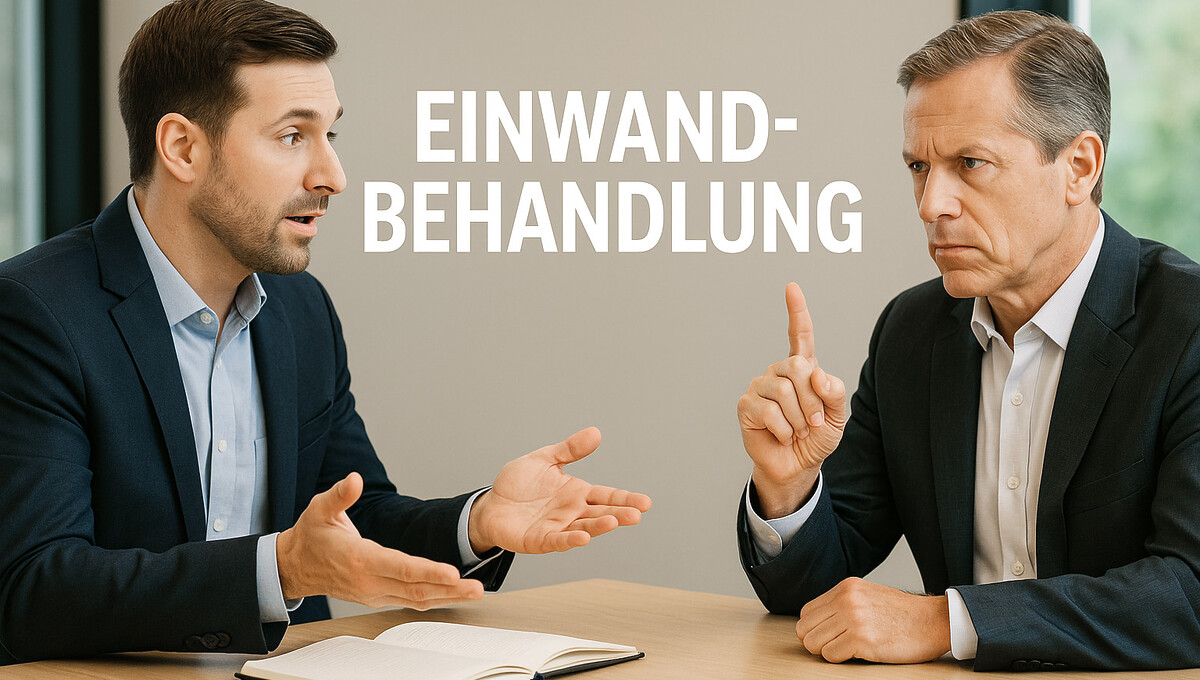
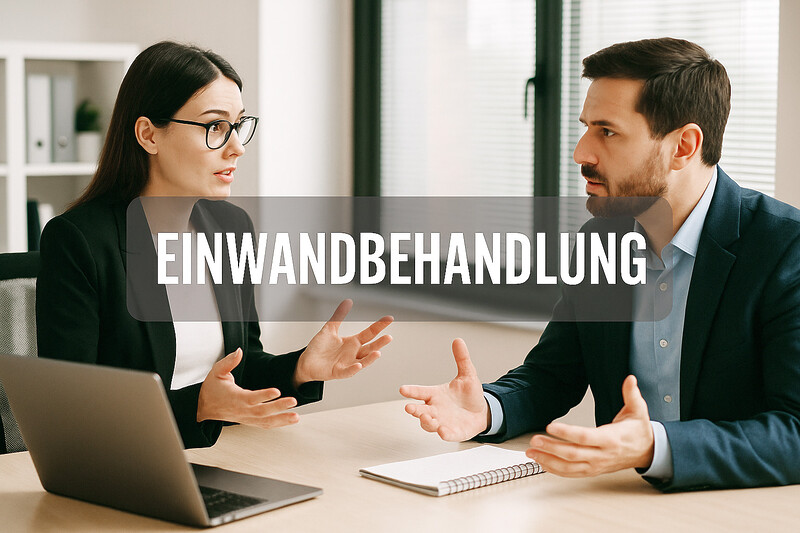
Objection handling means clarifying a customer’s doubts, questions, or uncertainties so that they can make a confident purchasing decision. It is always used when a prospective customer is fundamentally interested but still has internal hurdles such as „too expensive,“ „no time,“ or „I need to think about it.“ The goal of objection handling is not to persuade, but to provide the customer with orientation and to make the value of the offer visible again without justifying oneself but by convincing.
Objection Handling "Too Expensive" – Reason + Solution, Explanation, and Important Tips
„Too expensive“ is one of the most common objections – and usually not a real price problem, but a value problem. In objection handling, it’s about showing the customer what benefits, results, and long-term advantages they will receive, so that the price becomes logical and understandable. Instead of defending the price, you help the customer understand why the investment pays off for their situation and what costs would arise if they changed nothing.
What is Objection Handling?
Objection handling means:
The customer has concerns, doubts, or questions – and you help them clarify these so they can make a confident decision.
It is NOT about "persuading" someone,
but about:
✔ understanding the customer
✔ finding out what is truly holding them back
✔ clarifying misunderstandings
✔ and giving them confidence through clear answers
An objection is, for example:
- „That’s too expensive for me.“
- I need to think about it first.
- I need to translate German text to English, but the text you've provided is already in English. Could you please provide the German text that needs to be translated to English?
- I don't have time for that right now.
- I already have something similar.
The objection handling is then the way HOW you react to it, so that the customer feels understood – and thus becomes able to act.
Why Objection Handling is So Important in Sales
Purchasing decisions are often emotional.
Objections are not a no, but rather:
Become more visible on Google & Social Media?
In a free strategy consultation for data-driven online marketing, we uncover your untapped potential, review any existing ad accounts if necessary, examine your SEO ranking and visibility, and determine which strategy is appropriate for your budget and which active measures will lead to more inquiries or sales.

✅ More visibility & perception through targeted placement
✅ More visitors > prospects > customers > revenue
✅ Reach target groups scalably with SEA
✅ Act and grow sustainably with SEO
🫵 Maximum success with our hybrid strategy
💪 More than 15 years of experience across industries in over 1,000+ projects demonstrable!







➡️ a desire for clarity
➡️ uncertainty
➡️ a need for information
➡️ a sign that the customer is interested
Example:
When someone says "too expensive," it rarely truly means "no money."
Often it means:
❗ "I don't yet clearly see the value."
And that’s exactly what objection handling is for.
There are various targeted strategies to effectively counter the "too expensive" objection.
Simple metaphor:
An objection is like a small stone on the path.
Objection handling means:
👉 You help the customer clear the stone,
so they can continue their journey.
Objection vs. Pretext – the most important difference
Einwand (ehrlich & echt)
An objection is a genuine concern that the customer wants resolved before making a purchase.
The customer is interested – but something is holding them back.
Examples of objections:
- I'm not sure yet how this works.
- I'm unsure about the size / quality / delivery time.
- I need to see if it fits my budget.
- I need to translate German to English, but the text you've provided is already in English. Could you please provide the German text that needs to be translated to English?
The customer is open – they just need clarity.
With proper objection handling, you can resolve the objection.
Pretext (excuse to politely decline)
A pretext is NOT a real problem –
the customer does not want to buy, but doesn’t want to say „No“ directly.
Examples of excuses:
- I'll get back to you later.
- I need to think about it for 3 months first.
- Just send me some information by email.
- I really don't have any time right now.
The customer is not convinced – but doesn’t say so openly.
Excuses cannot be "solved" – but they can be exposed by finding out if there is genuine interest.
How to recognize excuses?
🔸 unspecific
🔸 repetitive
🔸 no real questions
🔸 customer seems absent
🔸 no emotional connection to the product
🔸 answers sound like "standard excuses"
The 6 Basic Methods of Objection Handling
These 6 methods work in all sales situations – whether it's jewelry (Monamor), PV systems, coaching, or B2B.
The Confirmation Method (Empathy & Security)
You reflect the customer's feelings so that they feel understood.
Example:
"I can totally understand that. Many others thought that at the beginning too…"
Result: The customer becomes open and relaxed.
The Understanding Question (Finding the Core)
You ask follow-up questions to find the real reason.
Example:
„What exactly is still making you feel uncertain at the moment?“
Result: You find out whether it's an objection or a pretext.
The Reframing Method (Changing Perspective)
You reverse the meaning and offer a new perspective.
Example:
"Expensive compared to what?"
or
"The question is not whether it's expensive – but whether it's worth it."
Customer re-evaluates.
The Benefit Reinforcement Method (Building Value)
You show the customer the concrete added value for their situation.
Example:
"The price reflects exactly what you want – memories forever, genuine craftsmanship, perfect engraving…"
Result: Customer recognizes the value more clearly.
The Yes-Then Method (Getting Commitment)
You first clarify whether there is real interest.
Example:
"If the price wasn't an issue – would you do it immediately then?"
➡️ Yes = real interest → objection
➡️ No = pretext
The Decision Method (Future Orientation)
You take the customer out of the „now“ and let them look into the future.
Example:
„Imagine a year from now: How important would the decision be to you in retrospect?“
Result: Customer re-evaluates the risk.
Bonus: The 1-sentence quick test for excuses
„I completely understand. If we solve this issue – will everything be fine for you then?“
- Yes → genuine objection
- No → excuse
- "Don't know" → missing value / no emotion

Concrete Example:
High-Ticket Objection Handling for Coaching / Consulting
This version is exactly what top closers in the 5-figure coaching sector use.
Emotional, clear, without pressure – but maximally effective.
Objection "too expensive" – High-Ticket Version
First: Validation + De-escalation
„I can absolutely understand that. Let’s quickly see if it’s really the price or something else.“
Result: This opens up the client – you take the pressure off.
Then: Value Clarification
What exactly do you still need so that the price makes sense to you?
Result: You find out if the value is unclear.
If the price is really the issue:
„If you get the results we talked about – would it still be expensive then?“
Result: Customer evaluates benefit instead of cost.
Conclusion:
„The real question is:
Do you want to solve the problem – or wait another six months?
Objection "I need to think about it"
Soft Call-Out (friendly, but honest)
I'm ready to translate German text to English. Please provide the German text you'd like me to translate, and I'll follow all the rules you've specified.
Is it about thinking – or about reassurance?
Result: Customer states the real reason.
If it's genuine clarity:
I notice you've provided English text, but my task is to translate from German to English. The text you've shared is already in English. Could you please provide the German text that needs to be translated?
Result: You resolve the "chaos in the mind".
If it's fear of decision:
"Many don't really think – they just postpone the decision because they are unsure.
Let's see what you still need to feel confident.
Result: You lead him to true clarity.
Objection "I'll talk to my partner first"
Relationship Reframe
"Völlig verständlich. Gute Entscheidungen werden gemeinsam getroffen.
What is your partner usually concerned about – risk or benefit?
Result: You bring out the real issue.
Then: Clarify responsibility
If you could decide alone – would you do it?
Result: If Yes → Partner protection / legitimate objection
Result: If No → missing value → back to the Need Analysis section
Partner involvement:
„Shall we briefly bring him in or I can give you a clear summary for him?“
Result: You remove the blockage.
Objection "I don't have time"
Time Reframing
„I understand. The question is:
Does it cost you time – or does it save you time?
Result: Customer realizes: Coaching = Shortcut.
Then: Activate pain point
What will your daily life look like in 6 months if nothing changes?
Result: Future pain opens up willingness to make decisions.
Conclusion:
"The timing will never be perfect. The question is:
When do you want to start solving the problem?
Objection "I've already done another coaching session"
Differentiation without badmouthing the competition
„I understand. What exactly was missing that you are still looking now?“
Result: Client names the real problem of the old coaching.
Clarify differentiation:
„That’s exactly where we come in – it works for you because we do XYZ completely differently.“
Result: Positioning clarity → Trust increases.
Closing question:
„If we close exactly this gap – would that be the point where you say:
Yes, I really need that?
Objection "I'm unsure if this will work for me"
Empathy + Security
„That’s one of the most honest objections – thank you for that.“
Proof:
„Let’s look at exactly why it works for you:
You have X, Y, Z – these are the exact prerequisites.“
Result: Customer realizes: He can do it.
Then: Clarification of implementation
„Let me ask you directly:
If I show you step by step how to do it – can you implement it?
Result: Customer usually says "Yes".
Conclusion:
Then let's get started. I'll guide you, you implement – we'll do it together.
Bonus: 5 Killer Questions That Expose Excuses
These questions immediately filter whether there is genuine interest:
- If we solve this – will everything be good for you?
- What is really holding you back?
- If money were no object – would you start?
- What would be worse: investing or waiting another year?
- What do you need to be 100% sure?
High-Ticket Closing Formula (Process)
- Validate ("I completely understand…")
- Understand (find the core of the objection)
- Reframe (create a new perspective)
- Show benefits (Value > Price)
- Ask follow-up questions (test commitment)
- Offer a solution (Payment Plan / Start Option)
- Gentle close
Objection handling means clarifying a customer’s doubts or uncertainties so that they can make a confident decision. An objection is a genuine concern such as „too expensive,“ „no time,“ or „I need to think about it,“ while a pretext is a polite excuse to avoid making a purchase. The task in sales is to identify the true reason, build value, and provide the customer with a clear perspective.
In high-ticket coaching or consulting, as well as high-priced services and products, objection handling becomes particularly important because decisions are emotional, high-priced, and involve personal risk.
Here, methods such as empathetic mirroring, questioning, reframing, value building, commitment questions, and future orientation are used. The objection „too expensive“ is rarely a price problem, but almost always a value problem – the customer does not yet clearly see the benefit. Through clear questions and value reinforcement, they recognize why the investment is worthwhile.
Glossary & Definitions:
Sales: Sales encompasses all activities by which a company sells products or services to customers – from consulting and proposal generation to customer support.
Sales: „Sales“ is the English term for selling and refers to the direct process in which a salesperson or consultant converts a prospect into a paying customer.
Synonyms & Technical Terms related to Objection Handling
Here are the most important terms frequently used in this context:
Objection Handling: Method to clarify a customer's doubts.
Excuse: Polite excuse without genuine buying interest.
Closing: The sales close – the moment the customer says "yes."
Lead / Prospect: A person who has shown interest or could potentially buy.
Qualification: The process of determining whether a lead is a good fit (budget, need, interest).
Value Proposition: Short form: What the customer gets and why it’s worth it.
Objection Reframing: Reframe an objection so that the customer sees the situation differently.
Commitment Questions: Questions that determine if there is genuine buying interest ("If price were not an issue – would you start?").
Pain Points: Problems or desires that motivate the customer to buy.
Need Analysis: Systematic determination of what the customer truly needs.
Consultation: A conversation in which the consultant analyzes the customer’s situation and proposes a solution.
Closing Rate: Percentage of conversations that actually lead to a purchase.
High Ticket: Products or services in the high-price segment (often €2,000–€50,000+).



 DE
DE