
The internet can be very unforgiving. While positive online reviews boost companies‘ sales, one- or two-star reviews quickly achieve the exact opposite effect on important search engines. Worse still, sometimes just a few scathing reviews are enough to pulverize the impact of dozens of positive reviews.
Delete or report Google reviews? Review portals with reviews from good to bad and „below the belt“
There are understandable reasons for this: 9 out of 10 customers rely on online reviews when they are interested in a product or service (Source: Splendid Research – Online Review Portal Monitor 2019). 92% of all search queries in Germany run on Google. (Source: Statista as of October 16, 2018). 60% of all internet users have actively rated goods or services via Google Maps at least once (Source: Also Splendid Research – Online Review Portal Monitor 2019).
This makes Google the most important search engine not only in Germany! With an average of over 85% worldwide, the Google Maps and MyBusiness profile must be maintained and clean.
This offering is supplemented by other portals and search engines, which are sometimes of great importance for individual industries. These include Jameda, Amazon, HolidayCheck, Kununu, or TripAdvisor. They all have one thing in common: Whoever collects bad reviews here will quickly see their sales decline!
Delete bad Google reviews – report and remove reviews
The good news is: you are not defenseless against negative reviews online. So what should you do if you find yourself rated on Google with only a few stars and nasty comments?
- Stay calm! It is quite natural to be annoyed when your own name or product is unexpectedly subjected to publicly visible criticism. It is all the more important to remain composed and, instead of an overly spontaneous reaction, to analyze exactly what happened. For this, it is crucial to consistently monitor the reviews published about your company to be able to react quickly.
- Act transparently! The more detailed the customer articulates their disappointment in the review, the more specifically you can address it. Seek dialogue and signal to customers that you have acknowledged their dissatisfaction and want to clarify what might have gone wrong.
- Many complaints can certainly have a certain justification, for example, if human error or technical problems are responsible for customer frustration. However, customer disappointment is often also caused by factors that you cannot influence, such as unexpected delivery problems or shipping difficulties. Communicate this in individual cases via direct messages or personal emails; for problems affecting many, use high-reach channels and media. Proactive complaint management can limit damage early on.
- A negative review does not have to be the final word. In cases of justified dissatisfaction, you should consider compensating the customer’s disappointment with a benefit in addition to an apology. A lenient solution can sometimes lead to the bad review being deleted and ideally replaced by a more positive one.
- Sometimes, however, customer disappointment was also based on misunderstandings or false expectations that your product or service could not fulfill. Therefore, ensure legally sound, easy-to-understand, and clearly visible terms and conditions. These are just as important as precise and realistic product descriptions, including photos and videos.
- Some portals like Kununu or Tripadvisor offer companies the opportunity to comment on reviews concerning them. Use this tool to admit any mistakes, but also to present your view on unjustified negative reviews. It is equally sensible, by the way, to thank for benevolent reviews. While this involves some effort, it is a proven instrument for customer loyalty and sends a signal to new customers.
- Consistently address the „difficult cases“. This applies particularly to demonstrably false, aggressive, and offensive postings. If several negative reviews with almost identical justifications or even comment-free one-star feedback accumulate within a short period, the suspicion of an orchestrated campaign is close. Competitors, former employees, or generally someone with whom you have fallen out for some reason could be behind it. To limit the damage, you must act quickly now. This will be the focus of the following discussion:
At Google and many other portals, it is generally not possible to delete reviews. Here, you must hold Google accountable if you are convinced that the review violates the company’s guidelines. For this purpose, next to the stars of every Google review, there is a flag symbol that allows you to report the respective review as inappropriate.
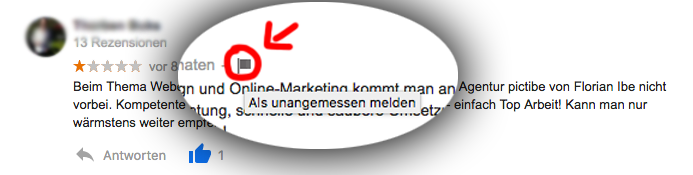
Unfortunately, the form that then pops up on the portal offers only a few options to complain about the review. The process is similar when entering information into Google My Business.
In both cases, it can take a very long time before the search engine responds with a standard letter – if at all. The corporation expects „informative and insightful“ reviews that are factual and should be written „with respect and style.“ Google often invokes the right to freedom of expression and wants to allow reviews that one might personally find untrue and hurtful.
By reporting it multiple times, the chances of the review being deleted increase. You can therefore ask friends to report the same review to Google. However, there are many reports that even this does not help. Google disclaims responsibility, as they merely provide the platform, and they primarily emphasize people’s freedom of expression.
"Cover up" negative reviews
If the negative review is not deleted even after multiple reports to Google, it can also help to simply cover up the negative review. Ask your customers to write a positive review on Google if they are satisfied with your product or service. With many positive reviews, a single negative review will not carry as much weight.
Become more visible on Google & Social Media?
In a free strategy consultation for data-driven online marketing, we uncover your untapped potential, review any existing ad accounts if necessary, examine your SEO ranking and visibility, and determine which strategy is appropriate for your budget and which active measures will lead to more inquiries or sales.

✅ More visibility & perception through targeted placement
✅ More visitors > prospects > customers > revenue
✅ Reach target groups scalably with SEA
✅ Act and grow sustainably with SEO
🫵 Maximum success with our hybrid strategy
💪 More than 15 years of experience across industries in over 1,000+ projects demonstrable!







It can also help if you directly reply to the negative Google review. This way, you can get in touch with the customer and try to change their mind. Apologize for any errors or discrepancies that may have occurred and express your willingness to do everything possible to ensure the customer is satisfied with your product or service. Of course, it is uncertain whether the author of the review will respond, but a public resolution of the problem shows other potential customers that you value high customer satisfaction and work in a service-oriented manner. Through your clarification, they can also form their own opinion on whether the negative review is justified or not. And possibly, you can even persuade the customer to delete the negative review. Try to reach a solution to the problem together.
However, do not let yourself be blackmailed if the review was arbitrarily written to harm you or does not come from one of your customers.
Reputation law and engaging a lawyer to have reviews deleted
Here, it is advisable to involve a lawyer specializing in reputation law, who can push for deletion with a letter to Google’s legal department. Often, such a letter is sufficient to make the business-damaging criticism disappear, but sometimes courts also have to be involved. The initial legal assessment of whether deletion can be successfully pursued is often free of charge. Next, the lawyer will send a „notice-and-take-down-letter“ to Google, urging them to act.
You should use the time until then wisely: Motivate satisfied customers and business partners to leave positive reviews about you. This not only improves the average rating of the reviews, but each positive new entry also simultaneously worsens the visibility of the criticism, which consequently slides further and further down.
It is true: As a company or self-employed person, you cannot avoid public online reviews. According to the assessment of the Federal Court of Justice (BGH „Spickmich“ judgment of 23.06.2009 – VI ZR 196/18 and judgment of 23.09.2014 – VI ZR 358/13), these reviews are permissible and covered by freedom of expression, as the reviewed products and services are also offered publicly. These reviews are inadmissible if they violate the portal’s guidelines or your personal rights. It is unfortunately a fact that Google interprets the right to freedom of expression very broadly, often to the detriment of the reviewed company.
However, there are also points here where one can start, for example, with the difference between opinions and factual claims. If someone felt uncomfortable in a restaurant or practice and then communicates this, that is their opinion. Factual claims, on the other hand, can at least theoretically be verified; they are either right or wrong. So, if a review wrongly claims that the wrong products were delivered or a justified exchange was refused, then this review must be deleted.
However, reviews that violate the guidelines,spread falsehoods, and infringe upon the personal rights of the entrepreneur are not permitted. (Art. 2 para. 1 GG in conjunction with Art. 1 para. 1 GG). Furthermore, insults (§ 185 StGB), defamation (§ 186 StGB), and slander (§ 187 StGB) are not permitted.
However, review platforms only have to become active upon notification from affected parties; there is no obligation to actively scan their portals for incorrect reviews.
Are 1-star reviews permissible?
A particular challenge is the uncommented 1-star reviews. They also fall under protected expressions of opinion, but are indirectly linked to a factual assertion. After all, the anonymous person implies having business relations with the reviewed party. If this is not true or cannot be proven by the author, this review must also be deleted. The view of the Hamburg Regional Court (LG Hamburg, judgment of 12.01.2018 (Az. 324 O 63/17)) is interesting here. A one or two-star review represents the negative opinion of the author, whereby the absence of a comment raises doubts about the reviewer’s customer status. This must be checked by Google. This also applies to insulting three-star reviews.
Further instruments are available to combat the effects of false and defamatory reviews. For example, criminal charges may be filed against the author for defamation or insult. In addition, there is a claim for deletion and injunctive relief, as well as damages. This includes the legal fees incurred, but also proven loss of sales due to the poor review. In cases of serious violations of personal rights, pain and suffering may also be claimed.
However, this becomes problematic due to the fact that the undesirable reviewer only needs a free Google Plus account to submit their review – usually under a pseudonym. Their identity is therefore only known to Google and only needs to be disclosed in the case of serious offenses, usually at the instigation of the police and public prosecutor’s office. According to a decision by the Federal Court of Justice, German courts are also responsible for lawsuits against portals such as Google (BGH judgment of April 21, 2016 – I ZR 43/14), even if the corporation is not based in Germany. However, Google is neither liable for unjustified reviews nor is the portal liable for damages for their effects.
Conclusion on bad Google reviews and how to have them deleted
In conclusion: Reviews on Google & Co. are an important instrument for business success and marketing. It is all the more important to react quickly and consistently to negative reviews on rating portals, also with the support of professionals.

Fragen zu Bewertungen löschen oder dem richtigen Umgang?
E-Mail: fi@vastcob.com
Florian Ibe





 DE
DE