
First it hit France and Austria, now Berlin is also targeting the big platforms. For advertising companies, this is not a distant tax debate, but soon a real surcharge on every campaign. In this article, we tell you what to expect and how to prepare now.
Why the digital tax will soon make your advertising on Google and Meta more expensive
The digital tax is no longer a distant theoretical debate, but is now reaching the invoices of advertising companies. Because at VASTCOB we have been supporting clients from start-ups to corporations through online marketing for over 15 years, we recognize such developments early on. Those who look closely will quickly see how political disputes turn into a tangible cost factor.
France and Austria are already collecting. Because several advertising platforms are now passing on the burden, it ends up with the advertising clients. In Germany, too, its own version is taking shape. In this article, we clarify how the digital tax works, who ultimately bears it, and what you should deduce from it for your budgets.
What a digital tax is and why it is intended to hit tech corporations
The definition of a digital tax in simple terms
What exactly is a digital tax? It refers to a levy on certain digital revenues of large online corporations, for example from online advertising, platform intermediation, or the trading of user data. While a local business remains unaffected, it targets globally active providers such as Google, Meta, Amazon, or TikTok.
Why does it specifically affect these giants? Because they generate enormous revenues in many countries without maintaining a classic permanent establishment with factories or branches there. It is precisely this lack of physical presence that corporations use to channel profits to places where hardly any taxes are incurred.
Which tax loophole it is intended to close
A local company pays taxes on its earnings where it is located and operates. Corporations with a global reach, on the other hand, shift their profits to low-tax countries, even though value is created by users across Europe. To close precisely this loophole, the levy is not based on transferable profit, but on revenue in the respective country.
While experts argue about details, several terms are circulating for the same idea. Whether digital levy, platform levy, or Digital Services Tax, at its core, the same instrument is always meant. Since each country sets its own thresholds, there is still no uniform digital tax definition today.
How this levy works and why you ultimately pay
Revenue instead of profit as the tax base
How a digital tax works is most clearly shown by its tax base. What is taxed is not the reported profit, but the digital revenue generated in the country, usually in the low single-digit percentage range. This allows states to circumvent the very problem that profits can be easily shifted abroad.
In addition, there are clear thresholds. Since only corporations with very high global total revenues and high digital revenues are affected, smaller providers remain exempt. This ensures the levy maintains its intended direction.
Why the costs end up with advertising clients
Who actually pays the digital tax in the end? Formally, the platform owes it, but corporations treat such levies like any other cost factor and pass them on through surcharges. Those who place ads therefore indirectly bear the tax without ever filing their own tax return.
Become more visible on Google & Social Media?
In a free strategy consultation for data-driven online marketing, we uncover your untapped potential, review any existing ad accounts if necessary, examine your SEO ranking and visibility, and determine which strategy is appropriate for your budget and which active measures will lead to more inquiries or sales.

✅ More visibility & perception through targeted placement
✅ More visitors > prospects > customers > revenue
✅ Reach target groups scalably with SEA
✅ Act and grow sustainably with SEO
🫵 Maximum success with our hybrid strategy
💪 More than 15 years of experience across industries in over 1,000+ projects demonstrable!







This passing on is not theory, but long-established practice. In several countries, the surcharge already appears as a separate item on the advertising invoice. As soon as this happens, the essentially political question shifts to a very business-economic level, namely that of one’s own media costs.
Digital tax soon also for Germany and what Berlin is planning now
The current initiative for a German digital levy
In Germany, too, the discussion is gaining momentum. Minister of State for Culture Wolfram Weimer is pushing for a digital levy for large platforms and wants to finally settle an old dispute. While a finished draft law is still pending, the Bundesrat has already paved the way for it with a broad majority.
The Austrian model explicitly serves as a role model. A digital tax for Germany would therefore be based on a proven example instead of starting from scratch. This shifts the central question from whether to how and, above all, to when.
What the revenues are intended to finance
According to its own statements, Berlin primarily wants to strengthen journalism and media diversity. If platforms earn money with third-party content and reach, they should contribute to the financing of independent media. Those who ask the proponents hear one argument above all, namely fairness towards publishers and broadcasters.
However, resistance is forming against the plan. Since business associations and digital representatives warn of rising costs and reactions from abroad, the outcome is open. Whether and when the levy will come therefore depends heavily on how viable the political compromise ultimately turns out to be.
Why Austria and France are already collecting digital tax today
Austria as a pioneer since 2020
While Germany is still struggling, the digital tax has long been a reality in several neighboring countries. Since 2020, Austria has been levying five percent on the online advertising revenues of large corporations and is considered a pioneer in the EU. It is precisely this model that Berlin is now using as a blueprint.
One thing in particular is remarkable. Although critics predicted a collapse, the platforms are paying and the advertising market continues to run. Skeptics of feasibility find the best counter-argument in Austria.
France and the GAFA tax
As early as 2019, France led the way with the so-called GAFA tax and taxes digital revenues at three percent. As the name suggests, the levy targets Google, Apple, Facebook and Amazon. A common EU solution, however, has so far failed to materialize.
Why is that? Because international negotiations are deadlocked, more and more states are creating their own rules. The OECD was supposed to provide a global solution for the taxation of the digital economy with its reform package, but this process has been stalled for years.
The open power struggle with the USA over tech billions
Why the USA rejects national digital taxes
Behind the factual facade lies a fierce power struggle. Because almost all affected corporations come from the USA, Washington regards national digital taxes as targeted discrimination against American companies. A digital tax by the USA itself, on the other hand, is not up for debate.
If you ask Washington, it is a discriminatory special tax against its own economy. As soon as Europe takes action, a tax issue quickly turns into a transatlantic trade conflict.
Tariffs as leverage
To build pressure, the US government repeatedly threatens tariffs in this dispute. Anyone who levies a digital tax comes under pressure to weaken it or scrap it entirely. The United Kingdom has also already been openly confronted with punitive tariffs because of its digital tax.
For Germany, this makes the situation doubly delicate. While its own levy is intended to create tax justice, it could also trigger new tensions in trade relations. With every step, this balancing act between principle and economic risk accompanies the German debate.
What advantages and disadvantages the digital tax really has
Arguments for more tax justice
As with any tax, it is worth taking a sober look at the advantages and disadvantages, instead of just following headlines. Those who argue for the levy primarily cite fairness and the financing of public services. In doing so, it brings back a portion of the value creation that currently largely flows abroad untaxed.
The main advantages can be summarized as follows:
- Fairer distribution of burdens between global platforms and local companies
- Additional revenue for public tasks such as media promotion
- Equal treatment of digital and traditional business models
Risks for advertisers and consumers
Despite all justification, the advantages are offset by real disadvantages, which advertisers in particular feel. Because the corporations pass on the levy, higher advertising costs and ultimately rising prices for end customers are threatened. In addition, there are trade conflicts and additional bureaucratic effort.
The main disadvantages at a glance:
- Passing on to advertising customers via percentage surcharges
- Possible price increases along the entire chain
- Trade policy risks through countermeasures by other states
Whether the digital tax ultimately does more good than harm depends heavily on its specific design. How significant its impact is depends on the rate, the thresholds, and the question of how skillfully the corporations pass on the costs.
What the digital tax costs your advertising on Google and Meta
Meta’s new location fees from July 2026
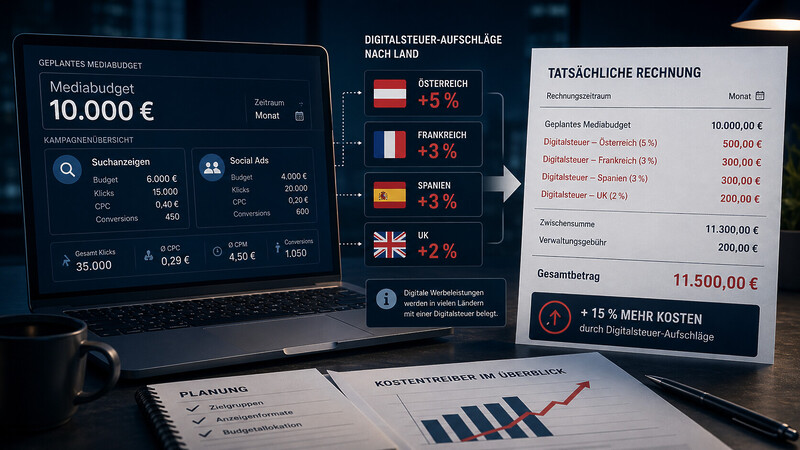
Now it gets specific for every advertising budget. From July 1, 2026, Meta is introducing so-called location fees, i.e., percentage surcharges on advertising spend in selected countries. The decisive factor is the country of your target audience, not the location of your company. So anyone advertising to an Austrian audience from Germany also pays the surcharge there.
What Google Ads already charges in addition today
This principle is not new. With Google Ads, corresponding surcharges have appeared on invoices for years as country-specific operating costs or digital service surcharges. As soon as an ad is served in an affected country, the platform adds the respective rate. Like Google, Meta is now following suit with its own location fees. The following overview shows the current rates by country:
| Country | Meta location surcharge from 01.07.2026 | Google Ads surcharge currently | National digital tax |
|---|---|---|---|
| Austria | 5 % | 5 % | since 2020, five percent on online advertising |
| Turkey | 5 % | 7 % | yes |
| France | 3 % | 2 % | taxe GAFA, three percent since 2019 |
| Italy | 3 % | 2.5 % | three percent |
| Spain | 3 % | 3 % | three percent since 2021 |
| United Kingdom | 2 % | 2 % | two percent since 2020 |
An important detail is easily overlooked. While the reported key figures in the advertising account, such as cost-per-click or cost-per-mille, remain the same, the actually invoiced sum increases. From over 1,000 completed projects, we know how quickly a two to five percent surcharge can add up in international campaigns. As a Google Partner and Meta Business Partner, we therefore align our clients‘ advertising accounts early on with these additional costs, whether in the SEA agency for Google Ads or for Facebook and Instagram advertising.
How to act now before the additional costs impact your budget
Factor additional costs into media planning
First, the good news. You are not helplessly exposed to these surcharges. If you know the additional costs, you can plan for them instead of discovering them only on the invoice. To avoid any surprises, every country-specific surcharge should be a fixed item in media planning.
Specifically, you should address these measures:
- Check target countries and determine which markets are affected by surcharges
- Separate net and gross budgets so that the true costs remain visible
- Inform internal teams, especially finance, purchasing, and marketing
- Increase conversion strength to offset additional costs with better results
Regularly check target countries and budgets
The last point is particularly effective. Those who achieve more conversions per euro invested often easily compensate for a surcharge of a few percent. This is precisely where clean conversion optimization comes into play, which measurably gets more out of the same budget.
It is also advisable to regularly review the distribution of budgets across target countries. If a market becomes expensive due to surcharges, it is sometimes worthwhile to shift priorities. If you would like to align your campaigns precisely with the new framework conditions, we, as a performance marketing agency, would be happy to assist you. The positive reviews from our customers on ProvenExpert confirm that this approach works.
Conclusion
The digital tax is far more than an abstract political issue, as it directly impacts your advertising budgets through platform surcharges. France and Austria have long taxed digital revenues, Meta and Google pass on the costs, while Germany is also visibly working on its own levy.
For companies, therefore, one thing is particularly important: to plan early instead of being surprised. As soon as you know the affected target countries, factor in the surcharges, and at the same time work on your own conversion, you will keep costs under control. This turns a political burden into a calculable factor that keeps your advertising plannable.





 DE
DE