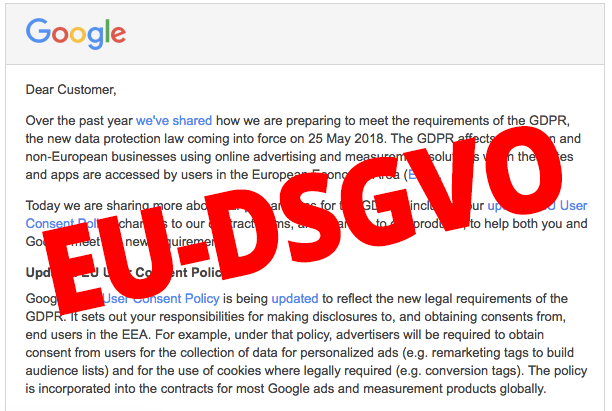
In recent days, most Google users and advertisers have received a relevant email. As is often the case these days, it concerns the upcoming GDPR. Data protection will be extended EU-wide on May 25th and will now apply to all, truly all, companies operating in the EU – regardless of where the company is headquartered!
We have translated this email from Google into English and hope to shed some „light on the darkness.“
Last year, Google already reported on how Google is preparing to meet the requirements of the General Data Protection Regulation, which comes into effect on May 25, 2018. The GDPR affects European and non-European companies that use online advertising and measurement solutions, as well as websites and apps accessed by users in the European Economic Area (EEA).
In this email, Google primarily shares more about its preparations for the GDPR – including the updated EU User Consent Policy, changes to contractual terms, and changes to Google products to help you and Google meet the new requirements.
Updated EU User Consent Policy
Google's EU User Consent Policy is being updated to reflect the new legal requirements of the GDPR. It outlines your responsibilities for disclosure and consent from end-users in the EEA. According to this policy, advertisers must, for example, obtain user consent for data collection for personalized ads (e.g., remarketing tags to create audience lists) and for the use of cookies when legally required (e.g., conversion tags). The policy is globally integrated into the contracts for most Google advertising and measurement products.
Contractual Changes
Since August of last year (2017), Google has been introducing updates to the contracts for many products that reflect Google’s status as a processor or controller under the new law (see full data processing terms for Google advertising products). The new GDPR provisions supplement your contract with Google and will come into effect on May 25, 2018.
- For AdWords customers worldwide, the GDPR provisions are part of the Terms of Service, which you can accept in your account (if you haven’t already). In the case of AdWords customer search and Google Store direct sales, Google acts as a processor. For the rest of AdWords, Google acts as a controller.
- For customers using DoubleClick and the Google Analytics (GA) Suite, you can review and accept the processor terms in your account. If you are an EEA customer of GA, the data processing terms will soon be included in your terms. GA customers located outside the EEA and all GA 360 customers can accept the terms from GA.
- If you do not have a contract with Google for the use of Google products, you should seek advice from the parties with whom you do have contracts.
Google Product Changes due to EU Regulations and GDPR
To comply with and support your compliance with the GDPR, we are:
- Making changes to the publisher advertising network where your ads may appear. This will allow publishers to serve non-personalized ads and select which third-party providers measure and serve ads on their websites and apps for EEA users.
- Taking measures to limit the processing of personal data for children under the GDPR consent in individual member states.
- Standardizing ad data retention practices and introducing new controls for Google Analytics customers to manage the retention and deletion of their data.
- Exploring consent solutions for publishers, including collaborating with industry groups such as IAB Europe.
You can visit privacy.google.com/businesses to learn more about Google’s privacy policies and approaches, as well as review our Google Data Processing TermsandGoogle Data Processing Terms.
If you have any questions about this update, please contact your account team or Google staff via the help section in your Google profile. Google will publish more information on its plans in the coming weeks.
We at pictibe are happy to help you, together with our partner lawyers, make your website and your company compliant with EU data protection regulations.




 DE
DE