
A campaign can shine in the advertising account and still burn money. An inconspicuous switch changes the basis for evaluating entire accounts without changing actual revenue. Anyone who does not understand it is steering by numbers that have little to do with actual profit.
How Google Ads new customer acquisition changes your numbers
Google Ads new customer acquisition sounds like a simple path to more growth. With a few clicks, the feature weights new customers more heavily and promises better campaign results. This seems tempting, especially for shops and service providers; after all, a new customer is often worth more than a single order from an existing customer. But that is precisely where the risk lies. The feature changes what your campaigns optimize for and can make ROAS look significantly better than it is economically. This article shows what the feature does, how the additional conversion value works, where the risks lie, and how to calculate new customer value reliably.
What new customer acquisition in Google Ads is
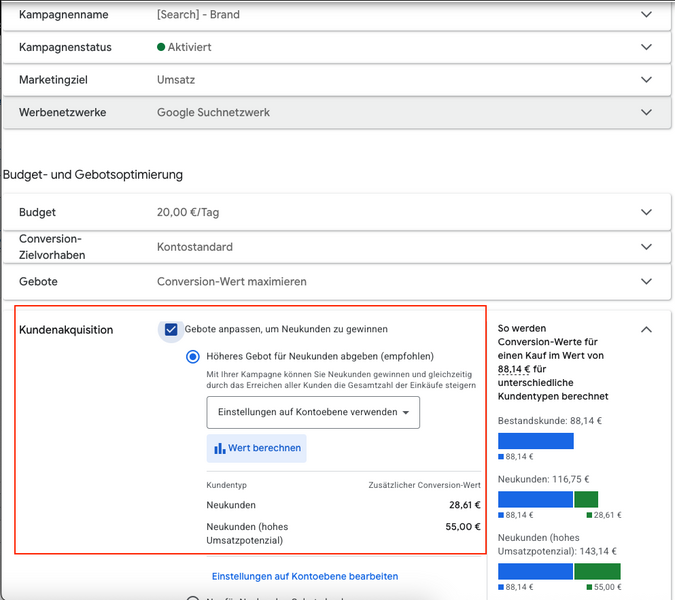
New customer acquisition is a feature of value-based bidding strategies in Google Ads. It ensures that campaigns weight new customers more heavily than existing customers, and therefore treats a first-time buyer differently from a returning customer. Officially, it runs under the customer acquisition goal, which is part of the customer lifecycle goals. It can be activated directly in a campaign’s budget and bid settings via the customer acquisition field.
Technically, the feature is built on Smart Bidding. The system controls bids automatically and takes into account that a new customer should contribute a higher total value. The option is supported in Search, Performance Max, Shopping, and Demand Gen campaigns, among others.
The goal is to direct the advertising budget more specifically toward acquiring new customers. Instead of treating every conversion equally, the campaign should invest recognizably more in first-time buyers. How strong this weighting is depends on the stored new customer value, and this value is the decisive lever.
How the additional conversion value works
The core of the feature is a markup on the conversion value. If Google recognizes or suspects that a purchase is from a new customer, the system adds an additional amount to the actual order value. In reporting, the conversion then no longer appears with the pure revenue, but with an increased sum.
A practical example illustrates this. If a customer makes a purchase for 88.14 euros and is considered a new customer, Google can add a new customer value of 28.61 euros. 88.14 euros thus becomes 116.75 euros. With a higher value, even 143.14 euros or more is possible.
The following overview shows how the same order value appears in the account depending on the customer type.
| Customer type | Actual order value | Additional value | Conversion value in Google Ads |
|---|---|---|---|
| Existing customer | 88.14 euros | 0 euros | 88.14 euros |
| New customer | 88.14 euros | 28.61 euros | 116.75 euros |
| New customer with high revenue potential | 88.14 euros | 55.00 euros | 143.14 euros |
The real revenue is identical in all three rows. Only the figure that Google optimizes for differs. Setting up such value logics properly belongs in the hands of an experienced SEA agency, so that the bidding strategy matches actual profitability.
Become more visible on Google & Social Media?
In a free strategy consultation for data-driven online marketing, we uncover your untapped potential, review any existing ad accounts if necessary, examine your SEO ranking and visibility, and determine which strategy is appropriate for your budget and which active measures will lead to more inquiries or sales.

✅ More visibility & perception through targeted placement
✅ More visitors > prospects > customers > revenue
✅ Reach target groups scalably with SEA
✅ Act and grow sustainably with SEO
🫵 Maximum success with our hybrid strategy
💪 More than 15 years of experience across industries in over 1,000+ projects demonstrable!







The two modes compared
Google offers two variants. In the recommended mode „higher bid for new customers,“ the campaign continues to bid on all users but weights first-time buyers more heavily. In the „new customers only“ mode, the campaign targets exclusively new customers, whom Google identifies via past purchases and uploaded customer lists. For most accounts with purchase goals, Google recommends the first mode because it favors new customers while still maintaining contact with existing customers.
Why the feature can distort your ROAS
At first glance, more conversion value through new customer acquisition sounds like better performance. More value means a higher ROAS and seemingly more efficient campaigns. In reality, this can be exactly what misleads you. Because the metric that is now rising is no longer your revenue, but a blended value assessed by Google.
Because your real revenue remains unchanged. Your margin, your payment fees, shipping, returns, and procurement costs also remain the same. Only Google values the conversion higher. If you steer your campaigns via ROAS, target ROAS, or the Maximize conversion value strategy, the system optimizes for an artificially inflated figure.
As a Google Partner that has managed ad accounts since 2010, we encounter this pattern regularly. A campaign looks profitable but delivers barely any profit based on real contribution margin. If the account then scales based on these figures, costs rise faster than real returns.
Revenue is not the same as value
Many ad accounts already work with overly optimistic data because they only pass gross revenue to Google. When the artificial new customer value is added, the gap between appearance and reality widens. The ROAS in the account and the profit in the books drift further and further apart.
Particularly critical with brand campaigns
New customer acquisition becomes truly tricky with brand campaigns. Anyone searching for your brand name is usually already very close to purchasing. This person already knows your brand from social media, organic search, the newsletter, or previous visits.
If Google adds additional new customer values in such a campaign, a distorted picture emerges. The brand campaign appears to deliver particularly valuable new customers. In reality, the ad often just got the last click on someone who would have bought anyway. The example shown in the screenshot of a campaign named [Search] Brand is therefore a typical case for caution.
For most accounts, a clear line therefore applies. Brand Search should run cleanly, in a controlled manner, and rather defensively. An uplift for new customers fits better in non-brand, Shopping, or Performance Max campaigns, and even there only with realistic values.

How to calculate the new customer value correctly
The decisive point is the additional value applied. It must not come from Google’s suggestion or from wishful thinking, but must be derived from real company figures. Smart Bidding is not neutral; it spends exactly as much budget as you specify via the value.
A simple formula helps. The additional new customer value results from the expected future contribution margin multiplied by the repurchase probability. This way, only the share that can actually be expected economically is included.
Suppose a new customer later makes another purchase for 100 euros, and the true margin after all variable costs is 25 percent. That yields 25 euros in additional contribution margin. But if only 50 percent of new customers purchase again, the realistic additional value is 12.50 euros. Not at 55 euros and not at an automatically suggested value.
Why Google's suggested value rarely fits
The default value suggested by Google does not know your margin, your return rate, or your repeat purchase rate. It is a placeholder, not a business result. Anyone who adopts it without checking hands over control of their budget to an estimate.
When new customer acquisition makes sense and when it does not
New customer acquisition is not fundamentally bad. With the right starting position, it can be a strong lever because it directs budget specifically to where the most value is created in the long term.
Sensible use cases
The function is particularly well-suited when a new customer is demonstrably worth more than their first order. This includes:
- High repurchase rate with regular follow-up purchases
- Subscription models and consumables
- Replacement and accessory products with predictable re-purchase
- Strong email marketing and CRM-driven customer loyalty
- Known Customer Lifetime Value as a reliable basis
When you should rather deactivate the option
Caution is advised, however, when the data situation is thin or the long-term value is unclear. Particularly critical are:
- Brand Search campaigns and very small budgets
- Small data basis and unclear new customer recognition
- Low repurchase rate and one-time products
- High return rates and low margin
- Unclean conversion tracking without a clear data basis
It is also important how Google recognizes new customers. The system uses past purchase conversions, uploaded Customer Match lists, and automatic recognition. However, this automatic recognition is not perfect because users can delete cookies or reject tracking. Google itself points out that this method is less reliable than its own customer data. Those who seriously use new customer acquisition should therefore rely on well-maintained Customer Match lists.
Check Google Ads figures against actual company figures
As soon as new customer acquisition adds additional value, you should no longer read the Conversion Value column as pure revenue. It then contains the actual order value, the artificial new customer value, and possibly other value rules and modeled values. Two accounts with an identical ROAS can therefore have completely different real profitability.
This may be desirable for the bidding strategy. However, for your business analysis, you need independent control. Therefore, additionally check the campaigns against shop revenue, net revenue, contribution margin, new customer rate, repurchase rate, customer acquisition cost, return rate, and real profit after advertising costs. A reliable data basis is created by a Google Analytics agency that sets up tracking and evaluation properly.
From more than 1,000 implemented projects, we know how important it is to check every value logic against the real company figures before scaling an account based on it. The positive reviews from our customers on ProvenExpert confirm that this approach works. If you want to consistently align your campaigns with economic results instead of embellished surfaces, an experienced performance marketing agency will manage your accounts based on real key figures.
Conclusion
Google Ads new customer acquisition is not a harmless switch; it changes the basis on which your campaigns are optimized. With a realistically calculated added value, it can help acquire more valuable new customers. Used incorrectly, it achieves the opposite. ROAS appears stronger, campaigns receive more budget, and real profit still decreases. Google Ads doesn’t have to look good; your company needs to grow profitably. Therefore, always check every new customer value optimization against your real figures, not just against the surface of the ad account.





 DE
DE