
The Google Consent Mode, effective from March 2024, represents an adaptation and extension of the previous functionalities of the Google Consent Mode to help website operators improve compliance with data protection regulations such as the GDPR in the European Union. This technology allows websites to manage the use of Google services like Google Analytics and Google Ads depending on users‘ consent. This means that websites have the ability to modify data collection and processing based on whether a user agrees to the use of cookies and similar technologies.
Attention: EVERYONE who runs Google Ads and uses Analytics must take action and switch over.
Google Consent Mode – GDPR Consent Mode + WordPress Setup
First, here is the official page and help article on Google Consent Mode: https://support.google.com/google-ads/answer/10000067. In this article, we will cover „What it is,“ „What it means,“ „What I need to do,“ and „How to do it (with WordPress).“
What is Google Consent Mode?
Consent Mode is a flexible framework from Google that allows websites to adapt the functionality of their Google services, such as Analytics and Ads, based on users‘ consent to data protection and cookie usage. It enables differentiated data collection and processing by automatically adjusting which data can be collected, depending on whether and how users give their consent. This helps website operators improve compliance with data protection regulations like the GDPR without having to forgo valuable insights for data analysis and personalized advertising.

Key features of the updated Consent Mode (Manager) are:
- Enhanced Customization Capabilities: The ability for website operators to make finer settings on how and when data is collected, based on users‘ consent decisions.
- Improved Integration with Consent Management Platforms (CMPs): Closer integration with tools and platforms that help companies manage and document user consent.
- Increased Transparency and Control for Users: Google may offer users improved information and control options on how their data is used, which meets the demand for more transparency in the digital space.
- Optimizations for Privacy-Friendly Analytics: Features that make it possible to gain useful insights from data even if users do not consent to data collection, for example by using aggregated data or by applying privacy-preserving techniques.
It is important to emphasize that Google’s Consent Mode is specifically designed to help website operators, finding the balance between data-driven insights and advertising activities and preserving user privacy and autonomy. As legal and technical frameworks continuously evolve, it is advisable for website operators and companies using digital marketing services to regularly inform themselves about the latest updates and best practices.
For all WordPress and WooCommerce users, the explanation for implementation is also provided at the bottom of the article.
Google Consent Mode v2 represents a significant evolution in how websites manage and use user consent in compliance with data protection laws, particularly the General Data Protection Regulation (GDPR) in the European Union and the European Economic Area. This feature is mandatory from March 2024 for all websites and apps that use Google advertising products. Its implementation allows for more precise adaptation and use of Google tags or scripts, based on users‘ consent decisions, which is crucial for both compliance with data protection regulations and the efficiency of online marketing campaigns.
Summary:
- Background: With the increase in online shopping worldwide, advertisers need to be able to measure how effectively their digital campaigns drive online sales. Data protection authorities in Europe may require many companies to obtain user consent on their digital properties for activities related to advertising and/or analytics, which impacts advertisers‘ understanding of how users convert on their sites.
- Consent Mode: Google is introducing Consent Mode, which provides two new tag settings that manage cookie behavior for advertising and analytics purposes. These settings can be adjusted to control the behavior of Google tags before and after users‘ consent decisions, helping advertisers measure conversions more effectively while respecting users‘ consent choices for advertising and analytics cookies.
- How it works: With Consent Mode, advertisers can gain insights into conversion data and ensure that the Google tags that help them measure conversions reflect users‘ consent choices for advertising cookies. If a user does not give consent for advertising cookies, Google tags do not use cookies for advertising purposes.
- Integration with Google Analytics: Consent Mode also works with Google Analytics. This means that Analytics can understand and respect the user’s consent for advertising cookies. If the „ad_storage“ tag setting is disabled for non-consenting users, Analytics will not read or write advertising cookies, which means that optional features based on Google signals, such as remarketing, will be disabled.

Become more visible on Google & Social Media?
In a free strategy consultation for data-driven online marketing, we uncover your untapped potential, review any existing ad accounts if necessary, examine your SEO ranking and visibility, and determine which strategy is appropriate for your budget and which active measures will lead to more inquiries or sales.

✅ More visibility & perception through targeted placement
✅ More visitors > prospects > customers > revenue
✅ Reach target groups scalably with SEA
✅ Act and grow sustainably with SEO
🫵 Maximum success with our hybrid strategy
💪 More than 15 years of experience across industries in over 1,000+ projects demonstrable!







Core functionalities and implementation mechanisms
Google Consent Mode v2 works closely with consent banners on websites by automatically sending signals to Google tools integrated on the website. These signals include important information about the user’s consent to various areas such as analytics, advertising, personalization, and data sharing. Depending on the consent given or denied, Google tags adjust their behavior accordingly, enabling data collection and use in compliance with data protection regulations.
A key feature of Consent Mode v2 are the two new tag settings: ad_storageandanalytics_storage. These settings offer website operators the ability to control the behavior of cookies for advertising and analytics purposes, both before and after users make their cookie consent decision. This enables a differentiated and user-centric handling of cookies that respects user privacy while also providing advertisers with valuable insights into user behavior.

Image source: https://blog.google/products/marketingplatform/360/measure-conversions-while-respecting-user-consent-choices/
When Google Consent Mode is implemented in your Consent Management Platform (CMP), it offers the possibility to collect differentiated user data for services such as Google Analytics,Google Ads, and Google Tag Manager, precisely tailored to the respective user consent. This means that despite strict data protection regulations, you can gain valuable insights into user behavior without compromising the privacy of your website visitors. This adaptability ensures that advertising campaigns and analytics strategies remain effective even in an increasingly regulated environment by creating a data protection-compliant basis for collecting and processing user data.

Benefits for Advertisers and Website Operators
For advertisers, Consent Mode v2 offers significant advantages by enabling detailed insights into conversion data, even when users do not consent to the use of advertising cookies. This is achieved through intelligent adaptation of data collection, which allows conversions to be measured at an aggregated level while still drawing precise conclusions about the effectiveness of advertising campaigns. Advertisers can thus optimize their campaign strategies without disregarding users‘ privacy preferences.
The integration of Consent Mode v2 with Google Analytics further enhances these benefits by enabling data protection-compliant analysis of user behavior. Analytics adjusts data collection based on consent to ad_storageandanalytics_storage, providing website operators with valuable insights without violating data protection regulations.

Florian Ibe
CEO & Marketing Consultant
Your contact person: Florian Ibe
Significance for Advertisers and Website Operators
- For Advertisers: Consent Mode v2 allows advertisers to track the performance of their ads more effectively and make optimizations in their advertising strategies. By using Consent Mode v2, advertisers can gain insights into conversion data and ensure that the Google tags that help them measure conversions reflect users‘ consent choices for advertising cookies.
- For Website Operators: Implementing Consent Mode v2 helps website operators better comply with data protection regulations while gaining valuable insights into user behavior and campaign effectiveness.
Compliance and Implementation
The implementation of Google Consent Mode v2 requires careful integration into the website infrastructure, ideally using a Google-certified Consent Management Partner (CMP). This not only facilitates technical implementation but also ensures that the solution complies with current legal requirements. As of March 2024, the use of Consent Mode v2 is mandatory for all websites and apps operating in the EU or EEA and using Google advertising products to comply with data protection regulations.
Example Google Analytics:


Help article: https://support.google.com/analytics/answer/14275483
A good solution for any CMS or shop system is iubenda*:

Another alternative is Cookiebot.
Tip for current and correct legal texts: Privacy Policy + Imprint Text from IT-Recht-Kanzlei

Set up Google Consent Mode in WordPress & WooCommerce
The best and easiest solution is still the Real Cookie Banner. With license costs of just 49 Euros per year, it is the legally compliant and extremely simple, and even semi-automatic, solution for a cookie banner with Consent Mode.
20% discount with coupon code: "FLORIANIBE"

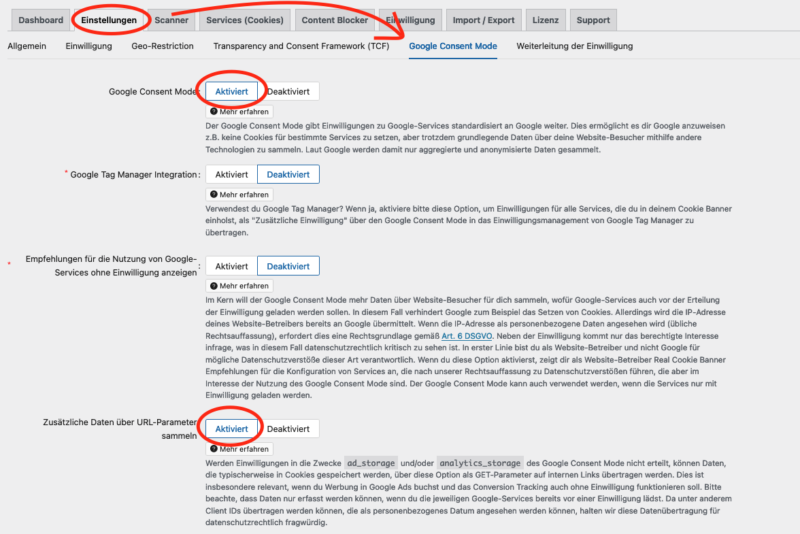
The official and detailed explanation of Consent Mode with Real Cookie Banner can be found here:
A video about it:
Blog article generally on the topic of WordPress Cookie Banner:
WordPress GDPR Plugin (TTDSG) – Data protection compliant with cookie solution
Conclusion on Consent Mode with Google Consent Manager
Google Consent Mode v2 represents a significant step forward in the balance between effective online marketing and strict data protection requirements. By providing a mechanism that allows websites to manage and utilize user consent in a way that respects privacy while also offering valuable marketing insights, Google provides a tool that is crucial for the future of digital marketing. Implementing this mode will not only contribute to compliance but also strengthen user trust in brands‘ digital presence.
Google Consent Mode v2 is an important development for websites and advertisers operating in the EU or EEA. It allows for flexible adaptation of Google tag behavior based on user consent choices, enabling advertisers and website operators to conduct their campaigns and analyses in line with user privacy preferences. Implementing Consent Mode v2 by March 2024 is crucial to comply with data protection regulations while gaining valuable insights into user behavior and campaign effectiveness.




 DE
DE