Some of your visitors do not read images, do not skim paragraphs, and do not click through a menu. These visitors process your page as structure, as code, and as a user interface. Anyone who technically ignores this class of visitor loses them quietly, without seeing it in a report.
Three ways in which AI agents perceive a website
Software that acts on behalf of a user moves through a page differently than a classic crawler. The latter collects text and moves on. An agent, by contrast, is supposed to accomplish something, such as filling out a form, comparing a price, or booking an appointment. AI agents on your website are therefore less readers than operators.
When people talk about an AI agent website today, that is exactly the shift they mean. In its developer documentation, Google describes three channels through which an agent captures a page. Each channel has a typical weak point. That is precisely where most websites fail.
The screenshot shows only what is visibly rendered
If an agent sees your page as an image, then for it only what is on the screen at that moment exists. A cookie banner over the content, an overlay without a visible close button, or collapsible content simply do not exist for it.
Raw HTML reveals structure, but not intent
The second path runs through the source code. Because nested div containers without semantic markup do provide text but no level of meaning, the agent often gropes in the dark here. A clean heading hierarchy, real lists, and properly marked-up tables are the map it uses for orientation.
The accessibility tree determines operability
As soon as the agent is supposed to act, the third channel becomes the most important. A button without a programmatic name is an unnamed field to it. An input field without an associated label remains a black box.
Anyone who has built their site to be accessible is, at this point, already far along without intending to be. Whether your site has this foundation can be clarified with a structured test checking a website for accessibility.
Why agent readiness became a topic in 2026 of all years
Why now? The topic runs in parallel under several labels: AI agent website, agent readiness, or agentic browsing. There is no marketing term behind it, but rather a striking accumulation. Google published its guideline for agent-friendly websites in early April 2026. Two weeks later, on April 17, 2026, Cloudflare launched the Agent Readiness Score along with a public scanner. Since May, the same score has been part of the URL Scanner in the Cloudflare dashboard. With Chrome M150, Lighthouse received the new Agentic Browsing category in June 2026.
So three major providers addressed the same gap within a few weeks. At the same time, a sober look is worthwhile. Because the Lighthouse category is explicitly labeled as informative and unbenchmarked, it does not factor into any rating. We have been following similar standard shifts since 2010. The pattern repeats reliably: first come the measurement tools, then the recommendations. Only afterward does it become clear what among them gains weight. The right response is therefore preparation, not panic.
What the Agent Readiness Score measures and how meaningful it is
Anyone who wants to know how technically advanced their own AI agent website is gets a score between 0 and 100 from Cloudflare. Four areas are checked. The test is free, runs in seconds, and requires no access to your system.
Become more visible on Google & Social Media?
In a free strategy consultation for data-driven online marketing, we uncover your untapped potential, review any existing ad accounts if necessary, examine your SEO ranking and visibility, and determine which strategy is appropriate for your budget and which active measures will lead to more inquiries or sales.

✅ More visibility & perception through targeted placement
✅ More visitors > prospects > customers > revenue
✅ Reach target groups scalably with SEA
✅ Act and grow sustainably with SEO
🫵 Maximum success with our hybrid strategy
💪 More than 15 years of experience across industries in over 1,000+ projects demonstrable!







| Category | What is checked | Prevalence in the Cloudflare scan |
|---|---|---|
| Discoverability | robots.txt, sitemap.xml, link header | robots.txt on 78 percent of domains |
| Content | machine-readable delivery, Markdown content negotiation | 3.9 percent |
| Bot Access Control | declared usage preferences via Content Signals | 4 percent |
| Capabilities | MCP server cards, API catalogs, commerce protocols | fewer than 15 domains in the entire dataset |
The figures come from a scan of the 200,000 most-visited domains on the web. They put a low score of your own into realistic perspective: A weak score is currently the norm, not an alarm signal. For the advanced signals, practically the entire web sits at zero.
Honesty also means acknowledging the tool’s limits. Because the score counts technical signals, it evaluates neither your content nor your offerings. A page with a perfect 100 points and thin content remains uninteresting to an agent. It finds nothing there that it could pass on.
Optimizing a website for AI agents: the technical foundation
Almost everything that makes a page usable for agents also improves it for people. This sentence from Google’s documentation is the real reason the effort pays off, even if agentic traffic is barely measurable for you today. You are not investing in a trend, but in craftsmanship quality.
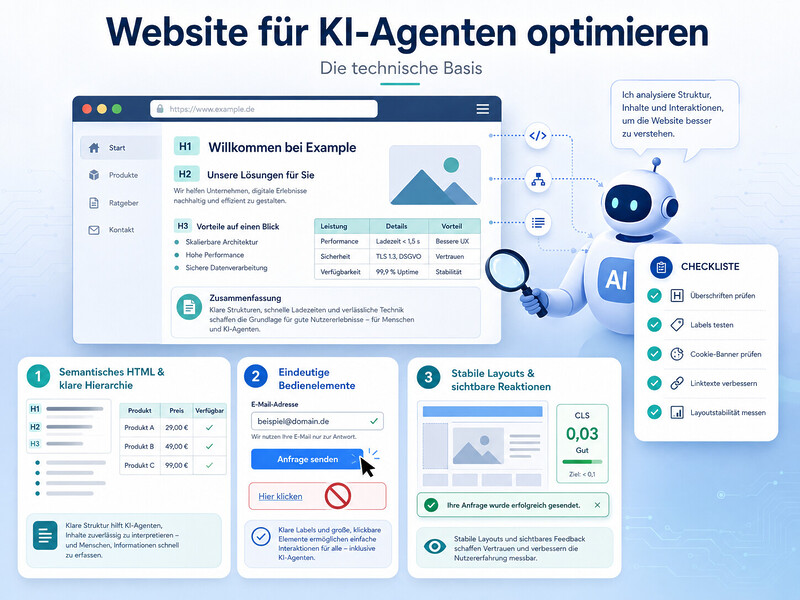
Anyone who wants to optimize their website for AI agents therefore does not work on a special version. Three areas carry the largest share, and all three should be on every checklist anyway.
Semantic HTML and a clean hierarchy
Headings run from H1 to H2 to H3 without gaps. Lists are real lists, tables have column headers, link texts name their destination instead of claiming „click here.“ Because agents often pass on content in abbreviated form, longer articles also benefit from a concise summary near the top.
Controls that can be addressed unambiguously
Every input field is linked to its label. Click areas are large enough, cursor pointer reliably signals what is clickable. Invisible overlays over real elements are among the most common stumbling blocks: the agent reaches into empty space without receiving any feedback.
Stable layouts and visible reactions
If the layout shifts after loading, an agent hits the wrong element. If the visible confirmation fails to appear after an action, it repeats the step or aborts. Both can be measured, layout shifts for instance via the well-known CLS value.
If you want to build an AI agent website step by step, start here. Five points you can check in one afternoon:
- Check the heading hierarchy of an important page for jumps
- Test all form fields for linked labels
- Check cookie banners and overlays for clean closing
- Change link texts in body copy to descriptive labels
- Measure layout stability of the homepage and a service page
WebMCP turns reading into acting
So far, the focus was on being understood. The next step goes further: with WebMCP, a website provides its own functions as callable tools, directly in the browser, without API keys and without a separate backend connection. The agent then no longer has to guess which click leads to which result.
In practice, this means: an availability query, an appointment booking, or a product filter become clearly defined functions. Instead of simulated mouse movements, there is a clean call. Because this is the first time a completion without human intermediate steps becomes conceivable, this is the most exciting part of the development for shops and booking-driven providers.
Nevertheless, a sober assessment applies. The standard is young, and Lighthouse currently checks registered tools purely for informational purposes. In the worldwide scan, corresponding entries appeared on fewer than 15 domains. For the vast majority of operators, WebMCP therefore remains a topic to watch. Whether the effort pays off earlier for your business model is best clarified in a conversation with an AI agency that can also assess the technical foundation of an AI agent website.
Who may access your content and who may not?
An AI agent website does not mean opening every door. A training crawler that collects content for a model pursues a different purpose than an answer engine that cites you. Both differ from the acting agent that performs something for a specific user. Make this distinction deliberately instead of leaving it to chance.
The tools for this are available. The robots.txt remains the foundation, and Content Signals allow a declared usage preference. Web Bot Auth aims to make legitimate agents verifiable in the first place. Only 4 percent of the domains examined have stored their preference so far. How quickly uncontrolled bot traffic becomes a burden is shown by the current crawler flood, which puts measurable pressure on servers.
From more than 1,000 completed projects, we know above all one mistake: the blanket block. Anyone who blocks everything that looks like AI regularly also excludes the answer engines in which they later want to be found. A differentiated rule that distinguishes between training, citation, and action makes more sense.
How to identify AI agents on your website
Without measurement, the topic remains a claim. The effort is manageable, however, the usual paths lead astray.
Server logs instead of analytics
Because many agents do not execute scripts at all, JavaScript-based tracking systematically reports too little. Server logs, on the other hand, show the accesses completely, including the user-agent identifier. There, patterns become visible long before they appear in a dashboard.
Three segments instead of one number
Separate humans from AI answers, humans from classic search, and agents cleanly from one another. Without this separation, dwell time and conversion rate become diluted. Agents navigate differently, otherwise you compare metrics that have nothing to do with each other.
Test your own site with agent tools
The Cloudflare scanner, the Lighthouse category Agentic Browsing, and Chrome DevTools for Agents cost nothing. In just a few minutes, they provide an initial picture of how far along your AI-agent website is. If you would like to evaluate the result together with content and technology, combine it with a structured website analysis.
Three metrics that can be collected immediately:
- Share of agent accesses in all server requests per month
- Number of pages where agents abandon instead of continuing
- Score development of your most important pages over time
What has priority now and what can still wait
The craft foundation makes sense immediately. Semantic HTML, a clean heading hierarchy, linked form fields, stable layouts, and a deliberate decision about which accesses you allow. This block costs little and works regardless of how agentic traffic develops.
In the medium term, machine-readable product and service data follow, along with measurement so that you even notice changes. Observation, on the other hand, is sufficient for now with WebMCP and the commerce protocols such as ACP, UCP, or x402. Anyone searching today for AI-agent website or agent readiness finds mainly tools and little reliable data on adoption in Germany. That is exactly what should determine the order of your measures.
The good news lies in the overlap. Anyone who completes the first two stages properly ends up with a better site for humans, regardless of how quickly the agents arrive. As our customers confirm on ProvenExpert, this order pays off: first the foundation, then the standards that are only just sorting themselves out. Contact us if you would like to have the current state of your site professionally assessed.




 DE
DE