2026 wird Bot-Traffic für viele Websites und Shops zu einem echten Performance-Problem. Neben Google und Bing greifen heute auch KI-Crawler, SEO-Tools, Social-Media-Bots, Preisvergleichsdienste, Feed-Systeme, Scraper und Wettbewerbs-Monitoring-Tools auf Websites zu.
The problem is not crawling itself! Crawling is important for visibility. It becomes critical when bots massively retrieve filter pages, search results, sorting options, pagination, and parameter URLs.
Particularly affected are WooCommerce, Shopify, Magento, Shopware, and other e-commerce systems because they can generate very many URL combinations through product filters, variants, collections, tags, and search pages.
The solution is not a blanket blocking of all bots, but intelligent crawl management:
- keep important product pages, categories, collections, landing pages and blog articles open
- internal search, filter combinations, sorting parameters, and deep pagination limit
- allow reputable search engines and relevant AI systems selectively
- Identify and throttle fake bots, scrapers, and aggressive crawlers
- Analyze server logs regularly
- use robots.txt, canonicals, sitemaps, caching and bot limiters together
A modern bot limiter protects not only the server, but also SEO, visibility, load times, checkout stability, and hosting costs.
By the way, we also offer IMMEDIATE ASSISTANCE here! Just write to us!
In short: Not every bot is bad. But not every bot should be allowed to crawl every URL without limits.
Crawler flood 2026: Why modern websites need an intelligent bot limiter to distinguish real from fake and meaningful from meaningless.
In the past, crawling was comparatively manageable. A website was visited regularly mainly by Google, Bing, and a few other search engines. This was technically predictable and even explicitly desired from an SEO perspective.
In 2026, reality looks different.

How search engines, AI bots, SEO tools, and scrapers overload modern websites – and why blanket blocking is not a solution
Today, not only classic search engines access websites. AI crawlers, AI search systems, SEO tools, social media bots, link preview crawlers, feed systems, price comparison services, monitoring tools, commerce platforms, scrapers, competitive analysis, and data providers that want to build their own indices are also added to the mix.
Each of these systems pursues a legitimate or at least understandable goal: capturing content, understanding products, comparing prices, generating snippets, training data, improving search results, or supplying new answer systems with information. The problem arises where useful crawling becomes uncontrolled technical load.
Become more visible on Google & Social Media?
In a free strategy consultation for data-driven online marketing, we uncover your untapped potential, review any existing ad accounts if necessary, examine your SEO ranking and visibility, and determine which strategy is appropriate for your budget and which active measures will lead to more inquiries or sales.

✅ More visibility & perception through targeted placement
✅ More visitors > prospects > customers > revenue
✅ Reach target groups scalably with SEA
✅ Act and grow sustainably with SEO
🫵 Maximum success with our hybrid strategy
💪 More than 15 years of experience across industries in over 1,000+ projects demonstrable!







Our video on this:
Important terms and definitions:
Fraud = Fraud / Misuse
Fraud refers to intentional deception or manipulation with economic damage. In a web context, this means, for example, click fraud, fake leads, counterfeit orders, account abuse, or automated actions with fraudulent intent.
Bot = automated program
A bot is a software program that performs tasks automatically. Bots can be useful, such as search engine bots, monitoring bots, or security scanners, but also harmful, such as spam bots, scrapers, or attack bots.
Crawler = Bot for scanning websites
A crawler systematically accesses web pages, follows links, and collects content. Legitimate crawlers such as Googlebot or Bingbot serve indexing purposes. Crawlers become problematic when they access too many pages too quickly or overload shops through filter, search, and parameter URLs.
Scraper = Bot for Copying Content or Data
A scraper reads web pages to automatically copy content, prices, product data, images, or text. In e-commerce, scrapers can create server load, extract competitor data, or cause content theft.
Good Bot = desired bot
A good bot serves a legitimate purpose, such as Googlebot, Bingbot, payment provider checks, monitoring services, or SEO tools when they operate in a controlled and compliant manner.
Bad Bot = Unwanted or Harmful Bot
A bad bot causes spam, scraping, fake traffic, credential stuffing, form abuse, shopping cart manipulation, or massive server load. Not every bad bot is immediately a hacker attack, but it can cause significant economic and technical damage.
AI Crawler = Crawler for AI Systems
AI Crawlers collect website content to supply AI search systems, language models, or answer machines with information. For companies, this can bring visibility, but at the same time it can create server load and loss of control over content.
Rate Limiting = Restricting Access
Rate Limiting restricts how many requests a user, bot, or IP address may make within a specific time period. The goal is to avoid hindering normal visitors while slowing down excessive access.
Bot Limiter = Intelligent System for Bot Control
A Bot Limiter recognizes suspicious access patterns and limits, delays, or blocks problematic requests. Ideally, it distinguishes between real visitors, legitimate search engine bots, and harmful bots.
Burst = surge / flood.
In a network/bot detection context: a phase in which a very large number of requests arrive in a very short time from a single IP.
DDoS = Massive Overload Attack
DDoS stands for "Distributed Denial of Service". A website or server is overwhelmed by a very large number of simultaneous requests. Unlike normal crawler floods, a DDoS is usually deliberately destructive in nature.
Server Load = Technical Burden on the Server
Server load is created by database queries, PHP processes, shopping cart requests, filter pages, search queries, image requests, or many parallel visitors/bots. High server load leads to slow loading times, errors, or outages.
Peak load = temporarily significantly increased utilization
A peak load is a sudden increase in access or server processes. It can be caused by real visitors, campaigns, bots, crawlers, attacks, or misconfigured tools.
So what does this mean for visitors, servers, loading time and security of website and shop?
For simple business websites, this is often barely noticeable. For large shops (regardless of which system!), WooCommerce systems, directories, portals, and websites with many filters, parameters, pagination, sorting, and internal search, crawling can become a real performance and cost problem.
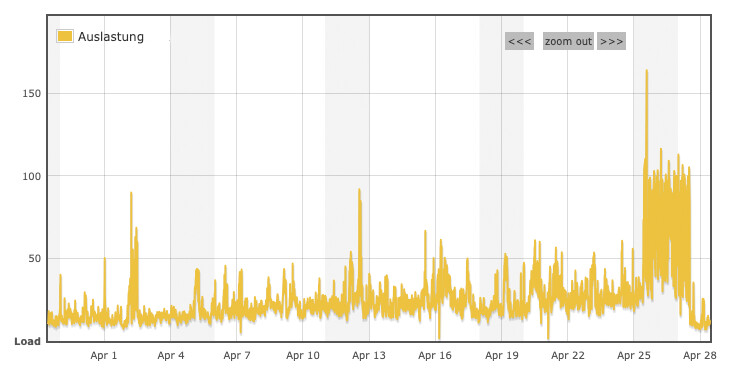
Server load can quickly increase tenfold or more, as can be seen here:
Weekly view: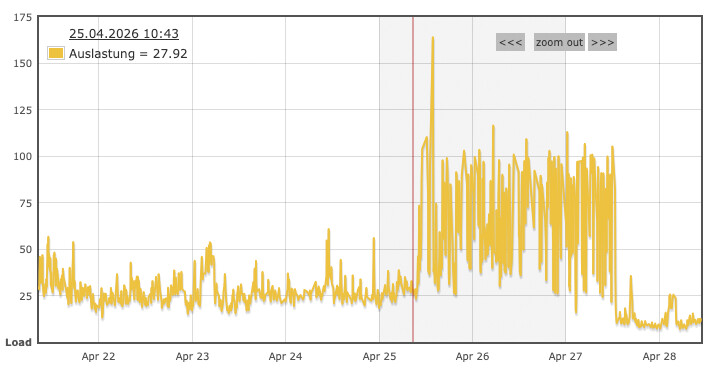
Google itself points out that faceted navigation and filtered URLs can generate enormous quantities of URL combinations and often unnecessarily consume server resources when crawlers retrieve them without filtering. For many filtered product lists, Google therefore recommends controlling crawling specifically via robots.txt to control when these URLs have no independent search value.
This is exactly where the central question comes in:
How does a website remain visible to search engines and relevant AI systems without bots overloading servers, databases, and shop functions?
The answer is not: "Block all bots."
The answer is: intelligent crawl management.
Recommendation for very good and affordable hosting is always All-Inkl from the BUSINESS package*!
What is meant by "crawler flood"?
Crawler flood does not mean that every bot is automatically harmful. Crawling is a fundamental component of the open web. Without crawlers, there would be no Google search, no Bing search, no product ads, no link previews, no SEO analysis, and no visibility in many modern answer systems.
The problem is the volume, speed, and depth of access.
A single bot that occasionally visits important pages is not critical. It becomes problematic when many systems simultaneously retrieve entire shops, filter pages, search results, parameter combinations, and pagination pages.

Typical bot groups are:
- classic search engine crawlers such as Googlebot or Bingbot
- Image, News, Video, and Commerce crawlers
- AI crawlers and AI search systems
- SEO tools for index, backlink, and ranking analysis
- Social media and messenger bots for link previews
- Price comparison and shopping systems
- Feed and marketplace crawlers
- Scrapers and automated competitive monitoring
- unidentifiable bots with changing user agents or IPs
Google itself documents different crawlers for various search products and use cases, including Googlebot, Googlebot-Image, Googlebot-Video, and other specialized systems. Crawling is therefore no longer just a single bot with a simple access pattern.
OpenAI also describes several crawlers or user agents for different purposes, including web search, training, and user-initiated requests. Website operators can control these accesses via robots.txt control differentiated. (developers.openai.com)
Common Crawl operates its own web crawler with CCBot and also provides a way to restrict access via robots.txt to prevent. (commoncrawl.org)
This shows: crawling is no longer a uniform process in 2026. It is an ecosystem of many actors with different interests.
Recommendation:

Why WooCommerce shops are particularly affected
WooCommerce shops are particularly vulnerable because they frequently generate many technical URL variants.
A shop with 1,000 products can quickly generate tens of thousands or hundreds of thousands of retrievable URLs through filters, categories, brands, colors, sizes, materials, sorting options, and pagination.
Examples:
/shop/?filter_farbe=blau
/shop/?filter_farbe=blau&filter_material=baumwolle
/shop/?filter_marke-hersteller=...
/shop/page/48/?filter_farbe=blau&orderby=price
/shop/?per_page=96
/?s=suchbegriff&post_type=product
/verwendung/sessel/page/259/?filter_...
For users, some of these URLs are useful. Anyone looking for blue cotton products wants to be able to filter. For search engines, however, not all combinations are valuable. Many filter pages have no independent search intent, no unique content, no backlinks, and no relevance as a landing page.
Technically, they can still be expensive.
Because each of these pages can trigger database queries:
- Product Queries
- Taxonomy queries
- Meta-Queries
- Price Filter
- Attribute filter
- Sortings
- Pagination
- Inventory determination
- Variant logic
- Theme Templates
- WooCommerce hooks
- Third-party plugins
- Caching bypasses through query parameters
Especially WooCommerce systems with many attributes and filters often generate complex SQL queries. When bots retrieve such URLs in large quantities, the load is not primarily created by the homepage or product pages, but by technically expensive list, search, and filter pages.
The result:
- high CPU load
- high RAM consumption
- slow database queries
- overloaded PHP-FPM workers
- Timeouts
- 500 Errors
- poorer Core Web Vitals
- unstable checkout
- slow admin area
- increasing hosting or server costs
In the worst case, bots compete with real customers for server resources.

The core problem: crawlers do not automatically understand what is economically important
A bot initially only sees URLs.
He does not automatically know that /produkt/mein-bestseller/ is valuable for the shop, while /shop/page/259/?filter_farbe=blau&orderby=price-desc&per_page=96 probably has no independent SEO value.
It also does not know that a particular internal search page triggers 20 database queries or that a particular filter is technically expensive.
From the bot's perspective, the rule often is: if a URL is accessible, it can be crawled.
From the website operator's perspective, however, the following applies: Not every accessible URL should be crawled without limits.
This is precisely the difference between technical accessibility and strategic crawl release.
Why blanket blocking is dangerous
Many website operators initially respond to bot load reflexively:
Then we simply block all bots.
That sounds logical, but it is dangerous.
Because crawling is the foundation for visibility. Those who block too much risk:
- worse indexing
- Delayed updates to product pages
- Reduced visibility in Google and Bing
- lower discoverability in AI search systems
- Issues with link previews in social media
- faulty product data in commerce systems
- less data for SEO tools and monitoring
Google explicitly points out in connection with crawl budget that robots.txt Crawling and thereby significantly reduces the probability that blocked URLs are processed or indexed by Google systems. At the same time, noindex for crawl budget problems is often not an efficient solution, because the page still has to be retrieved before Google noindex can see.
This means:
If you block incorrectly, you may save server load, but you lose visibility.
A good bot limiter must therefore not be crude. It must be able to distinguish.

The right strategy: not blocking, but controlling
A modern bot limiter does not aim to block all crawlers.
He pursues three goals:
- Important bots must be able to reliably crawl important content.
- Unimportant or expensive URL patterns are limited.
- Aggressive, unnecessary, or harmful access is reduced or blocked.
This is a fundamental difference.
Poor bot protection thinks in black and white:
Bot = schlecht
Mensch = gut
An intelligent bot limiter thinks in categories:
Googlebot auf Produktseiten = wichtig
Googlebot auf endlosen Filterkombinationen = begrenzen
KI-Suchbot auf redaktionellen Inhalten = strategisch relevant
SEO-Tool mit moderater Frequenz = nützlich
Scraper mit hoher Frequenz = blockieren
Unbekannter Bot auf Suchseiten = stark limitieren
The goal is not maximum isolation.
The goal is SEO-safe prioritization.
What an intelligent bot limiter must be able to do
An intelligent bot limiter should not merely read user agents and block them indiscriminately. That would be too simplistic and too insecure.
It should combine multiple signals:
- User-Agent
- IP Address
- Reverse DNS verification for major search engines
- URL Pattern
- Query Parameters
- Request Frequency
- Access depth
- HTTP method
- Referrer
- known bot categories
- Behavior over time
- Server Load
- Page value from an SEO perspective
The distinction between bot type and URL type is particularly important.
Because a good bot on a poor URL can still be problematic.
Example:
Googlebot on important product pages:
/produkt/ergonomischer-buerostuhl/
→ desired.
Googlebot on endless filter and pagination combinations:
/shop/page/259/?filter_farbe=blau&orderby=price&per_page=96
→ often not expedient.
Unknown bot on internal search:
/?s=xyz&post_type=product
→ usually limit or block.
Scrapers on price and product pages with high frequency:
/produkt/...
→ depending on business model, limit or block heavily.
The most dangerous URL patterns for shops
From a performance and SEO perspective, these URL types are particularly critical:
1. Filter URLs
/shop/?filter_farbe=blau
/shop/?filter_farbe=blau&filter_groesse=xl
/shop/?filter_material=leder&filter_marke=...
Filters quickly generate millions of possible combinations. Some are valuable, many are not.
2. Sort parameters
/shop/?orderby=price
/shop/?orderby=popularity
/shop/?orderby=rating
Sorting usually changes only the order, not the actual content. This often creates no new added value for search engines.
3. Pagination with filters
/shop/page/48/?filter_farbe=blau
/verwendung/sessel/page/259/?filter_...
Deep pagination is particularly dangerous for bots because it opens up large URL spaces.
4. Internal Search
/?s=suchbegriff
/?s=suchbegriff&post_type=product
Internal search pages can be generated in bulk by bots. They often contain thin, duplicate, or irrelevant content.
5. Per-page parameters
/shop/?per_page=96
/shop/?per_page=120
These URLs can become particularly expensive because more products are loaded per request.
6. Combined parameters
/shop/page/20/?filter_farbe=blau&filter_material=baumwolle&orderby=price&per_page=96
This is where the actual load is generated. It is not a single parameter that is the problem, but the combinatorial explosion.
Google describes this exact problem with faceted navigation: parameter combinations can generate enormous quantities of URLs that often have little or no independent value but consume crawling resources and server performance.
SEO-safe crawl management: What should be allowed?
A bot limiter must not accidentally cut off the most important pages.
As a rule, the following areas should remain easily accessible to legitimate search engines:
- Homepage
- Main Categories
- strategic SEO category pages
- Product pages
- important guide pages
- Blog Article
- Landing Pages
- Brand or manufacturer pages with genuine search intent
- static information pages
- structured data
- XML Sitemaps
- important images when image search is relevant
Google points out that different Google crawlers are responsible for different search products and functions. Therefore, you should not blindly treat all Googlebot variants the same way, but rather understand which areas are relevant for which visibility.
For WooCommerce, this means:
Product pages and important categories are crawl priority. Filter combinations, internal search, and deep parameter URLs are crawl risk.
robots.txt is important – but not enough
The robots.txt is a central tool for crawl control. It can inform crawlers which areas should not be crawled.
Example:
User-agent: *
Disallow: /*?s=
Disallow: /*?filter_
Disallow: /*orderby=
Disallow: /*per_page=
This can make sense, but must be planned carefully.
Why?
Because robots.txt only voluntarily respected. Reputable bots adhere to it. Aggressive scrapers not necessarily.
Furthermore, it can robots.txt be too broad. Perhaps you want to block certain filter pages but allow individual SEO landing pages with clean URL structures. Perhaps Google and Bing should crawl certain areas while SEO tools or AI training crawlers are more restricted.
Google describes in its robots.txt documentation that when there are multiple groups, the most specific matching user-agent group applies. Incorrectly structured rules can therefore have different effects than expected. (Google for Developers)
The robots.txt is therefore important, but it is not a complete bot limiter.
It is a crawl instruction.
An intelligent bot limiter is a technical enforcement layer.

Why classic rate limits are often insufficient
Many server setups work with simple rate limits:
Maximal 100 Requests pro Minute pro IP
This can help, but is often too imprecise with modern bot load.
Problem 1: Legitimate crawlers can work with many IP addresses.
Problem 2: A single expensive request can cause more load than ten simple requests.
Problem 3: A limit per IP does not recognize whether a URL is SEO-important or technically worthless.
Problem 4: Good bots should not be unnecessarily throttled when they crawl important pages.
Problem 5: Bad bots sometimes disguise themselves as browsers or known crawlers.
An intelligent bot limiter should therefore not only count, but also evaluate.
Not only:
Wie viele Requests?
Rather:
Wer fragt an?
Was wird angefragt?
Wie oft?
Mit welchem Muster?
Wie teuer ist diese URL?
Wie wichtig ist diese URL?
A good rule model for WooCommerce shops and other shop systems
A practical bot limiter for WooCommerce can work with multiple priority levels.
Level 1: Always allow
For trustworthy bots and important URLs:
/
 /produkt/
 /produkt-kategorie/
 /marke/
 /blog/
 /ratgeber/
 /sitemap.xml
But only if requests remain moderate and the bot identity is plausible.
Level 2: Allow, but limit
For bots on moderately important areas:
/page/2/
 /produkt-kategorie/.../page/3/
 /tag/
 /author/
A gentle rate limit can be useful here.
Level 3: Severely limit
For expensive or mostly unimportant patterns:
?filter_
?orderby=
?per_page=
?s=
/page/50/
These URLs should not be crawled without limits.
Level 4: Block
For clearly problematic patterns:
?s=beliebige-bot-suche
?add-to-cart=
?wc-ajax=
/cart/
/checkout/
/my-account/
Checkout, shopping cart, account areas, and AJAX endpoints should generally not be crawling targets for bots.
Level 5: Escalate
For aggressive scrapers:
- high frequency
- changing parameters
- missing asset requests
- unusual user agents
- no cookie or session logic
- repeated access to expensive URLs
- Retrieval of many product pages in a short time
Hard limits, temporary blocks, or challenge mechanisms are useful here.
Particularly important: do not blindly trust Googlebot
Many bots disguise themselves as Googlebot. Therefore, the user agent alone is not sufficient.
An access with:
Mozilla/5.0 ... Googlebot/2.1
is not automatically genuine Googlebot.
For important search engines, verification via IP and reverse DNS should ideally be performed. Google documents that website operators can verify Google crawlers instead of relying solely on the user agent.
This is especially important when rules need to distinguish between real search engines and fake bots.
Recommendation:

AI crawlers: block, allow, or limit?
AI crawlers are a strategic topic in 2026.
On the one hand, many companies want to be visible in AI search systems and answer machines. On the other hand, they do not want complete content, product data, or pricing structures to be extracted uncontrollably.
The decision is therefore not purely technical. It is strategic.
Possible approaches:
1. Allow AI search bots
Useful when visibility in AI answer systems is important.
2. Limit or block AI training bots
Sensible if content should not be used for training purposes.
3. Allow editorial content, limit shop parameters
Often the best compromise.
4. Selectively allow product pages
It makes sense if AI systems are allowed to find products, but should not crawl expensive filter and search pages.
OpenAI distinguishes its own crawlers or user agents according to use cases and enables website operators to control them separately via robots.txt.
This is important: AI crawlers are not automatically the same. A bot for user-initiated search must be evaluated differently than a bot for training data or a generic data crawler.

The difference between crawl management and bot defense
Many security solutions view bots primarily as a threat. This is correct for DDoS, credential stuffing, or spam.
With SEO and shops, the situation is more complex.
A Googlebot is not an attacker. A social media link preview bot is not an attacker. An SEO tool is not automatically harmful. An AI search crawler can be strategically valuable.
But everyone can generate load.
That is why a separate category is needed:
Crawl management.
Crawl management sits between SEO, server administration, performance optimization, and security.
It is not just about protection.
It is about control.
Why caching alone does not solve the problem
Many shop operators think of caching first. That is understandable.
A good cache significantly reduces load. However, bot traffic on WooCommerce parameter pages is often difficult to cache.
Reasons:
- Query parameters generate many cache variants
- Shopping cart and session cookies bypass the cache
- Filter pages generate dynamic content
- Sorting creates new HTML versions
- Plugins set no-cache headers
- personalized prices or tax logic prevent static caching
- Bots retrieve URLs that have never been cached
A cache helps with frequently requested pages. It helps less with a bot flood from ever new URL combinations.
Therefore, the following applies:
Caching reduces the cost per request. A bot limiter reduces unnecessary requests itself.
Both belong together.

Practical example: The shop is slow not because of customers, but because of bots
A typical scenario:
A WooCommerce shop has 20,000 products, many attributes, and filters. During the day, CPU and RAM suddenly increase significantly. Checkout becomes slow. Memory limit errors appear in the error log. The database shows long queries. The operator initially suspects a plugin issue.
Upon closer analysis, it becomes clear:
- many requests to
/shop/page/.../ - many filter combinations
- internal search queries with
?s= - Requests with
orderby=price - high frequency from bots
- real users only account for a small portion of the load
The shop therefore does not primarily have a 'traffic problem'.
He has a crawl quality problem.
The solution is not to hide the website completely, but to reduce the crawl space:
- keep important product pages open
- Maintain sitemaps properly
- Limit filter combinations
- reduce deep pagination
- Block internal search for bots
- known good bots verify
- slow down aggressive bots
- Analyze server logs regularly
What website operators should check now
If you want to know whether your own website is affected, you should not guess, but analyze logs.
Important Questions:
- Which user agents cause the most requests?
- Which URLs are retrieved most frequently by bots?
- How many requests go to parameter URLs?
- How often is the internal search crawled?
- How deep do bots go into pagination?
- Which requests generate 500, 502, 503 errors or timeouts?
- Which bots to ignore
robots.txt? - Which bots are hitting checkout, shopping cart, or AJAX endpoints?
- Which URLs are SEO-important and which are not?
- Which areas cause high database load?
Combined evaluations are particularly revealing:
User-Agent + URL-Muster + Statuscode + Antwortzeit
Because a bot with many fast requests is less problematic than a bot with fewer but extremely expensive requests.
Tip: Book hosting & server from All-Inkl from the BUSINESS package onwards*
Concrete measures for WooCommerce
1. Limit internal search for bots
Internal search pages are rarely good SEO landing pages. They can generate infinitely many thin pages.
Typical pattern:
Disallow: /*?s=
Additionally, a server-side limit can take effect when bots request search URLs.
2. Check filter parameters
Not every filter should be crawlable.
Example:
Disallow: /*?filter_
Disallow: /*&filter_
But be careful: if certain filter pages are deliberately used as SEO landing pages, they should have their own clean URLs and their own content.
3. Block sorting parameters
Sorting usually only changes the order.
Disallow: /*orderby=
4. Limit per-page parameters
Disallow: /*per_page=
Especially high product quantities per page can be expensive.
5. Limit deep pagination
Not every page 259 of a category is crawl-important.
A possible rule strategy:
- Pages 1–3 Open
- then limit
- block or slow down very deep pagination for bots
6. Strengthen Sitemaps
Bots should not have to guess. Good XML sitemaps help to find relevant product, category, and content pages in a targeted manner.
7. Set canonicals cleanly
Filter, sorting, and parameter pages should have clear canonical strategies.
8. Handle facets with SEO value separately
If "blue cotton fabrics" have genuine search volume and conversion potential, it should become a real landing page rather than a random parameter URL.
9. Detect fake bots
Known bots should not only be recognized by user agent. Verification is particularly important for Googlebot.
10. Using server load as a signal
An intelligent limiter can respond more dynamically:
- Low load: allow more crawling
- High load: limit expensive bot URLs more strictly
- critical load: temporarily block aggressive bots

Not just WooCommerce: Shopify, Magento, Shopware and other shop systems are also affected
The problem does not only affect WooCommerce. Shopify, Magento, Shopware, PrestaShop, Salesforce Commerce Cloud, and other e-commerce systems can also be heavily burdened by uncontrolled crawling. The technical implementation differs depending on the platform, but the underlying problem remains the same: modern shops generate many retrievable URL variants through categories, product variants, filters, sorting, internal search, tags, collections, pagination, and tracking parameters.
With Shopify, for example, collections, tags, sorting, search pages, and parameter URLs can create additional crawl paths. With Magento and Shopware, similar patterns arise through layered navigation, attribute filters, price filters, manufacturer pages, sorting, and paginated category pages. It becomes particularly critical when bots not only access individual product or category pages, but systematically go through every possible combination of color, size, brand, price range, material, availability, and sorting.
For the server, it makes little difference whether the platform is called WooCommerce, Shopify, Magento, or Shopware. Every unnecessary bot call can trigger database queries, template rendering, app logic, plugin logic, cache variants, or external API processes.
Therefore, larger shop systems fundamentally need a well-thought-out crawl strategy: important product pages, categories, and landing pages should remain visible, while irrelevant filter, search, sorting, and parameter URLs are limited or excluded from crawling. An intelligent bot limiter is thus not merely a WooCommerce topic, but a central performance and SEO topic for modern e-commerce architectures.
Specific recommendation for Shopify shops
With Shopify, shop operators should pay particular attention to collections, tags, sorting, search pages, and parameter URLs. Shopify is fundamentally very performant as a platform, but here too bots can create unnecessary crawl paths if they systematically retrieve collections, tag URLs, internal search results, or sorted variants.
Typical Shopify URLs that should be checked:
/collections/alle-produkte
/collections/sommerkleider
/collections/sommerkleider/blau
/collections/sommerkleider?sort_by=price-ascending
/search?q=produktname
/search?type=product&q=...
/products/produktname?variant=...
The most important recommendation is: Keep product pages, main collections, and strategic SEO landing pages open – but limit search pages, irrelevant tag combinations, sorting parameters, and unnecessary parameter URLs.
With Shopify, you should particularly check:
- whether collection tags are truly SEO-relevant or merely represent internal filter logic
- ob
/search-URLs must be accessible to bots - ob
sort_by-parameters generate indexable or crawlable variants - whether product URLs with
?variant=generate unnecessary duplicate URL patterns - whether tracking parameters such as
utm_,fbclidorgclidare canonicalized cleanly - whether apps generate additional dynamic URLs or parameters
- whether product feeds, Meta, Google Merchant Center, and price comparison services generate their own retrieval patterns
For many Shopify shops, a sensible basic strategy is:
Wichtige Seiten erlauben:
- Startseite
- Produktseiten
- Haupt-Collections
- ausgewählte SEO-Collections
- Blogartikel
- Pages
- Sitemap

Kritische Bereiche begrenzen:
- /search
- sort_by-Parameter
- irrelevante Collection-Tags
- tiefe Pagination
- Tracking-Parameter
- nicht benötigte App-URLs
It is important: With Shopify, you should not blindly block all collections or tags. Some collection or tag pages can be valuable SEO landing pages, for example for brands, product types, colors, or specific use cases. These pages should then be deliberately maintained – with their own title, meta description, descriptive text, internal linking, and clean canonical strategy.
The best Shopify strategy therefore consists of three levels:
- Deliberately strengthen SEO-important collections
These pages remain crawlable and are actively optimized for Google, Bing, and AI search systems. - Limit technical filter and sort URLs
Anything that only produces a different order or random product combination should not be crawled without limits. - Regularly check bot traffic via logs, Shopify Analytics, Search Console, and server/CDN data
Especially with Shopify Plus, headless setups, or shops with Cloudflare, you can analyze and control bot traffic much more effectively.
For Shopify, the same basic rule applies as for WooCommerce: The platform is not the problem, but rather the uncontrolled crawl space. Those who cleanly expose their most important product and collection pages but limit unnecessary search, filter, sorting, and parameter URLs protect performance, crawl budget, and visibility simultaneously.
What an SEO-safe bot limiter should not do
A poor bot limiter can cause more harm than good.
These errors should be avoided:
- Block Googlebot across the board
- Block Bingbot across the board
- block all AI crawlers without strategy
- Accidentally blocking product pages
- Block sitemaps
- Make CSS/JS/images inaccessible to search engines
noindexmisunderstand as a replacement for crawl control- rely only on User-Agent
- Disrupt real users through hard challenges
- Mixing checkout and shopping cart with SEO rules
- Create rules without log analysis
Particularly critical is the confusion between index control and crawl control.
noindex says: "Do not index this page."
robots.txt says: "Do not crawl this page."
A bot limiter says: "This request will be allowed, limited, or blocked under these conditions."
These are three different levels.
Why this topic becomes strategically more important in 2026 and beyond
The number of automated requests will not decrease.
On the contrary: the more important web data becomes for AI search, product search, price comparisons, commerce automation, and competitive analysis, the stronger the pressure on websites grows.
For businesses, this means:
- Visibility remains dependent on crawling.
- Performance remains dependent on technical control.
- Data sovereignty becomes more important.
- Server costs increase when crawl space is not controlled.
- SEO is becoming more technical.
- Bot management becomes part of the website architecture.
Anyone operating a large shop today should not wait until the server fails to pay attention to bots.
Crawl management falls into the same category as:
- Caching
- Core Web Vitals
- Database optimization
- technical SEO
- Security
- Hosting architecture
- Log monitoring
The ideal approach: protect crawl budget, maintain visibility
An intelligent bot limiter should function like a traffic management system.
It allows important visitors through. It reduces unnecessary traffic. It blocks dangerous access routes. And it keeps critical infrastructure clear.
For websites, this means:
- Google is allowed to crawl important content.
- Bing is allowed to crawl relevant pages.
- AI search systems can strategically see desired content.
- SEO tools can work in a controlled manner.
- Social bots can generate previews.
- Scrapers are being limited.
- expensive filter and search pages are reduced.
- Real users and customers have priority.
The result is not less visibility.
The result is better technical control over visibility.
Conclusion: The future does not belong to the open or closed web – but to the controlled web.
The crawler flood of 2026 is not a short-term phenomenon. It is the consequence of a web in which data becomes increasingly valuable.
Search engines need data. AI systems need data. SEO tools need data. Price comparisons need data. Competitors want data.
This creates a new responsibility for website operators: they must decide which systems may access which content at what depth and at what speed.
A blanket 'allow everything' is technically risky.
A blanket "block everything" approach is strategically risky.
The right approach lies in between:
intelligent, SEO-safe crawl management.
Modern websites do not need a simple bot blocker. They need a bot limiter that understands which bots are important, which URLs are valuable, and which accesses only generate server load.
Because visibility does not arise from allowing everyone to crawl everything.
Visibility is created by the right systems reliably reaching the right content.
FAQ: crawler floods, bot limiter, and crawl management
What is a bot limiter?
A bot limiter is a technical solution that controls automated access to a website. Unlike a simple bot blocker, it does not block everything indiscriminately, but rather distinguishes based on bot type, URL pattern, frequency, server load, and SEO relevance.
Is a bot limiter bad for SEO?
No, if it is implemented cleanly. A good bot limiter protects important SEO pages and primarily limits unnecessary or expensive URL patterns such as filter combinations, internal search, sorting options, and very deep pagination.
Should one limit Googlebot?
Googlebot should not be blocked across the board. However, it may make sense to specifically keep Googlebot away from irrelevant parameter and filter URLs. Google itself often recommends for faceted navigation to keep unnecessary filter URLs via robots.txt to be excluded from crawling if they have no independent value.
Is robots.txt sufficient as a solution?
No. robots.txt is important, but only an instruction for cooperative crawlers. Reputable bots respect it, aggressive scrapers do not always. An intelligent bot limiter complements robots.txt through technical rules, rate limits, pattern recognition and bot verification.
Should one block AI crawlers?
This depends on the strategy. Those who want to be visible in AI search systems should not blindly block all AI crawlers. A more sensible approach is differentiated control: allow editorial content and important landing pages, but limit expensive shop parameters and internal search pages.
Which URLs are particularly critical in WooCommerce?
Filter URLs, sorting parameters, internal search pages, deep pagination are particularly critical, per_page-Parameters, shopping cart URLs, checkout areas, AJAX endpoints, and combined parameter URLs.
Why do filter pages cause so much load?
Filter pages frequently trigger complex product, attribute, taxonomy, and meta queries. When bots retrieve many filter combinations, this creates very many dynamic page views with high database load.
Is caching not sufficient?
Caching helps, but does not solve everything. Many bot URLs cannot be efficiently cached due to query parameters, dynamic filters, sessions, or previously uncalled combinations. A bot limiter reduces unnecessary requests before they become expensive.
How do you recognize bot problems?
Typical indicators include high server load, many requests to parameter URLs, slow database queries, 500 errors, timeouts, high access to internal search, unusual user agents, and deep pagination calls by bots.
What is the goal of crawl management?
The goal is to keep important content accessible to search engines and relevant systems while reducing unnecessary, costly, or harmful bot access. Crawl management protects performance, server costs, and visibility simultaneously.
Also a related topic:
as well as:
Click fraud on Google Ads, Microsoft Ads (Bing Ads) & Meta Ads on Facebook / Instagram




 DE
DE