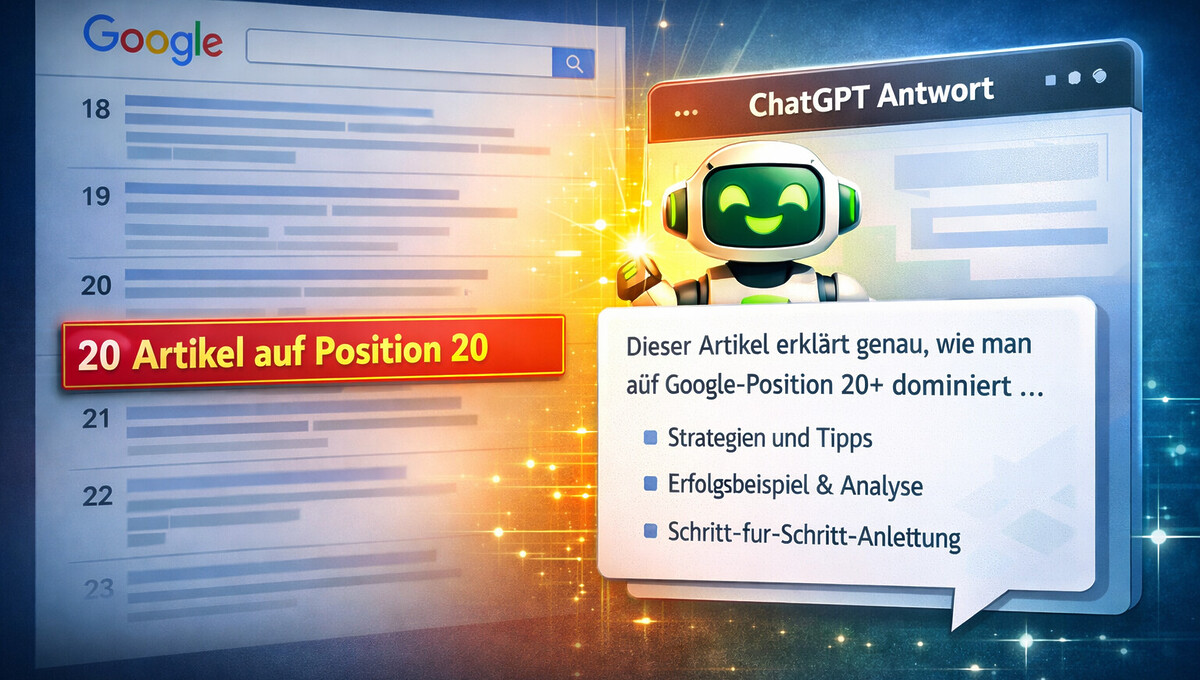
A listicle on page 2–3 of Google, without backlinks,without thematic domain authority, and with zero organic clicks – yet it has been the primary source for ChatGPT for months. What sounds like a system error is one of the first documented cases of Generative Engine Optimization (GEO) in the DACH region. This case study documents what happened, the data behind it, and what this means for the future of content visibility.
Invisible on Google, Primary Source for ChatGPT – How Generative Engine Optimization Works
The Paradox: Invisible on Google, Primary Source for ChatGPT
By classic SEO standards, this article should play no role. Its Google position is 20–22, meaning it’s on page 2–3 of the search results. In twelve months, the article has generated over 11,000 impressions in Google Search Console, but exactly zero clicks for the main keyword. The CTR is 0 percent. The backlink profile is empty: not a single external link, URL Rating 0, no referring domains.
The domain itself ranks for completely different topics and has no thematic SEO authority in the relevant area. It lacks an H1 heading, there is no schema markup, and only a single AI-generated image. Common AI visibility tools also consistently show zero: Google AI Overview, Perplexity, Gemini, and Copilot – not a single mention.
And yet: ChatGPT cites this very article as the main source when users ask about the best alternatives in this software category. Not as a side note, but as the primary source in first place.
The hard numbers: Why this article should not play a role by SEO standards
The data is clear. The following table shows the keyword performance at a glance:
| Keyword | Search volume/month | Keyword Difficulty | Google position |
|---|---|---|---|
| Main keyword (singular) | 410 | 32 | Position 22 |
| Main keyword (plural) | 410 | 31 | Position 20 |
| Long-tail variant | 30 | – | Deindexed |
Google Search Console confirms the picture over a twelve-month period:
| Search term | Impressions | Clicks | CTR | Avg. position |
|---|---|---|---|---|
| Main keyword (singular) | 11,032 | 0 | 0% | 17.14 |
| Main keyword (plural) | 6,209 | 0 | 0% | 19.75 |
| „Alternative to [Tool]“ | 4,456 | 2 | 0.04% | – |
The article’s technical data underscores the starting point: WordPress as the CMS, a Domain Rating of 62, but a URL Rating of zero. Organic traffic stands at four visitors per month. Of the three organic keywords, none is in the top 3. Backlinks and referring domains: zero in each case.

What the article has instead: factors that count for LLMs
Despite all the missing SEO signals, the article possesses characteristics that are evidently relevant for large language models – even if they hardly play a role for Google.
The article follows a clear listicle structure with a clean H2/H3 heading hierarchy. Each list entry follows a uniform format and is easily machine-parseable. The title delivers an exact query match in the format „The [X] best alternatives to [Tool] in comparison“ – a perfect query intent match for typical LLM queries.
Become more visible on Google & Social Media?
In a free strategy consultation for data-driven online marketing, we uncover your untapped potential, review any existing ad accounts if necessary, examine your SEO ranking and visibility, and determine which strategy is appropriate for your budget and which active measures will lead to more inquiries or sales.

✅ More visibility & perception through targeted placement
✅ More visitors > prospects > customers > revenue
✅ Reach target groups scalably with SEA
✅ Act and grow sustainably with SEO
🫵 Maximum success with our hybrid strategy
💪 More than 15 years of experience across industries in over 1,000+ projects demonstrable!







The article relies on pure body text in natural language. No lists, no tables, but descriptive paragraphs per tool. This format is apparently particularly well suited for the natural language processing of LLMs. In addition, it is native German content for the DACH market – a niche with significantly less competition than English-language content.
Two further factors: With a rating of 62, the domain has a certain baseline trust, even if topical authority is lacking. And the article is regularly updated and maintained.

The Experiment: Change to the Listicle, Reaction from ChatGPT in 3 Hours
To test the hypothesis of whether ChatGPT actively uses this article as a source, a controlled experiment was conducted. The logic: If the article actually serves as a source, content changes should be directly reflected in the ChatGPT responses – regardless of the Google ranking.
| Time | Action | Result |
|---|---|---|
| August 2025 | Listicle goes live | Position on page 2–3 on Google, no organic traffic |
| January 2026 | Baseline query on ChatGPT 5.2 | Article is cited as a secondary source |
| February 4, 2026, 11:43 a.m. | Tool B moved from position 6–7 to 1st place | – |
| February 4, 2026, approx. 2:45 p.m. | Repeat ChatGPT query | Tool B in 1st place, article as primary source |
In addition to the position change, three minor adjustments were made: a link change, an expanded heading, and a sentence formatted in bold. The response time between change and adoption was approximately three hours.
Before vs. after: How the ChatGPT response changed
The direct comparison shows the effect of the restructuring:
| Position | Before the change (January 2026) | Source | After the change (Feb. 4, 2026) | Source |
|---|---|---|---|---|
| 1 | Tool X | External source | Tool B | Our article |
| 2 | Tool B | External source | Tool X | External source |
| 3 | Tool A | External source | Tool A | External source |
| 4 | Tool D | External source | Tool Y (new) | External source |
| 5 | Tool C | Our article | Tool C | Our article |
Our article was thus the cited source for two out of five recommendations and determined the order of the ChatGPT response.
Four insights that change the understanding of content visibility
Four key insights can be derived from this experiment.
Insight 1: LLM citations work independently of Google ranking. A position beyond 20 on Google can still mean being the primary source on ChatGPT. The classic SERP position is not an indicator of LLM visibility. Anyone who focuses exclusively on Google rankings overlooks a growing channel.
Insight 2: Content changes take effect in about three hours. Changes to the listicle order were reflected in the ChatGPT responses within about three hours. This is a degree of influence that even top rankings on Google rarely achieve. The speed suggests that the LLM crawler actively and regularly retrieves the article.
Insight 3: Structure beats classic SEO signals. Plain-text listicles work – despite the lack of tables, bullet points, H1 heading, schema markup, backlinks, and topical domain authority. For LLMs, the semantic quality and machine readability of the content appear to be more important than the classic ranking factors.
Insight 4: GEO is a discipline in its own right. Generative Engine Optimization follows different rules than traditional SEO. Semantic relevance, content structure, and machine readability replace backlinks and domain authority as decisive factors.
Traditional SEO vs. GEO: The new ranking factors
What counts on Google is often irrelevant for LLMs – and vice versa. The paradigm shift can be pinned down to specific factors:
| Factor | Traditional SEO | GEO (Generative Engine Optimization) |
|---|---|---|
| Authority | Backlinks & Domain Authority | Content structure & information density |
| Keywords | Keyword density | Semantic completeness |
| Technical | PageSpeed & Core Web Vitals | Machine readability |
| Relevance | SERP position | Query intent match |
| Domain | Topical Authority | Individual article quality |
| User signals | CTR & dwell time | Irrelevant |
| Structured data | Schema Markup | Clean heading hierarchy |
This does not mean that traditional SEO becomes obsolete. It means that an additional discipline is emerging that has its own rules and must be considered independently.
How to Optimize Your Content for LLM Visibility
Based on the observations of this case study, four concrete measures can be derived to increase the chances of LLM citations.
Optimize listicle structure for LLMs. Use a clear heading hierarchy with H2 and H3 tags. Maintain a consistent format per list entry. Rely on flowing text with natural language – bullet points are not strictly necessary. Design each tool or topic as its own section with a descriptive paragraph.
Write title tags for LLMs. Use exact query matches in the title. Numbers like „7 best“ or „Top 5“ increase the likelihood of a query intent fit. Formulate clear content promises in the meta description. The title decisively determines whether an LLM recognizes the article as a relevant source.
Perform regular updates. Actively maintain your listicles and document changes. Monitor the response time – in our case, it was approximately three hours. Freshness signals are a potential factor for LLM crawlers.
Establish LLM monitoring. Conduct regular ChatGPT queries for your target keywords. Document source citations and track competitor citations. Note that common SEO tools currently do not capture ChatGPT citations correctly. Manual verification is still indispensable at present.
Why is this particular article being cited? Five hypotheses
A definitive explanation does not yet exist – but strong indications that justify further investigation.
Hypothesis 1: Semantic relevance beats ranking. LLMs evaluate content based on semantic agreement with the query, not on SERP position. The exact title match and the clear structure create a strong query intent fit that could be more decisive for source selection than any classic SEO signal.
Hypothesis 2: Flowing text with clear hierarchy is preferred. Articles with H2/H3 headings and natural flowing text are apparently particularly well parsable for LLMs. Tables and bullet points are not strictly necessary – possibly even detrimental to the way LLMs extract information.
Hypothesis 3: Thematic authority is irrelevant for LLMs. The domain ranks for completely different topics and has no thematic authority whatsoever in the relevant area. LLMs appear to evaluate individual articles independently of domain context – a fundamental difference from Google.
Hypothesis 4: Unknown factor in a highly competitive niche. The niche is by no means underserved. All major websites in the industry have published comparable articles. However, these are not cited as primary sources. The decisive differentiating factor remains unclear.
Hypothesis 5: Crawl timing and early indexing. The LLM crawler may have indexed the article at a favorable time. Since then, the position may have been „defended“ – similar to a first-mover advantage in the LLM index.
Limitations of this study
Transparency is important to us, which is why we openly document the limitations of this case study. It is a single case without statistical significance. There is no control group. ChatGPT responses can vary for the same query. The measured delay of three hours could be coincidence. We do not have access to crawler logs and cannot determine the exact indexing time.
Specific URLs, domain names, and tool names have been anonymized for data protection and competitive reasons. Upon legitimate interest, complete data, original screenshots, and WordPress revision logs can be viewed after direct contact.
This case study is not a definitive answer to the question of how LLMs select their sources. It is an invitation to discussion – and a first documented proof that Generative Engine Optimization works in the DACH region and delivers measurable results. If you would like to know how your content performs on ChatGPT and other LLMs, we analyze your LLM visibility and develop a GEO strategy that makes you the cited source.




 DE
DE