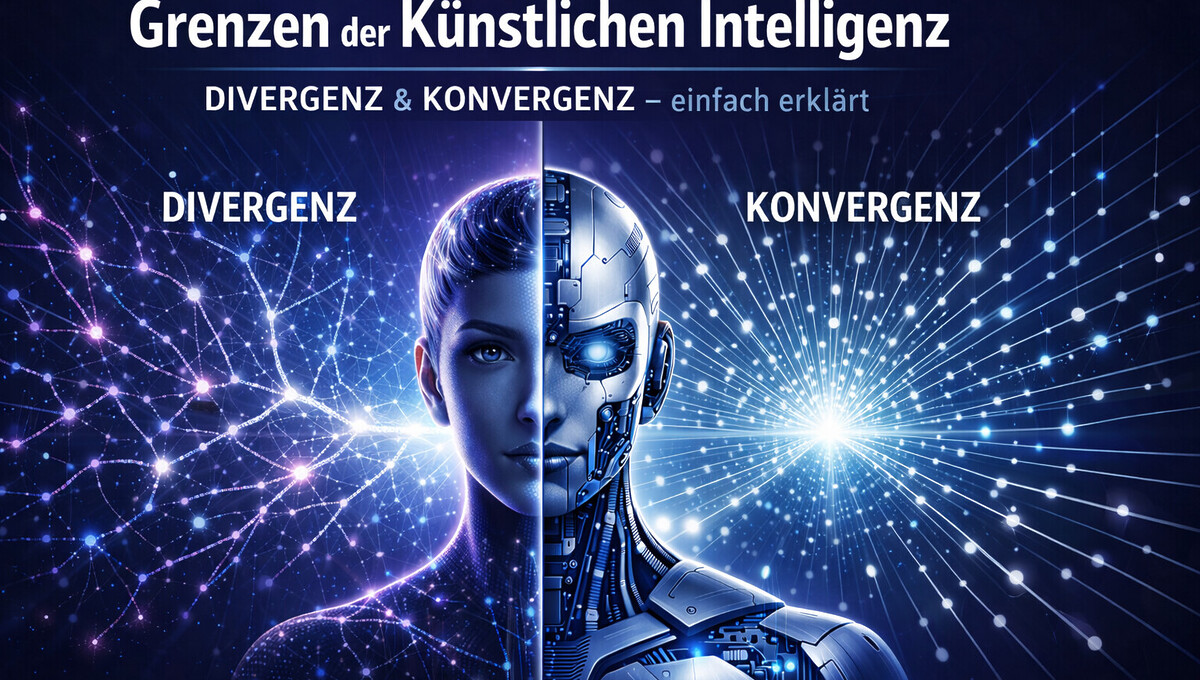
340 URLs, one lunch, and a finished mapping. What failed at step 15 two years ago now works at step 53 and beyond. The limits of artificial intelligence no longer lie in knowledge – but in endurance. And that is exactly where something has changed.
Limits of Artificial Intelligence: Why AI Suddenly Solves Complex Tasks
A former client reached out last week. In 2021, I had managed his online shop – stable rankings, everything was running well. Then an acquaintance came along with a supposedly more professional solution and persuaded him to switch to a different content management system.
Now, three years later: The shop works, but the search engine rankings have collapsed by 73 percent. The agency at the time had not set up any redirects during the migration. 340 product URLs with accumulated backlinks lead nowhere. The category structure was rebuilt completely differently. He wanted to know whether I could quantify the damage and create a migration plan.
I gave Claude the crawl data and went to lunch. When I came back an hour later, Claude was still at it – but almost finished. It had worked through every single product category assignment, recognized and resolved conflicts with similar product names, adjusted the redirect order when something didn’t work.
While I’m writing this article, Claude is at step 53. It’s still working. That is exactly the point this article is about: The limits of artificial intelligence have shifted. Not toward omniscience – but toward endurance.
Where were the limits of artificial intelligence until now?
Anyone who has worked with AI models in recent years knows the pattern. You give it a complex task, the AI delivers a first draft, you correct one error – and suddenly two new problems appear. You correct those errors as well, but other parts of the solution fall apart. After an hour, you have more chaos than at the beginning.
This phenomenon has a name: error accumulation. In complex tasks with many dependencies, each correction generated new errors. The limits of AI were not primarily in knowledge or computing power. They lay in the ability to correct itself without creating new problems in the process.
For many users, this led to frustration and a clear verdict: AI is suitable for simple tasks, but it fails at anything complex. This assessment was justified for a long time. An SEO audit with several hundred URLs, a data migration between different systems, the debugging of a nested codebase – such tasks seemed to lie beyond AI’s limits.
Divergence and convergence – the limits of AI simply explained
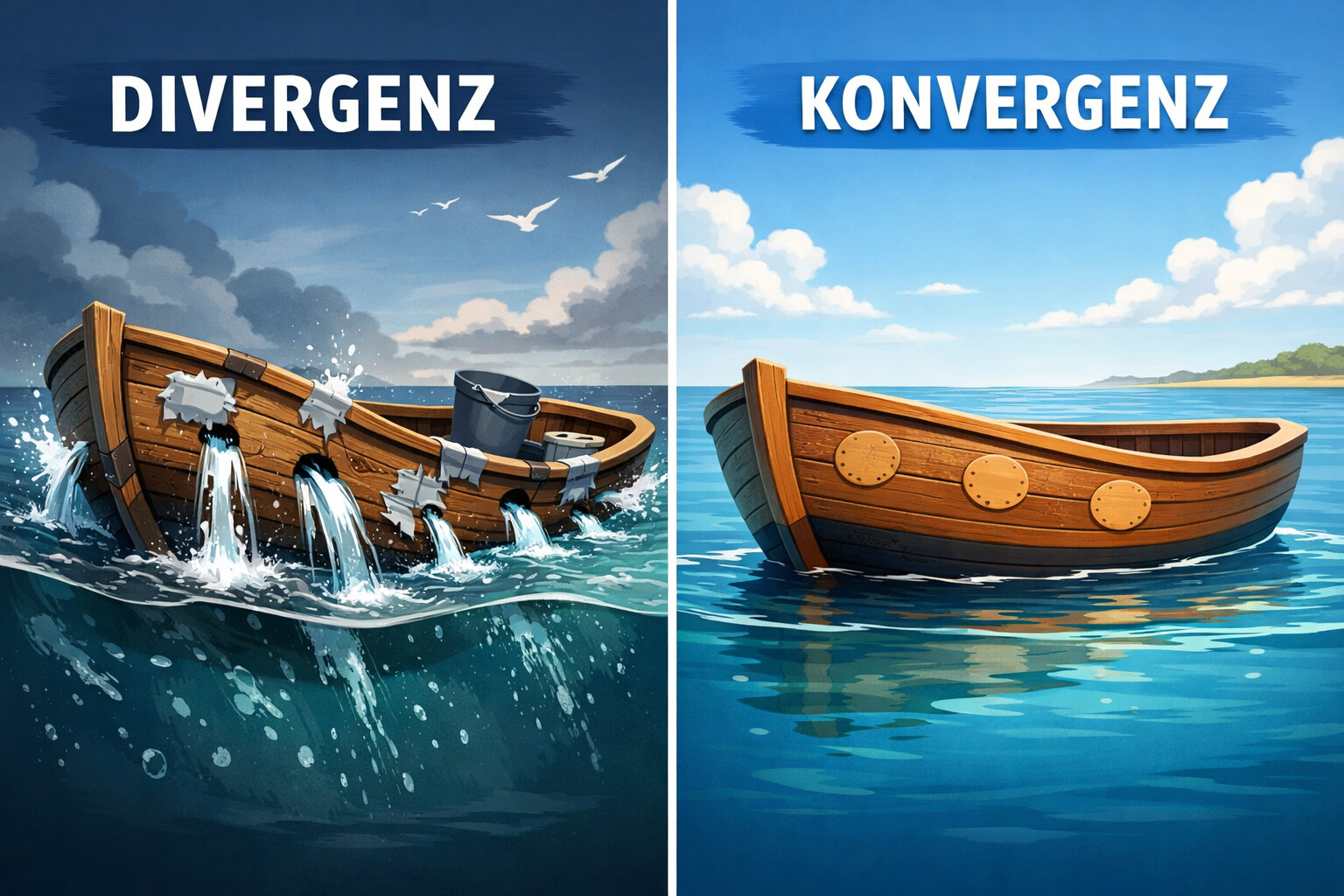
To understand what has changed, a simple image helps. Think of a boat with several small leaks. You begin to plug the first leak. While you work, the water pressure creates two more leaks. You plug these as well – and three new ones appear. The boat sinks, even though you repair nonstop. That is exactly what divergence is:New problems arise faster than you can solve them.
Convergence describes the opposite. You plug one leak, and it stays sealed. You plug the next one, and that one holds too. With every leak repaired, there are fewer open spots, less water pressure, fewer new damages. At some point, the boat floats steadily. The decisive difference lies not in your craftsmanship—but in the ratio between problem-solving and problem-creation.
Become more visible on Google & Social Media?
In a free strategy consultation for data-driven online marketing, we uncover your untapped potential, review any existing ad accounts if necessary, examine your SEO ranking and visibility, and determine which strategy is appropriate for your budget and which active measures will lead to more inquiries or sales.

✅ More visibility & perception through targeted placement
✅ More visitors > prospects > customers > revenue
✅ Reach target groups scalably with SEA
✅ Act and grow sustainably with SEO
🫵 Maximum success with our hybrid strategy
💪 More than 15 years of experience across industries in over 1,000+ projects demonstrable!







| State | What happens | Result |
|---|---|---|
| Divergence | New errors arise faster than corrections | System derails, task fails |
| Convergence | Corrections outpace error generation | System stabilizes, task succeeds |
With AI models like Claude, it was long held that: complex tasks almost always led to divergence. The limits of artificial intelligence became apparent precisely at this tipping point. But this tipping point has shifted. Not because AI systems have suddenly become omniscient, but because their self-correction has become faster than error generation.
What has changed in AI models?
The change cannot be attributed to a single capability. Claude has not become dramatically smarter in the classical sense. What has changed is its endurance in complex, multi-stage tasks. Modern language models can now perform dozens of work steps in a row, recognize and correct their own errors – without losing the original context.
In my client project, this specifically meant: Claude checked a URL assignment, detected a conflict, adjusted the redirection logic, retested, and only then moved on to the next URL. Step by step, 53 times and more.
What Claude specifically accomplished in this project:
- Matching 340 old URLs with the new page structure
- Detecting conflicts with similar product names
- Prioritizing based on backlink value from external analysis
- Creating complete redirection rules
- Automatic adjustment in case of rule conflicts
Previously, at step 15 or 20, the system would have entered a loop or produced inconsistent results. The limitations of AI became apparent precisely where persistence and self-correction were required. These specific limitations have shifted further back – not indefinitely, but far enough to handle tasks that previously simply did not work.
What does this mean for you specifically?
Tasks that you previously considered too complex for AI support deserve a re-evaluation. A technical SEO audit with several hundred pages, the analysis of redirection chains after a relaunch, the systematic processing of product data – such projects were for a long time purely manual work. They required hours of concentrated human attention because every AI attempt ended in an accumulation of errors after a short time.
Technical background knowledge is less important here than the ability to define a task clearly. Describe the problem precisely, provide the relevant data, and let Claude work. Your role shifts: less execution, more control and quality review.
| Before | Today |
|---|---|
| You complete the task yourself | You define the task precisely |
| Hours of manual work | Minutes for briefing, then wait |
| Every mistake requires your correction | Claude corrects itself |
| Complex tasks = impossible with AI | Complex tasks = feasible with patience and perseverance |
This does not mean that you should blindly trust. Results must be checked, especially with business-critical data. But the effort for this check is significantly less than the effort of doing everything yourself. The artificial intelligence boundaries have not disappeared – they have shifted. And this difference can mean significant time and cost savings for your projects.
 Visibility in AI Search Systems: The New Dimension
With the shifting AI boundaries, a new challenge simultaneously arises: How will your company be found in AI-powered search results? More and more users are asking their questions directly to ChatGPT, Perplexity, or Google Gemini – and receiving answers there without ever seeing a classic search results page.
Classic search engine optimization alone is no longer sufficient. So-called Generative Engine Optimization (GEO)andLarge Language Model Optimization (LLMO) add a new dimension to proven SEO strategies. This involves preparing content in such a way that AI systems can understand, cite, and integrate it into their responses.
If you would like to delve deeper into this topic, our article on ChatGPT SEO provides a comprehensive introduction. There, we explain how to optimize your content for AI search systems and what technical foundations are necessary for this.
For companies that wish to expand their existing SEO support with this new dimension, we have developed specialized GEO & LLM packages. These combine classic search engine optimization with targeted optimization for AI-powered answer engines.
Practical Implementation: The Right Tools
The shifting boundaries of artificial intelligence are not only evident in external models like Claude. The tools for daily use have also evolved. An example from our own practice: Technical SEO analyses, which previously required hours of manual review, can now be performed significantly more efficiently.
For WordPress users, we have developed our own plugin, FLAVOR SEO, which brings precisely this efficiency into everyday use. It combines classic on-page optimization with the requirements of modern search systems – without the complexity that many other solutions entail.
The crucial point: Tools are only as good as their application. An AI model like Claude can take over the analysis for you, but the strategic decision – which URLs have priority, which content needs to be revised, how internal linking should be structured – remains yours. The combinationof intelligent tools and human expertisedelivers the best results.
What are the current limitations of artificial intelligence?
An honest assessment is important, as exaggerated expectations lead to disappointment. Claude and other AI models are not autonomous problem solvers that can perform any task without human involvement. Complex projects take time – sometimes an hour, sometimes several. During this time, the system is working, but you cannot simultaneously work on other tasks in the same context.
What still requires human expertise:
- Strategic decisions and prioritization
- Creative conception and brand positioning
- Assessment of business risks
- Customer communication and expectation management
- Quality review of results
The quality of the results heavily depends on the quality of your input. Unclear task descriptions lead to unusable results. Missing or inconsistent data generates faulty analyses. Claude can only work with what you provide. Garbage in, garbage out – this old rule remains unchanged.
An AI model can tell you which 340 URLs need redirects. Whether the entire relaunch is economically viable, what priorities you should set, and how you should communicate the project to your client – that requires human judgment. The limits of AI lie where context,experience and entrepreneurial assessment are required.
Conclusion – The boundaries of AI are shifting
The boundaries of artificial intelligence are not a fixed line. They move, sometimes faster than expected. What failed at step 15 two years ago now works at step 53 and beyond. The difference lies not in spectacular breakthroughs, but in the silent improvement of endurance and self-correction.
For your daily work, this means: Re-attempt tasks that previously failed. Define problems precisely, provide good data, and give your AI model time. The results will surprise you – not because AI can suddenly do everything, but because it persists significantly longer in what it can do.
By the way, the URL mapping for my client is finished. 340 pages, neatly assigned, with ready-made redirection rules. I was only out for lunch.
Would you like to know how Claude and other AI-powered tools can support your SEO projects? Or are you interested in optimizing your visibility in AI search systems? Contact us – we will advise you on the possibilities and realistic limitations.





 DE
DE