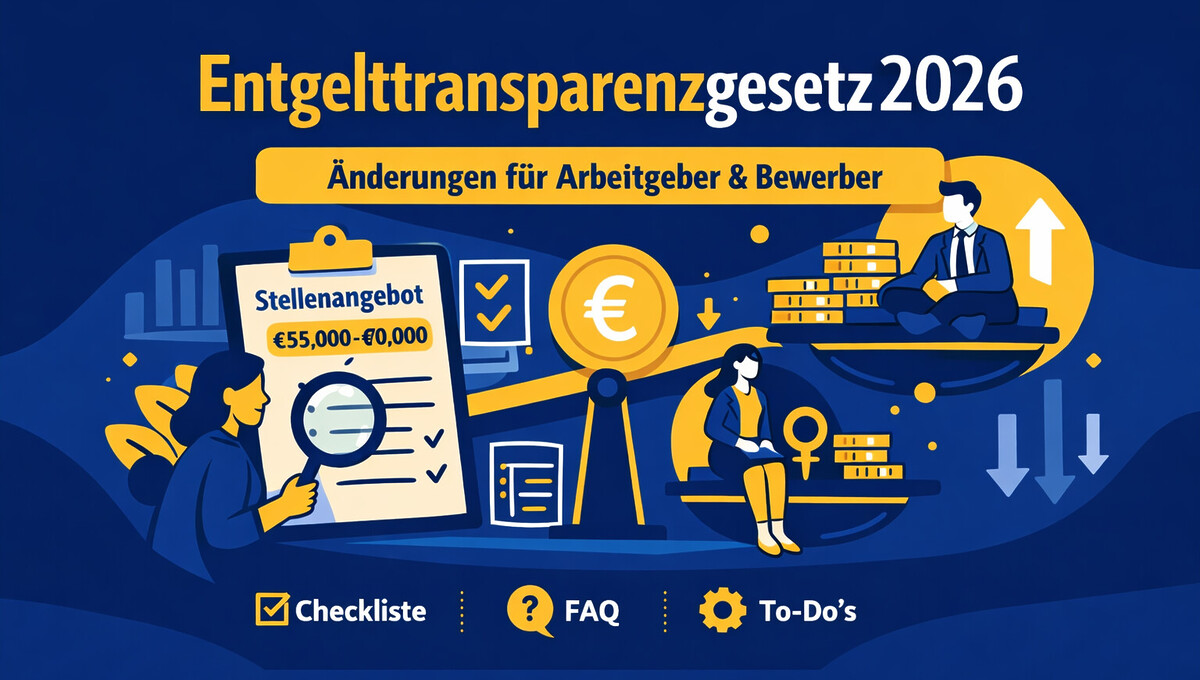
The new Pay Transparency Act 2026 is shaking up the labor market. Companies and applicants must prepare for more openness regarding salaries – away with old secrets, in with clear structures! This article not only provides an overview of all legal changes but also offers practical tips, success stories, and a direct link to the law. Take the opportunity to adapt to the new environment in good time and benefit from more fairness and efficiency – for employers and applicants alike.
Pay Transparency Act 2026: What changes for employers and applicants – including checklist & FAQ
Since the beginning of 2026, Germany’s labor market has been facing a real turning point: a new law, more fairness, and stricter rules for pay transparency. What does this mean for your company or your application? In this article, you will find practical answers, a clear checklist, and important links to the law – everything you need to know for successful implementation and the opportunities of the Pay Transparency Act (2026). Be prepared now and benefit from the change!

Case Study: How Companies Benefit from Pay Transparency
A medium-sized IT company from Bavaria already implemented the principles of the Pay Transparency Act in advance in 2024. By introducing clear salary bands and transparent criteria in every job advertisement, the number of qualified applications increased by 30% within one year. At the same time, the company recorded significantly fewer salary renegotiations and noticeably higher satisfaction among existing employees. The proactive employer branding in particular paid off: the employer brand was strengthened and specifically attracted new skilled workers. The example shows how pay transparency can not only be a legal obligation but also a real strategic advantage.
Classification: Why the Pay Transparency Act 2026 is a Turning Point
For years, the German labor market has suffered from a certain lack of transparency regarding salaries. Applicants often invest a lot of time in processes that ultimately fail due to completely unrealistic salary expectations. At the same time, structural wage discrimination often remains invisible because comparative data is simply missing.
With the new Pay Transparency Act, however, not only the internal salary structure but also online marketing around e-recruiting and social recruiting will radically change from 2026. Companies must transparently communicate salary ranges and criteria, which will particularly influence the digital approach to candidates, their search habits, and the success factors for recruitment campaigns, as well as the entire strategy in employer branding. Those who act early will position their employer brand as attractive, modern, and legally compliant. More background on the interlinking of transparency and digital recruiting can also be found under E-Recruiting & Employer Branding.
The new legal situation forces companies to systematically explain their remuneration instead of just paying it out. Pay transparency thus changes from a „nice-to-have“ to a strict compliance requirement – and is now firmly linked to strong employer branding.
Legal basis: EU directive as a driver
In 2023, the European Commission adopted the EU Pay Transparency Directive. This obliges member states to introduce clear transparency rules – the Pay Transparency Directive implementation must be transposed into national law by June 2026 at the latest.
Germany is thus re-drafting its previous law (in force since 2017). The decisive difference: transparency will in future begin before the application and not only in the event of a dispute or upon complicated request. This also creates new dynamics for employer branding – those who value openness can significantly enhance their employer brand and present themselves as pioneers.
Become more visible on Google & Social Media?
In a free strategy consultation for data-driven online marketing, we uncover your untapped potential, review any existing ad accounts if necessary, examine your SEO ranking and visibility, and determine which strategy is appropriate for your budget and which active measures will lead to more inquiries or sales.

✅ More visibility & perception through targeted placement
✅ More visitors > prospects > customers > revenue
✅ Reach target groups scalably with SEA
✅ Act and grow sustainably with SEO
🫵 Maximum success with our hybrid strategy
💪 More than 15 years of experience across industries in over 1,000+ projects demonstrable!







What exactly will change from 2026?
The reform introduces three essential pillars that HR departments and managing directors need to be aware of.
1. Salary ranges in job advertisements (mandatory)
Companies will have to disclose in the future:
- A specific salary range for the advertised position.
- The relevant criteria for classification (e.g., experience, responsibility, qualifications).
This means the end of phrases like „market-standard remuneration“ without figures. Applicants will know what to expect financially before clicking „submit.“ This has a positive effect on employer branding, as transparency signals appreciation and credibility.
2. Disclosure of comparable salaries and right to information
Employees will receive a significantly strengthened right to information. The right to information under the Remuneration Transparency Act will become simpler and more direct. Employees can request information about average salaries for comparable positions – differentiated by gender.
Here, the Pay Transparency Act comparison group plays a central role. Employers must define which activities are equivalent. In cases of differences that cannot be objectively explained (gender pay gap over 5%), there is an obligation to make improvements and a reversal of the burden of proof: the employer must prove that no discrimination exists.
3. Increased pressure against the gender pay gap
A well-known practical example is the case of journalist Birte Meier, who successfully sued ZDF. Such cases are to be avoided in the future not by arduous lawsuits, but by preventive transparency. The Pay Transparency Act (2026) aims to prevent unequal treatment from arising in the first place, because the data is open. This not only strengthens equal treatment for companies, but also their position as a credible employer brand in the competition for talent.

Impact on applicants
For employees, the reform is a gain in information and negotiating power.
- Realistic expectations: You immediately know whether a position is financially suitable.
- Fewer inefficient applications: No wasted time on jobs that pay below one's expectations.
- Better negotiating position: Those who know what is common in their peer group negotiate with more confidence.
- Protection against discrimination: The topic of Pay Transparency Act men vs. women also comes into focus – unequal pay becomes immediately visible.
- Improved application quality and trust: Open communication strengthens trust in the employer brand – a decisive factor, especially for younger generations.
Impact on employers
For companies, the transition involves work, but also offers strategic opportunities.
Opportunities:
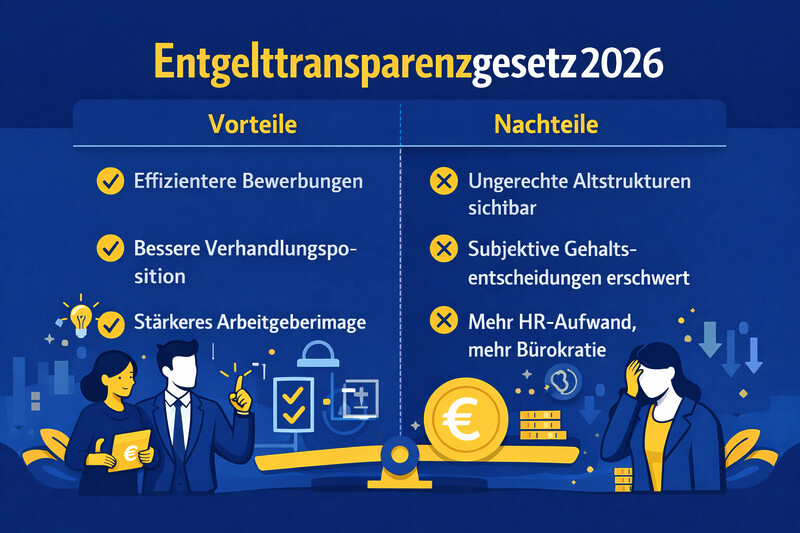
- More efficient recruiting: You receive applications that also match salary expectations.
- Higher credibility: Transparency builds trust and strengthens the employer brand.
- Fewer conflicts: Clear rules prevent the feeling of arbitrariness in salary increases.
- Modern E-Recruiting and Social Recruiting: The new requirements not only enforce internal processes but also demand adapted strategies in online marketing and a targeted alignment of employer branding measures. Social recruiting, in particular, must align more closely with applicants‘ expectations for transparency and information. You can also learn how companies can successfully implement social recruiting at pictibe Social Recruiting.
Risks:
- Visible Legacy Issues: Unchecked legacy structures and "favoritism" salaries become visible.
- Pressure to justify: Subjective salary decisions are hardly sustainable anymore.
- Bureaucracy: The Pay Transparency Act Report Template and documentation requirements demand resources.
- Challenges for Employer Branding: Those who do not act proactively risk being perceived as an outdated employer, which can weaken the employer brand.

Employer Checklist: What Companies Must Change by 2026
Practical for you: Download the complete checklist as a PDF and use it directly for your company.
- Vergütungsstruktur analysieren:
– Gibt es klare Gehaltsspannen pro Rolle?
– Sind Unterschiede zwischen Mitarbeitern in ähnlichen Rollen objektiv begründbar? - Define & document criteria:
– What factors influence salary? (Professional experience, qualifications, responsibility, market comparison)
– Write down these criteria. - Establish internal comparability:
– Check: The same role does not necessarily mean the same salary, but comparable compensation structures.
– Proactively analyze gender-specific deviations. - Prepare job advertisements:
– Set realistic salary ranges for all standard profiles.
– Use neutral, clear language and ensure a positive representation of the employer brand. - Train HR & Managers:
– Managers must be able to explain salary decisions.
– Develop clear lines of argument for salary discussions to strengthen both pay transparency and employer branding. - Set up reporting & documentation:
– Prepare for the right to information.
– Ensure traceability for potential audits.
Do not wait until June 2026. Use the time to make your structures „transparency-fit“ and specifically strengthen your employer brand.

Glossary: Important terms related to the Pay Transparency Act
Comparison group:
A group of employees with comparable tasks, qualifications, and responsibilities. It serves as a basis for fair and objective salary comparisons.
Gender Pay Gap:
The average income difference between men and women in comparable positions and with similar qualifications. The aim of the law is to measurably reduce this gap.
Right to information:
The right of employees to request information from the employer about the average salaries of comparable positions – broken down by gender.
Employer Branding:
The strategic positioning of a company as an attractive employer in the labor market. A transparent salary policy is a central element for successful employer branding and sustainably strengthens the perception of the employer brand.
Employer Brand:
The image or reputation of a company as an employer – significantly shaped by values such as transparency, fairness, and communication.
Frequently Asked Questions (FAQ)
When does the new Pay Transparency Act come into effect?
The directive must be transposed into German law by June 2026 at the latest. From then on, the new obligations will be binding.
Does the Pay Transparency Act apply to small businesses?
Yes, in part. While previous reporting obligations often only applied to large companies, the obligation to state the salary range in job advertisements and the prohibition of asking about current salary generally apply more broadly. The exact wording for Pay Transparency Act small businesses will be finalized in the national legislative process, but the EU directive provides fewer exceptions here than before.
Do exact salaries have to be stated?
No, realistic salary ranges are permissible in job advertisements. It is important that these ranges are based on objective criteria.
Where can I find the current law?
You can find the current legal text of the existing law here: Law on the Promotion of Pay Transparency between Women and Men. Please note that this text will be adapted to the new EU directive by 2026.
Is there a Pay Transparency Act form or template?
Official forms are often provided by the BMFSFJ (Federal Ministry for Family Affairs, Senior Citizens, Women and Youth) once the law is finalized. However, many HR software providers already integrate corresponding Pay Transparency Act PDF templates and reporting tools.
Are there penalties for violations?
Yes. The EU directive stipulates that member states must introduce effective, proportionate, and dissuasive sanctions. These can include fines, but also compensation payments to discriminated applicants or employees.
What are the advantages and disadvantages (pros and cons)?
- Pros: More fairness, reduction of the gender pay gap, more efficient recruiting, trust & strengthened employer brand through consistent employer branding.
- Cons: Bureaucratic effort, unrest in the company when old inequalities are uncovered, loss of flexibility in „salary negotiations“.

Conclusion on the Law for Employers and Employees
Recommendation for action: Prepare specifically – depending on company size
The Pay Transparency Act 2026 requires all employers to take early and targeted action. Use the remaining time for proactive preparation – with clear steps appropriate to your company size:
- Companies with up to 49 employees:
Define transparent salary bands and fair, comprehensible criteria. Train your managers to be able to respond competently to information requests. Document remuneration structures and promote an open communication culture as well as your employer brand. - Companies with 50+ employees:
Furthermore, establish binding processes for salary information and regular reporting. Invest in suitable digital HR tools and conduct internal reviews. This will ensure lasting compliance and specifically strengthen your employer branding in the competitive environment. - Companies with 250+ employees:
Develop comprehensive transparency and salary management, establish internal audits, and inform employees systematically about all relevant changes. Professional systems and close involvement of all stakeholders will help you reliably meet the particularly high requirements and establish your employer brand as an industry role model.
Conclusion: Those who act now will gain security, strengthen their employer brand through clear pay transparency, and position themselves in the competition for talent with modern employer branding.

E-Recruiting and Social Recruiting in Transition: What the Pay Transparency Act Means
With the new requirements for pay transparency, online marketing strategies are also changing – especially in the areas of e-recruitingandsocial recruiting. Job advertisements with salary ranges are becoming standard and must be digitally visible early in the candidate journey. This opens up opportunities to position oneself as a fair and modern employer and to specifically attract qualified applicants. Professional employer branding across all digital channels thus becomes a decisive competitive factor.
Read more about this at E-Recruiting & Employer Branding and Social Recruiting.
3 direct tips for your recruiting in the context of pay transparency:
- Consistently implement salary transparency in all online job advertisements. Also use social media channels and your website to highlight your attractive compensation models and the values of your employer brand.
- Optimize your employer branding strategy especially for digital and social channels, because applicants primarily inform themselves online – clear communication about salary, benefits, and corporate culture is now the biggest plus in building a strong employer brand.
- Automate and measure your recruiting efforts: Use digital tools to efficiently process inquiries and salary information and continuously optimize your processes – this improves the applicant experience and sustainably strengthens your employer brand.

Florian Ibe
CEO & Marketing Consultant
Your contact person: Florian Ibe
Use change as an opportunity
With a strong partner by your side, adapting to the new legal requirements will be easier and more successful. Let Vastcob, one of the leading agencies for targeted employee acquisition, employer branding, and innovative social recruiting, provide you with individual advice – so that your recruiting strategy remains competitive in 2026 and beyond. Do not hesitate: analyze your data, revise your processes, and train all relevant teams.
This will ensure a smooth and legally compliant transition to the new Pay Transparency Act, and your employer brand will remain top-positioned digitally.




 DE
DE