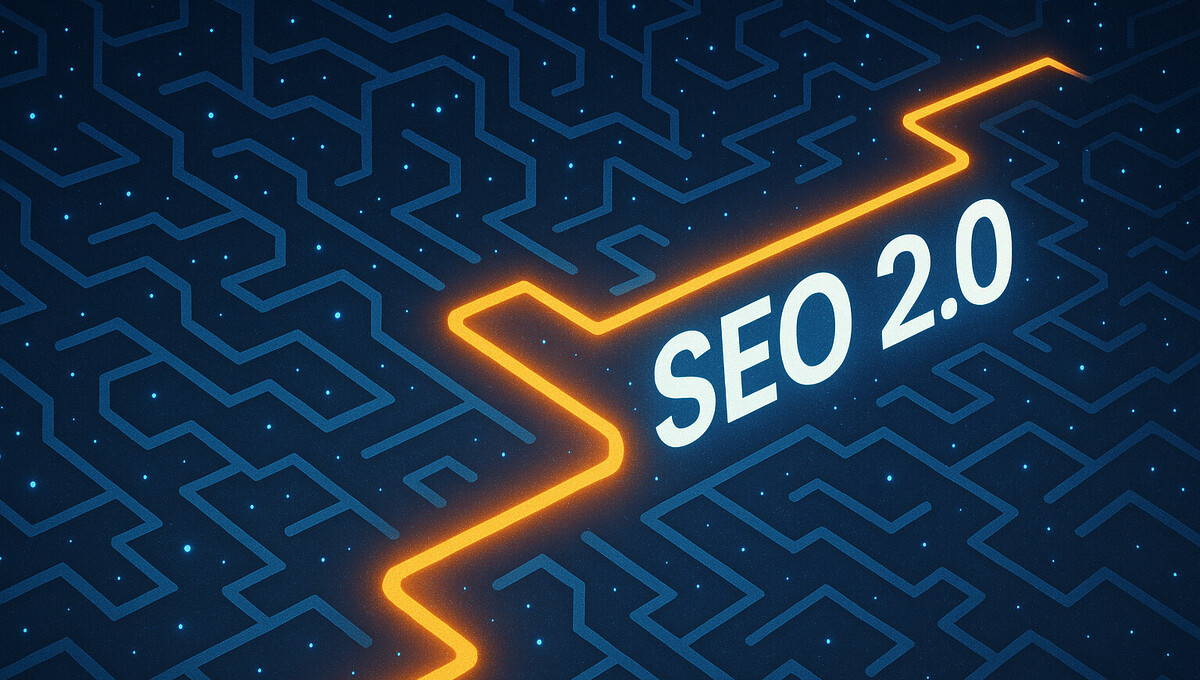
SEO 2.0 – How Search Engine Optimization Has Evolved
Organic rankings on traditional search engines are no longer sufficient to guarantee digital visibility. Today, users search for information across a wide variety of channels – from social media platforms to voice assistants to AI-powered chatbots.
SEO 2.0 describes precisely this new reality: a comprehensive approach that goes far beyond classic keyword optimization. Unlike in the past, modern search engine optimization no longer focuses exclusively on a single platform, but orchestrates your presence across an entire ecosystem of digital touchpoints. The technical foundations remain important, but they now form only the foundation of a significantly more complex strategy.
This development fundamentally changes how companies are found online. Those who rely solely on traditional methods are leaving considerable potential untapped – or even risk being overtaken by the competition.
What Is SEO 2.0?
SEO 2.0 refers to a holistic approach to increasing digital visibility across all relevant search systems and platforms. While classic search engine optimization primarily aimed at rankings in traditional search engines, this modern approach encompasses all channels through which your target audience searches for information.
Search behavior has changed radically. Today, users expect answers wherever they happen to be – whether on YouTube, on social networks, or via AI assistants. Search engines themselves draw on a significantly broader range of sources and integrate videos, social media posts, and discussions from a wide variety of platforms into their results.
Search engine optimization 2.0 therefore means not only optimizing your website, but being strategically present on all platforms that are relevant to your target audience. This requires coordinated content strategies across various channels, adapted to the respective requirements and user expectations. Classic SEO methods remain an important building block, but now form only one part of a more comprehensive digital strategy.
The Limits of Classic Search Engine Optimization
A top ranking in traditional search engines no longer automatically guarantees high visitor numbers today. Search results pages have changed significantly: AI-generated answers, knowledge panels, featured snippets, and a wide variety of media formats are pushing classic organic listings further down. Users frequently receive direct answers without even clicking on a website.
At the same time, search behavior is increasingly distributed across alternative platforms. Younger target groups are increasingly using social networks as their primary source of information – whether for product research, local recommendations, or tutorials. Voice assistants provide direct answers without users having to visit a website.
This fragmentation of search behavior makes an exclusive focus on traditional methods risky. Those who rely on only a single channel make themselves dependent on its algorithms and updates. Any change can result in significant traffic losses. A diversified strategy protects against such risks and simultaneously opens up new target groups that you might not reach through classic channels.
User-Centered Approach in Search Engine Optimization 2.0
Search engine optimization 2.0 consistently places user intent at the center. While earlier approaches focused heavily on technical factors and keyword densities, today it is about creating genuine added value that fulfills the actual needs of those searching. Search engines are becoming increasingly better at understanding the intent behind a search query and delivering correspondingly relevant results.
Semantic optimization plays a central role in this. Instead of considering individual keywords in isolation, modern systems analyze the thematic context and the relationships between different terms. Structured data helps search engines better understand and classify content – an aspect that is also becoming increasingly relevant for AI-powered search systems.
Become more visible on Google & Social Media?
In a free strategy consultation for data-driven online marketing, we uncover your untapped potential, review any existing ad accounts if necessary, examine your SEO ranking and visibility, and determine which strategy is appropriate for your budget and which active measures will lead to more inquiries or sales.

✅ More visibility & perception through targeted placement
✅ More visitors > prospects > customers > revenue
✅ Reach target groups scalably with SEA
✅ Act and grow sustainably with SEO
🫵 Maximum success with our hybrid strategy
💪 More than 15 years of experience across industries in over 1,000+ projects demonstrable!






Content quality far surpasses technical tricks. Detailed, well-researched content that comprehensively answers questions is given preferential treatment. This requires a deep understanding of your target audience: What problems do they have? What questions do they ask themselves? At what stage of their decision-making process are they? Those who consistently take these aspects into account create content that is valuable both for users and for search systems.
From Visibility to Omnipresence
True digital presence only emerges when your target audience encounters your content regardless of the channel they choose. A potential customer might discover a helpful post from you on a social network in the morning, come across your blog article through a search at midday, and receive a video recommendation from you in the evening. This repeated encounter builds trust and recognition.
Diversifying your traffic sources also offers considerable security. Those who rely exclusively on a single channel risk massive losses when algorithms change or platforms update. A broadly positioned presence makes you more independent from individual systems and their whims.
However, omnipresence does not mean being active indiscriminately on every available platform. Rather, it is about strategically identifying those channels where your target audience actually spends time and being consistently present there. Quality and continuity beat quantity. Better to regularly deliver valuable content on a few but relevant platforms than to be only half-heartedly represented everywhere.
The Ecosystem of SEO 2.0
SEO 2.0 encompasses a broad spectrum of search channels and platforms that you should strategically leverage:
| Channel Type | Examples | Relevance for SEO 2.0 |
|---|---|---|
| Classic Search Engines | Google, Bing, DuckDuckGo | Foundation and data basis for other systems |
| AI Search Systems | ChatGPT, Perplexity, Bing Chat | Growing importance for direct answers |
| Social Media | YouTube, LinkedIn, Instagram, TikTok | Primary search platforms for specific target groups |
| E-Commerce | Amazon, Ebay, Specialized Portals | Direct product search and purchase decision |
| High-Authority Platforms | Trade magazines, news portals, forums | Additional visibility through established reach |
Your goal is to be present on all channels relevant to your target audience with high-quality content. This requires setting priorities: not every channel is equally important for every business model. Analyze where your potential customers are actually looking for solutions and concentrate your resources on these areas.
Classic Search Engines as a Foundation
Traditional search engines still form the backbone of digital visibility. They not only deliver direct traffic but also serve as a central data source for many other systems, including AI-powered search assistants. What does not exist in classic search indexes can hardly be considered by these downstream systems.
Proven SEO practices therefore remain indispensable: technical optimization of your website, clean structure, fast loading times, and mobile optimization. Keyword research helps you understand what terms your target audience is actually searching for. High-quality backlinks signal authority and relevance in your subject area.
However, the focus has shifted. Instead of mechanical keyword placement, it’s about thematic depth and comprehensive treatment of complex topics. Search engines today evaluate the overall quality of your content, the user experience on your website, and your expertise in the respective field. These factors form the foundation upon which all further measures within the framework of SEO 2.0 can be built.
AI Search Systems and Language Models
Large language models and AI-powered chatbots are fundamentally changing how people search for information. These systems provide direct, conversational answers instead of a list of links. Users are increasingly getting used to this form of information retrieval, which has significant implications for digital visibility.
You cannot „rank“ in the classic sense with these systems, but you can increase the likelihood that your content will be referenced or recommended by them. High-quality, well-structured content with clear expertise has a better chance of being picked up by AI systems. Clear structures, unambiguous source references, and demonstrable expertise help with this.
The importance of these systems is growing rapidly. They are already among the most visited digital offerings worldwide. Anyone creating content today should therefore consider that it will not only be „read“ and processed directly by human users but also by AI systems. This requires special attention to factual accuracy, clear structuring, and clear expertise in your field.
Social Media as Search Platforms
Social networks have evolved into full-fledged search engines. Users search there for product recommendations, instructions, local tips, and much more. Platforms like YouTube, Instagram, or LinkedIn have their own highly developed search algorithms, specifically tailored to the respective format and user expectations.
Each platform has its own rules and mechanisms. Videos perform differently than text posts, hashtags don’t work the same everywhere, and preferred content formats vary considerably. Successful presence therefore requires platform-specific strategies tailored to the respective peculiarities.
This becomes particularly relevant for target groups who primarily use social networks for information retrieval. If your potential customers are looking for solutions there, you must be present there with relevant content. This does not mean following every trend, but strategically playing on those platforms where your target audience is actually active. Consistency and authenticity are more important than mere reach.
Strategically Utilize E-commerce Platforms
Many product searches today do not start with search engines but directly on marketplaces and e-commerce platforms. Users search where they can also buy – a direct path from research to transaction. These platforms have their own search algorithms that evaluate according to different criteria than traditional search engines.
Product listings require specific optimization: meaningful titles, detailed descriptions, high-quality images, and, above all, authentic customer reviews. These factors significantly influence whether your offer is prominently placed in the internal search results. Reviews and testimonials act as a strong signal of trust.
Even if you do not operate your own online shop, price comparison portals, review platforms, or industry-specific directories can be relevant. Wherever potential customers are looking for offers in your area, you should be present with optimized, up-to-date information. This significantly expands your visibility and opens up target groups that you might not reach through your website alone.
Strategically Leverage High-Authority Domains
Established platforms with high authority offer significant potential for additional visibility. Guest posts in renowned trade magazines, interviews on news portals, or detailed answers in specialist forums can help you appear prominently in search results – even if this content is not on your own domain.
The advantage is obvious: these platforms already have considerable reach and trust. Your content benefits from this existing authority and often ranks faster and better than new posts on your own website. At the same time, you position yourself as an expert when you publish on reputable platforms.
Systematically applied, you thus conquer additional positions in search results, diversify your visibility, and reach target groups who may never have heard of you. Quality is important here: only valuable contributions are accepted and actually read. Focus on platforms that are relevant in your industry and whose audience matches your target group.
Building Strategic Omnipresence
Omnipresence is not created by random activity on various channels, but by strategic planning. First, you need a clear core message: What do you stand for? What unique perspective or expertise do you bring? This message should consistently run through all your activities and be recognizable at all touchpoints.
Content recycling is an efficient approach. From a detailed technical article, various formats can be developed for different platforms:
- Key statements as compact social media posts
- Central findings as a visual infographic
- Summary as a short video or audio snippet
- Detailed aspects as a newsletter series
This maximizes the value of every content production without having to constantly start from scratch. The key is adaptation to the respective platform. A formal technical article works on LinkedIn, while the same content for Instagram must be visually prepared. Continuity outweighs frequency: it is better to be active regularly on a few relevant channels than sporadically everywhere.
Understanding and serving the customer journey
Digital visibility must consider different phases of the customer journey. Each phase requires specific content formats and messages:
Awareness Phase: Potential customers first learn about you. Broad content that answers fundamental questions and sparks interest is suitable here – such as informative blog articles, short videos, or attention-grabbing social media posts.
Interest Phase: The need for more in-depth information grows. Detailed guides, whitepapers, or webinars meet this need and position you as an expert. Lead magnets are also suitable here: valuable content that you provide in exchange for contact details.
Decision Phase: Concrete evidence and trust signals become crucial. Case studies with measurable results, customer testimonials, and detailed product comparisons help to dispel any remaining doubts. A clear call to action facilitates the final step.
Loyalty Phase: Satisfied customers can become repeat buyers and referrers. Regular communication, exclusive offers, and personal support strengthen this bond and create organic growth.
Developing long-term digital assets
Sustainable visibility arises from the systematic building of assets that generate lasting value. High-quality content forms the foundation. Evergreen content, which remains relevant even years later, acts like a self-reinforcing mechanism: it continuously attracts visitors, strengthens your authority, and generates long-term traffic without further investment.
Your own data and research results clearly set you apart from the competition. Surveys of your target group, evaluations from your practical work, or new compilations of existing data create unique content that others cannot simply copy. Such content is frequently linked and cited, which further increases your visibility.
Your personal brand and reputation are also valuable assets. People trust people more than anonymous organizations. Show your face, share your expertise publicly, and systematically build your reputation. An email list also gives you a direct communication channel that works independently of platform algorithms. This list belongs to you and no one can restrict it – an invaluable asset for long-term visibility.
Diversifying traffic sources
Dependence on a single traffic channel carries significant risks. Algorithm changes, technical problems, or platform decisions can cause your visitor numbers to plummet overnight. A diversified strategy protects against such scenarios and simultaneously opens up various target groups with different preferences.
Different traffic sources complement each other optimally:
| Traffic Source | Strengths | Challenges |
|---|---|---|
| Organic Search | Sustainable, high quality, free | Requires ramp-up time |
| Social Media | Viral, brand awareness | Algorithm-dependent |
| Direct line, high conversion | Must be built up | |
| Referral | Reputation, new target audiences | Not controllable |
| Paid Ads | Immediately available, scalable | Ongoing costs |
The mix of these sources creates synergies. Someone might discover you through a search, then follow you on social networks, subscribe to your newsletter, and be moved to conversion by a later email. Monitor your analytics regularly: ideally, no single source should account for more than 60-70% of your traffic.
Use paid advertising strategically
Paid advertising and organic measures are not opposites, but ideally complement each other. Paid ads offer immediate visibility and can specifically target the audiences you want to reach. While organic strategies unfold their effect, advertising campaigns bridge the startup phase and generate immediate results.
The data gained from advertising campaigns provides valuable insights for your organic efforts. You see which keywords actually convert, which messages resonate, and which target groups are most profitable. You can use this information to refine your content strategy and organic optimization.
Retargeting allows you to re-engage prospects who have already visited your website. Repeated contact creates familiarity and significantly increases the likelihood of conversion. A strategic approach is important: set clear goals, measure your results precisely, and optimize continuously. Start with manageable budgets, test different approaches, and then scale what works. This is how paid and organic measures complement each other into a powerful system.
Integration of all measures
SEO 2.0 requires the coordinated integration of all the measures described into a coherent system. The technical foundation of your website must be flawless – fast, secure, and optimized for mobile devices. Building on this, you develop a content strategy that covers different phases of the customer journey and builds on your actual expertise.
Your multi-channel presence should grow strategically. Start with the platforms where your target audience is most active and gradually expand your network. Ensure that your various channels reinforce each other: social media followers become newsletter subscribers, website visitors follow you on relevant platforms, email recipients share your content further.
Continuous analysis and optimization are indispensable. Monitor your metrics, identify weaknesses, and improve systematically. Digital visibility is not a state that you achieve once, but an ongoing process. Every optimization, every new piece of content, every interaction contributes to growth. What begins small today can develop into significant market leadership – provided you stay consistently on the ball.




 DE
DE