
Search engine optimization without a clear plan rarely leads to lasting results. We show you the systematic path from the first analysis to a finished SEO strategy that sustainably increases visibility, traffic, and inquiries.
Develop an SEO strategy that delivers measurable rankings
An SEO strategy forms the foundation for sustainable success in search engines. Without it, optimization measures remain isolated actions that rarely unfold long-term effect. At VASTCOB, we have been developing SEO strategies for companies of every size for over 10 years and know from experience which steps make the difference between stagnation and growth.
This article shows you our proven process from keyword research through content creation to technical implementation. With 150+ analyzed search terms, 10 audited competitors, and professional SEO tools, we create content that convinces both Google and your customers equally.
What distinguishes an effective SEO strategy from individual measures
Many companies practice search engine optimization as a collection of individual actions. Here a text is added, there a backlink is built, occasionally the load time is improved. Without an overarching plan, these measures lack direction. An SEO strategy connects them into a coordinated overall concept with clear priorities and measurable goals.
The difference becomes visible in the results. Tactical SEO achieves isolated short-term ranking improvements that often quickly fizzle out. Strategic SEO, by contrast, systematically builds visibility that grows month after month. Every measure contributes to a defined goal and reinforces the effect of previous optimizations.
The three pillars of a sustainable SEO strategy
An effective SEO strategy rests on three pillars. On-page optimization ensures that content, headings, and meta data are aligned with the right search terms. Off-page measures strengthen the website’s authority through qualitative links from external sources. Technical SEO ensures that Google can crawl, index, and evaluate the website without problems.
Only in the interplay of all three areas does an SEO strategy unfold its full effect. If one of the pillars is missing, even extensive optimizations remain behind their potential. That is why our approach always encompasses all three disciplines simultaneously.
Targeted SEO strategy development begins with an audit
Every SEO strategy needs a well-founded starting point. An SEO audit captures the current state of your website and provides the data basis for all further decisions. Existing rankings, organic traffic, technical errors, and indexing problems are systematically analyzed.
From the results of the audit, you derive concrete, measurable goals. Instead of vague wishes like „more visibility,“ you formulate quantifiable target values. A realistic goal would be, for example, an increase in organic traffic of 40% within 12 months or 15 relevant keywords in the top 10 of Google search results.

Become more visible on Google & Social Media?
In a free strategy consultation for data-driven online marketing, we uncover your untapped potential, review any existing ad accounts if necessary, examine your SEO ranking and visibility, and determine which strategy is appropriate for your budget and which active measures will lead to more inquiries or sales.

✅ More visibility & perception through targeted placement
✅ More visitors > prospects > customers > revenue
✅ Reach target groups scalably with SEA
✅ Act and grow sustainably with SEO
🫵 Maximum success with our hybrid strategy
💪 More than 15 years of experience across industries in over 1,000+ projects demonstrable!






Which KPIs truly reflect the success of your SEO strategy
Not every metric is equally meaningful. Organic traffic shows overall growth, keyword rankings measure visibility for individual search terms. The visibility index provides a quick overview of overall development. The conversion rate reveals whether the traffic gained actually leads to inquiries or purchases.
We recommend focusing on 3 to 5 core KPIs and evaluating them monthly. This way you keep an eye on the progress of your SEO strategy without getting lost in a flood of data. Professional tools like Mangools, Ahrefs, and Semrush provide precise and reliable data for this.
Professional keyword research as the foundation of every SEO strategy
Keyword research forms the first and most important step of every SEO strategy development. At least 150 search terms per topic are systematically recorded and evaluated. For each term, we check search volume, keyword difficulty, and the underlying search intent.
Long-tail keywords play a central role for most companies. These longer, more specific search terms have less search volume, but significantly less competition and a higher probability of conversion. A keyword like „SEO agency WordPress WooCommerce“ brings more qualified visitors than the generic „SEO agency.“
Understanding search intent and selecting the right keywords
Behind every search query is a specific intent. Informational searches aim at knowledge, transactional ones at an action such as an inquiry or a purchase. An SEO strategy must cover both types in order to reach users in different phases of the customer journey.
Sometimes a keyword with 50 monthly search queries is more valuable than one with 5,000. What matters is not the pure search volume, but the combination of relevance, competition, and proximity to purchase. A professional keyword research and analysis makes these connections visible and provides the basis for your content planning.
How a competitor analysis sharpens your SEO strategy
In the second step of our process, we take a close look at the top 10 of Google search results for your relevant keywords. How long are the ranking texts? Which topics do they cover? What is missing from the competition? These questions form the basis for a data-driven content strategy.
A thorough SEO competitor analysis reveals where your opportunities lie. It often becomes apparent that certain sub-aspects of a topic are not adequately covered by any competitor. These content gaps are your greatest leverage for quick ranking success.
Identifying content gaps and using them strategically to your advantage
Content gaps arise when users search for certain information but cannot find satisfactory answers. Whoever fills these gaps first positions themselves as the most relevant source for Google. At the same time, we examine how much traffic the ranking pages actually receive and through which channels.
The competitor analysis yields a clear strategy for your content. You then know which topics you need to cover, what text length is appropriate, and which information makes the difference compared to existing search results. These insights flow directly into the next steps of your SEO strategy.
Keyword mapping and avoiding keyword cannibalization
The third step in our SEO process is often underestimated but is crucial for success. Each keyword is assigned to a specific page. If multiple pages are optimized for the same keyword, they compete with each other. Google then cannot decide which page is relevant, and both lose rankings.
This so-called keyword cannibalization is one of the most common mistakes in SEO strategy development. It is particularly insidious in established websites with many subpages, where the problem creeps in unnoticed. Clear keyword mapping prevents this and ensures that each page has a distinct role in the overall concept.
The following table shows an SEO strategy example of what a structured keyword map can look like:
| Page Type | Main Keyword | Search Volume/Month | Search Intent | Supporting Keywords (Longtail Keywords) |
|---|---|---|---|---|
| Service Page | SEO Agency | 6,800 | transactional | Search Engine Optimization Agency, Agency Search Engine Optimization |
| Blog Article | SEO Strategy | 750 | informational | Create SEO Strategy, SEO Strategies, Develop SEO Strategy, SEO Strategy Development, SEO Strategy Example, SEO Strategy Development |
| Glossary Entry | Keyword Research | 2,300 | informational | Keyword Research, SEO Keyword Research |
| Service Page | OnPage SEO | 1,100 | transactional | OnPage Optimization, OnPage Analysis |
How to Create a Keyword Map for Your Website
A keyword map is a central planning document for your entire on-page optimization. For each page, you define one main keyword and 2 to 4 supporting terms. Additionally, you document the search intent and priority.
The result of this step reveals whether your website structure matches the keyword portfolio. If pages are missing for important topics, plan new content. If there are overlaps, consolidate pages or sharpen their focus. This way, every URL has a clearly defined task within your SEO strategy.
How Professional SEO On-Page Texts Are Created with a System
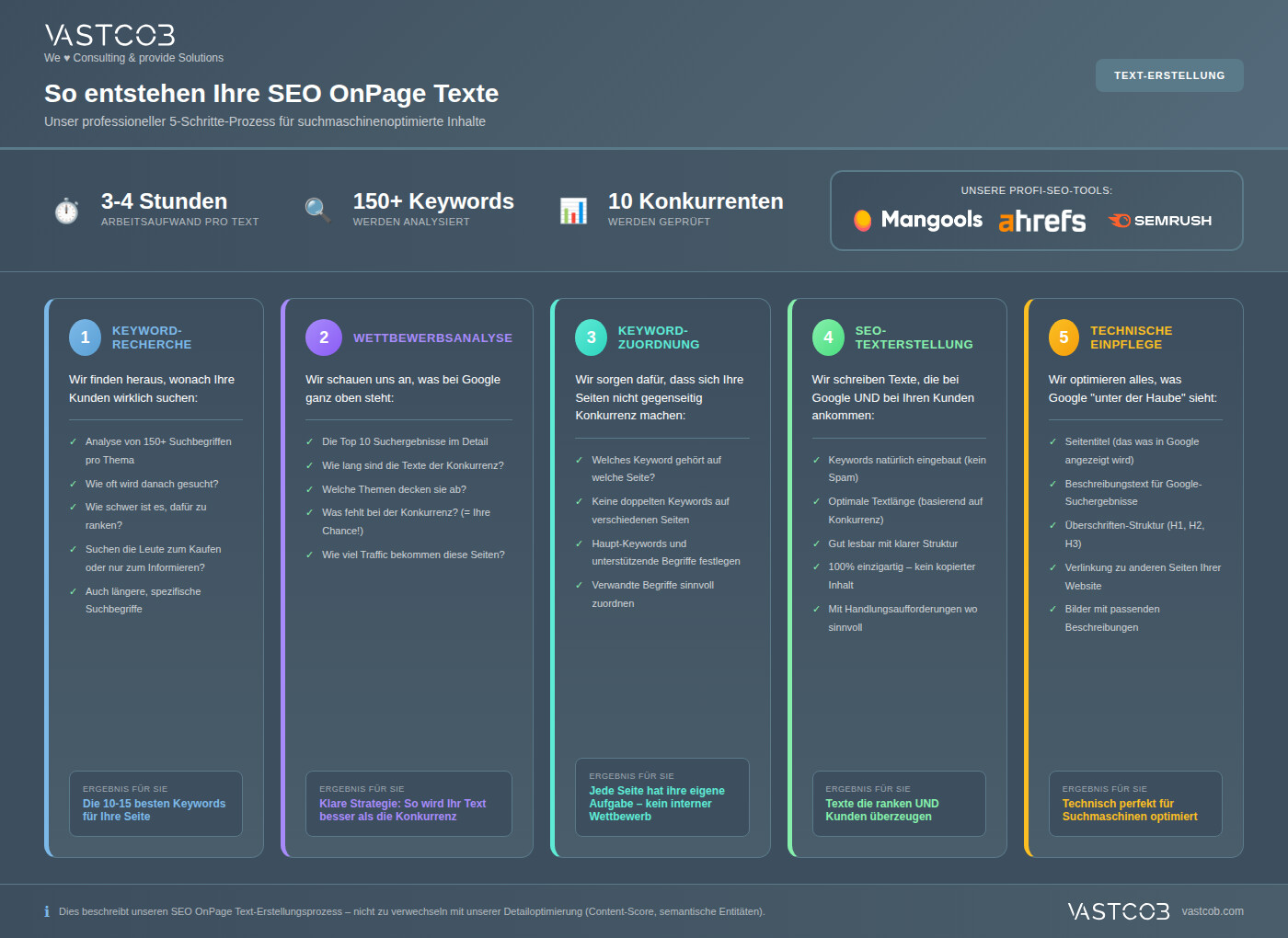
SEO texts for service and category pages require a structured creation process. We invest 3 to 4 hours of work per text and go through five consecutive steps. This systematic approach ensures that no relevant aspect is overlooked.
The process starts with the keyword research and competitor analysis already described. This is followed by keyword assignment, which ensures that your pages do not cannibalize each other. In the fourth step, the actual SEO text is created with naturally integrated keywords, optimal text length, and a clear heading structure. Every text is 100% unique content without copied or rewritten material.
Five Steps from Keyword to Finished SEO Text
Technical implementation as the fifth step completes the process. Page titles and meta descriptions are optimized, the heading hierarchy (H1, H2, H3) is cleanly structured, and internal links to thematically relevant pages are set. Images receive meaningful descriptions for Google image search.
Each of these five steps delivers a concrete result for you. Keyword research identifies the 10 to 15 best keywords for your page. Competitor analysis provides a clear strategy for how your text will outperform the competition. Keyword assignment gives each page a unique task. Text creation produces content that ranks and convinces. Technical implementation ensures that Google can process the text optimally.
Blog Articles as a Strategic Lever for Sustainable Rankings
Blog articles serve a different function within an SEO strategy than on-page texts. While service pages serve transactional search queries, blog articles capture users in the research phase. They answer questions, provide orientation, and build trust before a purchase decision is even on the horizon.
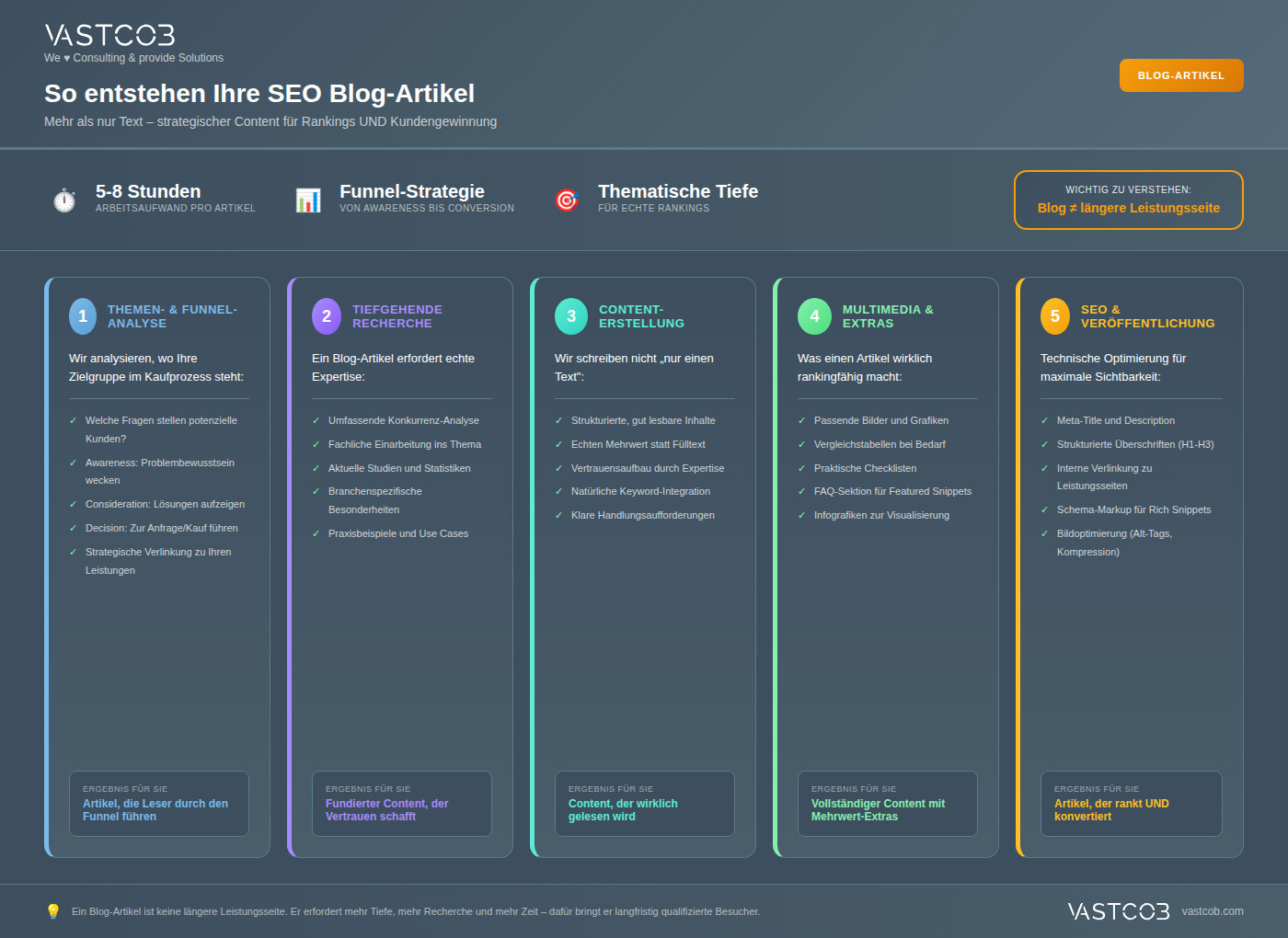
A blog article is not a longer service page. It requires significantly more research depth, a well-thought-out funnel strategy, and 5 to 8 hours of work. In return, it brings long-term qualified visitors who reach your website through informational search queries and get to know your expertise there.
Why Blog Articles Are Planned Differently Than On-Page Texts
Our blog process begins with a topic and funnel analysis. We identify which questions your potential customers ask and in which phase of the buying process they are. Awareness content raises problem awareness, consideration content shows possible solutions, decision content leads to an inquiry or purchase.
This analysis is followed by in-depth research with comprehensive competitor analysis, professional immersion in the topic, and the integration of current studies and statistics. Only then does the actual content creation begin with structured, highly readable content that offers real added value instead of filler text. A strategic content marketing approach specifically connects these articles with your service pages.
What Really Makes a Blog Article Rankable
Rankable blog articles are distinguished by several quality characteristics. In addition to depth of content, multimedia elements play an important role. Suitable images and graphics, comparison tables where needed, practical checklists, and FAQ sections for featured snippets increase dwell time and the chance of prominent placements.
Technical optimization completes the process. Meta titles and descriptions are formulated for maximum click-through rate. Structured headings (H1 to H3) organize the article logically. Internal links connect the post with relevant service pages. Schema markup enables rich snippets, and optimized images with alt tags round off the overall package.
Technical SEO as the Foundation of Every Successful SEO Strategy
Without a clean technical foundation, even the best content has no effect. Google must first be able to find, crawl, and index your pages before they can even appear in search results. Technical SEO creates these prerequisites and eliminates obstacles that slow down your rankings.
Core Web Vitals measure the user experience on your website using concrete metrics. Load time (LCP), interactivity (INP), and visual stability (CLS) feed directly into ranking evaluation. Mobile-first indexing also means that Google primarily evaluates the mobile version of your website. Over 70% of all search queries now come from smartphones.
These technical factors directly influence your rankings
An XML sitemap makes it easier for Google to find all relevant pages. The robots.txt controls which areas may be crawled. Canonical tags prevent problems caused by duplicate content. Structured data (schema markup) enables rich snippets with stars, FAQ accordions, or product information directly in the search results.
HTTPS encryption is mandatory and a confirmed ranking factor. Well-thought-out internal linking distributes authority evenly across all important pages and helps Google understand your page structure. All these technical aspects belong firmly in your SEO strategy, because they form the foundation on which your content can unfold its full effect.
An SEO strategy requires continuous development
SEO is not a one-time project with a fixed end date. Search engines constantly develop their algorithms, competitors optimize their content, and your target audience’s search behavior changes. A successful SEO strategy must therefore be a living process that is regularly reviewed and adjusted.
Google Search Console provides valuable data on clicks, impressions, and average positions free of charge. For more in-depth analyses, we rely on professional tools such as Mangools, Ahrefs, and Semrush, which make changes in rankings, backlink profiles, and visibility index visible. Regular content audits identify content that should be updated or expanded.
Experience shows that long-term SEO support delivers significantly better results than one-time optimization projects. Building rankings takes months; maintaining and expanding them requires continuous work. If you are looking for a professional SEO agency as a partner for your SEO strategy development, we are here to support you with over 10 years of experience, Google Partner certification, and a proven methodology. Contact us for a no-obligation initial consultation.




 DE
DE