
The search for the one magical authority value of a website has shaped SEO thinking for years. After more than ten years of practical work in consulting and implementation, however, we consider this view to be outdated. In this article, we explain why a widespread concept is not sufficient for well-founded SEO decisions and what really matters instead.
Why Topical Authority is so often misunderstood in SEO practice
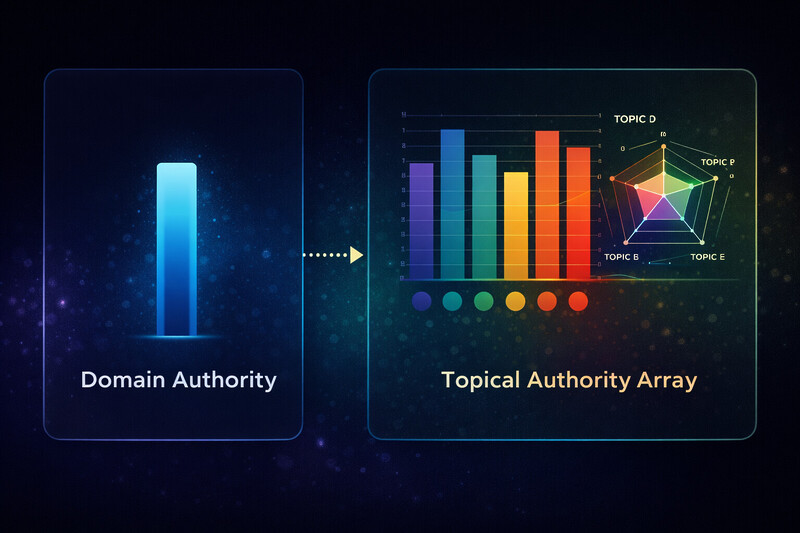
Topical Authority is considered one of the central concepts of modern search engine optimization, yet it is regularly misused in professional discussions. At VASTCOB, after more than ten years of work in SEO consulting and implementation, we observe that many companies still cling to an outdated idea, namely the notion of a single sitewide authority score. In this article, we debunk this myth and show why Topical Authority is not a single value, but an array of topic-specific values. We explain how PageRank actually flows through a website, why even strong domains fail on certain topics, and how you can systematically build your topical authority.
Why Domain Authority as a sole metric is outdated
The historical role of Domain Authority as a substitute for Toolbar PageRank
Domain Authority, or DA, is not an official Google metric. It is a metric developed by third-party providers like Moz and once served the purpose of replacing the old, no longer public Toolbar PageRank. The goal at the time was understandable, namely to provide a simple and comparable number for the strength of a domain.
Why a global number does not reflect the reality of modern search results
In practice, Domain Authority is still often misunderstood as a sitewide authority value. However, a high DA value does not automatically mean that every single page of the domain will rank. In client projects, we regularly see how teams focus exclusively on this one number and overlook essential ranking signals that Google actually evaluates.
The reality of modern Google search is much more nuanced. Google does not evaluate the entire domain across the board, but rather the thematic relevance of individual content in the context of specific search queries. This is precisely where the concept of Topical Authority comes into play, and this is precisely why we believe that Domain Authority as the sole control variable in SEO is no longer sufficient.
Why Topical Authority is an array and not a single value
Every topic has its own authority value
Topical Authority is not a single value, but an array of many values. Every topic, every concept, and every thematic area has its own level of authority on your domain. A website can simultaneously have high Topical Authority in one topic area and be at zero in a completely different one, without this being a contradiction.
New pages therefore do not inherit authority across the board from the domain, but rather in a topic-specific manner. If you have already published strong content in a specific topic area, a new article on a related topic will benefit from it. An article from a completely different topic area, however, will hardly benefit, because it lacks the semantic proximity and the appropriate link profile.
Why sitewide relevance is an SEO myth
Sitewide relevance in the sense of a uniform global evaluation is, in our opinion, an SEO myth. Google could not implement such a manual overall evaluation for billions of pages. The algorithms work thematically, context-dependently, and granularly, and Topical Authority Google thus becomes a much more realistic model for evaluating true ranking strength.
How PageRank actually flows through a website
PageRank Decay and the loss per link jump
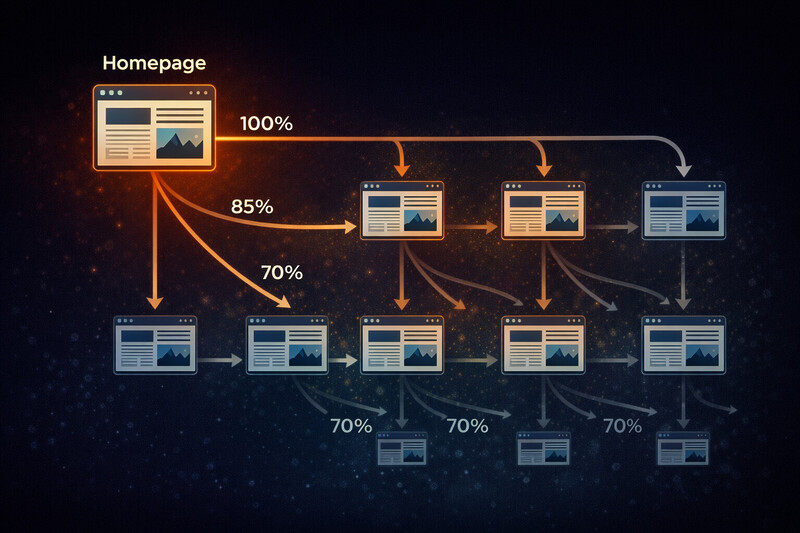
PageRank does not flow evenly through a website, but in practice rather irregularly and with significant losses. Each link jump costs a considerable portion of the authority that one page passes on to the next. Practical models speak of about 85 percent loss per jump, which often leaves practically nothing after three to four click depths.
Become more visible on Google & Social Media?
In a free strategy consultation for data-driven online marketing, we uncover your untapped potential, review any existing ad accounts if necessary, examine your SEO ranking and visibility, and determine which strategy is appropriate for your budget and which active measures will lead to more inquiries or sales.

✅ More visibility & perception through targeted placement
✅ More visitors > prospects > customers > revenue
✅ Reach target groups scalably with SEA
✅ Act and grow sustainably with SEO
🫵 Maximum success with our hybrid strategy
💪 More than 15 years of experience across industries in over 1,000+ projects demonstrable!







Why new pages start at zero despite a strong domain
For new pages, this means an unpleasant truth. A new page on a strong domain does not automatically start with high authority. If it is too deep in the architecture, hardly internally linked, or stands thematically isolated, it can practically start from scratch. This explains why new content, despite a perceived strong domain, sometimes does not rank or ranks only very weakly for months.
For SEO work, this means that the architecture of your website is a central ranking issue and not a side note. Anyone who is serious about visibility must deal with flat hierarchies, consistent internal linking, and the targeted transfer of authority. This is precisely where good OnPage SEO comes into play in practice.
Why off-topic content on strong domains does not rank
The NASA thought experiment with the dishwasher
Imagine you publish an article about dishwashers on a NASA-related science website. The domain enjoys the highest authority, the content is technically flawless, and the article itself is well written. And yet, this article will not rank because it simply lies outside the Topical Authority of this domain.
What this means for your content planning
The example clearly shows what thematic authority means in practice. Authority is not arbitrarily transferable from one topic area to another. Even the strongest domain cannot simply generate visibility in an unfamiliar topic area because it lacks the thematic depth, the appropriate link profile, and the semantic proximity to the target topic.
For company websites, this leads to a clear rule. New topics should preferably grow where related content already exists and trust has been built. Anyone venturing into a completely new topic area must first build Topical Authority from scratch there and cannot simply rely on the strength of the domain as a whole.
Why Topical Authority must match the content volume
A single backlink does not carry millions of pages
Authority and content volume are closely related. You cannot rank ten million pages with a single strong backlink from Microsoft or another top domain. The existing authority must be distributed among the amount of your content and quickly becomes so thin that ranking effects fail to materialize.
Why even Amazon reaches its limits with indexing
An impressive litmus test is indexing even on the largest websites in the world. Amazon only achieves an indexing rate of about 42 percent for its own product pages. Less than half of the pages are even fully included in the Google index. If a global marketplace reaches such limits, it is clear that content rollout must never be planned separately from authority building.
In our daily work, we therefore always consider content rollout together with authority building. How many new pages can you realistically support with your current Topical Authority, and how do you grow in parallel without diluting your thematic strength? This question ultimately decides the success of any major content initiative and shapes every serious SEO consultation.
Building Topical Authority purposefully and redirecting it strategically
Topic clusters as a stable foundation
Topical Authority is most stably created through consistently built topic clusters. A central pillar page broadly covers the main topic and is flanked by many related subpages with specific detailed questions, application examples, and in-depth information. Internal links connect all components into a semantic network that Google clearly recognizes as a coherent topic area.
FAQ pages as a bridge to non-ranking content
If a single page does not rank despite good content, it is rarely due to the text alone. Often, the integration into the surrounding topic area is missing. A proven method is the targeted creation of related FAQ pages nearby and the internal linking to the non-ranking page. This way, we strategically redirect Topical Authority to where it was previously missing and strengthen the target page with additional thematic substance.
Internal linking in this context is one of the underestimated levers in SEO. It distributes PageRank, marks thematic connections for Google, and connects new content to existing strength. Those who work systematically here often see measurable effects faster than through external link building alone. For deeper competitive analyses and targeted external backlink building, we supplement this internal work with professional link building measures.
What this means for your SEO strategy in practice
Mentally say goodbye to a single sitewide authority score. Instead, think in terms of topic areas and evaluate your ranking success per topic cluster. This change in perspective alone noticeably improves the quality of your SEO decisions and makes monthly reports for management more understandable and meaningful.
Specifically, this means that new content is preferably created where you have already built Topical Authority. If you want to venture into a new topic area, you should realistically plan the effort and link content rollout and authority building from the outset. Topic clusters developed in depth are significantly more valuable than broad but superficial content collections without semantic connection.
If you would like to re-establish your SEO strategy based on Topical Authority and are looking for an SEO agency that works deeply both technically and in terms of content, please feel free to contact us. We will jointly examine your existing topic clusters, your internal linking, and the path to reliable rankings in the topic areas that are crucial for you.
Conclusion
Topical Authority is not a buzzword, but a change in perspective. Domain Authority as a single metric is outdated because it does not reflect the thematic reality of Google search. Topical Authority is an array of many topic values, and authority flows only to a limited extent and with significant losses through a website. Those who understand this combine content rollout, internal linking, and topic clusters and develop their SEO strategy consistently along the topics in which they truly want to become strong. This is more complex than looking at a single number, but much closer to how modern search engines actually work.





 DE
DE