
Marketing budgets are shrinking, costs are rising – and many entrepreneurs are reacting with cuts instead of strategy. However, the real bottleneck is not in the advertising budget, but in the lack of understanding of numbers.
Marketing 2026: Why your biggest problem isn't the budget – but Excel
In 2026, many entrepreneurs are cutting their marketing budgets. Not because marketing doesn’t work. But because they never understood their numbers. This statement is uncomfortable, but it hits the nail on the head. Current surveys show: Marketing budgets in German industry fell by an average of over three percent compared to the previous year. At the same time, external costs continue to rise. The result is not a savings program – it is flying blind.
As a multi-entrepreneur with seven-figure profits, I have observed this pattern for years. The difference between profitable and struggling companies is not in the marketing budget. It lies in a single question: Do you know your numbers – or are you just hoping? If you don’t know what contribution margin a product generates, you can’t make a decision. If you don’t know your break-even, you’re gambling with every campaign.
This is not a marketing problem. This is a controlling problem. And that’s why so many entrepreneurs are pulling the wrong lever. They cut where they should be managing. They treat marketing 2026 as a cost factor – when it is an investment. But only if the numbers are right.
The Pattern: Covid 2020–2022 vs. 2024–2026
The Parallels of Economic Crises
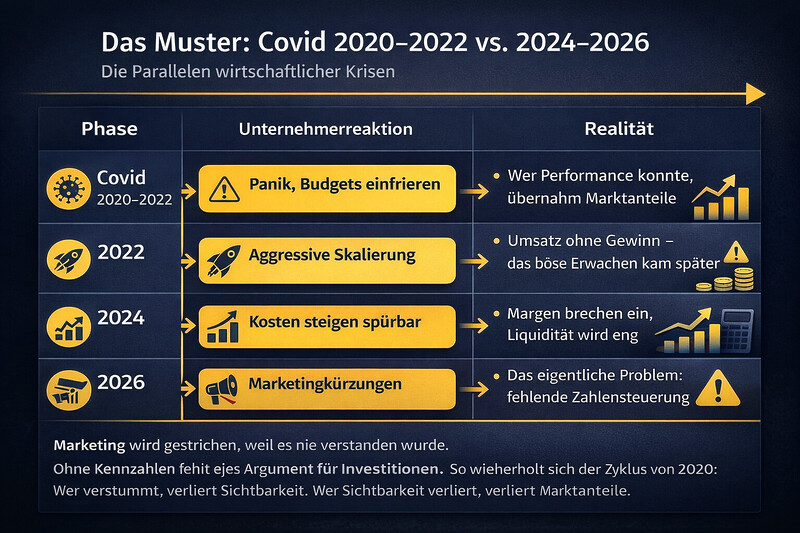
Current developments repeat a familiar pattern. Those who recognize it can act. Those who ignore it pay double.
| Phase | Unternehmerreaktion | Realität |
|---|---|---|
| Covid 2020–2022 | Panik, Budgets einfrieren | Wer Performance konnte, übernahm Marktanteile |
| 2022 | Aggressive Skalierung | Umsatz ohne Gewinn – das böse Erwachen kam später |
| 2024 | Kosten steigen spürbar | Margen brechen ein, Liquidität wird eng |
| 2026 | Marketingkürzungen | Das eigentliche Problem: fehlende Zahlensteuerung |
Marketing is cut because it was never understood. Without key figures, there is no argument for investment. This is how the cycle of 2020 repeats itself: Those who fall silent lose visibility. Those who lose visibility lose market share. The winners were always the same – entrepreneurs who knew their numbers and invested based on them, while others hesitated.
Why Success Has Become "Unsexy"
The Unglamorous Truth of Profitable Companies
Success looks different than most people believe. No viral campaigns. No impressive follower counts. Success is created in spreadsheets. That’s not Instagram-worthy. It’s Excel. Profitable companies work with these metrics daily:
- Calculate the contribution margin per product precisely
- Be able to distinguish between ROAS and POAS
- Know the break-even point to the exact Euro
- Track and optimize the conversion rate cleanly
- Determine customer acquisition cost realistically
- Understand and increase the repurchase rate
The contribution margin determines which products actually generate profit. Without this figure, companies optimize in vain. They push bestsellers that have no margin. They ignore niche products that carry the profit. This is not a marketing failure. This is numerical blindness – and no campaign in the world can compensate for that.
The "Numbers Game" Principle
The 5-Number System for Informed Decisions
Entrepreneurial success can be reduced to five key figures. These figures objectify every marketing decision. They replace hope with facts. I call it the 5-number system:
Become more visible on Google & Social Media?
In a free strategy consultation for data-driven online marketing, we uncover your untapped potential, review any existing ad accounts if necessary, examine your SEO ranking and visibility, and determine which strategy is appropriate for your budget and which active measures will lead to more inquiries or sales.

✅ More visibility & perception through targeted placement
✅ More visitors > prospects > customers > revenue
✅ Reach target groups scalably with SEA
✅ Act and grow sustainably with SEO
🫵 Maximum success with our hybrid strategy
💪 More than 15 years of experience across industries in over 1,000+ projects demonstrable!







- Break-even revenue – At what point do you cover all costs? This threshold is the minimum requirement for every campaign.
- Contribution margin per product – What remains after deducting variable costs? Without this value, advertising decisions are guesswork.
- Maximum allowable CAC – What can a new customer cost before you burn money?
- Conversion Rate – How efficiently is traffic converted into sales? A one percent difference changes everything.
- Customer Lifetime Value (LTV) – What is a customer worth over the entire relationship?
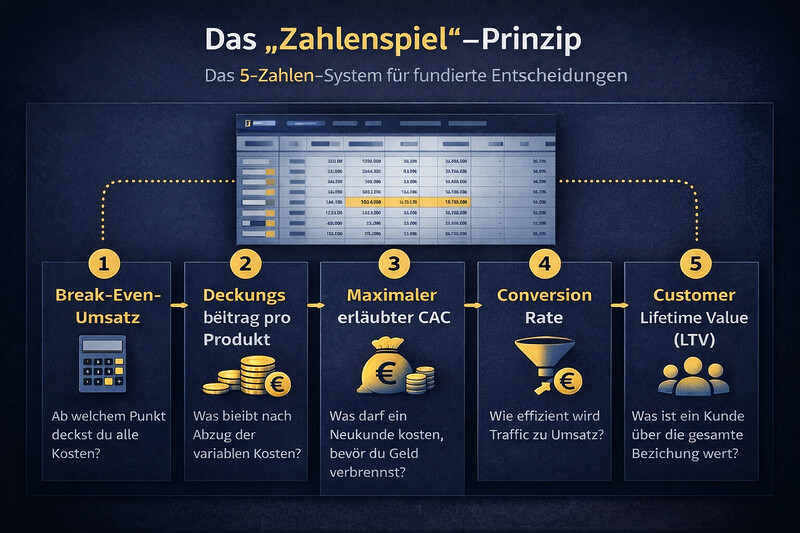
Anyone who knows these five key figures needs no motivation. They have mathematics. The ratio of LTV to CAC should be at least 3:1 – anything below that jeopardizes long-term profitability.
ROAS vs. POAS: Why one number lies
Most entrepreneurs manage by ROAS – Return on Ad Spend. This is a mistake. ROAS measures revenue per advertising euro. Not profit. A concrete example:
| Kennzahl | Value |
|---|---|
| Produktpreis | 100 € |
| Wareneinsatz | 40 € |
| Fixed Cost Share | 20 € |
| Echter Deckungsbeitrag | 40 € |
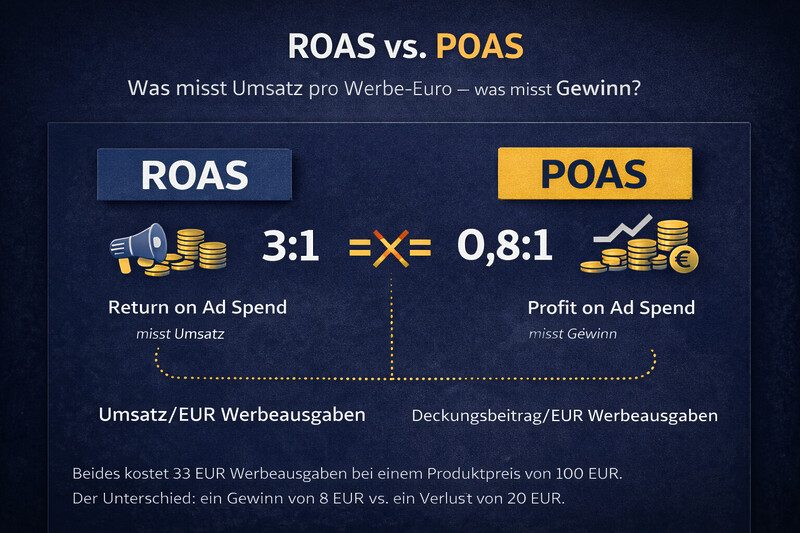
With a ROAS of 3:1 and a product price of €100, you have invested €33 in advertising costs. The dashboard shows green. But calculate further: payment fees (€2–3), return rate, packaging, proportional fixed costs. Little or nothing remains of your €40 contribution margin.
ROAS measures revenue per advertising euro. POAS measures profit per advertising euro. Only POAS shows the reality.
POAS (Profit on Ad Spend) includes the contribution margin, not the revenue. A ROAS of 3:1 can correspond to a POAS of 0.8:1 – and that means a loss. Marketing 2026 only works if you know which number truly counts.
Why many agencies fail
Structural Weaknesses in the Agency Business
Most agencies sell reach. Entrepreneurs need return. That is the core of the problem. Agencies optimize clicks and impressions – not profit. The most common mistakes:
- Focus on Traffic instead of Profit – Reach is celebrated, margins are ignored
- ROAS without Fixed Costs – Embellished figures that don't hold up in reality
- No Margin Calculation – Which product generates profit? No idea.
- Lack of process thinking – Marketing viewed in isolation, without considering fulfillment or cash flow
- No liquidity planning – Campaigns generate orders, but the account is empty
A ROAS of 3:1 sounds profitable. Factor in fixed costs, returns, and payment terms – and you’re at zero or in the red. I am not a marketing romantic. Marketing is a business discipline. The same rules apply as everywhere else: numbers decide. Not creativity. Not hope. Not gut feeling.
Personal Classification
What I myself did wrong
The principles described do not come from textbooks. They come from mistakes. My mistakes. Seven-figure profits did not come by luck – they came after I stopped lying to myself.
I experienced revenue phases where no profit remained. I pushed products that seemed to be bestsellers – and destroyed the margin. I believed ROAS figures that looked good – and still lost liquidity. I celebrated campaigns that cost the company money.
The lesson was painful but clear: revenue is not profit. This distinction sounds trivial. It is ignored daily. The solution was never more budget. It lay in better numbers, honest analysis, and the willingness to accept uncomfortable truths. Each of my companies underwent this transformation: from gut feeling to numerical control. That was never comfortable. But always profitable.
Conclusion
The consequence of the current economic situation
2026 does not require budget cuts. 2026 requires a numerical system. Those who understand their key figures can scale marketing – even in difficult times. Those who do not understand them will always make wrong decisions: cutting when investment should be made. Spending when caution would be appropriate. Marketing 2026 is not a cost center. It is an investment – but only with the right numbers.
Your first step for this week:
Sit down for two hours. Create a contribution margin calculation for your top 10 products. Calculate your maximum CAC. Compare ROAS with POAS. If you don’t know your five numbers, every campaign is speculation – no matter how creative it is.
Don’t use the current phase to retreat. Use it for professionalization. Build your number system. Understand your unit economics in detail. Then marketing decisions become what they should be: calculated investments with a measurable return. That’s not sexy. But neither is bankruptcy.





 DE
DE