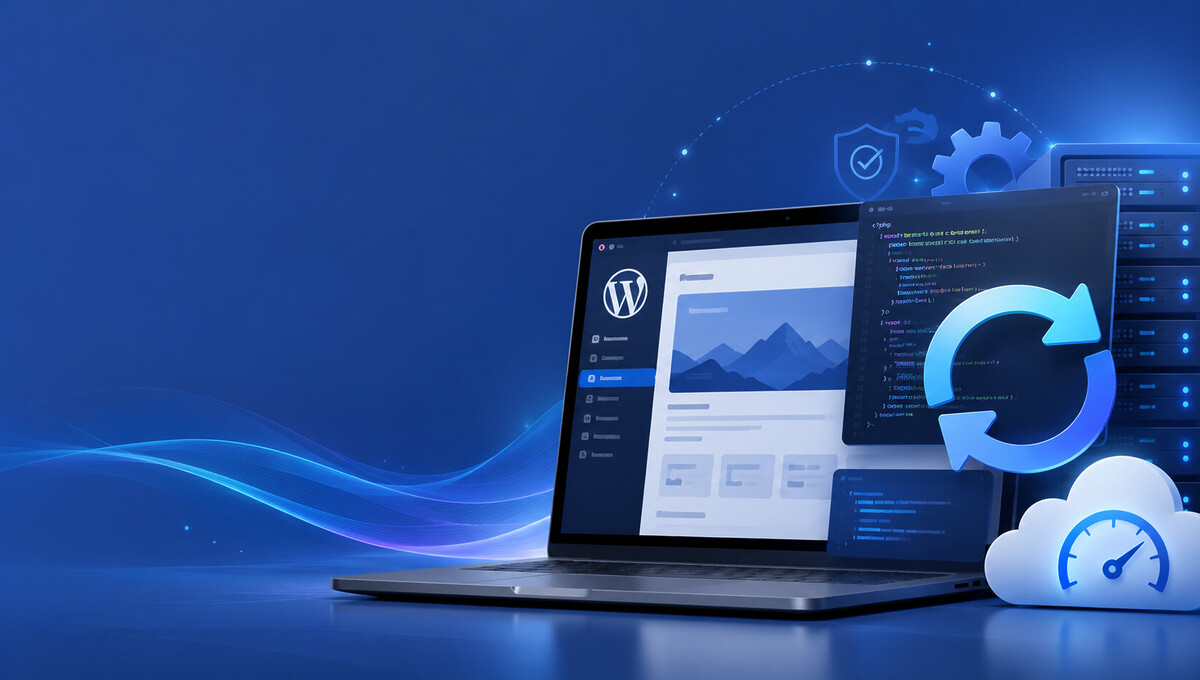
Is your WordPress site throwing warnings about an outdated PHP version? Does your host display a red notice in the backend about the next End-of-Life date? A cleanly executed change closes security vulnerabilities and measurably speeds up the site, if the order is right.
Safely perform a WordPress PHP update and avoid errors
A WordPress PHP update is one of those inconspicuous maintenance tasks that make the biggest difference in the background. A modern PHP version not only closes security vulnerabilities, it noticeably speeds up the entire site and ensures compatibility with current themes and plugins. At VASTCOB, we have been supporting WordPress projects, from sole proprietorships to corporations, since 2010 and regularly see sites in our audits that are still running on PHP 7.x, even though official support has long since expired. In this guide, we show you how to safely implement the update, which host offers the clean solution, and what to do if the screen remains white after the change.
Why a WordPress PHP update is important
PHP is the scripting language that powers WordPress in the background. If your site uses an outdated version, security, speed, and compatibility all suffer. Version maintenance with the host is therefore not an optional extra, but a recurring mandatory appointment.
Security and protection against known vulnerabilities
Each PHP version receives active security patches for about two years, followed by one year of security-only fixes, and finally End-of-Life status. PHP 7.4 has been without official support since November 2022, and PHP 8.0 since the end of 2023. Without patches, critical vulnerabilities remain open in your installation, which bots actively exploit.
Performance and speed gains
The leap from PHP 7.4 to PHP 8.x often brings 20 to 40 percent shorter response times in real WordPress setups, especially for WooCommerce shops and multiple plugin installations. Faster loading times directly improve Core Web Vitals and thus SEO positioning. Since 2010, we have measured such effects before and after each change.
Compatibility with current themes and plugins
WordPress itself states PHP 7.4 as the minimum requirement and PHP 8.x as a recommendation. Premium themes and serious plugins like WooCommerce, WPML, or Elementor Pro have been tested against current versions for years. Those who remain on old PHP versions cut themselves off from new features and block otherwise harmless plugin updates.
Check your site's current PHP version
Before you change anything, clarify the current status. Three ways lead to the current PHP version of your WordPress site, depending on access and prior knowledge.
In the WordPress Site Health Tool
In the WordPress backend, under Tools and the Site Health item, you will find the Info section. There, the Server entry shows the active PHP version. If you don’t see Site Health, you are using a very old WordPress version and should update WordPress itself first.
In the hoster backend
With ALL-INKL, you can find the PHP version in the KAS backend under Domain and Subdomain Management. With Strato, the path leads through the Customer Login and Package Management. Most other hosts show the version in a comparable place in their customer area.
Via your own phpinfo script
If you want a second source, upload an info.php file with the content phpinfo via FTP to the root and call it up in the browser. Delete the file immediately after checking, as it reveals sensitive server data.
Become more visible on Google & Social Media?
In a free strategy consultation for data-driven online marketing, we uncover your untapped potential, review any existing ad accounts if necessary, examine your SEO ranking and visibility, and determine which strategy is appropriate for your budget and which active measures will lead to more inquiries or sales.

✅ More visibility & perception through targeted placement
✅ More visitors > prospects > customers > revenue
✅ Reach target groups scalably with SEA
✅ Act and grow sustainably with SEO
🫵 Maximum success with our hybrid strategy
💪 More than 15 years of experience across industries in over 1,000+ projects demonstrable!






WordPress PHP Update step by step
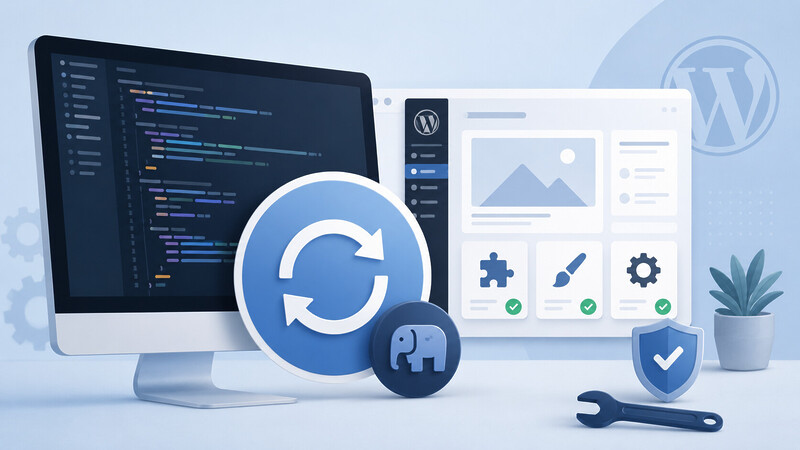
A WordPress PHP update can be done risk-free if the order is right. These six steps have proven effective in over 1,000 implemented projects.
Backup of database and files
A complete backup is mandatory, not a recommendation. Back up both all files via FTP and the database via phpMyAdmin or with a plugin such as UpdraftPlus or BackupBuddy. Check the backup for completeness before you proceed to the next step.
Staging system or test environment
Create a copy of the live site in a staging environment. Many hosts offer one-click staging; alternatively, copy the site manually. In staging, first switch the PHP version and check the behavior without visitors noticing anything.
Change the PHP version in the host’s panel
In the host’s backend, set the PHP version to the desired variant. At ALL-INKL, this works per domain via KAS in two clicks. Do not start with the very latest version, but with a stable LTS variant such as PHP 8.2 or 8.3, depending on your plugin landscape.
Function check and go-live
After the switch, systematically check the homepage, contact form, login, backend, search, and critical functions such as checkout in the shop. Only once everything runs without error messages should you activate the update on the live site as well.
The following sequence works in almost any setup.
- Back up files and database
- Create a staging copy of the live site
- Change the PHP version in staging
- Check plugins, themes, and custom code in staging
- Make adjustments or replace plugins
- Change the PHP version on the live site
PHP update at the most important hosts
The specific way to switch the PHP version differs depending on the host. The following table shows the most important providers in a direct comparison.
| Hoster | Available PHP versions | Switchover time | Rollback possible | Recommendation |
|---|---|---|---|---|
| ALL-INKL (Recommended) | 7.4 to 8.3, latest quickly available | Immediately in the KAS | Yes, switchable at any time | Top, highly recommended |
| Strato | 7.4 to 8.2, new versions with delay | Immediately, sometimes with waiting lists | Yes, in the Customer Login | Solid, but slow with new versions |
| IONOS | 7.4 to 8.2 | Immediately in the hosting panel | Yes | Solid for standard setups |
| mittwald | 7.4 to 8.3 incl. beta | Immediately | Yes, granular per vhost | Very good, more for developers |
| HostEurope | 7.4 to 8.2 | Immediately, limited depending on plan | Yes | Solid |
ALL-INKL with KAS in two clicks
With ALL-INKL, you log into KAS, open the domain administration, and set the PHP version for each domain via a dropdown. The change takes effect immediately, and a rollback is just as quick. If you don’t have a suitable host yet, ALL-INKL* offers a provider that quickly and easily provides current PHP versions.
Strato in the Customer Login
Strato offers PHP version switching in the Customer Login under Package Management and PHP Version. For many Strato tariffs, new PHP versions only appear months after official release. If you need a current version, you should consider switching to ALL-INKL, otherwise the Strato PHP update will become a test of patience for WordPress.
IONOS, mittwald and other providers
IONOS and HostEurope are solid, but their ease of use varies depending on the tariff. mittwald scores with fine granularity down to the beta version and is more intended for technical users. For most WordPress projects, a KAS-supported host like ALL-INKL is the fastest and most stress-free choice.
Plugins, Themes, and Compatibility with PHP 8
A PHP switch usually breaks sites not because of WordPress itself, but because of outdated plugins or themes. A little preparation protects against nasty surprises during the WordPress PHP 8 update.
Compatibility Check before Switching
Check all active plugins and the theme in use for PHP compatibility. Current versions from the WordPress repository are generally PHP 8 ready; delisted plugins often are not. Also, if you maintain custom code from an agency, have it checked for PHP 8 with a WordPress Professional Check.
PHP Compatibility Checker and Query Monitor
The PHP Compatibility Checker plugin scans the installation and identifies potentially problematic functions. Query Monitor displays warnings and notices directly in the frontend during runtime. Both help to make problems visible before the live switch and to solve them specifically.
Identify and Replace Outdated Plugins
Plugins that have not received an update for more than two years should be proactively replaced. Proceed as follows in staging.
- Deactivate all plugins for testing purposes
- Change PHP version
- Activate plugins individually and check functionality
- Mark conspicuous plugins and replace them with maintained alternatives
If WordPress is no longer accessible after a PHP update
Sometimes something goes wrong. Instead of panicking, proceed in a structured manner and use a clear emergency plan.
Understanding White Screen and Fatal Error
The White Screen of Death usually appears after a PHP update if a plugin or theme uses incompatible functions. In debug mode, WordPress reports the exact error including file and line number. If you have not activated the mode, you will only see the blank screen and must proceed differently.
Revert PHP version via FTP
If the backend is no longer accessible, log in to the hoster panel and revert the PHP version to the previous state. This is done in a few seconds in the KAS at ALL-INKL and immediately resolves the acute emergency.
Reading debug logs correctly
In wp-config.php, activate WP_DEBUG, WP_DEBUG_LOG, and WP_DEBUG_DISPLAY. You will then find the errors in wp-content/debug.log. The most common sources of errors after a PHP update are:
- Outdated plugin using deprecated PHP functions
- Custom code in the theme or child theme with syntax changes
- Incompatible version of an important plugin like WooCommerce
- Missing or outdated PHP extensions on the server
- Cache plugin delivering old code versions
With our WordPress maintenance, we prevent such situations by testing updates in a controlled staging environment before switching the live site.
Why ALL-INKL is the better choice for WordPress
From over 1,000 managed projects, a clear favorite emerges as a WordPress host, especially when it comes to regular PHP updates.
Current PHP versions without waiting time
ALL-INKL* usually offers new PHP versions within a few weeks of official release. Those who want to work on a current LTS version do not have to wait for months and can complete their plugin and theme tests earlier.
KAS backend with clear PHP switching
The in-house customer administration system enables domain, FTP, database, and PHP management in one place. The PHP version can be switched individually per domain and subdomain without affecting the entire server. This is a real time-saver, especially for multiple projects under one account.
Performance, support, and fair conditions
ALL-INKL hosts in Germany, offers SSD storage, HTTP/3, and telephone support, which we know from our own experience to be helpful. Our customers also confirm this in their daily work, and our reviews on ProvenExpert reflect exactly this positive experience in the WordPress Hosting environment.
When support from a WordPress agency is worthwhile
You can set up a small blog page yourself on PHP 8. For critical infrastructure, support with industry experience is the more honest model and protects against loss of revenue.
For critical sites and online shops
A WooCommerce site with live orders must not fail at any time. With multi-site with different themes per client or with individual plugins, complexity quickly increases. Here, a well-rehearsed procedure with staging, rollback plan, and performance comparison before and after the update pays off.
What we specifically take on
We analyze plugins and themes, create the backup, perform the update in staging, document performance data before and after, and only then go live. If you want to outsource the entire PHP update to a WordPress agency, we also take over the risk management. A telephone WordPress consulting and support hotline is also available if something urgent arises.
Conclusion on the WordPress PHP Update
A WordPress PHP update initially seems technical, but at its core, it is a simple mandatory maintenance with a big impact on security, speed, and future viability. With a current host like ALL-INKL, a proper backup, and a short staging phase, the change usually goes unnoticed. Those looking for support will find a safe haven for critical sites with an agency with experience since 2010, over 1,000 implemented projects, and positive ProvenExpert reviews.


 DE
DE