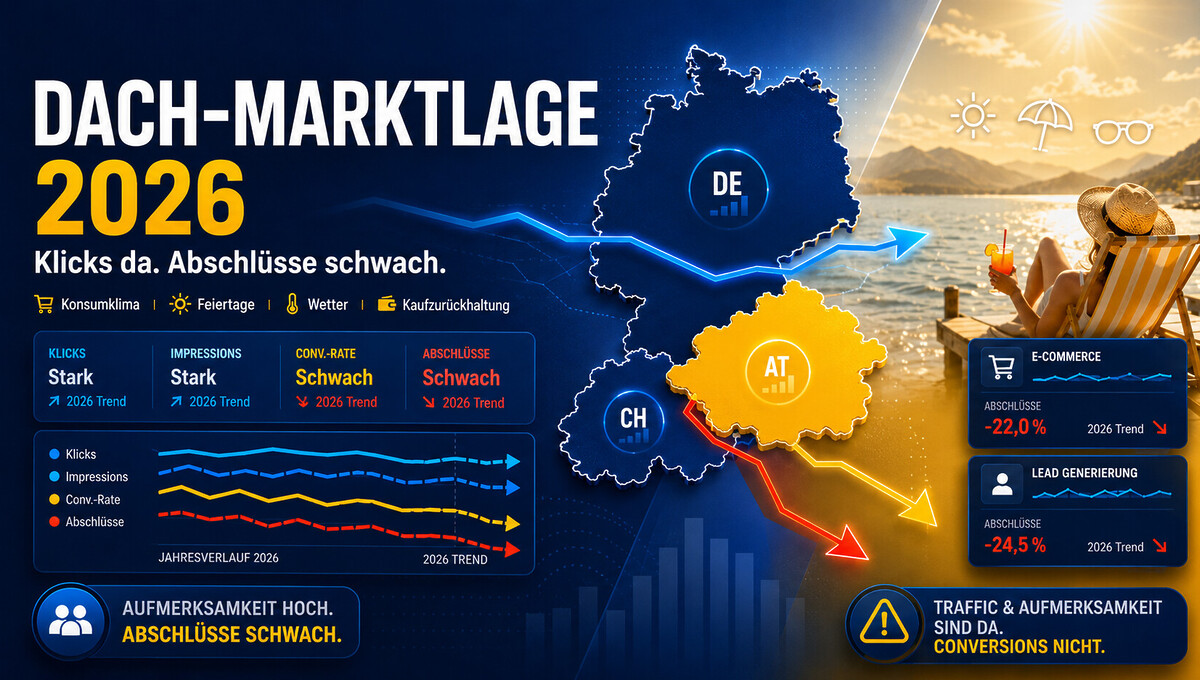
May 2026 shows a noticeable reluctance to close deals in many DACH markets. Our exemplary, aggregated practical data from various industries, e-commerce sales, and lead targets show: attention, clicks, and demand are still present – but users are less likely to buy, book, or inquire directly. Public economic, consumer, and platform data provide a plausible context for this: low consumer sentiment, weaker propensity to purchase, cautious investments, price and cost pressure, holidays, Pentecost, very good weather, and a generally uncertain economic environment.
May 2026 feels unusually weak for many companies in Germany, Austria, and Switzerland. This affects not only individual industries, not only e-commerce, and not only digital advertising. However, the development becomes particularly quickly visible in performance data because demand, click behavior, conversion rates, lead inquiries, and purchase completions become directly measurable there.
As a practical example, our aggregated data from the management account across various DACH customers shows a strikingly weak development. It includes different industries and business models – including online shops with e-commerce sales, service providers with lead targets, and B2B companies with inquiry processes.
This data is not official market statistics and should not be understood as a representative index for the overall market. However, it is an operational early indicator from real campaigns. And precisely this early indicator shows very clearly: interest and clicks are still present, but users are significantly more reluctant to buy, book, or inquire.
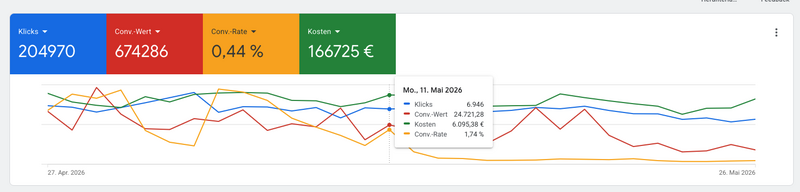
The screenshot below shows, for example, around 204,970 clicks,€166,725 in advertising costs, a measured conversion value of 674,286, and an average conversion rate of 0.44%. Since both e-commerce sales and lead conversions are included, the conversion value should not be read as pure shop revenue. Rather, the overarching trend is crucial: the willingness to close deals was weak across many business models in May 2026.
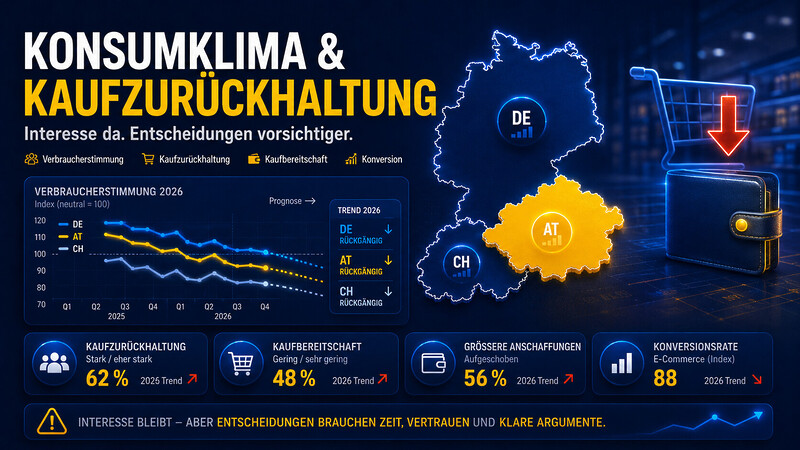
Why the market situation in DACH currently appears so hesitant and purchasing behavior is extremely declining
The current market situation in Germany, Austria, and Switzerland feels noticeably hesitant for many companies. The problem is not necessarily a lack of visibility or interest: users continue to click, gather information, compare offers, and engage with products or services. The crucial difference lies in the final step. Purchasing decisions are more often postponed, inquiries are less frequently completed, and larger expenditures are scrutinized more critically.
The reasons for this lie in a mix of weak consumer sentiment, high price sensitivity, economic uncertainty, and changed priorities in everyday life. Many consumers and companies are holding onto their money more tightly, comparing more intensively, and deciding more slowly. This reluctance is particularly noticeable for non-essential purchases, higher-priced products, services, and B2B investments.
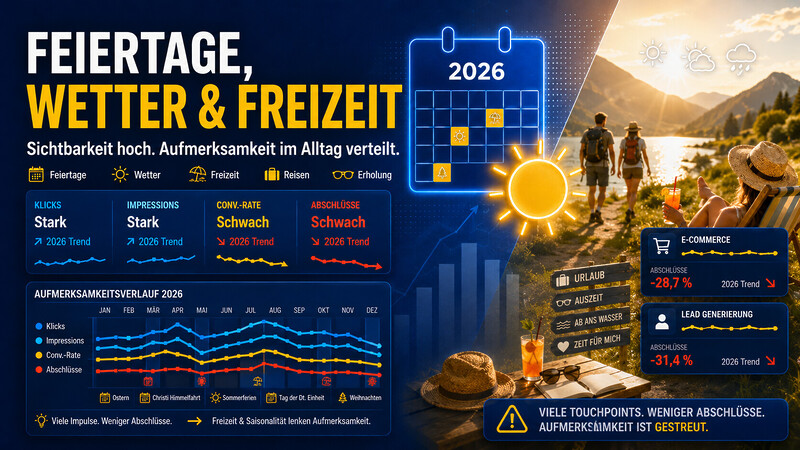
In addition, there are seasonal effects such as holidays, vacation planning, good weather, and leisure activities. During such phases, attention is present, but it is more distributed. People are reachable online, but not always ready to buy. For companies, this creates an apparent contradiction: reach, clicks, and touchpoints remain stable or even increase, while conversion rates, revenue, and lead completions decline.
Precisely for this reason, the current situation should not only be understood as a marketing problem. It is a market signal. Companies do not need to react hectically now, but rather analyze carefully: Where is real demand present? Where is there a lack of trust? Where are offers too complicated, too uncertain, or not clearly positioned enough? Those who improve communication, offer structure, follow-up processes, and conversion optimization during this phase can sell more stably despite a hesitant market situation and are better prepared when purchasing willingness picks up again.
Google Ads shows the symptom, not the cause, here
Real data from a management account from the DACH region across all products, services, sales, leads, etc.:
When campaigns perform weaker, the first suspicion often falls on Google Ads: wrong bidding strategy, poorer search terms, Performance Max problems, competition, tracking, or landing pages. These points must, of course, be checked.
But if a similar pattern becomes visible across many industries, accounts, and business models, Google Ads is not automatically the cause, but primarily the measuring window.
The real question then is: Why do people still click, but close less often?
Precisely on this point, public economic and consumer data provide a clear direction. The DACH region shows no strong, broad consumer dynamic in spring 2026, but a fragile situation: slight recovery trends, but still high uncertainty, weak sentiment, and reluctance for larger purchases.
🇩🇪 Germany: Consumer climate remains low despite recovery
For Germany, the NIM Consumer Climate powered by GfK shows a moderate recovery in May 2026. However, according to consumer expectations, the indicator for June remains at -29.3 points; the previous month was reported at -33.1 points. Thus, despite improvement, consumer sentiment remains at a very low level. (seco.admin.ch)
This is crucial for businesses. A slight recovery does not automatically mean a willingness to buy. It only means that the previous decline has not worsened. Consumers can still research, compare prices, and show interest – but larger decisions are made more cautiously.
The macroeconomic data also show no strong dynamics. According to Destatis, the price, seasonally, and calendar-adjusted gross value added increased only slightly by 0.1% in the 1st quarter of 2026. Gross fixed capital formation decreased significantly by 1.5% in the same quarter, and construction investments even by 2.5%. (seco.admin.ch)
For the market situation, this means: The market has not completely collapsed, but it is not strong either. Companies, consumers, and investors are acting more cautiously. Precisely this caution can manifest itself in lower conversion rates, longer decision cycles, and weaker closing rates.
🇦🇹 Austria: slight recovery, but no strong breadth
Austria also shows only a cautious recovery in the 1st quarter of 2026. WIFO reported a real GDP growth of 0.2% compared to the previous quarter for the 1st quarter of 2026. At the same time, the dynamics remained heterogeneous: Industry grew moderately, the construction sector declined again, and service sectors developed unevenly. (WIFO)
This fits a market picture in which individual areas are functioning, but no broad consumer or investment strength is emerging. For retailers, service providers, and B2B providers, this means: Demand may exist, but it is more selective, more price-sensitive, and more dependent on trust.
The WIFO business cycle tests in spring 2026 also show a cautious mood. For May 2026, WIFO describes the business sentiment as still skeptical despite improvement. (WIFO)
🇨🇭Switzerland: Consumer sentiment remains burdened
In Switzerland, SECO reported a consumer sentiment of -40 points for April 2026. Particularly relevant for companies: The sub-index „Time for major purchases“ was lower than in the previous year. (seco.admin.ch)
This is a strong indication that the reluctance does not only affect Germany or Austria. In Switzerland, too, the willingness for larger purchases is subdued. This is particularly relevant for higher-priced products, services requiring explanation, B2B projects, and investment decisions.
At the same time, the Swiss Flash GDP for Q1 2026 shows growth of 0.5%. This is positive, but it does not change the fact that consumer sentiment and willingness to purchase must still be assessed as cautious. (seco.admin.ch)
Meta, Facebook, Instagram, and TikTok: Reach is not the problem
The current situation does not only affect search engine advertising. On Meta, Facebook, Instagram, and TikTok, many companies show a similar basic pattern: reach, impressions, and attention are still present – but this does not automatically lead to a purchase, lead, or conversion.
Meta reported 3.56 billion daily active people worldwide across its Family of Apps for Q1 2026 and a 19% increase in ad impressions compared to the previous year. At the same time, the average ad price increased by 12%. (investor.atmeta.com)
This is important for classification: The platforms themselves are not „dead“. On the contrary: usage and ad delivery remain high. However, a different problem arises for companies: if attention becomes more expensive and users make decisions more cautiously, creatives, offers, landing pages, and follow-up processes must be significantly more convincing.
Online marketing is increasingly becoming a numbers game!
This is why we at VASTCOB are so strong, as we have long been taking on exactly this „unsexy“ part for our clients, compiling numbers, data, and facts, and then optimizing based on them.
Important: All of this is of no help if the offer, service, price, and brand presence are simply too weak.
For Facebook and Instagram, this practically means: mere reach is no longer enough. Campaigns that still worked in 2021 or 2022 with simple before-and-after claims, discount codes, or generic creatives are coming under pressure more quickly in a cautious market. Users see the ads, perhaps even react – but they don’t necessarily buy immediately.
On TikTok, the situation is similar, but even more content-driven. In its own Trend Report 2026, TikTok describes a shift in user behavior towards genuine curiosity, conviction, passion, and credible brand communication. (newsroom.tiktok.com)
For companies, this means: TikTok remains strong for attention, brand building, demand generation, and community. But here, too, direct conversion becomes more difficult when purchasing power and consumer sentiment are weak. Especially for higher-priced products or services that require explanation, more repetition, more trust, and clearer decision-making arguments are needed.
YouTube: strong platform, but also not an automatic closing channel
YouTube also remains a strong platform. Alphabet reported revenue growth of 16% in the Google Services segment for Q1 2026, driven in part by Search, YouTube, and Subscriptions. (s206.q4cdn.com)
For advertisers, YouTube is particularly interesting in the current market situation, but not always as a classic direct closing channel. YouTube is highly suitable for explanation, trust, expert positioning, product understanding, and retargeting. Precisely these factors become more important when users do not buy immediately but compare for longer.
For DACH, platform reach remains high. DataReportal reports for Germany at the end of 2025 around 78.5 million internet usersand64.7 million social media user identities. For Switzerland, 8.89 million internet usersand7.27 million social media user identities were reported. (DataReportal – Global Digital Insights)
This also shows: The problem is not a lack of online usage. The problem is the reduced willingness to convert attention directly into sales or leads.
What the data collectively means
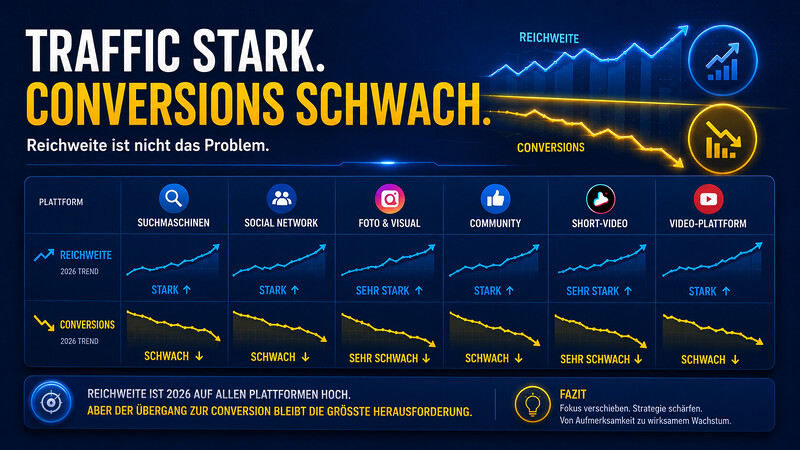
From our perspective, a clear overall picture emerges for May 2026:
- Demand is not gone.
- Attention is not gone.
- Users are not gone.
- Platform reach is not gone.
But the willingness to convert is weaker = purchase HESITATION.
In sales, one would say: A no only means not now. The timing simply isn't right.
This is evident in internal performance data, but it also aligns with public statistics: low consumer sentiment, weak propensity to buy, cautious investments, price and cost pressure, heterogeneous economic development, and seasonal distractions due to holidays and weather.
For businesses, this is an important distinction. A weak month does not automatically mean that marketing, shop, sales, or the offering are wrong. It can mean that the market is currently making slower decisions.
What companies should do now
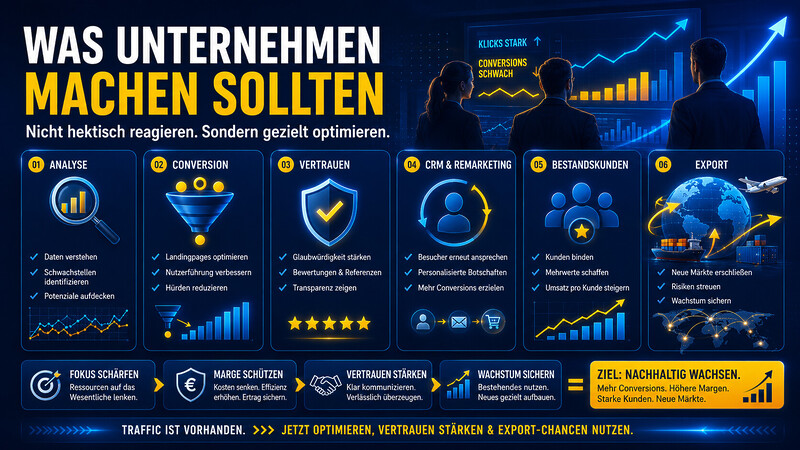
Companies should not react panickedly in this situation, but also not remain passive.
First, it is important to clearly distinguish between a traffic problem and a conversion problem. If clicks, impressions, and relevant search queries are still present, but conversions are declining, the problem is often not visibility, but rather trust, timing, price perception, or decision certainty.
Second, offers and landing pages should be more strongly focused on benefits, utility, and security. In cautious markets, users need clear reasons why they should act now: transparent prices, real contacts, references, reviews, delivery times, guarantees, consultation, and understandable benefit arguments.
Third, follow-up gains importance. Those who do not buy or inquire today may become relevant again in two weeks. Remarketing, newsletters, offer follow-ups, CRM processes, and trust-building content are more important in such market phases than in boom phases. In online marketing, remarketing is the strongest lever when purchasing decisions are weak.
Fourth, companies should not blindly cut budgets. If demand is only shifted, an excessive reduction in visibility can cause long-term damage. It is more sensible to concentrate budgets more strongly on purchase-oriented search intentions, profitable products, qualified leads, and existing customer potential.
And export to other EU countries or even worldwide has been the most effective strategy since Covid!

Florian Ibe
CEO & Marketing Consultant
Your contact person: Florian Ibe
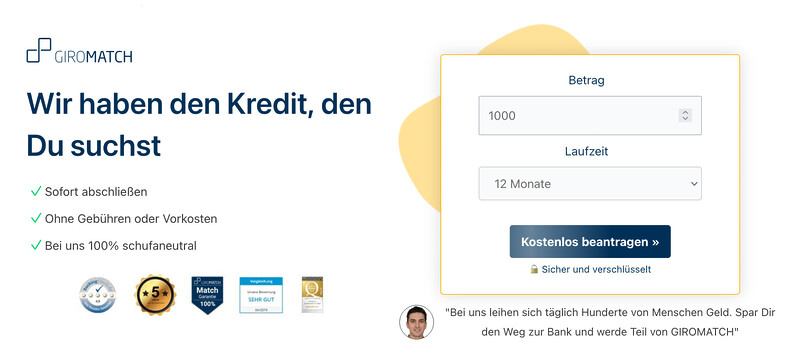
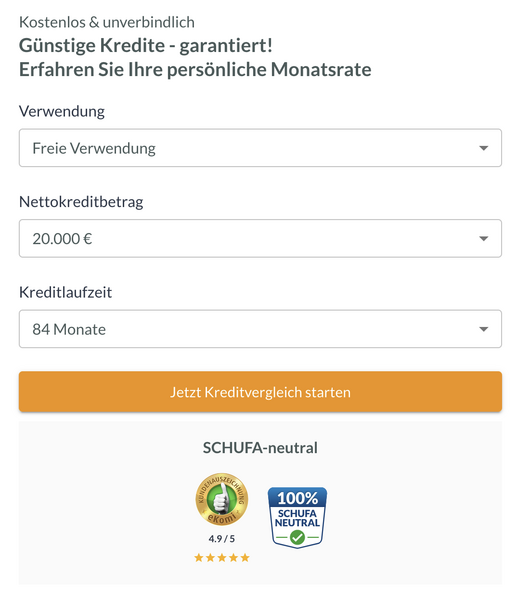
A growth market like never before – see also USA: Credit cards, loans, and credits
Tip for an ebook:
 💰Bank List: Without & Despite SCHUFA
20+ banks with conditions and credit criteria
Outlook 2027 for the DACH Region
From today’s perspective, no explosive recovery is expected for 2027, but a cautious normalization is possible.
According to SECO, Switzerland expects growth of 1.7% in 2027, after below-average growth of 1.0% in 2026. (seco.admin.ch)
For Germany, the OECD expects an acceleration to 1.5% growth in 2027, after 1.0% in 2026. At the same time, trade uncertainty, investment reluctance, and structural competitiveness issues remain significant risks. (OECD)
For Austria, WIFO/IHS forecasts also show a cautious outlook for 2026 and 2027. The IHS expects growth of 0.8% in 2027 for Austria after weaker growth in 2026, while inflation and the labor market continue to be burdensome factors. (ihs.ac.at)
For businesses, this means: 2027 may be better than 2026, but probably not automatically easy. Those who simply wait now will lose time. Those who, on the other hand, improve their margin structure, offer communication, conversion processes, customer retention, and content strategy can benefit more from a later recovery.
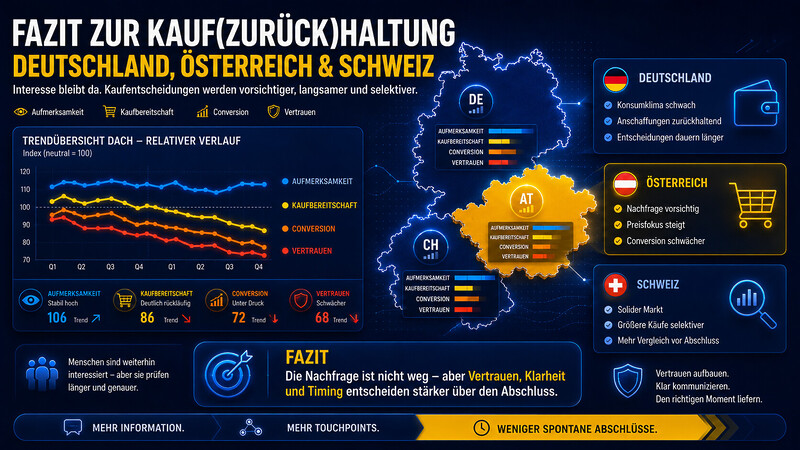
Conclusion on purchasing (restraint) behavior in Germany, Austria & Switzerland
May 2026 was not a normal month for many companies in the DACH region. Our aggregated performance data exemplarily shows what public statistics also suggest: the market situation is cautious, consumer sentiment is low, and the willingness to close deals is weaker.
Google Ads, Meta, Instagram, Facebook, TikTok, and YouTube are not the cause, but rather measurement and activation channels. They make visible what many companies are currently feeling: people continue to inform themselves, but they buy, book, and inquire less directly.
The combination of low consumer confidence, weak propensity to purchase, restrained investments, price and cost pressure, Pentecost, long weekend, and summer weather further burdened the market situation in May 2026.
For companies, this means: do not optimize hectically, but analyze thoroughly. Those who understand why users hesitate can specifically improve communication, offers, trust, and sales processes – and are better prepared when demand picks up again.5 Questions and Answers on the Current Market Situation
1. Should companies lower their prices when demand is weak?
Not automatically. Price reductions can generate sales in the short term, but quickly damage margins. In a cautious market situation, often the price alone is not the problem, but a lack of security. It is better to first check: Are benefits, warranty, delivery time, references, advice, and payment options communicated clearly enough? Discounts should be used strategically, not as a standard reaction.
2. What does the current situation mean for margins?
Margins are under double pressure: on the one hand, advertising and acquisition costs are rising, and on the other hand, customers are becoming more price-sensitive. Companies should therefore not only look at revenue, but also at contribution margin, return rate, lead quality, closing probability, and repurchase rate. More revenue is not automatically better if it is bought with too low a margin.
3. Has buyer behavior really changed?
Yes, at least in the current phase, it seems more cautious. Many users continue to research, compare more intensely, add products to their shopping carts, but abandon them more frequently or postpone decisions. In the B2B sector, inquiries are scrutinized longer, budgets are questioned more often, and decisions are more strongly coordinated internally. This is not a complete loss of demand, but rather an extension of the decision-making process.
4. Which revenue data should companies particularly monitor now?
Not only total revenue and ROAS are important. Crucial are conversion rate, shopping cart abandonment, average order value, contribution margin, share of returning customers, lead-to-sale rate, offer acceptance rate, and time to close. Especially with lead models, the pure number of leads is not very meaningful if the quality simultaneously deteriorates.
5. What goals are realistic in such a market situation?
Realistic goals include stabilizing profitable demand, improving the conversion rate, reducing unnecessary wastage, better lead quality, stronger existing customer activation, and a higher closing rate in follow-up. In weak market phases, companies should not only force growth but also make their sales and marketing structure more robust.
Note on the general GDP of DACH countries
The gross domestic product shows the general economic development of a country, but not automatically the specific revenue situation of individual companies. Germany, Austria, and Switzerland may experience slight economic growth, while individual industries, shops, or service providers may still experience weak months. This is precisely why GDP should always only be understood as a macroeconomic context – not as a direct explanation for every single revenue or performance development.
Disclaimer: This article is based on exemplary aggregated practical data from our own administration account as well as publicly available economic, consumer, and platform data. The internal data is not official statistics and not representative of the overall market. It serves as a practical indicator for observed developments in various industries, business models, e-commerce sales, and lead goals. Causal relationships – for example, between weather, holidays, consumer sentiment, and conversion rates – cannot be conclusively proven from this, but can be plausibly classified as market context.




 DE
DE