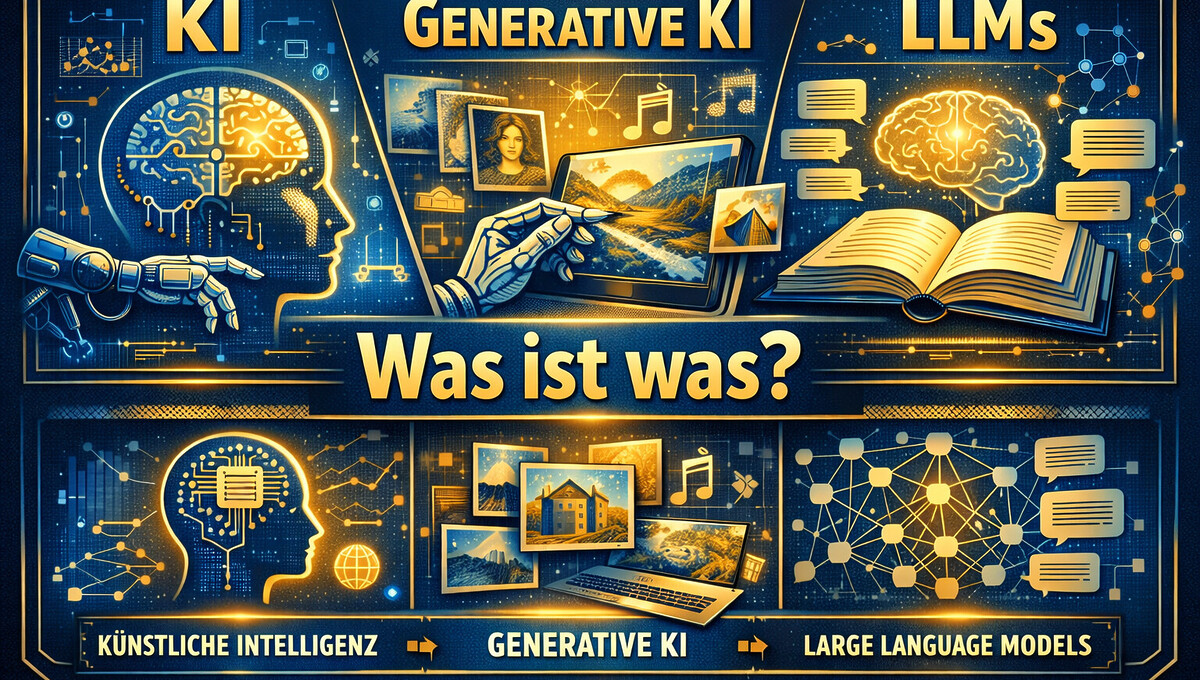
Artificial Intelligence (AI) is the umbrella term for technologies that enable machines to exhibit intelligent behavior – from simple decision trees to advanced algorithms. A specialized form of this is Generative AI, which is capable of creating entirely new content such as texts, images, or music. Large Language Models (LLMs) such as ChatGPT form a special subcategory of Generative AI and are trained to understand and generate language.
These levels build on each other! Every LLM is GenAI, every GenAI is AI – but not every AI can generate, and not every generative AI is an LLM. In the article you will find practical examples, helpful tool tips (including ChatHub*) as well as comparison tables that will help you use the terms correctly in everyday life. A future outlook also shows why the importance of these technologies will increase rapidly by 2030 – you should know the differences both privately and professionally. AI, Generative AI & LLMs: The 3 levels of modern AI.
AI, Generative AI & LLMs: The 3 levels of modern AI
Artificial Intelligence (AI)
Umbrella term for machine intelligence. Encompasses all systems that simulate human intelligence – from simple rules to complex machine learning.
Generative AI (GenAI)
Generates new content such as texts, images, code, or music. Uses generative models to create creative outputs based on learned patterns.
Large Language Models (LLMs)
Language models such as ChatGPT or Claude. Prediction machines that generate the most probable word sequence based on billions of text data.
You constantly hear terms like AI, Generative AI and LLMs, and often they are confused with one another. ChatGPT, Gemini, Copilot – these names appear everywhere. But what is really behind it? It is easy to lose track. This article sheds light on the matter. You will learn what these terms mean, how they relate to each other, and what the exact differences are. In the end, you will understand why ChatGPT is not simply just an AI, but something much more specific. As a AI agency with a focus on generative AI since 2018, we know very well what is possible.
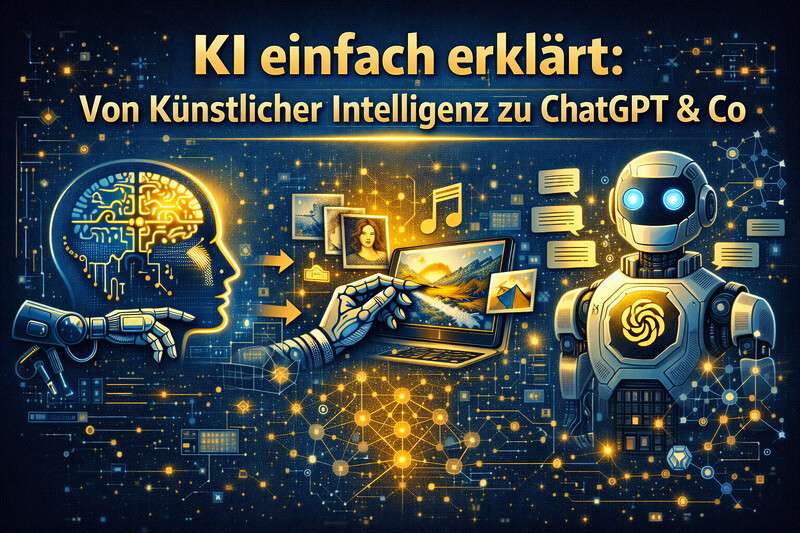
AI explained simply: From Artificial Intelligence to ChatGPT & Co
Artificial Intelligence (AI) is a vast field. Think of it as the umbrella term for all technologies that enable machines to demonstrate human-like intelligence. The goal is to teach computers to perform tasks that normally require human thinking. This includes learning, problem-solving, pattern recognition, and language understanding.
Think of AI like the concept "vehicle." A vehicle can be a bicycle, a car, a bus, or an airplane. All serve the purpose of transportation, but they function very differently and are built for different purposes. The same applies to AI. An AI that plays chess is different from one that filters spam emails or recognizes faces in photos.
Modern tools such as ChatGPT, Gemini and Copilot (AI Companion) are concrete applications based on specific AI technologies. They are, so to speak, the "sports cars" among vehicles – highly specialized and powerful. They impressively demonstrate what is possible today, but are only a small excerpt from the entire world of Artificial Intelligence.
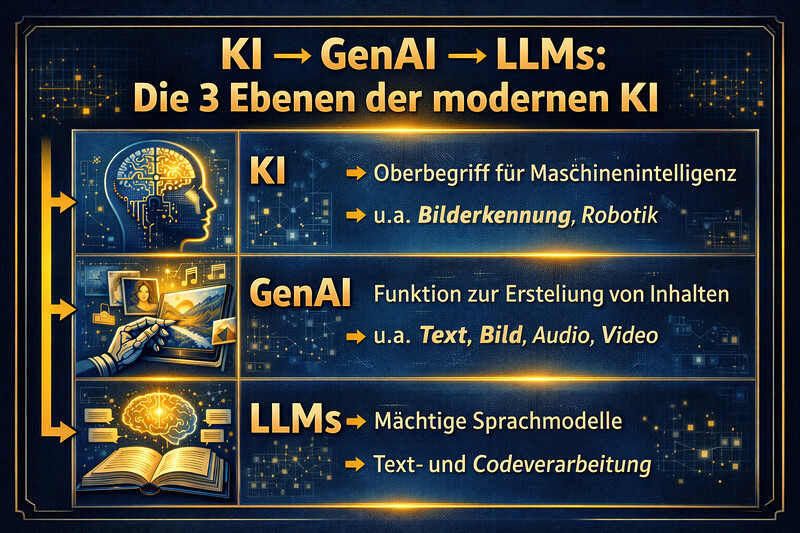
AI → GenAI → LLMs: The 3 Levels of Modern AI
To understand current developments, it helps to divide modern AI into three levels. Think of them like Russian nesting dolls: each level is part of the next larger one.
1. Level: Artificial Intelligence (AI)
This is the outermost, largest doll. As already mentioned, AI is the broad field that encompasses every form of machine intelligence. This also includes "classical" AI systems that do not necessarily create new content. A navigation system that calculates the fastest route, or an algorithm that predicts stock prices, are examples of AI. These systems often work according to fixed rules or recognize patterns in existing data.
How do AI systems work?
Classical AI is often based on algorithms, fixed rules, and predefined decision trees. It typically uses structured data, analyzes it according to specific patterns, and arrives at a result – for example, a recommendation or a prediction. A spam filter, for instance, recognizes whether an email is unwanted based on keywords and patterns.
Application examples for AI:
- Navigation apps like Google Maps that suggest the best route for you
- Spam filter in your email inbox
- Credit assessments at banks
- Facial recognition to unlock your smartphone
2. Level: Generative AI (GenAI)
Within the large AI doll is Generative AI. This is a subset of AI that specializes in creating new, original content. Instead of just analyzing data or recognizing patterns, GenAI produces something that did not exist before. This can be texts, images, music, code, or even videos. It learns from vast amounts of data and uses this knowledge to generate new things in a creative way. Tools that paint an image from a text description are a perfect example of Generative AI.
How do generative AI models work?
Generative AI mostly uses neural networks, especially so-called Generative Adversarial Networks (GANs) or Transformer architectures. They are trained on large datasets and learn regularities, structures, and features of existing content in the process. Afterward, they are able to generate completely new results that resemble the training material – for example, a new image, a piece of music, or a text.
Use cases for Generative AI:
- Image generators like DALL·E or Midjourney that create images from text descriptions
- Music generators that compose melodies or entire songs
- Code generators that write program code based on a task description
- AI that synthetically generates videos
3rd Level: Large Language Models (LLMs)
The smallest doll in our set is the Large Language Model (LLM), in English "large language model". LLMs are a special type of Generative AI. Their area of expertise is language. They are trained with gigantic amounts of text from the internet, books, and other sources. Through this, they learn the nuances, the grammar, the context and even the style of human language. Their main task is to understand and generate language. ChatGPT, Gemini and similar models are LLMs. They are the technological foundation for the chatbots that you can chat with.
How do Large Language Models work?
LLMs are based on so-called Transformer networks. When generating text, they analyze vast amounts of words and their relationships. During training, they learn which words and phrases typically follow one another. When you ask a question or enter text, the model calculates which is probably the most sensible next word – and this is how a coherent, understandable text gradually emerges. Thanks to their size (sometimes billions of parameters), LLMs are remarkably good at recognizing context and translating complex tasks linguistically.
How do LLMs work?
The Librarian
Attention mechanism: Searches all shelves simultaneously, recognizes connections.
Generate
Output
An LLM is not a database. It is more like a librarian who has learned from billions of pages read how language is structured. When needed, she looks up information in the archive using RAG/tools to remain factually accurate.
Application examples for LLMs:
- Chatbots such as ChatGPT, Gemini or Copilot to answer questions or compose texts
- Automated email responses and text summaries
- Translation services from LLMs that transfer comprehensible texts into different languages
- Text generation for social media posts, blog articles, or creative stories
In summary: Every LLM is a form of Generative AI, and every Generative AI is a form of Artificial Intelligence. But not every AI is generative, and not every Generative AI is a language model.
Now it gets interesting. When someone says: "ChatGPT is an AI", that is technically not wrong, but extremely imprecise. It is as if you were pointing to a Porsche 911 and saying: "That is a vehicle." Yes, that is correct, but it leaves out all the important details that make it special.
ChatGPT is much more than just a general AI. It is a concrete application based on a Large Language Model (LLM). This LLM in turn is a form of Generative AI (GenAI).
The statement is therefore incomplete because:
- You overlook the ability to generate:ChatGPT does not just analyze data. Its core competency is to generate new texts. It writes emails, composes poetry, summarizes articles, and answers your questions in fluent prose. This is an ability that many other AI systems do not have.
- You overlook the specialization in language:ChatGPT is an expert in language. It was specifically trained to understand and imitate human communication. An AI for facial recognition or for controlling a robot has completely different capabilities.
The more accurate description would therefore be: ChatGPT is an application that uses a Large Language Model (a specialized form of Generative AI) to conduct human-like conversations and create texts. While this is a long sentence, it precisely describes what the technology does. So the next time you hear someone speak of "AI" when they mean ChatGPT, you will know better.
Comparison matrix: AI vs. Generative AI vs. LLM
This table summarizes the most important differences clearly for you:
| Criterion | Artificial Intelligence (AI) | Generative AI (GenAI) | Large Language Model (LLM) |
|---|---|---|---|
| Definition | Umbrella term for all technologies that enable machines to exhibit intelligent behavior. | A branch of AI that creates new, original content. | Specialized GenAI trained to understand and generate human language. |
| Main Task | Solve problems, recognize patterns, make decisions, automate processes. | Generate content (text, image, audio, code, etc.). | Understand text, summarize, translate, and create new text. |
| Output | A prediction, a classification, an action (e.g., calculate route). | New content that did not previously exist (e.g., an image, a poem). | Naturally sounding text (e.g. a response, an email). |
| Example | Spam filter, navigation system, chess computer, recommendation algorithm. | Image generators (e.g. Midjourney), music composition tools. | ChatGPT, Google Gemini, Claude. |
| Analogy | The concept "vehicle" | The vehicle type "car" | The specific model "electric sedan" |
Top 10 Tools for AI, Generative AI & LLMs
Here you will find an overview of the currently most popular tools in the field of artificial intelligence, generative AI and large language models – including brief descriptions:
- ChatGPT
The most well-known LLM from OpenAI, with which you can generate texts, answer questions, or automate tasks. - Google Gemini
Google's multimodal LLM that understands and processes text, images, and code – ideal for creative and analytical applications. - Microsoft Copilot
An AI assistant integrated into Microsoft products such as Office for creating texts, presentations, and more. - Tip: ChatHub*
An AI tool for chatting with multiple LLMs simultaneously – perfect if you want to compare or combine different models. - Claude
The advanced language model from Anthropic, known for high-level dialogue and strong content generation. - Midjourney
A generative AI tool that is particularly used for impressive image generation from text descriptions. - DALL·E
OpenAI's AI model for creative generation of new images through text input. - Jasper
A powerful AI assistant for marketing, blog articles, and content creation at the push of a button. - Synthesia*
Generates AI-powered realistic-looking videos from written text – useful for tutorials and explainer videos.
Alternative: Colossyan* - Perplexity AI
A search and answer tool based on LLMs that answers complex questions at lightning speed and provides sources directly.
Why everyone should use ChatHub:
ChatHub combines all 3 levels of AI with all major LLMs and also offers Generative AI directly based on many models

Test ChatHub now and discover the possibilities of modern AI!
The terms AI, Generative AI and LLM describe different levels of a fascinating technology. Artificial Intelligence is the big picture, Generative AI is the creative creator within it, and Large Language Models are the language artists.
If you understand this difference, you will be able to classify current developments much better. You now know that tools like ChatGPT are not simply "just some AI," but rather the result of highly specialized developments in the field of language processing. With this knowledge, you are well equipped to understand and help shape the exciting future of artificial intelligence.
ChatHub* offers a cost-effective and efficient way to gain a global overview of the world of Artificial Intelligence. The tool combines all three levels – from classical AI through Generative AI to advanced Large Language Models (LLMs) – in a single, easy-to-use platform. This enables ChatHub not only to support versatile use cases, but also to provide better understanding and direct comparison of different AI technologies at an affordable price.
Blog article on ChatHub:
One tool, up to six AIs simultaneously: ChatHub changes the way you work with LLMs & AI chatbots
Practical examples: AI across different industries
| Industry | Practical Examples | Tools/Technologies |
|---|---|---|
| Marketing | Automated advertising copy, personalized email campaigns, audience segmentation, customer behavior prediction, market trend analysis | Jasper, ChatHub, Copilot |
| Industry | Quality control with image recognition, predictive maintenance, production optimization, robotics in manufacturing | IoT sensors, AI analytics |
| E-Commerce | Individual product recommendations, dynamic pricing, AI-powered chatbots, automatic image recognition for product categorization | ChatHub, LLMs, Recommendation Engines |
| Medicine | AI-supported diagnostics (e.g. radiology), intelligent health chatbots, therapy recommendations, data analysis for research | MedGPT, image recognition tools, ChatHub |
| Education | Automated assessment, AI learning platforms, personalized learning paths, interactive teaching materials, translation & accessibility | ChatGPT, Gemini, Synthesia |
The development of Artificial Intelligence will advance rapidly in the coming years. According to a PwC study, AI could generate economic output of up to 15.7 trillion US dollars worldwide by 2030. The share of Generative AI is growing continuously, especially through new applications in the creative sector, in software development, and in customer service. Gartner predicts that by 2026, more than 80% of enterprises will use generative AI in some form.
LLMs will also continue to gain importance: By 2030, experts expect them to be able to generate not only texts but also multimodal content such as images, videos, and audio data at the highest level. Continuous improvement of the models provides greater precision, context understanding, and adaptability to specific industry needs. Sources such as McKinsey and IDC assume that AI-driven productivity in many areas will lead to cost reductions of up to 20% and significant efficiency gains.
Overall, we are therefore facing a future in which AI, generative AI, and LLMs are an integral part of our everyday lives and the economy, and continue to open up new and innovative applications.

Florian Ibe
CEO & Marketing Consultant
Your contact person: Florian Ibe
Test ChatHub now and discover the possibilities of modern AI!
The terms AI, Generative AI and LLM describe different levels of a fascinating technology. Artificial Intelligence is the big picture, Generative AI is the creative creator within it, and Large Language Models are the language artists.
If you understand this difference, you can better classify current developments.
You now know that tools like ChatGPT are not simply "just some AI," but rather the result of highly specialized developments in the field of language processing. With this knowledge, you are well equipped to understand and help shape the exciting future of artificial intelligence.
FAQ on AI, Generative AI & LLMs
1. What is the difference between AI and Generative AI?
AI is the umbrella term for all technologies that enable machines to behave intelligently. Generative AI is a subset of this that can create new, original content.
2. What makes Large Language Models (LLMs) special?
LLMs are specialized generative AIs that focus on language. They understand and generate human-like text.
3. What are Generative AIs used for in everyday life?
Generative AI is used in text, image, music and code creation as well as for creative and supportive tasks, such as writing emails or designing images.
4. Is ChatGPT a typical AI application?
ChatGPT is more than a classical AI. It is based on an LLM and can not only analyze, but also generate new texts – which makes it particularly versatile.
5. Do I need programming skills to work with Generative AI?
No, many AI tools are now user-friendly designed and do not require programming skills. You can typically use chatbots or generators directly via websites or apps.
Important term definitions
- Artificial Intelligence (AI): Umbrella term for systems that demonstrate human-like intelligence.
- Generative AI (GenAI): Subfield of AI that generates new content such as texts, images or music.
- Large Language Model (LLM): Specialized GenAI trained to understand and generate human language.
- Chatbot: Software that automatically communicates with people via text or speech, often based on LLMs.
- Training: The process in which an AI learns from large amounts of data, recognizes patterns, and later performs tasks based on them.




 DE
DE