
Artificial Intelligence (AI) has a reputation for being an energy guzzler. Images of gigantic data centers and rising CO₂ emissions shape the public debate. But is this picture really accurate? In this article, we take a close look at the topic of AI sustainability and environmental protection and compare the energy consumption of AI with common digital applications such as Google Search, social media, and streaming.
We also have a tool recommendation as well as concrete usage advice. At the end, we have also embedded a current video.
How sustainable is AI? A comparison of artificial intelligence sustainability & environmental protection with Google Search, social media & streaming
The topic of „AI sustainability“ is generating discussions worldwide. Images of huge data centers, glowing server racks, and rising emissions dominate the headlines. Critics fear that the boom in artificial intelligence will cause electricity demand to explode and thereby endanger environmental protection.
But this view is only half the truth. For just as AI requires new energy, it can also save energy: through more efficient answers that replace entire search chains or time-consuming research. Instead of ten Google searches, twenty clicks, and several minutes of scrolling, an AI query delivers a consolidated answer in seconds – and that with an energy requirement that is comparable or even lower.
The difference becomes even clearer in comparison with social media or streaming. While one hour of TikTok, Instagram Reels, or Netflix quickly consumes several hundred Wh, an AI response remains in the range of fractions of a Wh. The ratio: a drop in the digital energy ocean.
At the same time, hyperscalers such as Google, Microsoft, and Amazon are investing massively in renewable energies and aiming to operate their data centers completely CO₂-free by 2030 at the latest. This means artificial intelligence is not only becoming more efficient, but can also become a driver of sustainable innovations in the long term.
TL;DR: Artificial intelligence (AI) consumes energy—but a direct comparison with Google searches, social media, and streaming shows: a single AI response is often more energy-efficient than classic internet research. While an hour of TikTok or Netflix consumes dozens of watt-hours, the demand of a response in modern language models is usually in the range of a single Google search. The decisive factors are the electricity mix, the efficiency of data centers, and the question of whether AI actually replaces searches or is used in addition.
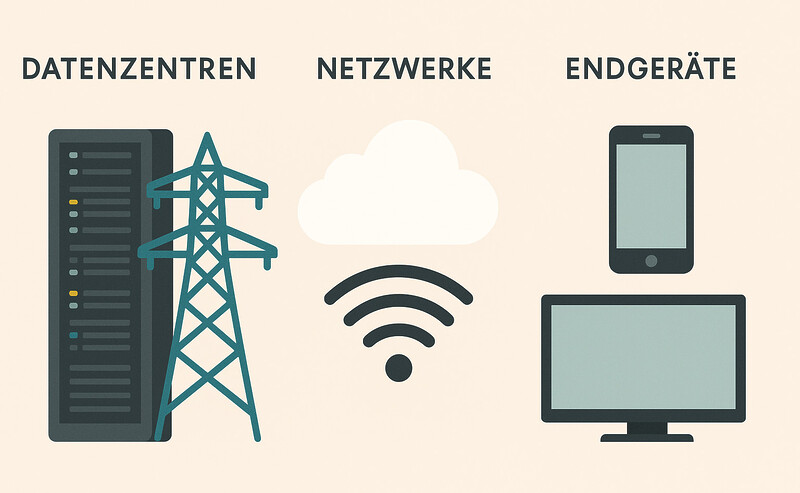
Where does energy consumption arise in the digital world?
Digital services consume electricity in three central places:
Become more visible on Google & Social Media?
In a free strategy consultation for data-driven online marketing, we uncover your untapped potential, review any existing ad accounts if necessary, examine your SEO ranking and visibility, and determine which strategy is appropriate for your budget and which active measures will lead to more inquiries or sales.

✅ More visibility & perception through targeted placement
✅ More visitors > prospects > customers > revenue
✅ Reach target groups scalably with SEA
✅ Act and grow sustainably with SEO
🫵 Maximum success with our hybrid strategy
💪 More than 15 years of experience across industries in over 1,000+ projects demonstrable!







- Data centers: Servers on which AI models, search engines, or streaming platforms run. Modern hyperscalers today achieve extremely low PUE values of 1.1–1.2, while conventional data centers tend to be at 1.5+.
- Networks: Data transmission via mobile networks (~0.14 kWh/GB) is significantly more energy-intensive than via Wi-Fi/fixed-line networks (~0.03 kWh/GB).
- End devices: A smartphone consumes only a few watts per hour when streaming, while a smart TV often consumes 50–150 watts.
AI in Focus: How Much Energy Does One Answer Consume?
When considering the energy demand of AI, one must distinguish between trainingandusage (inference). Training a large model can consume several thousand MWh, but this is spread across billions of requests. What matters for the user is the consumption per answer:
- Efficient models (2025): ~0.3 Wh per answer
- Typical: ~0.5 Wh per answer
- Inefficient models: up to 3–9 Wh per answer
This means one answer is often similarly energy-intensive as a Google search – and many times more economical than streaming.

Comparison: AI vs. Google Search, Social Media & Streaming
| Application | Energy demand (typical) | Explanation |
|---|---|---|
| Google search | ~0.3 Wh per search | Extremely efficient data centers |
| LLM response | 0.3–0.5 Wh | Comparable to a search |
| Social media reels (1 h) | 50–120 Wh | Data volume + end device dominate |
| Streaming 1080p (1 h) | 120–240 Wh | Depending on network & device |
| Video call (1 h) | 35–80 Wh | Camera, upload & display additionally |
Note on dispersion: Values fluctuate depending on the network (mobile vs. WLAN), end device (smart TV vs. phone), data center efficiency (PUE), and model size. Hyperscalers often have a PUE of ≈ 1.1–1.2 (very efficient), while classic data centers are more around ~1.5–1.6. Lower PUE ⇒ less „overhead power“ for cooling, etc.
Practical example: 300 AI questions vs. 1 hour of Instagram per day
A practical comparison shows the dimensions:
- 300 AI answers per month: 0.09–0.15 kWh (efficient/typical) or 1.5 kWh (inefficient)
- 1 hour of Instagram Reels per day: 1.5–3.6 kWh per month
👉 Even in the inefficient scenario, AI does not exceed the energy consumption of social media use. With modern models, the difference is orders of magnitude in favor of AI.
Does an LLM answer save energy compared to a search session?
Calculation example (realistic):
Without LLM: 8 searches × 0.3 Wh = 2.4 Wh + ~20 page views (≈ 50 MB total; network+DC ≈ 0.06 kWh/GB) → 3 Wh + device (5 min) ≈ 0.3 Wh ⇒ ~5.7 Wh.
With LLM (efficient): 1 answer ≈ 0.3 Wh + minimal transfer + reading ≈ ~0.4–0.5 Wh.
Result: ~90% less (5.7 Wh → 0.5 Wh) if the LLM answer truly replaces research. With inefficient/large models (e.g., ~7 Wh/answer), the balance would be worse than a manual search.
Emissions: The electricity mix is decisive
CO₂ emissions depend heavily on the electricity mix:
- 50 g/kWh (renewable): 0.0075 kg CO₂e (300 AI questions) vs. 0.12 kg (Reels 1 h/day)
- 250 g/kWh (EU mix): 0.0375 kg (AI) vs. 0.60 kg (Reels)
- 400 g/kWh (fossil): 0.0600 kg (AI) vs. 0.96 kg (Reels)
Clear difference: Social media causes significantly more emissions than AI questions – with an identical electricity mix.
What most influences the energy balance
Network path: Mobile (radio) ≈ 0.14 kWh/GB vs. fixed network/WLAN ≈ 0.03 kWh/GB; reducing data volume & using WLAN helps.
PUE & Location: Hyperscaler data centers (PUE ~1.1–1.2) are significantly more efficient than many traditional data centers (~1.5+).
Model Selection: Smaller/specialized models (RAG, Distillation) drastically reduce Wh/response.
Device: Smart TV ≫ Smartphone in terms of power consumption; this explains why streaming CO₂ often depends more on the end device than on the data center.
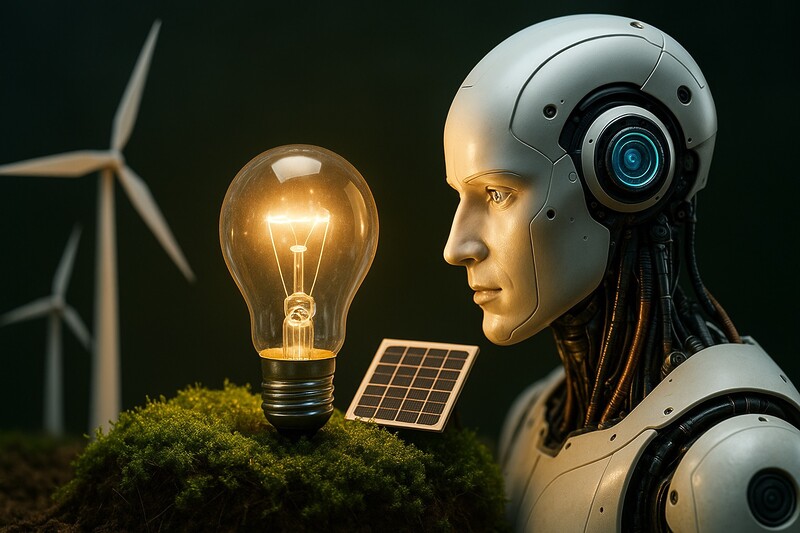
Artificial Intelligence Sustainability & Environmental Protection: What are the big players doing?
Hyperscalers are investing heavily in renewable energies:
- Google: Goal: 24/7 Carbon-Free Energy by 2030; in 2023, the global average was 64%.
- Microsoft: aims to cover every kilowatt-hour with CO₂-free energy at all times by 2030.
- Amazon (AWS): already 100% renewable in terms of balance (annual matching 2023).
These developments show that Artificial Intelligence Environmental ProtectionandAI Sustainability are not opposites, but increasingly go hand in hand.
- 2022–2023: The global average share of Carbon-Free Energy (CFE) remained stable at 64% – measured over the year, but not covered hourly.
- 2024: The total electricity demand for data centers increased by 27%, while emissions simultaneously decreased by 17%. This indicates improved energy efficiency and a higher share of carbon-free energy, but specific CFE percentages for 2024 have not yet been published.
- 2025: Google recorded a 51% increase in CO₂ emissions since 2019, triggered by the growing use of AI. A more precise conclusion about the current CFE share remains open.
For 2024, there are no new global CFE figures – the value remains at ≈ 64% (2023). Improvements are likely, but not yet transparently documented.
Microsoft
- Goal: Every kilowatt-hour CO₂-free at all times (24/7 CFE) by 2030 and carbon-negative by then.
- 2024–2025 Progress:
- Microsoft has so far contractually secured over 34 GW of renewable energy in 24 countries.
- Despite an electricity demand growth of 168% (AI-driven), the CO₂ emissions increased „only“ by 23.4% since 2020 – an indication of increased use of CO₂-free energy.
In 2024/25, Microsoft is demonstrating strong steps towards clean energy, particularly through 34 GW projects. However, an exact CFE percentage remains open.
Amazon (AWS)
- 2023: Amazon achieved 100% renewable energy on a net basis, seven years ahead of its 2030 target.
- 2024: The company was once again recognized as the largest corporate purchaser of renewable energy globally and continues to invest heavily.
- Early 2025: Amazon reported over 52 new renewable energy projects in Europe, adding a total of 2.5 GW of additional capacity – globally, the renewable energy capacity totals 9 GW in Europe alone.
Amazon continues to maintain its 100% renewable energy balance (matching) in 2024/25. Expansion continues with new projects and PPAs.
Does AI really save energy?
Yes – if used strategically. A single AI response can often replace multiple search queries and dozens of clicks. This not only saves time but also electricity. If AI is used additionally, the total consumption naturally increases.
Sustainability in everyday life: Tips for users
- Use Wi-Fi instead of mobile data – saves up to 80% network energy.
- Consider device choice: Smartphone ≪ Smart TV.
- Prefer efficient AI models.
- Obtain green electricity or choose providers with 24/7 CFE.
Tool Tip for Efficient and Sustainable Use of Artificial Intelligence
ChatHub* is the multi-chat AI tool for parallel model comparisons and summarization.
Anyone who uses various AI models knows the effort involved in constantly switching between platforms. This is where ChatHub comes in: The browser tool bundles several AI models such as ChatGPT, Claude, or Gemini into one interface. This allows responses to be compared more quickly and the appropriate solution to be used immediately. This not only saves time but also avoids unnecessary multiple queries – a small but effective contribution to greater efficiency and AI sustainability.
💡 Advantages of ChatHub:
- Test up to 6 AI models side-by-side
- Saves time & nerves when selecting models
- Direct answer comparison in real time
- Perfect for prompt optimization
- Instantly see strengths & weaknesses of each model
- Works with ChatGPT, Claude, Gemini, Mistral, Llama & Co.
- No more constant window switching
- Ideal for content creators, developers & researchers
- Clear, minimalist interface
Conclusion on Artificial Intelligence, Sustainability, and Environmental Protection
Artificial intelligence is not the major power guzzler it is often portrayed to be. Per answer, its energy consumption is on par with a Google search – and significantly below social media or streaming. The crucial factors are the electricity mix, model size, and usage patterns. Those who use AI purposefully can save energy and contribute to environmental protection.
- A single LLM response can be energetically comparable to a Google search if modern, efficient models are running (≈ 0.3 Wh per query). Older/larger setups can be significantly higher.
- If an LLM response replaces 5–10 classic web searches + numerous page views, it is often net more economical. However, if the model is very large/inefficient, the balance can tip.
- Social media scrolling (many short videos) and video streaming consume orders of magnitude more per hour than individual LLM or search queries – the main driver here is data transfer + end device, not data centers alone.
- Renewable energy shares: Hyperscalers currently match a lot of electricity with renewables (annually), but 24/7 coverage is not yet universal. Google was at ≈ 64% 24/7 CFE on average in 2023; Microsoft aims for 100/100/0 by 2030; Amazon reports 100% renewable matched in 2023 (annual balance). In 2025, it will remain 100%.
FAQ Questions and Answers
Does ChatGPT consume a lot of electricity?
No, one answer is roughly on par with a Google search (~0.3–0.5 Wh).
Is AI more sustainable than a Google search?
If an AI answer replaces multiple searches, it is more efficient.
Which digital service consumes the most energy?
Streaming and social media dominate private digital power consumption.
Where does the power for AI come from?
Google, Microsoft, and AWS are increasingly relying on renewable energies, but are not yet 24/7 CO₂-free everywhere.





 DE
DE