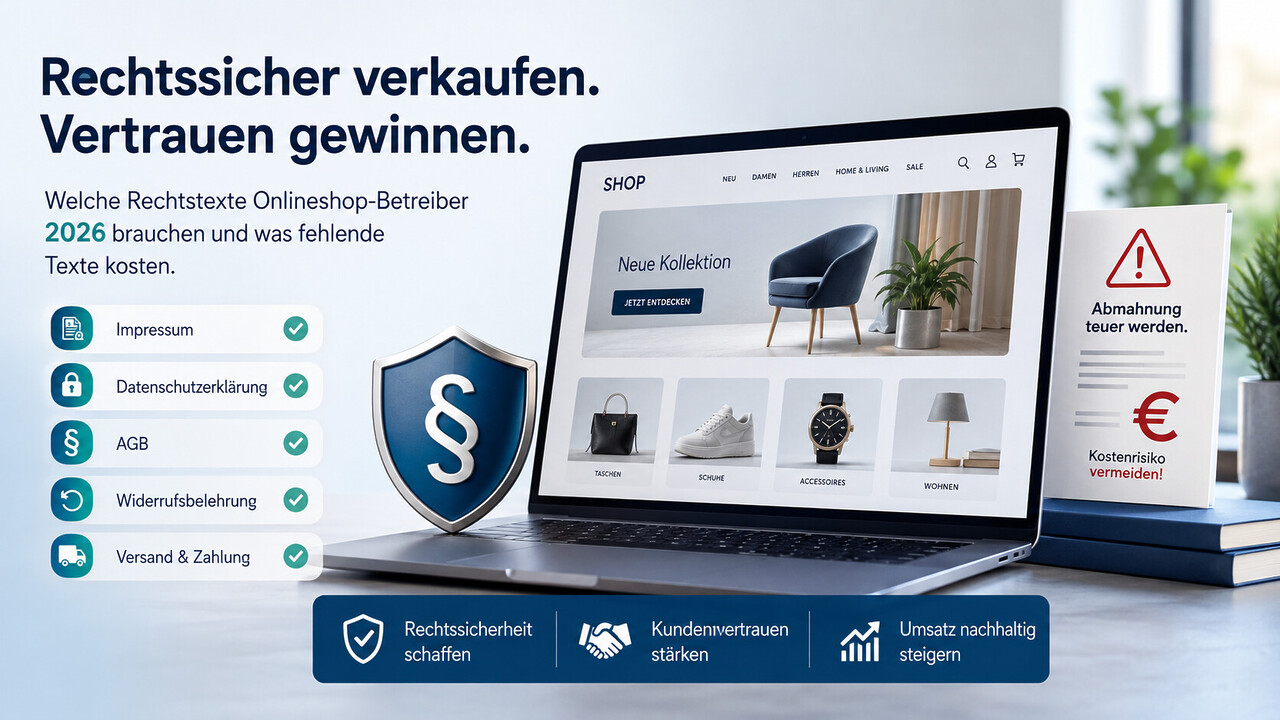
A tool for all areas of compliance. Specifically, it concerns legal solutions to make websites, shops, and apps compliant with laws in various countries and legislations. The settings, managed with an easy-to-use generator, are centrally administered in ONE place (a clear dashboard) for all documents, consents, and rejections for both internal and external communication.
Compliance from a single source 🛡 External & internal data protection, cookie banners, T&Cs with iubenda
Iubenda is the solution for sole proprietors/freelancers, corporate websites, and e-commerce, up to globally operating corporations. More than 90,000 customers in over 100 countries already trust this solution.
👉 Directly to the solution: https://bit.ly/iubenda-compliance*
✅ Generator for Privacy and Cookie Policies (creation of privacy policy and cookie policies)
✅ Cookie Solution (management of consent settings for ePrivacy, GDPR, and CCPA. Integrated with the IAB TCF and the CCPA Compliance Framework.)
✅ T&C Generator
✅ Consent Solution (Cookie Banner for collecting GDPR and LGPD consents + documentation of opt-ins and CCPA opt-outs)
✅ Internal Privacy Management (documentation of all data processing activities within the company)
📌 What does compliance mean? Compliance is the business and legal term for the adherence of companies to rules, i.e., the observance of laws, guidelines, and voluntary codes. (Source: Wikipedia)
👉 Test & Implement Now:
Become more visible on Google & Social Media?
In a free strategy consultation for data-driven online marketing, we uncover your untapped potential, review any existing ad accounts if necessary, examine your SEO ranking and visibility, and determine which strategy is appropriate for your budget and which active measures will lead to more inquiries or sales.

✅ More visibility & perception through targeted placement
✅ More visitors > prospects > customers > revenue
✅ Reach target groups scalably with SEA
✅ Act and grow sustainably with SEO
🫵 Maximum success with our hybrid strategy
💪 More than 15 years of experience across industries in over 1,000+ projects demonstrable!







Step-by-step to full compliance
1. Step – Get your Privacy Policy
You always need a Privacy Policy for your website and/or app, regardless of which law you refer to.
Your Privacy Policy should inform users about how you process personal data.
💡 If you operate a website/app, you are most likely processing user data. Even IP addresses can be considered personal data. You also process user data if you use registration forms or third-party services such as Google Analytics, social media widgets, or login buttons.
💡 Eine Datenschutzrichtlinie sollte… → Was Sie in unseren Datenschutz- und Cookie-Richtliniengenerator eingeben sollten
✔️ Define data processing → Use our Site Scanner and get a list of the services you need to integrate into your document with one click
✔️ Insert law-specific information → Add a cookie policy or specific data protection text (e.g., for the CCPA, the GDPR)
✔️ in the language of your website/app → Select the language(s) for your privacy policy (& cookie policy) from 9 languages
✔️ visible on your website/app → Easily integrate your document into your platform via an embed code, a link, or a plugin
📣 The Privacy and Cookie Policy Generator feature you shouldn’t miss: Our Site Scanner! It scans your website and suggests a configuration option for your privacy policy.
Step 2 – Discover the legal system relevant to you
Beantworten Sie einfach diese zwei Fragen…
- Where is your location?
- Where are your users located?
💡 You must apply the local data protection laws of the country where you are located and the legislation of the country/countries of your users. This means that multiple laws may apply to you if you and your users are from different countries/regions.
My location is in / My users are located in…
- 🇪🇺 EU: GDPR & ePrivacy ("Cookie Directive")
- 🇺🇸 USA: CCPA, COPPA & CalOPPA
- 🇧🇷 Brazil: LGPD
- 🌎 Other countries: General legal regulations & GDPR (recommended)
Step 3 – Define your T&Cs
It is not a requirement of online privacy laws, but it is still the best way to minimize risks and protect your website/app (& e-commerce) from potential liability claims.
💡 Terms and Conditions are essentially a contract between you and your users, establishing legally binding rules on how your products or services can be used. It is therefore a recommended and sometimes obligatory addition for your website/app.
💡 Terms and Conditions should… → What to enter in our T&C Generator
✔️ tailored to your specific case → Choose from over 100 lawyer-drafted clauses (including disclaimers) or customize clauses to your needs
✔️ in the language of your website/app → Select the language(s) for your document from the 9 available languages
✔️ available to users before purchase → Integrate your document into your respective platform using the embed code, a link, or a plugin
Step 4 – Create your Cookie Banner
The Cookie Policy requires you to obtain informed consent from users before storing technically unnecessary, non-consent-requiring cookies (e.g., tracking cookies) on your users‘ devices.
💡 To obtain informed consent for the installation of cookies, you should display a cookie banner when users visit your website/app for the first time. See an example of a cookie banner here.
💡 Ein Cookie-Banner sollte… → Was Sie in unserem Cookie-Solution-Konfigurator eingeben sollten
✔️ Inform users adequately → Link your cookie policy and add legal-specific information (GDPR & CCPA) with just one click
✔️ Legally obtain consent for cookies → Use our helpful tooltips to select your consent collection method
✔️ Implement prior blocking of scripts → Activate the „Prior blocking and asynchronous reactivation“ option and configure this blocking
🔴 Are you a publisher?
iubenda's IAB-certified Cookie Solution supports integration with TCF V2.0 with just one click.
🇺🇸 Are you based in the USA or do you have users from the USA?
iubendas Cookie-Lösung hilft Ihnen, eine CCPA-Datenschutzrichtlinie (auf Englisch) zu erstellen.
Step 5 – Obtain your users' consent for your marketing activities
You must obtain the active consent of your users when they enter their personal data into online forms such as contact forms or newsletter registration forms.
💡 Active consent is essentially the explicit and unambiguous answer of your users to this question:
„Do you, the user, agree that I, the website/app provider, may process the personal data you have just filled in this form for this specific purpose?“
If your users answer this question directly with „Yes“ (e.g., by checking a checkbox), you can, for example, send newsletters and at the same time be sure that you meet the requirements of the GDPR.
Depending on the law(s) you are referring to, requesting user consent requires different approaches:
- GDPR: Users should have the option to explicitly give their consent to receive a newsletter ("Opt-In") by, for example, clicking a checkbox.
- CCPA: Users should have the option to explicitly opt out of a „sale“ of personal data („Opt-Out“) by clicking a „Do Not Sell My Personal Information“ link.
⚠️ GDPR Requirement: You should store consent records (detailed records of how, when, and by whom consent was given), otherwise your users‘ consent will be considered invalid.
Save consent records now with our →
✔️ Activate our Consent Solution easily with just one click and add the JS widget to your website or use our HTTP API.
📣 The Consent Solution feature you shouldn’t miss: The user-friendly dashboard – check your users‘ consent settings at a glance!
Step 6 – Record your data processing activities
💡 Once users have given their consent to the processing of their personal data, you must keep detailed records of what type of personal data you collect and how you store, use and manage this data (requirement of the GDPR & LGPD.
Recording your data processing activities is highly recommended even if neither the GDPR nor the LGPD apply to you, as it is a good way to keep track and maintain appropriate internal data protection practices in relation to your online and offline activities.
- ✔️ Define areas: Perimeters where data processing activities are similar (e.g., your website/app, HR management)
- ✔️ Add a data processing activity to each area from a list of over 1700 pre-built activity fields
- ✔️ Add the required details to each data processing activity (e.g., purpose of processing)
📣 You shouldn’t miss the Internal Privacy Management Feature: It’s so versatile – you can manage multiple projects with a single iubenda account!
Do you need help checking off items from this list for your compliance?
- Generate your Privacy Policy
- Create your Terms and Conditions
- Create your Cookie Banner
- Collect and manage user consent & Record your data processing activities
Important: This video and the iubenda solution never replace individual legal advice from a specialist lawyer and/or data protection officer, but it is a technically sound and very easy-to-use solution for small and large companies.



 DE
DE