Cryptocurrencies are becoming increasingly important, while traditional banks still operate at the pace of the past. Many people want to manage euros and crypto flexibly without placing their money on centralized platforms or constantly switching between apps. This is where a new financial segment is emerging: crypto current accounts with a self-custody focus. Deblock is one of the most exciting providers in this space and promises to unite banking and Web3 in one app. But does the concept deliver on its promise? In our Deblock Test 2025/2026 we take a close look at how good Deblock really is — from security to features to everyday usability.
TL;DR (Executive Summary): Deblock combines a full-featured Euro current account, Visa debit card and a self-custody crypto wallet in a single app similar to crypto.com but better – comparison below. Users retain full control over their digital assets and can deposit and withdraw cryptocurrencies without limits. For anyone who wants to use crypto in everyday life or hold it securely long-term, Deblock is currently one of the best providers in Europe.
Deblock: The future of banking? Why a crypto checking account is changing the financial world
The way we manage our money has changed rapidly in recent years. Traditional banks are no longer sufficient for many people. Those who live digitally professionally and privately want to use euros and cryptocurrencies flexibly, securely, and without borders. This is exactly where Deblock comes in — an innovative provider that combines a current account and crypto wallet in a single app.
But what makes Deblock so special? And is Deblock really the first true crypto bank alternative for the DACH region and all of Europe? I took a closer look.

What is Deblock?
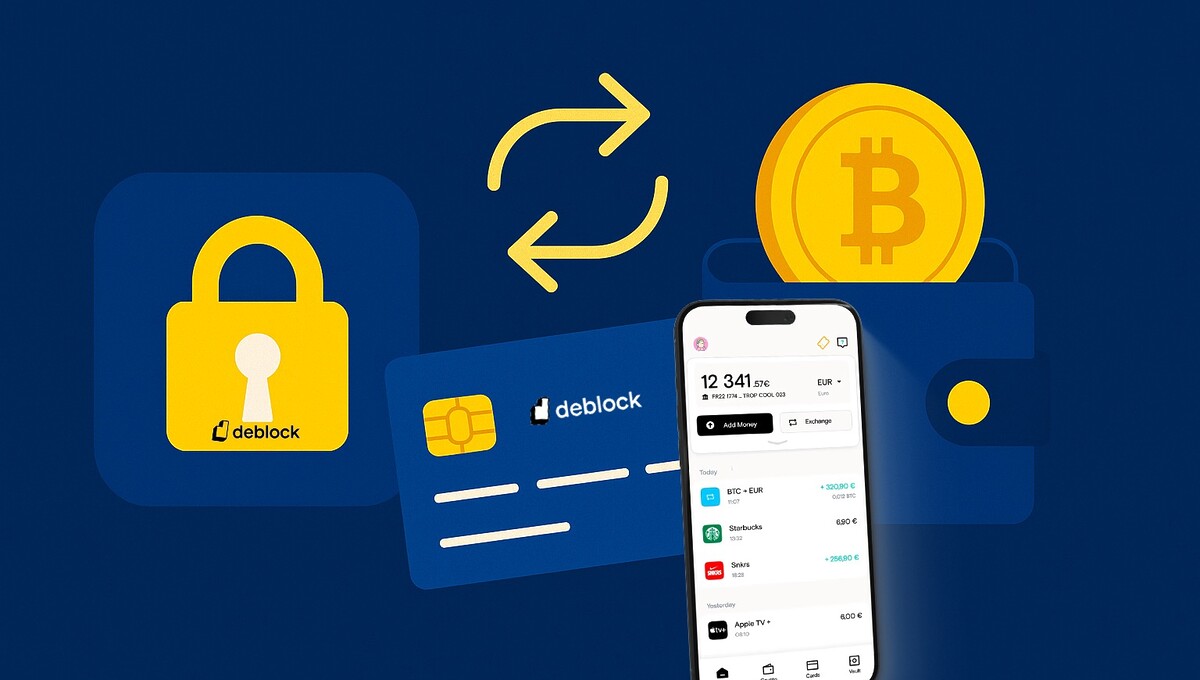
Deblock* is a modern financial platform that combines a full-featured European IBAN account, Visa debit card, self-custody wallet and crypto exchange functions in a single application. You can pay rent, coffee, and Netflix directly and at the same time manage Bitcoin, Ethereum, or other cryptocurrencies — without an additional bank, without an external exchange, without compromises.
What's special: Your cryptocurrencies truly belong to you. Deblock relies on self-custody, which means: You hold the private keys. No bank, no platform has access or can freeze your wallet. Anyone who has heard of locked exchange accounts, withdrawal stops, or exchange risks knows how important this point is.
Everyday life meets Web3 – Deblock in real-life use
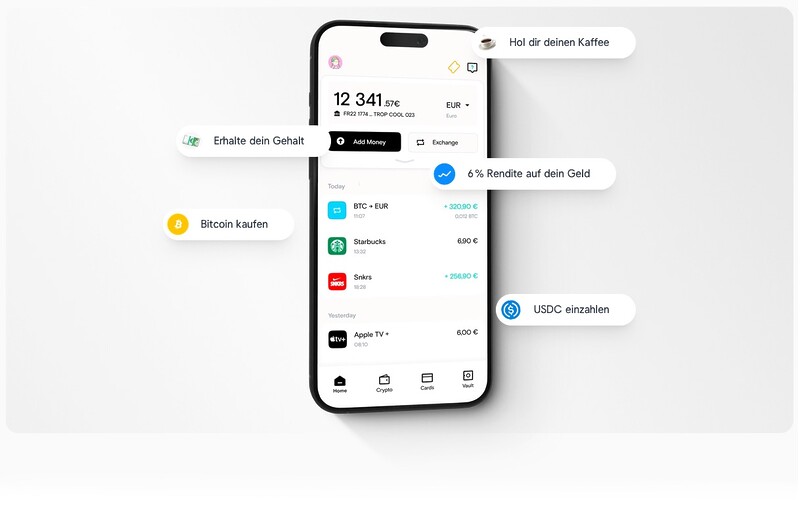
Imagine your salary arrives as usual in your Deblock IBAN account. You leave some in euros to pay your bills. You exchange the rest directly for Bitcoin or USDC to invest long-term — without fees, without limits and without complicated transfers between banks and exchanges.
With Apple Pay or Google Pay, the card is ready to use everywhere immediately. And if you're sitting in a café and the Bitcoin price rises? You can exchange, buy or sell in real time — directly where you are sitting.
Deblock feels like you already have Banking 2025 in your pocket today.
Become more visible on Google & Social Media?
In a free strategy consultation for data-driven online marketing, we uncover your untapped potential, review any existing ad accounts if necessary, examine your SEO ranking and visibility, and determine which strategy is appropriate for your budget and which active measures will lead to more inquiries or sales.

✅ More visibility & perception through targeted placement
✅ More visitors > prospects > customers > revenue
✅ Reach target groups scalably with SEA
✅ Act and grow sustainably with SEO
🫵 Maximum success with our hybrid strategy
💪 More than 15 years of experience across industries in over 1,000+ projects demonstrable!







Why Deblock is better than traditional neobanks
Revolut and Wise have begun to establish multi-currency bank accounts — but their "crypto function" was mostly just speculation, an in-app investment, without real control or on-chain assets.
Deblock, on the other hand, goes all-in on Web3:
Crypto is not "held in custody", but rather you hold the coins yourself. You can deposit and withdraw cryptocurrencies freely, send wallet-to-wallet or convert to euros whenever you wish.
This changes the power dynamics:
Assets controlled by banks ➜ to personal ownership.
That's exactly what makes Deblock a true crypto bank for your smartphone.
The Features in Detail
| Feature | Benefits for the user |
|---|---|
| IBAN Bank Account | Salary, invoices, everyday |
| Visa Debit Card | Pay worldwide, online & offline |
| Apple Pay / Google Pay | Ready to use immediately |
| Real-time SEPA | No Waiting Time |
| Self-Custody Wallet | Full control over cryptocurrencies |
| Crypto Exchange | Trade BTC, ETH & Co. directly |
Advantages
- All finances in just one app
- No custody of cryptocurrencies by third parties
- Unlimited crypto deposits & withdrawals
- Free of charge in the standard model
- Multi-currency support + instant transfers
More security, more freedom: The promise of self-custody
Many people think of self-custody as complicated hardware wallets, recovery sheets and technical risk. Deblock removes this barrier by combining state-of-the-art security with ease of use.
The wallet is fundamentally decentralized, but usage remains as simple as mobile banking.
Once set up, you have full control — and no longer have to rely on the goodwill of centralized platforms.
Fee-free & borderless: Who benefits from Deblock?
Whether Digital Nomad in Dubai, freelancer in Germany or student in Austria — more and more people manage income internationally, pay rent digitally and use crypto as an investment.
For precisely these user groups, Deblock offers a fee-free model, without hidden costs.
No transaction limits, no premium paywalls, no restrictions on crypto deposits or withdrawals.
In short:
Deblock is worthwhile for everyone who wants to live banking modern, flexible and self-determined.
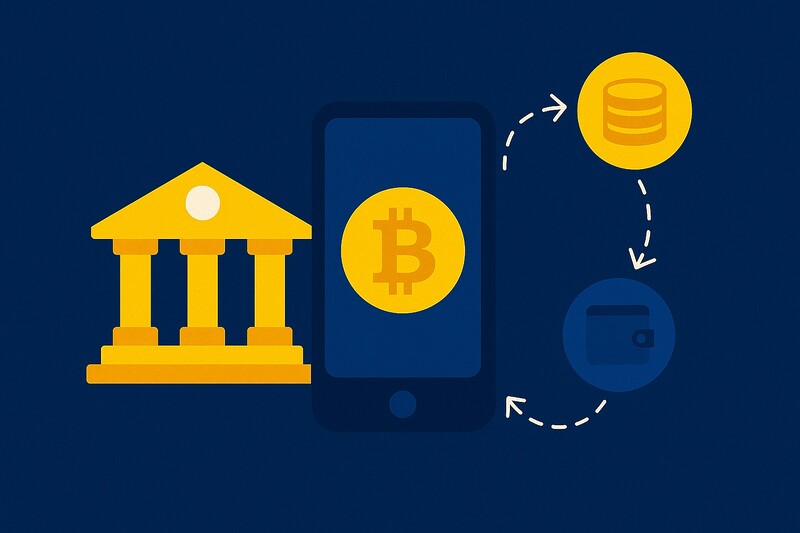
Deblock compared to alternative crypto banks with credit cards
While Revolut is more of an everyday account with crypto investment option and Crypto.com is a crypto ecosystem with card, Deblock combines the best of both worlds:
Euro bank account + real blockchain control.
That is why terms like "Deblock test", "Deblock experiences", "crypto account Europe" or "self-custody bank account" are already ranking more frequently — the trend clearly points toward hybrid finance.
Comparison: Deblock & alternatives at a glance
| Provider / Service | IBAN / Euro Current Account | Crypto Wallet / Crypto Support | Self-Custody possible?¹ | Card (Debit/Prepaid) / Everyday practicality | Typical fees / special features |
|---|---|---|---|---|---|
| Deblock | ✔️ (Euro IBAN + current account functions) | ✔️ (Wallet + Crypto Exchange) | ✔️ – User retains private keys (self-custody) | ✔️ Debit card + IBAN account + card payments/transfers + possibly Apple/Google Pay | Free basic model; crypto deposits/withdrawals unlimited according to provider |
| Bitwala | ✔️ (virtual Euro IBAN via partner bank) (Google Play) | ✔️ Bitcoin & Ether + Euro wallet + trading possible (Google Play) | Partially – wallet control, but often via partner bank/wallet infrastructure (Bitwala Support) | ✔️ Visa debit card, withdrawal via card/ATM possible (Bitwala) | Fees depending on usage, crypto-fiat conversion; IBAN via "virtual" (not a classic bank account) (Bitwala Support) |
| Wirex | ⚠️ No full-fledged traditional current account/IBAN standard (rather wallet + card model / crypto debit card) (Wirex) | ✔️ Supports many cryptocurrencies + stablecoins, wallet + exchange + crypto payments (Wirex) | Rather custody (wallet with provider), not classic self-custody with private keys | ✔️ Debit card for fiat & crypto, usable worldwide, crypto or fiat payment possible (Wirex) | Free with basic version; depending on plan, possibly fees, exchange rates + ATM limits/fees (Wise) |
| Revolut | ✔️ Multi-currency account + IBAN-like services / banking functions (depending on region) (Wikipedia) | ✔️ Crypto function + trading + crypto card possible (Revolut) | ❌ Self-custody typically not available: cryptocurrencies are held by the platform, not as a private-key wallet | ✔️ Debit card / virtual card / prepaid crypto card → Suitable for everyday use, payments with fiat or crypto possible (Revolut) | Basic version free, but crypto card & currency exchange depending on usage/subscription involve fees / limits (Wikipedia) |
Legend / Notes
- Self-Custody = whether users themselves and alone hold private keys and have full control over crypto assets (→ maximum control, hence risk & responsibility).
- At Bitwala: The euro account is based on a virtual IBAN via partner banks, not necessarily a classic full bank with all banking guarantees. (Bitwala Support)
- With Wirex and Revolut: The crypto function should be understood more as a wallet / exchange / payment layer. This means: crypto is often held by the provider (custody), and payments with crypto usually result in conversion to fiat — not necessarily self-custody or true blockchain control. (Revolut)
Comparison Deblock vs. Crypto.com
Deblock: Combines a euro current account with IBAN + card and a crypto wallet — so fiat banking and crypto self-custody in one app. Users have a "normal" account + crypto wallet in one solution.
Crypto.com: Provider with exchange, crypto wallet, prepaid/Visa card — primarily a crypto platform with payment/card functionality. The Crypto.com Visa (prepaid) card can be operated with crypto or fiat.
Advantages / strengths in each scenario
Deblock – good if you …
- … you need both a "regular" euro current account with IBAN and SEPA functions, as well as want to manage cryptocurrencies.
- … you value self-custody — meaning you want to retain control over your private keys and thus your crypto assets (not managed by third parties).
- … banking and crypto wallet in one solution — practical if you regularly switch between fiat and crypto.
Crypto.com – good if you …
- … frequently trade or hold cryptocurrencies, and also make payments or purchases with crypto or crypto-converted fiat currency. Crypto.com offers a wide selection of coins and an established infrastructure.
- … want to use prepaid cards with crypto or fiat top-up — for example to pay indirectly with crypto.
- … you want to benefit from cashback or rewards programs: Crypto.com often offers rewards or cashback on card transactions in the form of crypto or tokens.
Possible disadvantages / limitations
Deblock
- Self-custody also means personal responsibility: private keys etc. are in your hands — if lost, your crypto assets are at risk of being lost.
- It is possible that some features (e.g. international payments, crypto deposits and withdrawals) are regulated or limited — depending on the region.
- Possibly less extensive selection of coins or services compared to major crypto exchanges like Crypto.com.
Crypto.com
- The card is a prepaid card — you can only spend what you have previously loaded. No classic checking account or credit card convenience.
- Fees may apply when loading the card or for certain transactions.
- Crypto holdings often need to be converted to fiat first to pay with the card — this can be disadvantageous depending on market conditions (e.g. exchange rate risk, fees).
- Rewards and benefits often depend on the stake or the chosen plan — meaning not all users always receive maximum benefits.
Which option is suitable for whom – depending on user profile
| User Profile / Needs | Rather Deblock | Rather Crypto.com |
|---|---|---|
| Would like to use a "regular" bank account + crypto in one solution | ✅ Yes | ⚠️ Only with prepaid card and without current account |
| Wants crypto self-custody and control over private keys | ✅ Yes | ⚠️ Often control by platform / conversion required |
| Pays regularly with crypto or wants cashback/rewards | ⚠️ Possible, but possibly limited | ✅ Ideal (Card + Rewards) |
| Frequent crypto transactions, trades, many coins | ⚠️ Possibly restricted | ✅ Large selection, high flexibility |
| Security, stability, classic banking feel important | ✅ With IBAN + Banking functions | ⚠️ Prepaid card, crypto-dependent |
My assessment — depending on use case
- If you want a proper bank account with IBAN and euro account functions but at the same time want to control your crypto assets yourself, Deblock is probably the better solution for you.
- If, on the other hand, you trade frequently with cryptocurrencies, exchange them, or want to pay regularly by card, and can accept a prepaid account + possible conversion fees — then Crypto.com can be worthwhile.
- For someone like you (from Dubai / UAE) who wants to be flexible between fiat and crypto, it is important to check: Which services work there regularly? IBANs, SEPA, crypto transfers, etc. Some offerings may be regionally restricted.
Conclusion from the Comparison
- If you value traditional banking with IBAN + everyday usabilityand at the same time genuine crypto self-custody, only Deblock (or with limitations Bitwala) comes close to this ideal.
- If you prefer convenience, card payments & simple crypto usage without private key responsibility, then Wirex or Revolut can be practical — with the trade-off: less control, more convenience.
- Bitwala can be a compromise — with crypto wallet + euro payment function, but with a virtual IBAN instead of a classic current account.
- Crypto.com is a very good solution with a crypto focus and minor limitations compared to Deblock.
Deblock ratings & experience reports: What users currently praise
- Deblock currently has a score of approximately on Trustpilot 3,9/5 with over 2,300 reviews. (de.trustpilot.com)
- Numerous users are satisfied with the User-friendliness, the clear UI and the simplicity of the app. For example, it says:
"Everything works flawlessly" – one of the 5-star reviews on Trustpilot. (uk.trustpilot.com)
- The combination of bank account + crypto wallet is frequently praised: users appreciate that they can make euro payments with Deblock — but at the same time can manage their cryptocurrencies themselves and exchange them for euros at any time. (Google Play)
- Some highlight that Deblock works in everyday life — the card was accepted, payments ran smoothly, and the system overall seemed solid. (trustpilot.com)
- The transparency of the site regarding audit and security services is also rated positively: for example, ScamAdviser rates Deblock as "most likely legitimate and reliable." (scamadviser.com)
This shows: For many users, Deblock delivers what is promised — banking + crypto in one app with relatively good reliability and convenience.
What users currently report critically / possible weaknesses
- There are several negative reviews — particularly regarding account freezes, delays in withdrawals, or problems after deposits. Some users report that their money became "stuck" after transfer or refunds took a long time. (de.trustpilot.com)
- A frequent criticism concerns lack of transparency in promotions: for example, a referral promotion allegedly promised bonuses — some users claim to have met the conditions but received no payout. This is rated by users as questionable and poorly communicated. (de.trustpilot.com)
- Some users express skepticism about stability in the case of larger amounts: If the system tightens rules or needs to review transfers (e.g., after sale/asset conversion), delays or inquiries apparently occur occasionally — which can be disruptive for larger amounts. (trustpilot.com)
- As with many "hybrid" crypto-fiat providers: despite the self-custody wallet, there remains a certain administrative and risk aspect — users must pay close attention to security, private keys, backups, etc. (even though Deblock itself emphasizes this). This leads some users to uncertainty when coming from traditional banks. (Basics according to provider information) (Deblock)
This shows from looking at reviews: Deblock works well for many — but especially in special situations (account lockdown, large amounts, actions), it is worth proceeding with caution and not depositing large amounts thoughtlessly.
My assessment based on user feedback and current reviews
According to a large number of users, Deblock delivers the everyday experience of a bank account and crypto wallet relatively smoothly: Good app, good basic features, pleasant user experience. This makes it attractive especially for people who want to flexibly combine fiat and cryptocurrencies.
At the same time, the negative reviews show that the service is still young or facing challenges with a growing user base — particularly with regard to transparency and support when problems arise with larger amounts or special cases.
Recommendation: If you use Deblock — ideally start with manageable amounts, store private keys securely, and pay attention to transparency and terms in promotions or deposits. For "classic banking + light crypto" Deblock already seems well-suited. For large sums or long-term investments, I would be more cautious and possibly add additional safeguards.
Conclusion: Deblock is the kind of bank we always wanted
Deblock is not just another banking service, but a true game changer.
Here banking feels right: faster, smarter, safer — and finally aligned with the crypto economy in which so many of us already live.
Deblock is perfect for everyone who:
- want to control your money yourself
- Euro and crypto without limits want to use
- do not want to choose between convenience and true decentralization
For me it is clear:
If a platform sustainably closes the gap between fiat and Web3, then it is Deblock.
FAQ – The 5 most frequently asked questions & answers about Deblock
Is Deblock a full-fledged bank account with IBAN?
Yes. Deblock offers a European IBAN current account with all important features, including SEPA transfers, instant payments, debit card as well as Apple/Google Pay. You can use it just like a traditional bank to receive salary, pay invoices, or transfer money.
Is Deblock a secure solution for cryptocurrencies?
Yes — in fact even safer than classic crypto exchanges, because Deblock relies on self-custody.
You hold the private keys and thus have full control over your digital assets.
No third party can lock, freeze, or lose your coins.
Are there fees at Deblock?
According to the provider, the basic account is free of charge.
Crypto deposits and withdrawals are also possible without limits.
(Only blockchain network fees may apply — this affects every wallet transaction, regardless of the provider.)
Can I pay with cryptocurrencies at Deblock?
Yes — you can convert cryptocurrencies to euros at any time and thus pay with the Visa debit card or Apple/Google Pay anywhere cards are accepted.
This enables genuine everyday banking with crypto flexibility.
Who is Deblock particularly suitable for?
Deblock is ideal for people who want to combine banking and crypto in one app — for example:
- Digital Nomads
- Self-employed & Freelancers
- Tech-savvy Investors
- People with an international lifestyle
- Users who want to maintain true control over their crypto
In short: If you use fiat and Web3 flexibly, Deblock is your account.
Glossary: Important terms around Deblock & crypto banking
Web3
The next generation of the internet, where users can own digital values themselves — thanks to blockchain, tokens, wallets and smart contracts. No centralized platforms as owners of your data and assets.
Blockchain
A decentralized database in which transactions are stored immutably. It replaces central authorities like banks in controlling assets.
Self-Custody
Means: You own the private key to your cryptocurrencies yourself. Only you decide — no one else can freeze, lock or lose it. (→ In contrast to exchanges)
Custody
Here a provider such as an exchange or bank manages your private keys. Simpler, but riskier if the platform encounters problems.
Private Key
A kind of secret password that gives you access to cryptocurrencies. Whoever holds the private key owns the coins – that's why it's extremely important.
Fiat Currency
Government money, e.g. euro, US dollar, issued by central banks. In contrast to digital cryptocurrencies.
IBAN
"International Bank Account Number" – an internationally valid bank account number for SEPA transfers and classic payments in Europe.
Stablecoin
A cryptocurrency that is pegged to a stable currency, for example 1:1 to the US dollar. Example: USDC. Ideal for fast transfers without strong price fluctuations.
On-Chain / Off-Chain
- On-chain = transactions directly on the blockchain (transparent, secure, but sometimes fees)
- Off-chain = stored/settled outside the blockchain (e.g. at exchanges)
Wallet
Digital wallet for cryptocurrencies — can exist as app-based, hardware-based or as a paper wallet.
DeFi (Decentralized Finance)
Financial world without banks: loans, interest, trading — directly via smart contracts.
Crypto exchange (exchange)
Platform for buying/selling cryptocurrencies. With Deblock directly integrated — without additional apps.
Token
Digital assets on a blockchain — can represent a currency, an access, a property right, or a membership (examples: BTC, ETH, NFTs).
Disclaimer and important notice: The information provided in this article regarding Deblock and comparable financial service providers does not constitute financial, investment, legal or tax advice. All content has been researched to the best of our knowledge and is intended solely for general information purposes. Cryptocurrencies and the use of self-custody wallets are associated with significant risks. Prices can fluctuate substantially, and loss of digital assets is possible at any time through improper handling or technical errors. Before opening an account, purchasing cryptocurrencies or conducting financial transactions, we recommend that you conduct thorough independent research and, if necessary, consult with a qualified advisor. No warranty is given for the completeness, timeliness or accuracy of the information provided. Any use of the described services is at your own risk.




 DE
DE