International transfers are an essential part of the global financial system, enabling money to be moved across national borders. These transactions can be for a variety of purposes, from personal transfers between family members to business transactions between companies worldwide. Due to the different currencies, banking systems, and regulations in various countries, processing international transfers can be complex. It is therefore all the more important to familiarize oneself beforehand with the fees for international transfers and how to save money or send money cheaply in euros or other currencies at the best exchange rate.
Saving on international transfer fees + important tips for low costs
When making international transfers, various factors must be considered, including exchange rates, fees, transfer duration, and the banks involved. Especially when transfers are made to countries outside established financial networks such as the SEPA area in Europe, additional challenges such as the involvement of intermediary banks and potentially higher transaction costs can arise.
Understanding the dynamics and fee structure of international transfers is crucial to avoid unexpected costs and ensure that the transferred amount arrives fully and on time at the recipient. In this context, it is important to understand the role of intermediary banks and the associated fees that can arise when transferring to different countries.
The simplest and best solution follows later in the article!
» DIRECTLY TO THE SOLUTION

International Transfer Fee Structure and Explanation of Costs
Various fees may apply to international transfers from Germany to a third country. These depend on several factors:
- Bank fees: Many banks charge fees for international transfers, especially to countries outside the EU. These can be calculated either as a fixed amount or as a percentage of the amount to be transferred.
- Exchange rate fees: If the transfer is made in a currency other than the euro, currency conversion fees may apply. These fees vary depending on the bank and the current exchange rate.
- Recipient bank fees: The recipient’s bank may also charge fees for receiving the transfer. These fees are independent of the sending bank in Germany.
- Intermediary bank fees: For transfers to certain countries or with certain bank connections, intermediary banks may be involved, which may also charge fees.
- SEPA vs. Non-SEPA: Transfers within the SEPA (Single Euro Payments Area) usually incur lower fees than transfers to countries outside the SEPA area.
It is important to note that the exact fees may vary depending on the bank and the specific circumstances of the transfer. It is therefore advisable to inquire about the exact fees with the respective bank before making such a transfer. Some banks also offer online calculators that can be used to estimate the fees for international transfers.
Example of an online calculator from WISE*:


Bank Fees and Costs for International Transfers Explained
Bank fees for international transfers typically consist of several components. These can vary depending on the bank and the destination country of the transfer. Generally, these fees include:
Become more visible on Google & Social Media?
In a free strategy consultation for data-driven online marketing, we uncover your untapped potential, review any existing ad accounts if necessary, examine your SEO ranking and visibility, and determine which strategy is appropriate for your budget and which active measures will lead to more inquiries or sales.

✅ More visibility & perception through targeted placement
✅ More visitors > prospects > customers > revenue
✅ Reach target groups scalably with SEA
✅ Act and grow sustainably with SEO
🫵 Maximum success with our hybrid strategy
💪 More than 15 years of experience across industries in over 1,000+ projects demonstrable!







- Transfer Fees: These are the basic fees a bank charges for processing an international transfer. They can be a fixed amount or a percentage of the amount transferred.
- Exchange Rate Markups: If the transfer is made in a currency different from the sender’s account currency, an exchange rate is usually applied. Banks often do not offer the mid-market rate but a slightly less favorable exchange rate to generate additional revenue. The difference between the market rate and the rate offered by the bank is the exchange rate markup.
- Intermediary Bank Fees: If one or more intermediary banks are required for the transfer, these banks may charge their own fees. These costs can either be deducted from the transferred amount or charged additionally to the sender.
- Recipient Bank Fees: Sometimes, the recipient’s bank also charges fees for receiving international transfers. Whether and to what extent such fees apply depends on the recipient bank and the destination country.
- Additional Service Fees: Some banks charge additional fees for supplementary services, such as expedited transfers or sending notifications about the transfer status.
The exact composition of fees varies depending on the policies of the banks involved and the specific details of the transfer. Customers are therefore advised to inquire about the exact fees for international transfers with their bank in advance. Alternatively, there are also specialized service providers for international transfers that may offer more favorable conditions than traditional banks.

Exchange rate fees and why money transfers for international bank transfers with currency conversion can become really expensive
Special caution is advised here! Exchange rate fees are an important aspect of international financial transactions, especially when transferring money between different currencies. These fees arise because there are usually costs involved when converting from one currency to another. Here are some key aspects of exchange rate fees:
- Exchange Rate: The exchange rate is the price of one currency in relation to another. For international transfers, the sender’s currency must be converted into the recipient’s currency. The exchange rate offered by banks or money transfer service providers often does not correspond to the „mid-market rate“ but includes a markup.
- Exchange Rate Markup: This markup is the difference between the exchange rate that the bank uses for a currency conversion and the actual market rate at the time of the transaction. This markup is a common practice among financial institutions and serves as a form of fee for the currency conversion service.
- Exchange Rate Transparency: Not all banks and money transfer services are transparent regarding their exchange rates and markups. It is therefore important to check before a transfer which exchange rate the respective institution offers and how it compares to the current market rate.
- Exchange Rate Fluctuations: Exchange rates can constantly change due to market fluctuations. This can affect the amount of exchange rate fees, especially for large transactions or for currencies with high volatility.
- Comparing Providers: It can be worthwhile to compare different money transfer services and banks to find the best exchange rate. Some specialized providers might offer more favorable rates or lower fees than traditional banks.
Knowledge of exchange rate fees and a careful comparison of offers from various financial institutions can help minimize costs for international transfers. It is always advisable to obtain comprehensive information before carrying out such a transaction.
A very good alternative for inexpensive international transfers and currency exchange is WISE*.

Worst case – Attention: Fees of the recipient bank and especially if a transfer is made from Euro to, for example, AED (Dirham) and the recipient bank determines the exchange rate
The fees of the recipient bank and the exchange rate determination for transfers from Euro to another currency, such as the United Arab Emirates Dirham (AED), are important factors to consider for international money transfers. Here is some key information on this topic:
- Recipient Bank Fees: For international transfers, the recipient bank may charge fees for receiving the money. These fees vary depending on the bank and country and can be calculated either as a fixed amount or as a percentage of the transferred amount. It is important to note that these fees are in addition to the fees charged by the sending bank.
- Exchange Rate Determination by the Recipient Bank: When a transfer in Euros is sent to a bank abroad, which then converts it into the local currency (in this case, AED), the recipient bank often determines the exchange rate. This exchange rate may differ from the market rate and often includes a markup, which serves as a source of income for the bank.
- Transparency and Comparison of Exchange Rates: Exchange rates and how they are determined are not always transparent. It is therefore advisable to obtain information about the applied exchange rate before making a transfer. Sometimes it is more cost-effective to have the currency conversion done by the sending bank if it offers a better exchange rate or lower fees.
- Possibility of Pre-fixing the Exchange Rate: Some banks and money transfer services offer the option to fix an exchange rate in advance. This can be helpful to avoid exchange rate fluctuations and unexpected costs.
- Impact on the Recipient: The fees and exchange rates can significantly affect the amount of money the recipient ultimately receives. It is therefore important to consider these factors in advance to ensure that the recipient receives the expected amount.
To obtain the best conditions for an international transfer, it is advisable to understand the fee structure of both the sending and receiving banks and to compare the exchange rate policies of both banks. For large amounts or regular transfers, these factors can make a significant financial difference.

Intermediary Bank Fees
Intermediary banks are not specific countries, but rather banks that mediate the processing of an international transfer between the sender’s bank and the recipient’s bank. They are thus part of the transaction process and are not tied to a specific country.
For an international transfer, especially if it is made to countries outside common financial networks such as SEPA (Single Euro Payments Area) in Europe, one or more intermediary banks may be involved. These banks help route the transfer from the sending bank to the receiving bank, particularly if these two banks do not have direct business relationships.
The involvement of intermediary banks can incur additional fees, as each involved bank may charge its own fees for processing the transfer. These fees can either be deducted from the amount transferred or additionally charged to the sender.
The specific country in which an intermediary bank is located depends on the respective international banking connections and the destination country of the transfer. There is no fixed list of countries that are considered intermediary banks, as these vary depending on the transaction and the banks involved. Thus, international transfer fees also vary greatly.
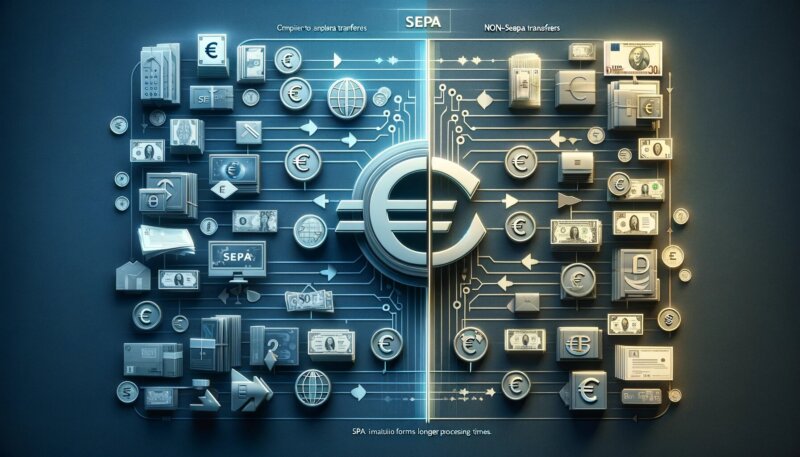
SEPA vs. Non-SEPA – International Transfers
The distinction between SEPA (Single Euro Payments Area) and non-SEPA transfers is essential for understanding international money transfers, particularly in terms of efficiency, costs, and duration of transactions. Here are the main differences and characteristics of these two types of transfers:
- SEPA Transfers:
- Scope: SEPA comprises 36 member countries, including all 27 EU states and other European countries such as Norway, Iceland, and Switzerland. SEPA enables money transfers in euros within this area.
- Currency: SEPA transfers are processed exclusively in euros. This significantly simplifies transactions within the SEPA area, as no currency conversions are required.
- Fees: SEPA transfers are generally more cost-effective than non-SEPA transfers. Many banks even offer SEPA transfers free of charge or levy only minimal fees.
- Processing time: SEPA transfers are usually faster than non-SEPA transfers. In many cases, SEPA transfers are processed within one business day.
- Simplification: SEPA aims to simplify and standardize cross-border payments to increase efficiency and reduce costs for consumers and businesses.
- Non-SEPA Transfers:
- Scope: Non-SEPA transfers refer to international money transfers outside the SEPA area, to countries worldwide.
- Currency: These transfers can be made in various currencies, depending on the destination country. This requires currency conversions, which can entail additional costs and complexity.
- Fees: Fees for non-SEPA transfers are generally higher. They can include various components, such as transfer fees, exchange rate markups, and potentially fees from intermediary and recipient banks.
- Processing Time: Non-SEPA transfers often take more time. The duration can vary depending on the destination country, the banks involved, and their processing times.
- Complexity: Due to different banking systems, regulations, and currencies, non-SEPA transfers can be more complex to process.
In summary, SEPA transfers within Europe and the extended European Economic Area offer a faster, more cost-effective, and standardized method for money transfers in euros. Non-SEPA transfers are required for international transfers outside this area but can be more complicated and costly due to currency conversions, higher fees, and longer processing times.
The most commonly used global banks for international transfers
The most commonly used banks for international transfers can vary depending on the region, country, and specific needs of customers. Some of the most well-known global banks frequently used for international transfers include:
- HSBC: As one of the largest banks in the world, HSBC offers extensive international transfer services, especially for customers with global banking needs.
- JPMorgan Chase: A leading bank in the USA, known for its comprehensive international transfer services, particularly for business clients.
- Citibank: Citibank has a strong presence in various countries and is known for its international money transfer services.
- Deutsche Bank: A leading bank in Germany and Europe, offering a wide range of international banking services.
- Barclays: One of the largest banks in the UK, offering a variety of international transfer services.
- BNP Paribas: A leading bank in the Eurozone, known for its international banking expertise.
- Standard Chartered: Particularly strong in Asia, Africa, and the Middle East, this bank offers comprehensive services for international transfers.
- Santander: One of the largest banks in the Eurozone and particularly active in Spain and Latin America, known for its international transfer services.
In addition to these traditional banks, there are also a number of specialized money transfer services such as Western Union, MoneyGram, and TransferWise (now known as Wise), which often offer lower fees and faster transfer times than traditional banks. These service providers have become popular alternatives for international money transfers due to their user-friendliness, transparency, and cost-efficiency.
The most frequently used German banks for international transfers
With traditional German banks such as DKB, Commerzbank, Postbank, Sparkasse, Comdirect, and Volksbank, it is also possible to make international transfers, although the conditions, fees, and services vary depending on the bank:
- Deutsche Kreditbank (DKB): Known for its online banking offering, DKB provides international transfers. Fees and conditions depend on the type of transfer and the destination country.
- Commerzbank: As one of the largest banks in Germany, Commerzbank offers a wide range of international transfer services. The bank can be particularly attractive for business customers who conduct international transactions.
- Postbank: Part of Deutsche Post, Postbank also offers international transfers. It is particularly popular with customers who value a broad branch network and traditional banking services.
- Sparkasse: The Sparkassen in Germany also offer international transfer services through their extensive branch network. Conditions may vary depending on the Sparkasse, as each Sparkasse is regionally independent.
- Comdirect: As Commerzbank’s online bank, Comdirect offers simple and convenient online international transfers. It is suitable for customers who primarily use online banking.
- Volksbanken and Raiffeisenbanken: These cooperative banks also offer international transfers. Similar to the Sparkassen, conditions may vary depending on the regional bank.
These traditional banks generally offer a secure and reliable option for international transfers, but their fees are often higher compared to specialized money transfer service providers. It is advisable to compare fees and exchange rates before making a transfer and to check whether a specialized provider might be more cost-effective for the specific transfer needs.

Recommendation for cheap, fast and best exchange rate transfers abroad – Wise

Also suitable as a business account for money transfers.
Test Wise Business Account*

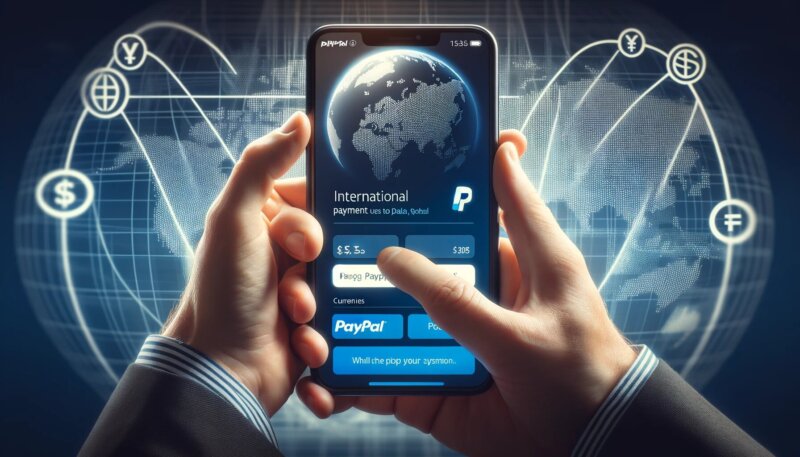
Is PayPal an alternative for international payments?
PayPal is a widely used and popular option for international money transfers and can, under certain circumstances, be a practical alternative to traditional bank transfers. However, it is important to examine the PayPal international fees in detail to assess whether it is actually cheaper for international transfers. Here are some aspects to consider:
- Transfer fees: PayPal charges fees for international money transfers. These can vary depending on the region of origin and destination. There is often a basic fee as well as a percentage of the amount transferred.
- Exchange rate surcharges: One of the main cost factors with PayPal is the exchange rate surcharges. PayPal applies its own exchange rates, which usually include a surcharge on the mid-market rate. This can significantly increase the cost of a transfer in foreign currency.
- Receiving fees: In some cases, the recipient of a PayPal transfer may also have to pay fees, especially if it is a business transaction.
- Speed and Convenience: One advantage of PayPal is the speed of transactions. Transfers are often completed within minutes. In addition, sending and receiving money via PayPal is generally easy and user-friendly.
- Security: PayPal offers a certain degree of buyer protection and security, which is particularly advantageous for online purchases.
- Limits and Restrictions: PayPal has certain transaction limits, which can vary depending on the account’s verification status.
Overall, PayPal can be a good option for smaller amounts or for transactions where speed and convenience are more important than the absolute lowest costs. For larger amounts or regular international transfers, however, specialized money transfer services or traditional banks may offer more favorable conditions. It is always advisable to compare fees and exchange rates in advance.

Conclusion on international transfer fees, alternatives, and cost-effective solutions


 DE
DE