
SEO experts invest millions in structured data – but new studies show: Large Language Models like ChatGPT, Claude, and Gemini cannot process Schema Markup. While the SEO community continues to rely on structured data as a secret weapon for AI Search, practical tests by industry professionals prove the opposite. This article explains why the tokenization process of AI models „destroys“ structured data and which strategies actually work for better visibility in AI search.
Structured Data Does NOT Help with Visibility in LLM and AI Search – What You Need to Know
Structured data transforms ordinary web content into machine-readable formats through standardized markup languages like Schema.org. This technology enables search engines to precisely understand the context and meaning of content:
- E-commerce products with detailed pricing and availability data
- Company profiles with contact information and location data
- Events with precise dates and venues
- Reviews and customer testimonials
Rich Snippets demonstrate the immediate benefits of structured data. Rating stars, price information, or availability status appear prominently in search results and measurably increase the click-through rate. SEO professionals therefore consider Schema Markup a fundamental optimization tool.
Traditional search engines reliably interpret this markup information and reward correct implementations with improved visibility. This proven success fueled the expectation that AI-based search systems would also preferentially process structured data.
The video:
The Myth: Structured Data as a Key to AI Search Success
Industry experts propagate structured data as a success factor for AI-powered search systems. This widespread belief is based on the intuitive assumption that machine-readable data formats must also be optimal for Large Language Models. Schema Markup appears as an ideal interface between human comprehensibility and machine efficiency.
Marketing agencies and SEO tools continuously reinforce this message:
- Extensive Schema Implementations for all content types
- Specialized Consulting Services for AI Search Optimization
- Premium Tools for automated markup generation
- Certification Programs for structured data
The alluring vision: AI systems would prioritize structured information and use it more frequently in generated responses. This hope motivates companies to make significant investments in complex schema strategies to gain supposed competitive advantages.

The Reality: How Large Language Models Process Web Content
Large Language Models work through a fundamental process called tokenization. Text content is broken down into the smallest semantic units, which function as tokens. Each token receives a unique numerical representation for the model’s mathematical calculations.
Become more visible on Google & Social Media?
In a free strategy consultation for data-driven online marketing, we uncover your untapped potential, review any existing ad accounts if necessary, examine your SEO ranking and visibility, and determine which strategy is appropriate for your budget and which active measures will lead to more inquiries or sales.

✅ More visibility & perception through targeted placement
✅ More visitors > prospects > customers > revenue
✅ Reach target groups scalably with SEA
✅ Act and grow sustainably with SEO
🫵 Maximum success with our hybrid strategy
💪 More than 15 years of experience across industries in over 1,000+ projects demonstrable!







| Processing step | Conventional text | Structured data |
|---|---|---|
| Input | „Our company“ | „@type“: „Organization“ |
| Tokenization | [„Our“, „company“] | [„@“, „type“, „:“, „Organization“] |
| Result | Context preserved | Structure dissolved |
Schema markup is systematically fragmented during tokenization. Attributes such as „@type“: „Organization“ break down into isolated components: „@“, „type“, and „Organization“. The model can no longer interpret these fragments as coherent structured information.
The original semantic architecture dissolves completely. Special characters such as „@“ are treated as ordinary tokens, without preserving their specific function as markup indicators. For the trained model, schema tokens do not differ from regular words in running text.
A screenshot of a test:
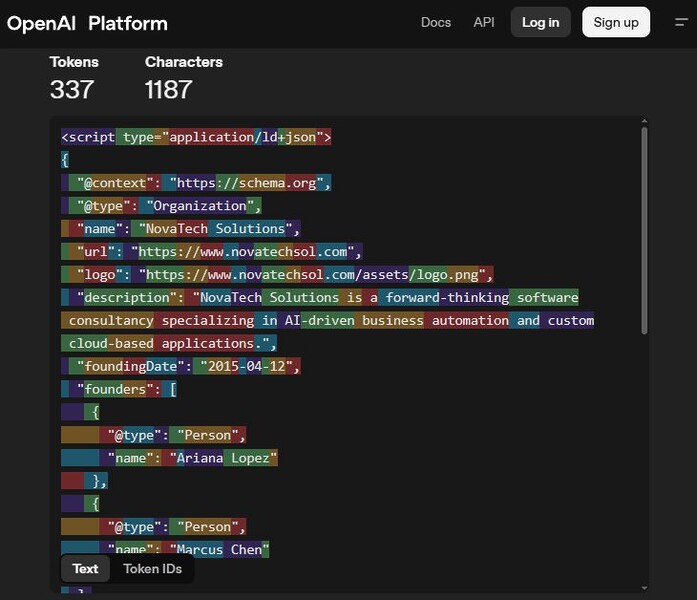
Source: https://www.seroundtable.com/structured-data-schema-ai-search-visibility-40099.html
Practical tests expose the schema myth
Industry experts have documented the ineffectiveness of structured data for AI search through controlled experiments. The test setup included identical product pages with one crucial difference in the data structure:
Experimental Setup:
- Test Page A: Complete visible text plus structured data
- Test Page B: Structured data only (visually empty page)
- Test Subject: Fictional products outside all training datasets
The results were clear: AI systems extracted product information such as prices, color variants, or item numbers exclusively from pages with visible text. Hundreds of different prompt variations confirmed this consistent pattern. Structured data remained completely invisible to the models.
Tokenization analyses illustrate the technical problem at a granular level. Visualizations of the parsing process clearly show how schema elements lose their original semantic structure. These well-founded test results refute the established assumptions of the SEO community about structured data and AI Search.
Why structured data is still not obsolete
Structured data retains its strategic value for established search infrastructures. Google's comprehensive retrieval stack continuously uses schema information for essential services:
- Google Merchant Center for e-commerce product data
- Knowledge Graph for entity information and facts
- Google Events for event presentations
- FAQ Rich Snippets for structured answer formats
RAG systems (Retrieval-Augmented Generation) can indirectly benefit from structured data. Although generation models do not directly process schema markup, structured data significantly influences content pre-selection. Pages with rich markup are more frequently considered in retrieval pipelines.
The citation probability increases through correctly implemented structured data, even without direct integration into model responses. Retrieval algorithms evaluate semantically enriched pages more positively, leading to more frequent mentions in generated AI answers. Schema markup acts as an indirect ranking factor for AI Search.

The Right AI Search Strategy: Focus on Visible Content
Effective AI Search Optimization prioritizes high-quality, human-readable HTML content. AI models exclusively process information that is also visible and understandable to website visitors. Hidden or purely technical markup elements remain non-functional for these systems.
Success Strategies for AI Search:
- Detailed product descriptions with all relevant specifications
- Comprehensive FAQ sections for typical user queries
- Structured texts with clear headings and paragraphs
- Complete information architectures on core topics
A sustainable optimization approach means developing content that remains valuable regardless of algorithmic changes. While AI Search mechanisms continuously evolve, informative, substantial content forms the most stable foundation for lasting visibility.
Invest in quality content rather than technical workarounds. This strategy pays off for both human users and AI systems and ensures future-proof optimization results.

Conclusion: Realistic expectations for structured data in the AI era
Test results clearly show: Structured data does not directly improve visibility in AI Search Systems. Large Language Models cannot process schema markup as coherent structured information due to their tokenization mechanisms. This insight requires a re-evaluation of established SEO priorities.
Recommended hybrid strategy:
| Optimization Area | Traditional Search | AI Search |
|---|---|---|
| Primary Focus | Structured Data + Content | Visible HTML Content |
| Main Tools | Schema.org Markup | High-Quality Texts |
| Success Measurement | Rich Snippets, CTR | Direct Answers, Citations |
| Investment Focus | Technical Implementation | Content Quality |
Future developments could revolutionize schema processing in AI systems. Until then, a pragmatic dual strategy is recommended: Keep structured data for proven SEO advantages, but for AI search optimization, focus on human-readable, informative content as the most reliable basis for sustainable success.
The SEO landscape is changing fundamentally. Successful optimization requires realistic assessments of new technologies instead of blind trust in established methods.
Understanding SEO for LLMs correctly:





 DE
DE