Over 40 percent of all websites worldwide run on WordPress, and that is precisely what makes the system a preferred target for automated attacks. A few standard settings are no longer sufficient to reliably protect a website today. We show which measures are truly effective and which common tools we deliberately do not recommend.
Increase WordPress Security, Protection Against Hackers and Security Vulnerabilities – How to Effectively Secure Your WordPress Website

First, an important piece of information about our Traffic Guard Rate Limiter Plugin: With the Traffic Guard Rate Limiter, you specifically increase the security of your WordPress website against automated attacks, excessive bot access, and suspicious requests. The plugin helps to detect and limit typical load and attack patterns early – such as brute-force attempts, aggressive crawlers, scrapers, or mass access to sensitive areas. This keeps your website more stable, faster, and better protected, without unnecessarily locking out normal visitors or important search engines.
Especially for WooCommerce shops, corporate websites, and highly frequented WordPress projects, the Traffic Guard Rate Limiter offers an additional layer of protection to effectively reduce security vulnerabilities, server load, and misuse.
Prevention is the better way, and the plugin does exactly that!
Why WordPress Security is Mandatory for Every Website
With a market share of around 43 percent, WordPress is the most widely used content management system worldwide. This reach is, on the one hand, a strength because a huge ecosystem of themes, plugins, and hosts is available. On the other hand, it makes WordPress a preferred target for automated attacks.
At VASTCOB, we have been supporting projects from founders to corporations since 2010. During this time, the threat landscape has significantly intensified. Brute-force attacks on logins, bot crawlers, automated vulnerability scanners, and targeted plugin exploits are now part of the daily routine for every actively operated website.
A successful attack has real consequences. Data loss, defacement of the homepage, blacklisting by Google, a sustained loss of customer trust, and potential GDPR violations concerning affected personal data are the most common consequences. WordPress security is therefore not an optional extra, but a mandatory topic for every professional operator.
Current video on this:
Become more visible on Google & Social Media?
In a free strategy consultation for data-driven online marketing, we uncover your untapped potential, review any existing ad accounts if necessary, examine your SEO ranking and visibility, and determine which strategy is appropriate for your budget and which active measures will lead to more inquiries or sales.

✅ More visibility & perception through targeted placement
✅ More visitors > prospects > customers > revenue
✅ Reach target groups scalably with SEA
✅ Act and grow sustainably with SEO
🫵 Maximum success with our hybrid strategy
💪 More than 15 years of experience across industries in over 1,000+ projects demonstrable!







The Most Common Security Vulnerabilities in WordPress
Most successful attacks do not exploit highly complex zero-day exploits, but rather simply known vulnerabilities that have not been closed in a timely manner. Knowing the typical entry points can massively increase the security of your website.
The most common security vulnerabilities in WordPress include:
- outdated plugins and themes that should have been patched long ago
- weak passwords and the „admin“ default user not being removed
- unpatched WordPress core versions
- insecure hosting configurations with overly open file and directory permissions
- missing or incorrectly configured SSL encryption
- unprotected login pages that allow unlimited attempts
- backups located in the same directory as the website
Plugins as a double risk
Plugins are one of WordPress’s greatest advantages and at the same time its biggest risk factor. The more plugins an installation contains, the larger the attack surface becomes. Abandoned plugins that are no longer maintained by the developer but remain active are particularly critical.
Consistent plugin hygiene is therefore the simplest and most effective measure to significantly improve WordPress plugin security. Anything not absolutely necessary should be deactivated and deleted, not just switched off.

Basic protective measures for a secure WordPress installation
Before you consider additional security plugins or specialized tools, the basic measures should be in place. Experience shows that they cover the biggest risks and take little time to implement.
At its core, securing WordPress means consistently applying updates, enforcing strong passwords, eliminating the default „admin“ user, and enabling two-factor authentication for all administrators. This is complemented by automated backups with external storage, continuous SSL encryption, and correctly set file and directory permissions on the server.
A compact checklist to make your WordPress website secure:
- Regularly update WordPress core, themes, and plugins
- Remove the default „admin“ user, use individual admin users with strong passwords
- Activate two-factor authentication for all admin accounts
- Set up automated backups and store them externally
- Enforce SSL/HTTPS for the entire website
- Set file and directory permissions correctly (typically 644 for files, 755 for directories)
- Customize the login URL and limit login attempts
- Completely remove unnecessary plugins and themes
Anyone who consistently implements these points will already close off the majority of standard attack vectors.
Which security plugins we recommend for WordPress
Even with a clean basic configuration, a dedicated security plugin is useful. It takes over continuous monitoring, blocks suspicious logins, scans for malware, and checks the integrity of important system files.
We recommend a lean WordPress security plugin that reliably performs precisely these core tasks without unnecessarily burdening performance. Functionally, this includes an application-level firewall, a reliable malware scan, login protection including limiting attempts, and a file integrity check. You can find our specific plugin recommendation here: WordPress Security Plugin*.
We deliberately do not recommend the widespread WordFence. The reasons for this are technical and not personal. WordFence has a very high performance footprint and noticeably burdens response times, especially on shared servers. Against the current generation of high-frequency AI crawlers and mass scanners, its effectiveness is insufficient in our experience. In addition, there is its own tracking and a heavy functional scope that simply represents overhead for most websites. For the requirements mentioned, there are lighter and more effective alternatives.
What to look for in a WordPress security plugin
When choosing a security plugin, look for a high update frequency, reliable support, a measurably low performance footprint, and clean data protection practices. Features such as firewall, malware scan, 2FA integration, and login protection should be included without bringing the entire server to its knees.
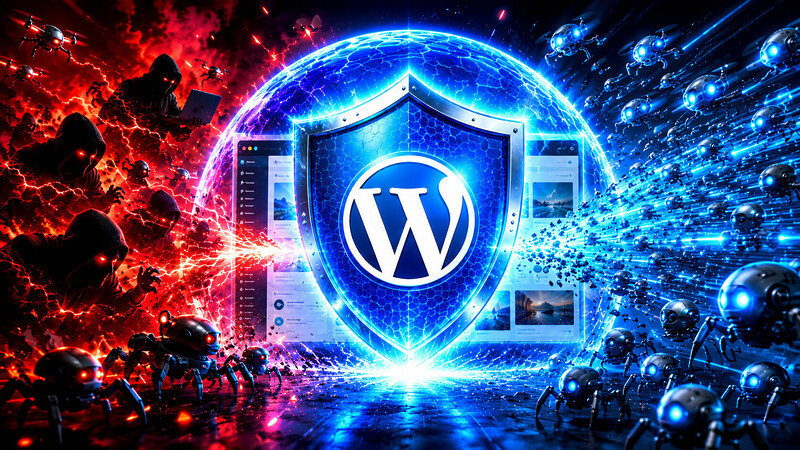
WordPress Protection against Bot Attacks, Crawler Floods, and Load Peaks
A development that overwhelms many classic security plugins is the massive increase in automated traffic. Since the boom of generative AI, the amount of crawlers, scrapers, and training bots has multiplied. While individual requests are often harmless, in total they lead to massive load peaks, higher hosting costs, and sometimes complete outages.
Classic plugins intervene too late here because they only evaluate requests at the application level. More effective is an intelligent rate limiter that recognizes and controls bots before actual processing. This is precisely why we developed the Traffic Guard Shield Rate Limiter, a solution that separates human traffic from automated traffic and smoothly controls load peaks.
A deeper classification of the current threat landscape and technical approaches can be found in our article on Crawler Flood 2026 and the Intelligent Bot Limiter. Anyone who wants to protect WordPress from hackers and bot load simultaneously can no longer do without an additional layer at the server or reverse proxy level today.
WooCommerce Security and GDPR Compliance
As soon as your WordPress includes a shop function, the security requirements increase significantly. WooCommerce manages payment data, customer accounts, order histories, and sometimes sensitive personal information. A successful attack on a shop therefore has not only operational but also legal consequences.
WooCommerce security begins with selecting a suitable payment provider with current PCI-DSS compliance and a clean TLS configuration. In addition, there are role-based permissions for employees, a conscious approach to plugin extensions, and a complete data backup including the database.
Making WordPress GDPR compliant involves more than just a cookie banner. You need a legally compliant consent process, documented data processing agreements with all service providers, a proper privacy policy, and technical and organizational measures for data security. For the consent part, we recommend our WordPress Cookie Consent Plugin, which is precisely designed for these requirements.
WordPress Security Check and Ongoing Maintenance
Testing WordPress security is not a one-time project, but a continuous process. Every week, new security vulnerabilities are published in WordPress plugins, and attackers automatically scan for affected versions. Those who only look once a year are constantly chasing vulnerabilities.
An effective WordPress security check comprises several levels. Online scanners like WPScan provide a quick first impression, a systematic logfile analysis shows suspicious access patterns, and a regular plugin audit uncovers unnecessary ballast. For higher security requirements, a light penetration test can be a useful addition. Those who want to ensure security permanently and systematically are well-positioned with professional WordPress maintenance. It covers updates, backups, monitoring, and security checks at fixed intervals.
If you would like a concrete inventory of your current WordPress security, we offer a structured audit of your installation with our Professional Check for WordPress. With over 1,000 implemented projects and consistently positive customer reviews on ProvenExpert, we bring the practical context to realistically assess risks and prioritize the right levers. Feel free to contact us for a non-binding initial consultation.




 DE
DE